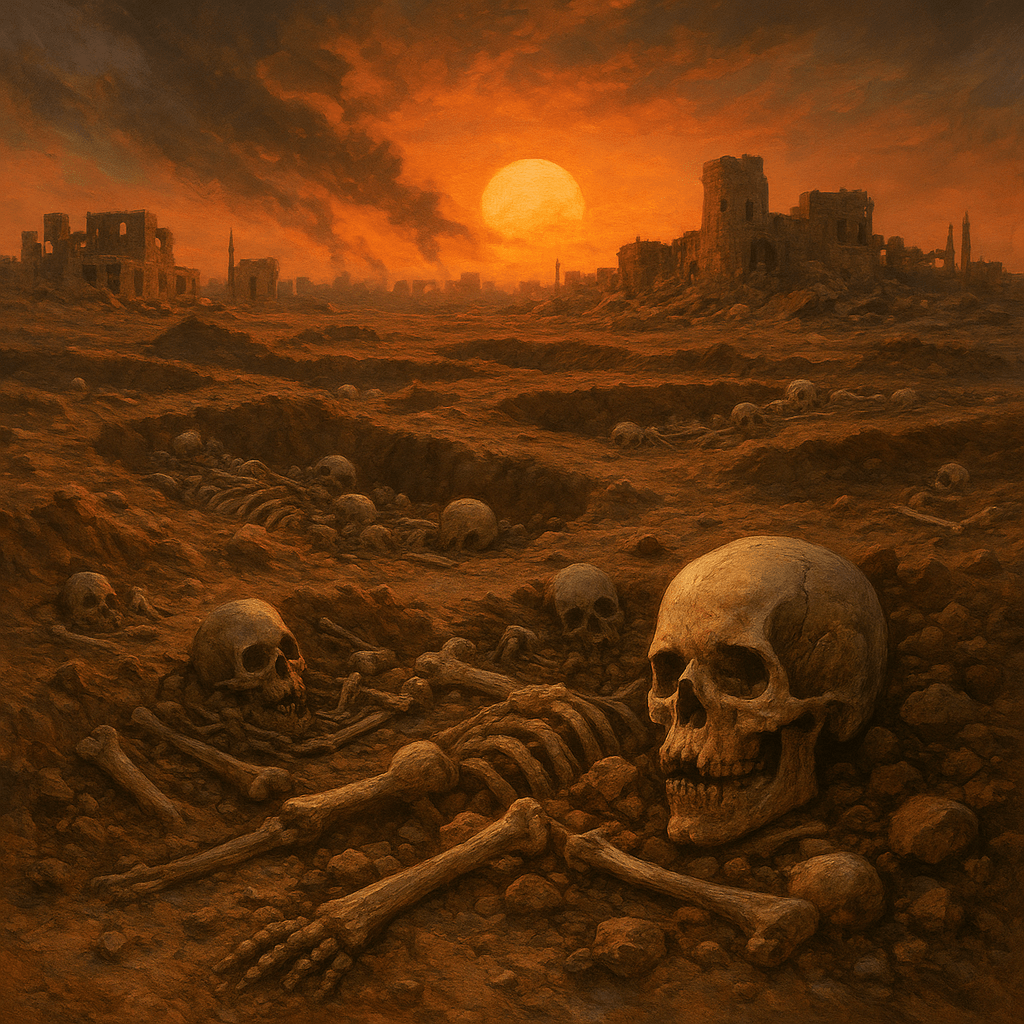
A new wave of mass graves uncovered in Libya reopens an old wound—one the imperialist media would rather sanitize than expose. But the bones beneath Sirte speak, and they tell a story of revolution, betrayal, and the unfinished struggle for sovereignty.
Unearthing the Narrative: How the West Buries Its Own Crimes
Earlier this week, CAJ News Africa ran a story about newly discovered mass graves in Libya—pits filled with the bones of people slaughtered in a war that never needed to happen. The article gasps with horror, as if this is some unexpected tragedy, as if the graves just appeared one day out of the desert like ghosts rising from the sand. But the truth is simple and brutal: these graves are not a mystery. They are monuments to NATO’s war crimes. And this article, like so many others before it, isn’t here to investigate the crime—it’s here to help bury it.
There’s no name on the article, and that’s no accident. That’s how this game works. When the truth might point fingers upward—toward the West, toward NATO, toward empire—the journalists vanish behind the curtain. CAJ News Africa, a South African outfit that claims to speak for the continent, often acts more like a subcontractor for the foreign policy goals of Europe and the United States. Funded and shaped through partnerships with Western NGOs and media syndication networks, its job isn’t to challenge empire—it’s to smooth it out, to wrap colonial violence in the soft language of humanitarian concern. Whoever wrote this piece wasn’t trying to tell the truth. They were trying to make the truth forgettable.
Once published, the article got passed along the usual imperialist information conveyor belt—Reuters, the UN press office, and a chorus of NGOs that make their living pretending that imperialism is a thing of the past. Names like AFRICOM, NATO, the International Criminal Court, and USAID all benefit from this kind of propaganda. Not because it reveals too much—but because it reveals nothing at all.
Let’s break down how this article works. First, it strips the story of history. No mention of the year 2011. No mention of the U.S., France, and Britain turning Libya into rubble. No mention of Gaddafi—except maybe in the silence, the way you can feel the shape of a body in the outline it left behind. It tells us there are mass graves, but not who filled them. It tells us Libya is unstable, but not who destabilized it. This is imperial storytelling at its slickest: a crime scene with no fingerprints, no suspects, and no motive.
Then comes the language. All of it passive. Graves were “found.” Bodies were “discovered.” Violence “broke out.” These are the phrases of cowards. This is how empire writes its obituaries: not in blood, but in bureaucratic distance. No one pulled a trigger. No one ordered the airstrikes. No one dismembered a nation. Things just… happened.
The article ends by invoking “international justice” and calling for investigations. But who’s investigating NATO? Who’s putting the U.S. and its European allies on trial? These so-called justice institutions—the ICC, the UN Security Council, the humanitarian watchdogs—are part of the same imperial scaffolding that dropped bombs on Libya in the first place. They’re not looking for truth. They’re looking for ways to manage the fallout—ways to make the bones disappear from public memory without ever answering for the system that scattered them across the sand.
What we’re reading here isn’t journalism. It’s a shovel. And every word is part of the effort to bury the truth. But some of us are still digging in the other direction.
The Bones Remember: Excavating the History Buried Beneath the Headlines
Let’s start with what the article gets right: dozens of bodies have been found in newly unearthed mass graves near the city of Sirte, Libya. The remains are decomposed, unidentified, and dumped in shallow pits—a grim reminder that death in Libya hasn’t ended, it’s just gone off-camera. The piece reports that local authorities are overwhelmed and international bodies are “calling for investigations.” That’s the extent of the facts. And in any honest world, that would be the beginning of the story—not its end.
What’s left out—what’s never spoken aloud—is the broader context of how these bodies got there in the first place. This isn’t some abstract tragedy. It’s the long tail of the 2011 NATO war, led by the United States, France, and the UK, under the fraudulent banner of “humanitarian intervention.” That war—justified through lies about impending genocide and Gaddafi distributing Viagra to enable mass rape—was a textbook case of militarized imperialism. It obliterated the most developed country in Africa and replaced it with chaos, mercenary militias, and a fragmented pseudo-state. These graves are not just post-war consequences—they are war crimes delayed by time.
Before that war, Libya wasn’t perfect—but it was sovereign. Gaddafi’s government, structured through the Jamahiriya system, delivered free healthcare, free education, subsidized housing, and ambitious pan-African infrastructure projects. Libya had the highest Human Development Index in Africa. It was pursuing continental currency independence from the U.S. dollar and euro, planning to launch a gold-backed dinar, and pushing to unify African militaries outside of Western command. These policies weren’t just economic—they were existential threats to the hyper-imperialist world order, where control over the Global South must be maintained through debt, destabilization, or direct war.
When NATO invaded, it didn’t just bomb airfields and barracks—it bombed state archives, hospitals, water infrastructure, and the national television station. What followed was not liberation. It was a scorched-earth campaign of imperialist recalibration, designed to kill not just a leader, but a model of post-colonial sovereignty. Today, Libya is divided between Western-backed “governments,” Turkish and Gulf-sponsored militias, and the looming presence of U.S. and French military installations. Its economy is fragmented, its assets looted, and its people forced to survive on the ruins of what once was.
Meanwhile, over $100 billion of Libyan sovereign wealth remains frozen in Western banks, seized under the guise of sanctions and “terrorism prevention.” As detailed in our investigation Blood Money, these funds have become bargaining chips in Western diplomatic games—used to punish, manipulate, and recolonize Libya through finance instead of bombs. This is financial piracy at the highest level—plunder carried out not with bayonets, but with bank accounts.
The reality is that Libya’s crisis didn’t begin with civil war—it began with foreign invasion. It didn’t become a failed state on its own—it was engineered that way, precisely because it dared to pursue anti-imperialist sovereignty in a world still run by empire. The mass graves now being “discovered” are not mysterious—they are consequences. They are the physical evidence of a war that the imperialist press has worked tirelessly to forget.
But the bones remember. And so do we.
Will the Jamahiriya Rise Again? Libya’s Revolution Beneath the Rubble
Beneath the rubble of Libya lie not only bodies, but a revolution interrupted. The Jamahiriya was never just a government—it was a radical experiment in post-colonial self-determination. It tried to build power from the ground up, redistributing oil wealth to fund free housing, education, and healthcare. It rejected the party system, attempting instead to organize society through popular congresses and people’s committees. It was flawed, contested, contradictory—but it was Libyan. And for a moment, it dared to put the tools of governance in the hands of the governed. That’s why it had to be destroyed.
NATO didn’t bomb Libya because it was falling apart—it bombed Libya because it was coming together. Gaddafi’s pan-Africanism, his push for a gold-backed dinar, his rejection of Western military dependency—these were red lines for the empire. So they lied. They called him a dictator. They claimed genocide was imminent. They told the world they were coming to protect civilians, then unleashed a military campaign that killed tens of thousands and plunged the country into permanent war. What they destroyed wasn’t just a government—it was the possibility of a different future.
Now, in the wreckage of that future, the question is whether something new can emerge. Can the revolutionary spirit of the Jamahiriya be resurrected—not as nostalgia, but as a living force in the fight for anti-imperialist sovereignty? Can the bones of the betrayed become seeds of resistance? These aren’t rhetorical questions. In Tripoli, in Sabha, in Sirte, there are still Libyans who remember what was stolen. There are still workers, tribes, students, and veterans who believe that the dream of people’s power did not die with Gaddafi—that it was buried alive.
And outside Libya, across the Global South, the lessons of the Jamahiriya still echo. In Mali, Burkina Faso, and Niger, we see new movements rising with demands for sovereignty, dignity, and pan-African cooperation. In the streets of Haiti, in the barrios of Venezuela, in the resistance camps of Palestine, the same spirit animates the struggle: the belief that the poor and colonized have the right to rule themselves, control their resources, and chart their own future. Libya’s revolution may have been cut short—but its story is not over.
The empire hoped that by killing Gaddafi, it could kill the very idea of grassroots, African-led socialism. But imperialism misunderstands how history works. It thinks in coups and contracts; we think in generations and struggle. The real question is not whether Libya can go back—it can’t. The question is whether it can go forward, building something new from the ashes, forged by memory and tempered by fire.
The Jamahiriya was a beginning. Its destruction was a defeat. But the future of Libya—like the future of all oppressed peoples—still waits to be seized. And revolutions, even when buried, have a way of rising again.
What Is to Be Done: From Mourning to Mobilization
If we mourn Libya, let it not be in silence. Let it be in the form of organized memory and militant solidarity. Because the same forces that destroyed the Jamahiriya are still at work today—seizing sovereign wealth, backing proxy regimes, flooding the Sahel with mercenaries, and branding recolonization as “stability.” They will not stop until every revolutionary dream is crushed beneath the boot of hyper-imperialism. But we still have a choice. We can fight back. We can raise the banner of Libya’s unfinished revolution and wield it as a weapon in the broader global struggle for liberation.
First, we must restore truth. That means refusing the imperialist media’s narrative of “civil war” and “state failure.” It means making sure that every mass grave discovered is traced back—not to “tribal militias” or “Islamists” in isolation—but to the U.S., France, the UK, and NATO, who bombed a functioning state into fragments and left the people to bleed in silence. It means naming names and calling crimes what they are. We must teach the younger generation that Libya wasn’t always like this—and doesn’t have to remain so.
Second, we must amplify and materially support ongoing efforts for national reconstruction and sovereignty inside and outside Libya. That includes:
- Supporting calls for the immediate repatriation of Libya’s frozen sovereign assets, and exposing the criminal role of institutions like Euroclear, BlackRock, and the U.S. Treasury in financial looting operations.
- Building pan-African solidarity networks that link Libya’s struggle to those of Burkina Faso, Mali, and Niger, where revolutionary governments are attempting to expel French influence and reclaim control over their resources and security.
- Creating and sharing counter-memory media—videos, infographics, oral histories, zines—that center the voices of Libyans who lived through the revolution, not just its destruction.
- Pressuring anti-imperialist blocs like BRICS+ and the African Union to recognize and respond to NATO’s war crimes, and to include Libya’s reconstruction in any future continental development agenda.
Finally, we must act in ideological unity with all those resisting empire. That means recognizing that the war on Libya was not an isolated case—it was a chapter in the broader story of imperialism’s long war against the Global South. What they did to Libya, they tried to do to Venezuela. To Syria. To Cuba. To Iran. To Iraq. To Palestine. The lesson is clear: when a people rises, empire retaliates. But when the people remember, organize, and resist—that’s when revolution becomes possible again.
Libya’s bones are not just relics of a past war. They are signposts. They point us toward the world that could have been—and the world that still can be. To honor them is to rebuild. To speak. To fight. To carry the Jamahiriya’s promise forward—not as nostalgia, but as strategy. Because revolutions never truly die. They wait. They smolder beneath the sand. And when the time is right, they rise.
 Weaponized Information
Leave a comment