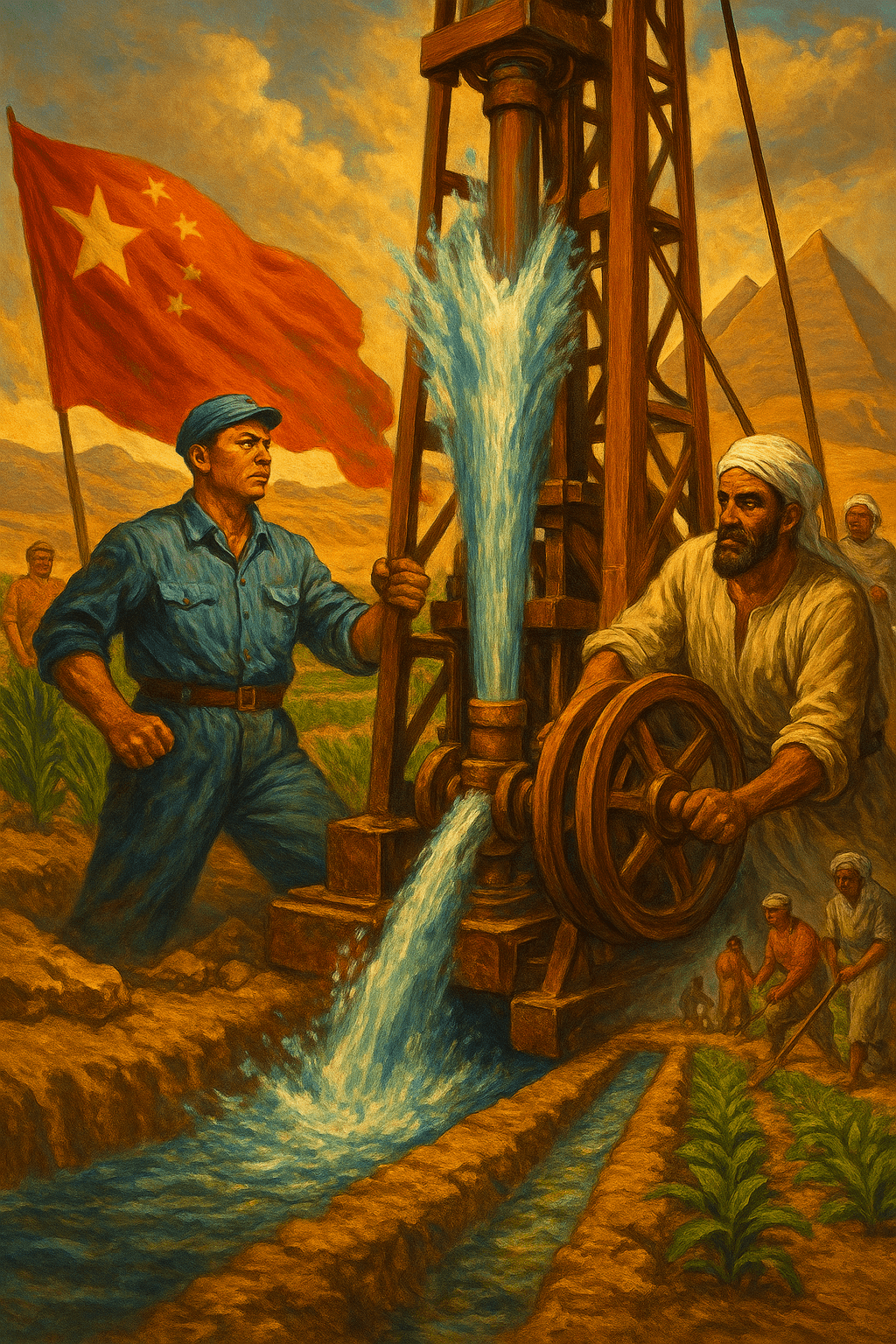
Where empire left famine, China drills for food. In the sands of Egypt’s Western Desert, water flows—not as charity, but as strategy. And the crops rising from that soil are a warning to the old world: sovereignty is being rebuilt underground.
By Prince Kapone | Weaponized Information | June 3, 2025
Digging Beneath the Headlines: Water, Work, and the Quiet Collapse of Empire
On the surface, it’s a tidy piece of state-aligned journalism: Chinese engineers drill 680 wells in Egypt’s Western Desert, wheat is harvested, sugar beets bloom, and farmers are grateful. The Global Times, China’s state-affiliated news organ, presents it with characteristic optimism—complete with quotes from workers, project managers, and Egyptian officials. But while the article reads like a public works report, it quietly reveals a fundamental truth the Western press has spent decades burying: **where empire delivered bombs and breadlines, multipolarity is bringing water and wheat**.
The author, writing under the Xinhua byline, serves the function of documenting Chinese development strategy with the posture of neutrality. But neutrality, here, is not the absence of politics—it’s its camouflage. This is not just infrastructure; it’s ideology materialized. It’s soft power with steel rigging and diesel engines. And unlike the West’s PR press corps—who chirp about reforms while Washington airdrops famine—this piece at least names what’s being done: **deep wells, new farmland, fresh wheat**. Material transformation, not metaphor.
Yet what’s missing from the article is just as important. There’s no mention of the 40+ years of structural adjustment that left Egypt’s agriculture sector hollowed out and tethered to foreign wheat. No analysis of the U.S.-backed regimes that prioritized military aid and debt over irrigation and food. No acknowledgment that water in the desert isn’t just a miracle of engineering—it’s a revolution in the making.
The article is populated by the usual institutional cast: ZPEC’s project managers, Egyptian agricultural technocrats, deans, and engineers. On the surface, they play their roles in a developmental success story. But beneath the script, something deeper is being carved out: a rupture with the West’s monopoly on “aid,” and a shift in loyalty, logistics, and leverage. China didn’t overthrow Egypt’s government or install a puppet regime to drill these wells. It showed up with rigs and work crews. And that, to the imperial core, is far more threatening than any coup.
So let’s read between the lines. This isn’t a goodwill project—it’s a geopolitical intervention against a long-standing imperial arrangement. Egypt’s Western Desert has been abandoned by empire because it offers no quick profit, no oil, and no strategic naval chokepoint. But now, that very desert is being transformed—into farmland, into wages, into grain. And the Global South is watching. Because while the West debates whether BRI is “neo-colonial,” working people in Egypt are eating their first locally grown wheat from land once written off as worthless.
The truth is, the article didn’t need to say all this outright. The facts alone betray the shift. The empire that once promised freedom through free markets now watches as China builds aquifers, not aircraft carriers. And in a world where famine is engineered, where aid comes tied to austerity, a 450-meter-deep well is more than a hole in the ground—it’s a blow against imperialism.
Wells of Defiance: Food, Water, and Egypt’s Unfinished Revolution
Under the scorching sun of Egypt’s Western Desert, Chinese and Egyptian engineers have drilled more than 680 wells, irrigating thousands of hectares of land once written off as wasteland. From Minya Province to the New Valley Governorate, wheat, alfalfa, and sugar beets now rise from sand, feeding a people long held hostage by imperial food chains. ZPEC—the Zhongman Petroleum and Natural Gas Group—has led the operation with a mixed workforce, technical innovations like air foam drilling, and field-tested solutions to logistical and environmental challenges. But what makes this story revolutionary is not the machinery. It’s the meaning.
China didn’t bring troops. It brought water. It didn’t bring austerity. It brought agriculture. And that is a direct challenge to the imperial architecture that has starved Egypt of its own sovereignty for two centuries. The Global Times offers the story with clean statistics and smiling quotes from workers and managers—like Zhao Baojiang, who notes his team drilled 63 wells in under a year, or Mohamed Gaber, who rose from a laborer to a platform manager. The article makes no ideological claims. But the implications are explosive.
Let’s place the facts in their proper terrain. Egypt is a country where only 4% of land is arable, and yet it has over 100 million mouths to feed. For decades, it has been the world’s largest wheat importer, dependent on volatile foreign markets and neoliberal trade policy. The U.S. and IMF have kept Egypt fed—but only just. And always at a price: privatizations, cuts to subsidies, import dependency, and debt servitude. Development came wearing a uniform, backed by drones and diplomatic threats.
This desert well project shatters that model. It is not merely agricultural cooperation—it is **geopolitical realignment**. Farmers in the Owainat sector of the Future of Egypt Project report that each feddan of land—roughly 0.42 hectares—can now yield three tons of wheat. According to Zhao Wutao, general manager of ZPEC Egypt, that’s enough to feed 20 Egyptians per year per feddan. Sugar beet cultivation in Canal Sugar Company’s mega-farm now covers over 22,000 feddans. None of this, according to local officials, would’ve been possible without the wells.
But to grasp the significance, we must go back to Egypt’s original fight for sovereignty. Under Mehmed Ali, Egypt sought to reclaim control over its agriculture and irrigation system. That project was crushed by British colonialism, which turned Egypt into a cotton monoculture and tied its land to the needs of empire. After the 1952 revolution, Gamal Abdel Nasser tried again: land reform, irrigation projects, and the construction of the Aswan High Dam as a monument to people-powered development. But Nasser was blocked at every turn—sanctions, invasions, and eventually the slow attrition of neoliberalism under Sadat and Mubarak.
China’s drilling rigs are, in many ways, completing the irrigation projects that imperialism prevented. They’re not just bringing water to sand—they’re bringing back the possibility of an Egypt that can feed itself. They are resurrecting the Nasserist dream not through slogans, but through infrastructure. And that is why Western commentators call BRI projects like this a “strategic threat.” Because when the Global South stops needing Western wheat, weapons, and welfare, the whole system starts to crack.
The Global Times article doesn’t mention USAID, the IMF, or Camp David. It doesn’t have to. The contrast speaks for itself. Instead of tanks and market reforms, the people of Egypt are being offered **sovereign water access, technical knowledge transfer, and productive labor**. ZPEC not only trains locals, it leaves behind the tools and techniques to keep drilling, growing, and feeding. This is what real development looks like—not temporary relief, but structural transformation.
Egypt’s revolution was never finished. Its people have been betrayed by king, colonizer, and comprador alike. But the ground is shifting. A new order is being dug from the desert floor—not in parliaments or IMF boardrooms, but in the water tables beneath Egypt’s scorched earth. These wells are not just holes—they are openings. And if the wheat keeps growing, so might the next chapter of Egypt’s liberation.
Development Without Domination: When the Wells Flow for the People
The West calls it “development.” But what they mean is debt. What they offer is dependency. They build pipelines, but only if they control the valves. They send fertilizer, but only after seizing the soil. For decades, development has been a euphemism for economic occupation—a sleight of hand where sovereignty is swapped for subsidies, where wheat is imported at prices set by Chicago, and where progress is measured by how fast foreign investors can extract value from your land.
But what’s happening in Egypt’s Western Desert doesn’t fit that model. These wells weren’t financed by the IMF or USAID. They weren’t conditioned on privatization or trade liberalization. They didn’t come with military advisors or democratic consultants. They came with pipes, pumps, and people willing to dig. And that alone makes them revolutionary.
This is development unhooked from imperial power—what Frantz Fanon might have called development “on new terms.” Not dictated, but negotiated. Not extracted, but shared. The ZPEC-led well operations are not simply acts of technical cooperation. They are material expressions of multipolarity—proof that the Global South can collaborate, build, and thrive without begging Washington or Brussels for permission.
This is also a radical reframing of what sovereignty looks like. In the postcolonial era, sovereignty was often reduced to flags and treaties. But the sovereignty that matters now is logistical, ecological, and infrastructural. Can you feed your people? Can you manage your water? Can you build without being bombed or blackmailed? If the answer is yes, you’ve escaped the gravitational pull of empire. That’s why a desert wheat harvest is more than a yield—it’s a declaration.
And we must be clear: this isn’t charity. China isn’t running an NGO. This is strategy. This is long-term investment aligned with national goals, regional partnerships, and geopolitical counterweights. China is building wells, railways, and refineries where the West built prisons, ports, and drone bases. The Belt and Road Initiative is not free of contradictions—but its central thrust runs in the opposite direction of colonial capital. It builds for the sake of circulation and cooperation, not capture.
For Egypt, this is a step—modest, but meaningful—toward reclaiming the revolution. Not the staged uprisings of electoral theater, but the real, material revolution of land, labor, and self-sufficiency. A peasant walking the edge of a wheat field in Owainat today walks in the footsteps of Nasser and Mehmed Ali—not in tribute, but in continuation. Because liberation is not only a question of who governs—it’s a question of who eats.
These wells reframe the story. Development is not what the West gives. It’s what the South builds. It doesn’t come from policy memos or financial packages. It comes from drills in the dirt, hands on the valves, and water finally flowing into the cracks left by empire. And when it flows, the whole world starts to change direction.
From Wells to Revolution: Dig Where Empire Refused to Build
The Western Desert is no longer empty. It’s no longer the dead zone empire left behind after centuries of cotton export, canal conquest, and trade dependency. It’s becoming fertile—not just with water, but with political potential. That’s what scares Washington and Brussels. Because they know the stakes: if Egypt can grow wheat without Western loans, then maybe Sudan can electrify without World Bank conditions. Maybe Iraq can rebuild without Exxon. Maybe Palestine can irrigate without occupation.
For the Global South, the lesson is this: liberation won’t come from reforms, elections, or climate summits. It comes from infrastructure. It comes from labor. It comes from reclaiming the basic elements of life—water, food, energy—from foreign control. Egypt’s collaboration with China is imperfect, complex, and full of contradictions. But it is movement in the right direction. It is motion against stagnation. And in the desert, even the smallest stream can shift the land.
Build alliances that are grounded in material benefit, not rhetorical declarations. Use these projects to educate peasants and workers about sovereignty—not as a slogan, but as a living system that must be irrigated, maintained, defended. Push for national food strategies that replace dependency with autonomy. Train engineers, not consultants. Grow wheat, not GDP.
For those of us within the imperial core, the task is equally urgent. We must dismantle the ideological scaffolding that justifies empire in the name of development. Expose how U.S. “aid” props up militaries, not farmers. Reveal how structural adjustment was always structural sabotage. We must call out the think tanks, lobbyists, and media outlets that portray Chinese well-digging as a threat, while U.S. warplanes circle the Mediterranean.
This means organizing—not just in solidarity with the Global South, but against our own state’s parasitic foreign policy. It means tearing down the military-industrial complex that feeds off war and famine abroad while collapsing communities at home. It means fighting for a world where water flows without permission slips from empire.
For revolutionary media and educational projects like Weaponized Information, the task is to name what is being built and why it matters. We must show that the future is not being negotiated in boardrooms—it’s being dug out of dry soil by workers and engineers who understand the meaning of life better than any diplomat. Our job is to document, analyze, and align these small shifts into a global movement.
The empire is thirsty, but it can no longer drink without poisoning the well. The people of Egypt are drilling anyway. And from the edge of the Sahara to the edge of the possible, a new world is flowing into view. One well at a time.
 Weaponized Information
Leave a comment