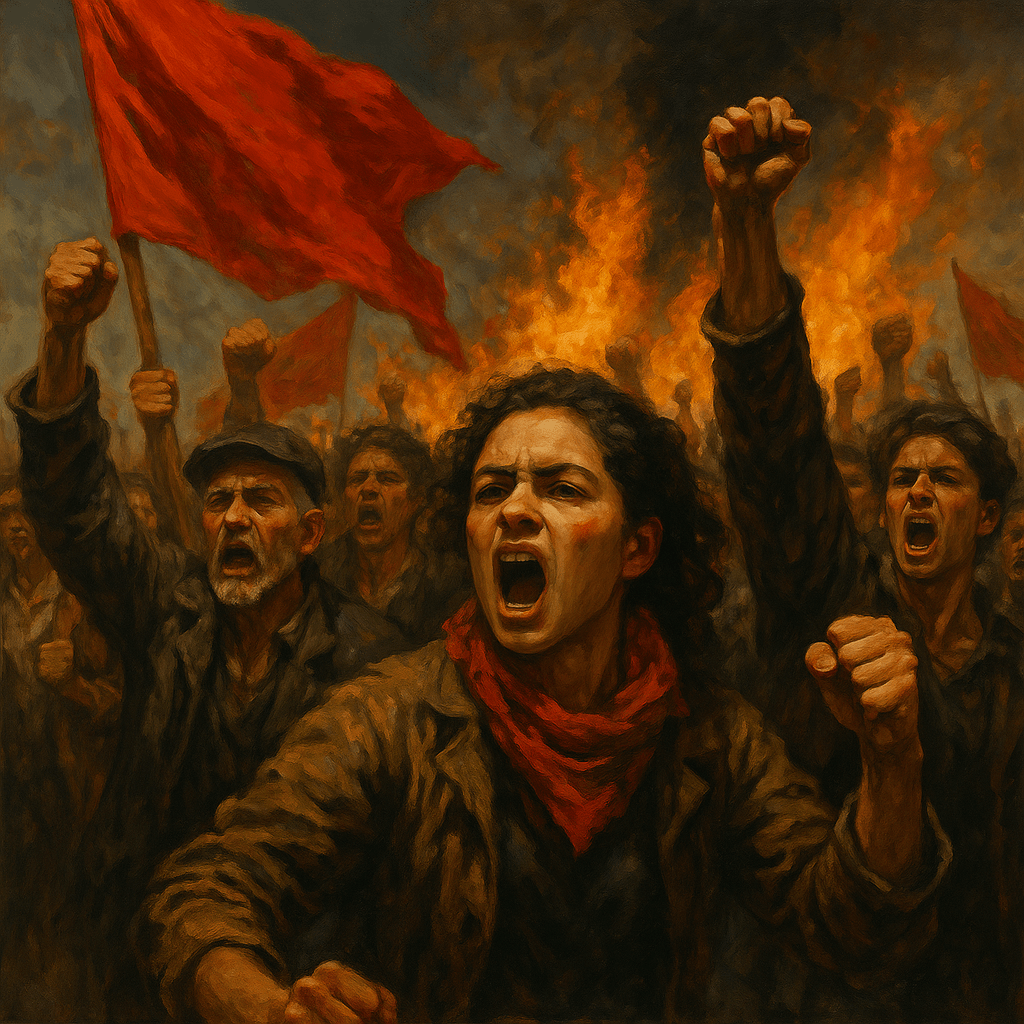
Human rights are not timeless truths—they are battle-scarred demands, born from rebellion and shaped by empire. To understand their meaning, we must interrogate their origin, their mutation under capitalism, and their revolutionary potential under socialism.
By Prince Kapone | Weaponized Information | Date: May 25, 2025
Rights Aren’t Natural—They’re Fought Over
Ask any liberal where human rights come from, and you’ll hear a bedtime story: they’re inalienable, universal, and self-evident. They belong to us by birth, like breath or blood. But that’s not history. That’s marketing. The truth is, rights don’t descend from heaven—they rise from struggle. They are not granted by benevolent states. They are seized by people in motion, through sweat, fire, and confrontation.
The phrase “human rights” has become so sanitized, so drained of its revolutionary charge, that it now floats in NGOspeak and legalese, stripped of all memory of barricades, strikes, and burning plantations. We talk about rights like they were born in a Geneva conference room instead of in the throat of the slave who broke her chains or the worker who seized the factory.
Every “right” we know today—speech, movement, assembly, bread, land—was once criminal. It had to be defended against monarchs, landlords, colonizers, and bosses. What counts as a right depends on who’s in power. Under empire, rights mean property. Under revolution, rights mean life.
This essay is not about the legal evolution of rights. It’s about the political terrain on which they’ve been contested. It’s about how human rights, as a philosophy, has never been neutral. It has always been ideological. It reflects the class war, not above it. It’s the mask the ruling class wears when it needs to sound moral. And it’s the sword the oppressed sharpen when we decide we’ve had enough.
We’re going to track how rights were constructed, claimed, denied, and weaponized. From the divine rule of kings to the charters of capitalism, from the Black Jacobins to the Soviet Constitution, from Haiti to Hanoi to Harlem. Not to tell a clean story—but to expose the blood that makes the ink on every declaration.
Before the Individual: Hierarchy, Divine Right, and the Absence of Personhood
Before anyone was marching for rights, the world was organized by rank, not reason. Power came from bloodlines and the Bible, not from the people. In feudal Europe, the idea that a peasant, woman, or bonded serf had “rights” would’ve been laughable. You had duties, obligations, and superiors. And if you didn’t like them, you prayed—because there was no appeal.
Under the rule of kings and lords, rights were attached to class, estate, and religion. Nobles had privileges, not because they earned them, but because the heavens said so. The Church declared the natural order immutable: God above, king below, and everyone else somewhere in the dirt. Justice was divine—and divinely unjust. In the Islamic caliphates, Mughal India, and dynastic China, similar vertical hierarchies reigned. Rights, where they existed, were fused with duty and tightly circumscribed by caste, confession, and class.
The very concept of the “individual” as we know it didn’t exist. There were no universal persons—just subjects of empire, parish, or crown. Law protected property, not people. And people were property: women as wives, serfs as labor, Africans as cargo. The only rights that mattered were the ones that protected the owners from the owned. The marketplace didn’t offer freedom. It offered control—legalized, baptized, and enforced.
Across the world, systems of domination were deeply spiritualized. The divine right of kings in Europe, the Mandate of Heaven in China, and the sacral cosmologies of caste in South Asia—all worked to naturalize inequality. The masses weren’t just governed—they were anesthetized. Their suffering wasn’t political. It was presented as cosmic.
This is where the modern notion of rights had to begin—not in freedom, but in confrontation with its absolute absence. Before we ever heard the word “liberty,” someone had to steal the land, the labor, and the language that justified its denial. That theft laid the foundation for the Enlightenment’s moral panic: how to reconcile Christian empire with capitalist expansion, how to justify ruling without divine right.
That panic gave birth to a new kind of rhetoric. But the world it inherited was soaked in blood. So the first modern rights wouldn’t free the masses—they would secure the transition from one ruling class to another. From robes and crowns to wigs and contracts. From God-given authority to market-based domination. From the church to the stock exchange. A different costume. Same hierarchy.
The Bourgeois Birth of the ‘Universal Man’
The modern idea of human rights was not born in struggle from below. It was drafted in parlors, printed by merchants, and signed in the blood of plantations. The 18th century revolutions—England’s Glorious Revolution, the American Revolution, the French Revolution—were not proletarian uprisings. They were bourgeois coups against the old feudal order, led by capitalists in powdered wigs who wanted to shake off the chains of monarchy while tightening their grip on labor.
In these revolutions, “rights” became tools of class warfare from the top down. They proclaimed liberty but protected property. They spoke of equality but institutionalized whiteness, patriarchy, and wage slavery. The American Declaration of Independence said all men were created equal while its authors enslaved human beings and waged war on Indigenous nations. The French Declaration of the Rights of Man was drafted as colonial uprisings in Haiti were being drowned in blood.
What was “universal” about these rights? Only the class that wrote them. The “universal man” was white, landed, male, and European. His liberty was the freedom to buy, sell, and rule. His right to property included the right to own people. His pursuit of happiness was built on enclosure, exploitation, and empire.
The Enlightenment didn’t birth freedom—it intellectualized conquest. It gave a secular language to justify the divine thefts of empire. It recast profit as progress, domination as development, and ownership as virtue. The liberal philosophers—Locke, Voltaire, Jefferson—spoke of reason while investing in slavery. They offered the world the lie of “rights” to mask the truth of capital.
And yet, within those declarations were seeds of revolt. The same language that protected the bourgeoisie could be seized by the enslaved, the colonized, the poor. Toussaint Louverture read Rousseau. The Paris Commune quoted the Declaration. Marx dissected it. The people knew that rights weren’t gifts—they were weapons, stolen back from the hands that wrote them.
Liberal Universalism and the Empire of Rights
After the revolutions of the 18th century, the new capitalist order needed legitimacy. You can’t build a global system of wage slavery, resource plunder, and racial hierarchy without a good story. And so liberalism told one: that the market would replace monarchy, that reason would replace religion, and that rights would flow to all people like clean water from the mountaintop of Western civilization.
But what liberalism actually built was an empire—a global hierarchy draped in paper constitutions. The same Europe that wrote declarations of liberty was colonizing Asia, Africa, and the Americas. Rights were never universal. They were civilized. And civilization, in liberal code, meant white, Christian, male, and capitalist.
The 19th century saw the rise of rights-based imperialism. Colonization wasn’t just theft—it was rebranded as moral duty. The “White Man’s Burden” was a lie that clothed genocide in philanthropy. The British in India, the French in Algeria, the Americans in the Philippines all claimed they were bringing law, order, and liberty. But what they brought was railroads for extraction, schools for indoctrination, and prisons for rebellion.
Even within the metropoles, liberal rights remained selective. The Industrial Revolution gave capitalists new power and workers new chains. Women were locked out of the franchise. Unions were criminalized. The poor were starved in slums policed by the same state that praised “freedom of contract.”
Liberalism did not abolish hierarchy. It privatized it. It replaced divine order with market order, and called that progress. Its “universalism” was not a guarantee of freedom—it was the cover story for a global regime of racialized capitalism. A system where rights were made real through warships and capital flows—not through human dignity.
Revolution Interrupts: Marxism and the Birth of Collective Rights
By the mid-19th century, the mask of liberal universalism had begun to slip. The working class didn’t just want paper rights. It wanted bread. It wanted time. It wanted land. And it was becoming organized. Paris, Berlin, Petrograd—these were not footnotes in liberal progress. They were ruptures. They were the return of history.
Marx didn’t just critique capitalism—he indicted the entire framework of bourgeois rights. “Equal rights in a society of unequal wealth,” he wrote, “is the right of the fox in the henhouse.” Freedom of contract? Only if starvation counts as a choice. Right to property? Only if you ignore who stole what to begin with. To Marx, rights meant nothing unless they abolished the conditions that made oppression legal.
The Paris Commune of 1871 gave us a glimpse. It declared housing a public right. It replaced salaried bureaucrats with workers’ councils. It abolished rent and seized abandoned factories. It didn’t just rewrite the law—it rewrote who made it. That wasn’t reform. That was revolution.
Lenin and Stalin picked up where the Commune fell. The Soviet Constitution of 1936 was not a liberal document—it was a socialist one. It guaranteed the right to work, the right to rest, the right to education, the right to culture, and the right to housing. These weren’t theoretical. They were backed by a planned economy, a mass mobilized state, and a class alliance of workers and peasants.
Where the West offered the right to compete, the USSR offered the right to exist. Where liberalism privatized need, socialism collectivized it. The factory didn’t just produce goods—it produced rights. The school didn’t sort labor—it expanded consciousness. These were not perfect systems. But they were decisive ruptures with liberalism. They didn’t ask for inclusion. They built another world.
The Cold War of Rights: Decolonization and the Global Battle for Dignity
The end of World War II didn’t bring peace—it redrew the map of domination. As old empires collapsed under the weight of anti-colonial resistance, a new imperial structure emerged, this time draped in the language of human rights. The United Nations was born, and with it, the Universal Declaration of Human Rights. But the ink on that parchment was still wet when bombs began falling in Korea, when Vietnam burned, when the Congo bled.
Rights had become a battlefield. On one side, the Western bloc insisted that liberty meant elections, speech, and markets. On the other, socialist states and the decolonizing world demanded land, food, housing, and sovereignty. It was civil-political rights versus economic-social rights. But the split wasn’t philosophical—it was geopolitical. The West had stolen the world and wanted to keep it. The rest had nothing and wanted it back.
The Bandung Conference of 1955 was a warning shot. African and Asian nations stood together and declared that human rights without self-determination was a lie. Kwame Nkrumah, Sukarno, Nasser, and Zhou Enlai spoke not of abstract freedom but of real independence—from capital, from colonial borders, from dependency. This wasn’t rights-talk for lawyers. It was a manifesto for the wretched of the earth.
The Non-Aligned Movement carried that flame into the Cold War. Nations from Cuba to India to Yugoslavia refused to be pawns in Washington’s or Moscow’s game. They declared their own path—and their own definition of rights. In 1974, the UN General Assembly adopted the Declaration on the Establishment of a New International Economic Order, driven by the G77. It called for restructuring global trade, redistributing wealth, and ending the dictatorship of Western capital.
But every attempt to assert those rights was met with sabotage. Patrice Lumumba was executed. Allende was overthrown. Sankara was assassinated. The message was clear: human rights were fine—so long as they didn’t challenge property, profit, or Western supremacy.
So the terrain of rights was internationalized—but also militarized. Human dignity became another front in the Cold War. And for the West, rights were never about justice. They were about containment. Containing socialism. Containing revolution. Containing the dreams of the colonized.
Rights in Reverse: Neoliberalism, Lawfare, and the New Empire
When the Berlin Wall fell, the ruling class threw a party. They declared the “end of history,” and with it, the end of revolutionary rights. The collapse of the socialist bloc didn’t bring freedom—it brought the privatization of survival. And the discourse of human rights was hollowed out, taxidermied, and put on display by the same forces that once strangled it.
Neoliberalism didn’t just gut the welfare state—it gutted the meaning of rights themselves. Housing? A market commodity. Health care? A private luxury. Education? A debt trap. The new gospel said that rights were best protected by free markets, even as those markets turned every necessity into a profit center and every life into a ledger entry.
Meanwhile, human rights became the official language of empire. The U.S. and EU no longer needed to justify war through anticommunism. Now they had “humanitarian intervention.” The Responsibility to Protect (R2P) doctrine gave NATO a blank check to bomb Yugoslavia, to dismantle Libya, to encircle Syria—all in the name of saving lives. NGOs multiplied like mushrooms after rain, not to build power, but to absorb it, to redirect rage into paperwork and protest permits.
This was not a rights movement. It was a counterinsurgency. Lawfare replaced liberation. Sanctions became siege warfare wrapped in legal jargon. Cuba, Venezuela, Iran, Zimbabwe—all declared enemies of rights, not because they violated them, but because they dared define them differently. The UN became a forum for managed consent, not global justice.
Today, we live under a regime of imperial human rights. One that weeps for Ukraine while starving Yemen. That celebrates girls’ education in Afghanistan, then bombs their schools. That criminalizes migrants while praising “freedom of movement” for capital. It’s a system that calls itself civilized—but only in the mirror of white power.
What happened to rights? They were captured, declawed, and turned into a weapon against the people who first imagined them. But the memory remains. Buried under the jargon and treaties is the whisper of revolution—that rights are not permission slips from power. They are birthmarks of struggle. They are not slogans. They are demands. And they will be born again.
Reclaiming Life: Revolutionary Human Rights Beyond Empire
If rights are forged in struggle, then the next chapter must be written in fire. We cannot reclaim human rights by appealing to the same institutions that weaponized them. We must build them anew—from the ashes of empire, from the wreckage of capitalism, from the soil of people’s resistance.
Revolutionary human rights begin not in courts but in communes. Not in treaties but in trenches. Not in think tanks but in liberation fronts. They are grounded not in abstractions, but in the material necessities of life: land to live on, food to eat, water to drink, air to breathe, education to awaken, medicine to heal, culture to cherish, and peace to sustain it all.
These are not rights the market can deliver. These are rights the people must take. The Bolivarian Revolution in Venezuela, despite sabotage and siege, redefined housing as a right and built millions of homes. Cuba, blockaded and punished, still sends doctors to heal the sick in the Global South. The Zapatistas built autonomous education, medicine, and justice systems from below—without permission. These are not perfect models, but they prove the principle: rights are real when people make them real.
Under capitalism, survival is conditional. Under socialism, it must be guaranteed. But even socialism must be vigilant—rights cannot be reduced to state decrees. They must be rooted in mass participation, in councils, cooperatives, assemblies, unions, revolutionary parties. They must be defended from within and without—because empire will never let liberation proceed unchallenged.
We don’t want a seat at the table. We want to flip the table and build a new one. One where life is sacred, not because a constitution says so, but because a revolution made it so. One where no child is hungry because hunger has been abolished. One where no worker is disposable because labor is the engine of dignity. One where no land is stolen, no body is commodified, and no soul is sacrificed for the profit margin of the ruling class.
To reclaim the terrain of rights, we must leave behind the language of charity and compliance. We must speak in the language of rebellion. Of red flags and green shoots. Of barricades and breadlines. Of mass struggle and mutual aid. Our rights will not be won through legislation. They will be won through liberation.
Conclusion — There Is No “Universal” Without Revolution
We began this journey by confronting the myth that human rights are timeless, universal, or self-evident. What we uncovered is that rights are not natural—they are born from the crucible of struggle. They have always reflected the balance of class and colonial forces, and what qualifies as a “right” changes depending on who holds power.
From the divine right of kings to the rights of property under bourgeois revolution, from the promises of socialist revolutions to the neoliberal erasure of collective human dignity, the story of rights is a history of domination and resistance. Every so-called “universal” right has its limitations, and these limitations are determined by the social order in which they are embedded.
True universality, however, is not an ideal to be carved in law or cemented in international treaties. It is a material fact. It is a world where rights are not privileges, but guarantees—where bread, land, education, healthcare, and peace are accessible to all as the fundamental conditions of life, not the whims of charity or state concession.
As Frantz Fanon wrote, we must invent a new humanism—one born not in courtrooms, but in struggle. This struggle will not be waged in the halls of power. It will be waged on the streets, in the fields, in the factories, in the communities—where people rise up and demand their dignity. It will be a struggle against empire, against capitalism, against all systems of oppression.
The future of rights depends on the defeat of empire. It depends on the overturning of a system that commodifies everything, even life itself. Only through revolutionary rupture can rights become truly universal. It is only when the oppressed take history into their own hands that we will see a new world—one where the rights of all people are not just written on paper, but lived in practice.
The fight for human rights is not over. In fact, it has just begun. And it will be won not through the rhetoric of politicians, but through the fire of revolution, through the blood of the oppressed, through the will of the people who know that life itself is a right worth fighting for.
 Weaponized Information
Leave a comment