Settler Myths and the Weaponization of ‘Whataboutisms’
By Prince Kapone | Weaponized Information | June 1, 2025
“Africans enslaved each other too.” If you’ve ever dared to speak on the horrors of the trans-Atlantic slave trade, you’ve heard it. Settlers love this line—not because they care about historical nuance, but because it helps them sleep at night. It’s a rhetorical shield, a deflection. A way to flatten five hundred years of racial capitalism into a meaningless soup of “everybody did bad stuff.” It’s the cousin of “all lives matter,” the sibling of “Black-on-Black crime,” and the weapon of choice for those trying to erase the foundational crimes of this settler empire.
But this isn’t about feelings. This is about systems. About production, exploitation, and the historical function of labor regimes. We’re not here to romanticize African societies or downplay contradictions. We’re here to put every form of servitude in its proper historical and material context—and expose the political function of lumping them all together. Because not all slaveries are the same.
As dialectical materialists, we begin not with guilt or innocence but with concrete conditions. What were the economic foundations of each system? What class structure did they serve? What was the relation between labor and surplus? Between conquest and production? Between race and empire?
The settler-colonial state doesn’t ask those questions—because it can’t survive the answers. It prefers myths: that slavery is as old as time, that it’s all the same, that Europe merely inherited it. That somehow, enslaving people for sugar plantations in Jamaica is equivalent to integrating war captives into kinship networks in West Africa. That Barbary pirates taking hostages for ransom is the same as building Wall Street on auction blocks and human stock. This is historical gaslighting, not analysis.
The goal of this piece is not to justify any form of unfreedom. It is to disarm the “whataboutism” that props up white supremacy and settler denial. To expose how historical equivalence is wielded to avoid historical responsibility. And to show that only one form of slavery—racial chattel slavery in the Americas—served as the engine for global capitalism, settler empire, and the modern world-system.
Let’s be clear: all systems of coerced labor reflect contradictions. But only one system—racialized, commodified, hereditary chattel slavery—produced the surplus that launched Europe into imperial dominance and built the U.S. settler state from the blood of African bodies. We’ll trace that history, in its complexity and brutality, not to win an argument—but to sharpen our understanding of how this world was made, and what it will take to remake it.
Pre-European Slavery in Africa: Kinship, Tribute, and Contradiction
Before European ships arrived on African shores, slavery existed—but it wasn’t capitalism. It wasn’t racialized, wasn’t hereditary, and wasn’t driven by global commodity markets. It was a different beast altogether, shaped by a web of kinship, tribute systems, warfare, and debt. Most enslaved individuals in precolonial Africa were war captives, debtors, or those marginalized by local conflicts—integrated, often tenuously but genuinely, into the social fabric of communities.
Let’s put this bluntly: precolonial African societies had class contradictions and hierarchical structures, no question. They were not idyllic utopias. But slavery there functioned primarily within kinship-based frameworks—not as pure property but as persons with social ties, obligations, and potential paths toward integration and social advancement. They could marry, own property, and often had clearly defined routes out of servitude.
This is crucial: the slavery practiced in places like the Ashanti Empire, Dahomey, or the Mali Empire wasn’t designed to produce sugar, tobacco, or cotton for distant markets. It wasn’t geared toward extracting surplus value on a mass scale for accumulation in foreign banks. It was locally embedded, structured around existing social orders, and never crystallized into a rigid racial caste system.
The settler narrative tries desperately to blur these distinctions. “See,” they cry, “Africans enslaved each other, so how can Europeans bear responsibility?” But this flattens history, erasing the unique conditions created by European capitalism’s violent intrusion. Pre-European slavery in Africa was not the global racialized capitalism that constructed anti-Blackness and the plantation system. Rather, it was a localized institution embedded within pre-capitalist, often feudal or tributary societies—societies that had contradictions ripe for exploitation once European ships landed.
Colonialism did not simply export African slavery to the Americas; it radically transformed and weaponized it. It stripped enslaved Africans of kinship, community, humanity itself, turning human beings into commodities—permanent, inheritable property, mere cogs in the machine of global capitalism.
Understanding this difference is not historical nitpicking—it’s revolutionary clarity. If we’re serious about dismantling capitalism, imperialism, and white supremacy, we must recognize precisely what makes each form of labor exploitation historically unique. Precolonial African slavery was embedded within contradictions of its own—but it did not birth the modern world-system. That gruesome legacy belongs entirely to the slave ships crossing the Atlantic, building fortunes in London, Lisbon, and New York on Black suffering and death.
The Arab Slave Trade: Exploitation Without Racial Capitalism
From the seventh century onward, Arab traders established extensive slave networks spanning East Africa, the Horn, and the Sahel—trafficking millions over centuries. But again, comrades, we must be precise: this trade, while brutal and inhumane, was fundamentally different in its logic and function from trans-Atlantic chattel slavery. Arab slavery, predominantly mercantile and domestic, did not lay the foundations for capitalist industrialization or construct race as a global category of permanent subjugation.
Enslaved Africans in Arab-controlled territories typically became domestic servants, soldiers, administrators, or concubines. Unlike the plantations of Brazil or Mississippi, the Arab slave trade rarely involved mass agricultural production for international markets. It did not exist to feed Europe’s hunger for cotton or sugar. It was tied to regional commerce, imperial tribute systems, and local political dynamics—harsh and coercive, yes, but not the backbone of a globalized capitalist system.
The Arab trade did not crystallize anti-Blackness as the central organizing principle of global exploitation. While prejudices and hierarchies certainly emerged, race did not become the fundamental logic structuring society’s entire economic foundation. Slavery under the Arab empires was typically fluid, often temporary, and rarely hereditary—enslaved individuals could and did integrate into Arab society, sometimes even ascending socially or politically.
And here’s the crucial historical-materialist distinction: The Arab slave trade did not finance European industrialization or fuel the expansion of global capitalism. It enriched regional elites and merchant classes but remained peripheral to Europe’s colonial and imperialist projects. It functioned without spawning an entire capitalist mode of production—without creating the banking systems, insurance companies, or stock exchanges built directly on human commodification.
Settlers invoke the Arab slave trade to claim moral equivalence—“everyone did it, so no one is uniquely guilty”—but this flattens history and betrays the complexity of global exploitation. We must firmly reject such historical illiteracy. All forms of slavery must be condemned, but revolutionary clarity requires us to recognize the fundamental qualitative difference between exploitative systems and their roles in shaping today’s world.
Arab slavery, brutal and exploitative though it was, did not birth racial capitalism. That unique historical distinction belongs to the European trans-Atlantic trade—a monstrous creation that restructured the globe and whose legacy continues to suffocate humanity under imperialism and neo-colonial domination today.
The Barbary Captures and the Weaponized Myth of ‘White Slavery’
Somewhere in every settler’s rhetorical toolkit lies the Barbary Coast. “What about the white slaves?” they ask, eyes gleaming with gotcha energy. They point to the corsairs of North Africa—Moroccan, Algerian, and Tunisian pirates who raided European ships and coastal towns between the 16th and 19th centuries, capturing sailors and civilians for ransom, imprisonment, or forced labor. And yes, it happened. Europeans were taken. Some were brutalized. But no, comrades, this was not chattel slavery. This was piracy, imperial warfare, and regional conflict—not the foundation of a world economy.
What the Barbary corsairs did was real—but what modern reactionaries do with it is fiction. They turn episodic maritime raiding into a grand narrative of reverse slavery. They inflate isolated captures into a racial equivalence that collapses historical specificity. In their mythmaking, the suffering of European captives is resurrected to eclipse the systemic, industrialized, transgenerational enslavement of millions of Africans who built the modern capitalist world.
Here’s the dialectical truth: Barbary enslavement was not racialized in structure, nor global in scope. It was not permanent or hereditary. It did not establish a caste system. It did not commodify whiteness as property. Most captives were held for ransom, exchanged in prisoner deals, or absorbed into local economies. No cotton, sugar, or tobacco empires were built on their backs. No racial pseudoscience was devised to legitimize their bondage. No colonial states or financial institutions grew rich off their suffering.
What the myth of “white slavery” does today is serve white grievance politics. It re-centers European victimhood in a world historically shaped by European conquest. It’s not a historical analysis—it’s a settler coping mechanism. A defensive cultural weapon meant to erase the particular horror of racialized chattel slavery and to derail conversations about reparations, colonial debt, and structural racism.
Let’s be unequivocal: the suffering of any human being matters. But historical equivalence requires historical rigor. Barbary enslavement was piracy and power struggle in a world of empires. It was not the bedrock of global capitalism. It was not a genocidal engine that converted skin color into capital. And it sure as hell wasn’t the same boat as the African Holocaust.
If we don’t make these distinctions, we surrender the terrain to reactionaries. Revolutionary clarity demands we reject these false equivalences. Because history matters—not for guilt, but for struggle. Not for shame, but for truth.
The Trans-Atlantic Slave Trade: Capitalism’s Birth Canal
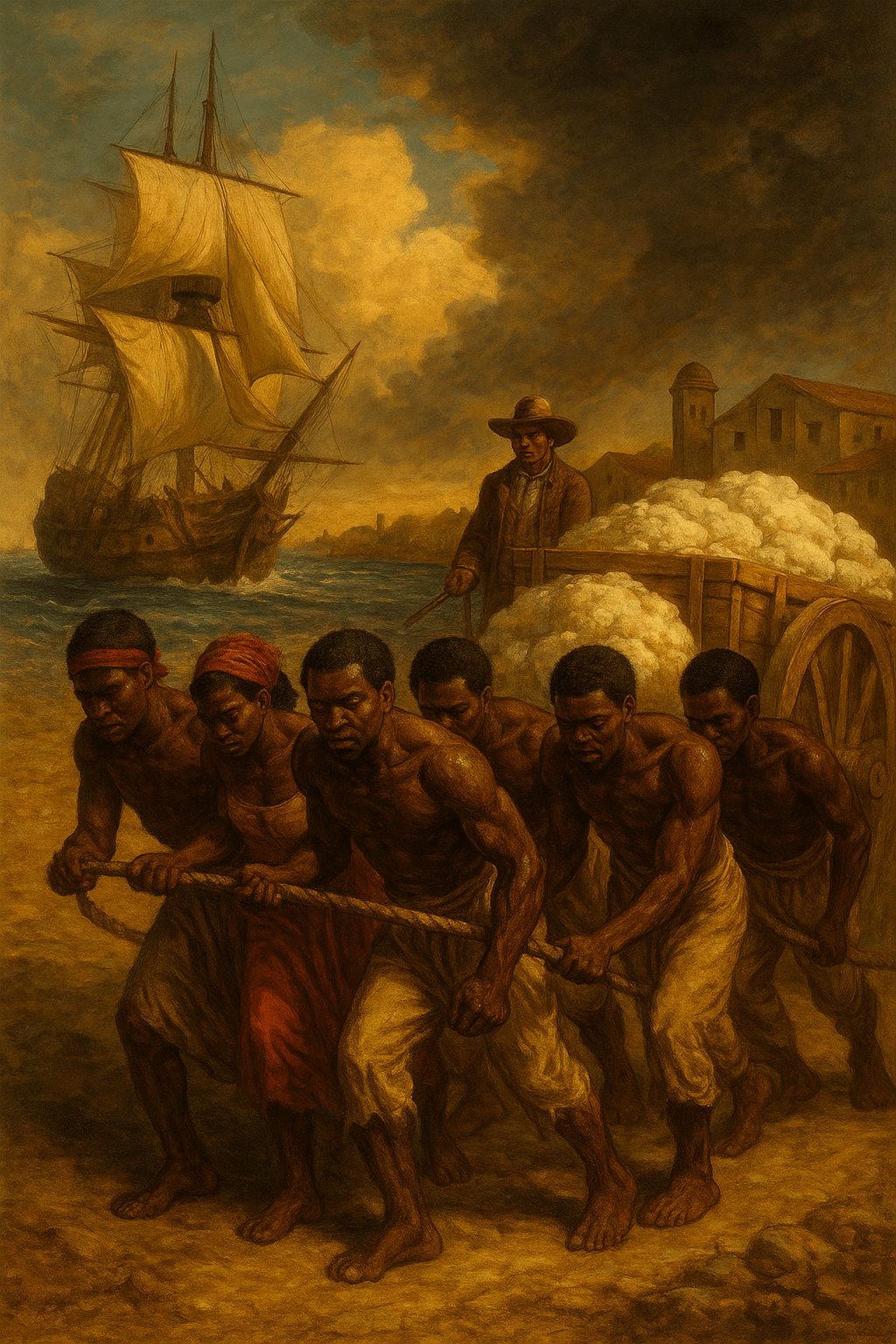
Let’s stop mincing words. The so-called “Trans-Atlantic” slave trade – more accurately, the Western European colonial slave trade wasn’t just a “dark chapter” in history—it was the bloody womb in which modern capitalism was born. It was the largest forced migration in human history. Over 12 million Africans were ripped from their homelands, shackled in iron, and shipped like cargo across the ocean. Millions died in transit. Millions more were worked to death in the cane fields of the Caribbean, the rice swamps of South Carolina, and the cotton plantations of the Mississippi Delta.
This was not a byproduct of capitalism—it was its engine. It was not an unfortunate side effect of European expansion—it was the central axis around which European wealth, empire, and industrialization turned. The Western European colonial slave trade created the infamous “triangular trade”: European manufactured goods were exchanged for African captives, who were then trafficked to the Americas to produce cash crops, which were then sold back to European markets. This cycle generated astronomical profits—so much so that banks, insurance firms, and ports across London, Liverpool, Nantes, Amsterdam, and New York were built atop Black bodies.
This wasn’t about labor shortages. It was about maximizing surplus. The entire system of chattel slavery was engineered to extract the highest possible return from the lowest possible cost. Africans weren’t just enslaved—they were rendered property, legally defined as subhuman, bred like livestock, and passed down as hereditary capital. This is what Marx meant when he wrote that “capital comes dripping from head to foot, from every pore, with blood and dirt.” Chattel slavery wasn’t a flaw in capitalism—it was capitalism in its purest, most naked form.
And it was racial to its core. It didn’t just exploit Black labor—it invented Blackness as a justification for perpetual subjugation. It constructed whiteness as a legal, economic, and cultural category of dominance. The “Negro” was made into a commodity—auctioned, appraised, insured, and mortgaged. The ideology of race was not an afterthought—it was a tool, a weapon, a necessary fiction to sustain a genocidal economy.
This is the difference settler ideologues don’t want to face. No other slave system in history was so structurally integrated into the birth and rise of a global economic order. No other system built the foundation for Western financial institutions, colonial infrastructure, and modern nation-states. This wasn’t just slavery—it was the foundational architecture of the modern world.
So when reactionaries say “Africans enslaved each other too,” they’re not just wrong—they’re defending a system of racialized accumulation that still shapes the world today. They’re trying to bury the truth beneath a thousand false equivalences. But we won’t let them. The truth is clear, comrades: capitalism came into the world not just dripping blood—but built on Black bones, lashed flesh, and stolen lives—through the Western European colonial slave trade.
Dialectics of Labor, Race, and Empire
What made the Western European colonial slave trade not just a crime but a world-historic rupture was its integration into the global capitalist system. Chattel slavery in the Americas wasn’t an anomaly—it was the blueprint for capitalist accumulation. It fused race and class into a machinery of extraction that spanned oceans, empires, and centuries.
Let’s lay it bare: this system was capitalist in form and colonial in function. African labor wasn’t exploited within their own communities—it was stolen, trafficked, and made to produce surplus for distant empires. It wasn’t a local contradiction—it was a global strategy. The fields of Haiti, Jamaica, Cuba, Brazil, and Mississippi were not isolated plantations; they were nodes in an international system of finance, naval militarism, industrialization, and settler expansion.
And it was racialized to its core. The European bourgeoisie didn’t just stumble into white supremacy—they built it. They engineered a legal fiction that transformed skin color into property status. They turned African people into commodities—branded, mortgaged, inherited, and liquidated like livestock. And they didn’t stop there. From plantation to police patrol, from slave codes to stop-and-frisk, the logic of Black criminalization became foundational to the state’s management of labor and order.
This isn’t some fringe interpretation. Even bourgeois historians admit it: Wall Street was built on slave finance. Harvard, Yale, and Princeton were endowed by slave traders. Entire national economies—Portugal, Britain, France, Spain, the Dutch Republic, and their settler colonies—were supercharged by stolen Black labor. The so-called Enlightenment happened while Black bodies were being whipped, raped, branded, and sold for profit. This was not a contradiction—it was the condition of possibility.
Here’s the dialectic: capitalism didn’t just exploit labor—it required race to manage it. It didn’t just dominate colonies—it invented ideological justifications for that domination. The idea of the “Negro” as subhuman, the white man as civilizer, the colonized as backward—these were not accidents. They were ideological tools to rationalize the extraction of wealth, the genocide of Indigenous nations, and the permanent subjugation of African peoples.
And this ideology didn’t evaporate with Emancipation. It was repackaged. From Jim Crow to mass incarceration, from sharecropping to gentrification, the same colonial logic persists: race as a method of social control, labor discipline, and resource allocation. Empire at home mirrors empire abroad.
No other form of slavery—not in Africa, not in the Arab world, not under the Barbary pirates—produced this scale of global transformation. Only the Western European colonial slave trade laid the material and ideological foundations for racial capitalism and modern empire. And it continues today in new forms—through prisons, borders, sweatshops, and debt traps.
Revolutionary analysis means naming this system, tracing its roots, and dismantling its lies. We don’t equate all slaveries. We interrogate which ones built the world—and which ones are still doing so.
Revolutionary Clarity Requires Historical Specificity
To abolish the present, we must understand the past. And to understand the past, we must reject the settler impulse to flatten history into a blur of equal suffering. Not all slaveries are the same. Not all bondage served the same social function. And only one—the Western European colonial slave trade—was the engine of a world system still feeding on the labor, land, and life of the colonized.
This clarity isn’t academic—it’s revolutionary. When settlers say “Africans enslaved each other too,” they’re not interested in truth. They’re interested in disarming struggle, erasing accountability, and neutralizing reparations. They’re not deconstructing history—they’re defending the architecture of empire.
Yes, slavery existed in Africa. Yes, the Arab empires exploited African bodies. Yes, Barbary corsairs captured Europeans. But none of these systems produced global racial capitalism. None established a global color line. None turned race into a social death sentence enforced by law, economy, and state terror across generations. That is the unique crime of the Western European ruling class—and it must be named as such.
This isn’t about relativizing pain—it’s about material foundations. The plantation didn’t just brutalize people—it built banks. It laid railroad tracks, funded universities, armed navies, and expanded empires. It created the modern wage system on the back of unpaid African labor. It was not a “side effect” of capitalism—it was capitalism itself, in its most concentrated and violent form.
So we don’t equivocate. We don’t generalize. We name names. We trace the bloodlines of wealth and power. We follow the money from slave ships to stock exchanges, from cotton fields to corporate boardrooms, from sugar plantations to Silicon Valley data mines. And we sharpen our understanding not for the sake of history alone, but for the revolutionary future it demands.
Because historical specificity is not a luxury—it is the precondition for strategy. To build a world free of exploitation, we must understand the world that was built on it. That means telling the truth: one system of slavery constructed the modern imperialist world, and that system was Western European colonial, racial, and capitalist to its core.
We do not collapse histories. We weaponize them.
 Weaponized Information
Leave a comment