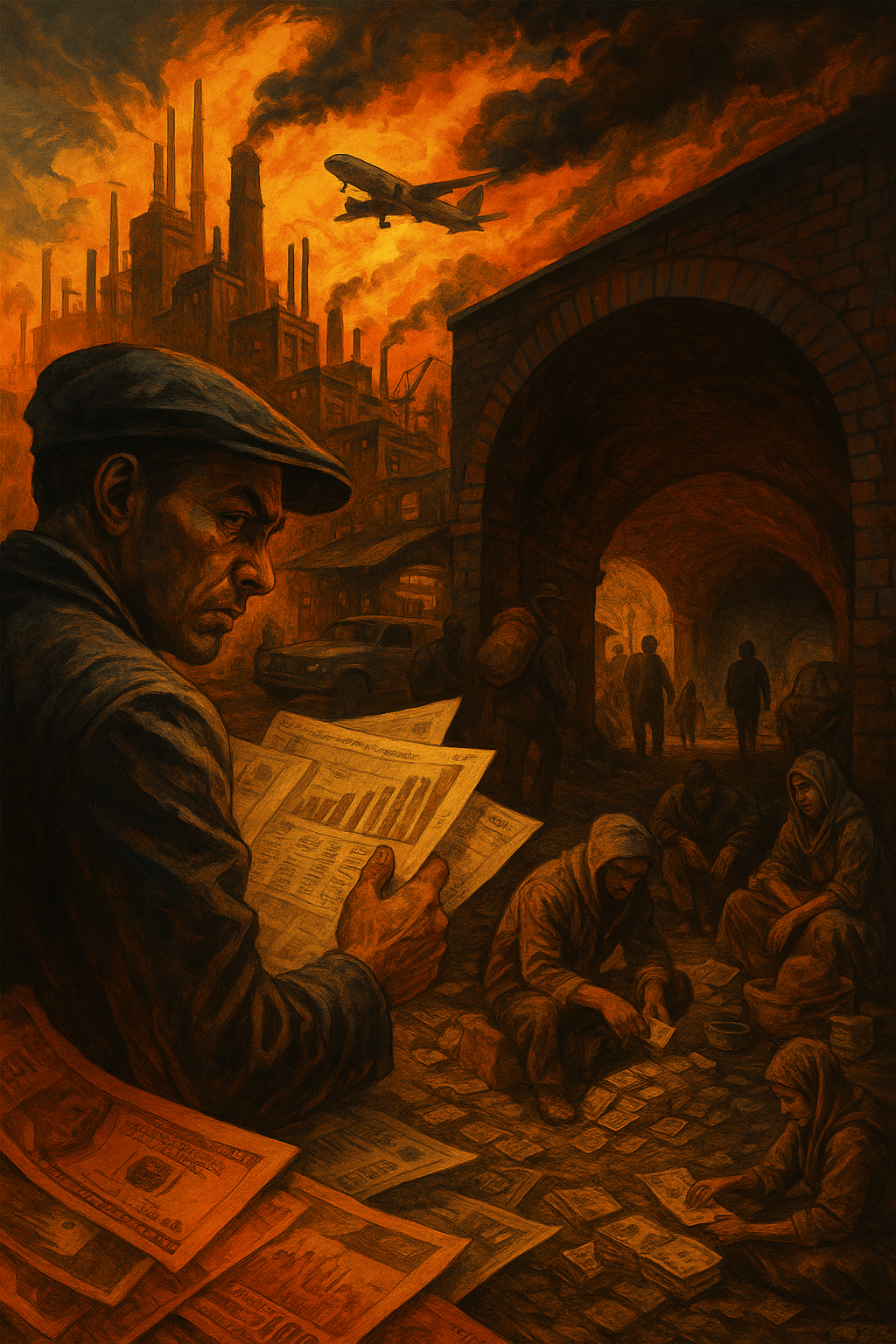
A Weaponized Propaganda Excavation of Visual Capitalist’s portrayal of the $12.5 trillion ‘shadow economy’
Prince Kapone | Weaponized Information | May 30, 2025
Behind the Chart: Who Draws the Lines of Visibility?
Dorothy Neufeld, the author of this glossy data piece on the world’s “underground economy,” is not a rogue number cruncher but a functionary of financial ideology. Her class orientation is not defined by her byline but by her consistent career service to the technocratic elite. Neufeld’s portfolio reads like a stylized investor’s briefing: GDP cartography, supply chain speculation, fintech trends, and polite graphs that translate planetary dispossession into tidy visuals. This is not journalism—it’s class war rendered in pixels.
Visual Capitalist, the outlet publishing this piece, operates as the design bureau of neoliberal capital. Its infographics circulate primarily among venture capitalists, data scientists, asset managers, and imperial technocrats—those who need elegant justifications for empire. Its function is not to inform, but to frame reality around the imperatives of capital accumulation and technocratic governance. It is an organ of the imperialist media apparatus, laundering structural exploitation into apolitical “trends.”
The article draws on data produced by Ernst & Young—a pillar of the Western financial consulting machine—and is amplified through platforms like the World Economic Forum, IMF-aligned media, and app-based content aggregators like Voronoi. These entities do not merely report on the shadow economy; they parasitize it. They offer no critique, only market analysis. To them, the informality of the South is not a crime of global capitalism—it’s a business risk.
Distorted Frames, Dispossessed Realities
The article claims the shadow economy is a $12.5 trillion behemoth that hides in the dark, implying that its existence is an aberration—an opaque tumor growing beneath the healthy body of global capitalism. But this is a lie of omission. What Neufeld and her ilk refuse to say is this: the shadow economy is not outside capitalism—it is one of its essential organs.
By presenting this economy as a vague amalgam of “street vendors and criminal networks,” the article collapses the world’s informal laborers into a single category of deviance. It equates subsistence survival in Lusaka with money laundering in Luxembourg. It erases the historical violence that created this sector in the first place: the deliberate destruction of communal land systems, the structural adjustment programs that gutted rural and urban employment, the global race to the bottom driven by WTO diktats and World Bank conditionalities.
Neufeld offers no explanation for why over 75% of Southern Asia’s workforce is informal. No historical memory of colonized economies restructured to serve the metropole. No mention of the way imperialist development banks designed unemployment as a disciplinary weapon. No understanding of how “informality” is the intended result of neocolonial extraction, not a natural market fluctuation.
Meanwhile, when addressing the Global North, the article engages in sleight of hand. It notes that the U.S. has the second-largest shadow economy by absolute value, but buries this fact under the celebratory claim that its percentage of GDP is the lowest. As if the scale of criminalized working-class survival, undocumented labor, and tax-evasion by billionaires doesn’t matter as long as it remains proportionate to empire’s wealth.
In doing so, the piece serves as a classic case of cognitive warfare: weaponizing data visualization to depoliticize and dehistoricize systemic contradictions. This is propaganda, not analysis. It is the cartographic face of hyper-imperialism, a narrative war waged with choropleths and dollar signs.
The Numbers Beneath the Narrative
Let us extract the facts from the imperialist frame. The article notes that the global shadow economy is valued at $12.5 trillion—11.8% of global GDP. This includes everything from informal street vending and day labor to unlicensed manufacturing and criminal enterprise. While North America has the lowest proportion (5% of GDP), the United States alone accounts for $1.4 trillion, second only to China in absolute terms. Eastern Africa, by contrast, reports 41.6% of its GDP in the shadow economy, with South Asia, Central America, and much of the African continent not far behind.
But these numbers, while technically accurate, are politically manipulated. Neufeld and her class quietly bury the underlying structures: global hunger, unemployment, land dispossession, mass migration, and the collapse of welfare under IMF-enforced austerity. They do not explain why the informal sector has grown—not as a cultural preference but as a structural necessity imposed by hyper-imperialism. They make no mention of the fact that nearly one-third of all workers in the world today live on less than $3.65 a day—not because they choose to, but because they are locked into a world economy designed to extract their labor without rights, stability, or bargaining power.
In Southern Asia, informality employs more than 75% of the workforce. In Eastern Africa, it surpasses 80%. These are not “hidden markets”—they are the primary economic reality for billions. They are the outcome of structural adjustment programs imposed by the IMF and World Bank beginning in the 1980s, which shattered public sectors, privatized basic services, and restructured national economies around export dependency and debt.
The U.S. and EU remain the primary beneficiaries of this informalization. Their corporations source raw materials and low-cost labor from these zones while shielding themselves behind “formal” sectors protected by legal infrastructure, armed enforcement, and state subsidy. This global system relies on a dual structure: legality and taxation for the imperial core; informality and precarity for the periphery.
And yet, even in the heart of empire, the shadow economy is growing. The U.S. figure—$1.4 trillion—is not fueled by street vending alone. It includes undocumented migrants pushed into hyper-exploited labor, gig workers excluded from protections, and entire communities forced into illegal survival economies due to eviction, incarceration, and criminalization. This is not an aberration—it is technofascist labor recalibration in motion.
What Neufeld calls “underground” is actually the base of the pyramid. This is where empire walks barefoot, where capitalism sheds its laws and shows its teeth. This is the economy of empire’s underside, where surplus is extracted in silence.
Reframing the Shadow: From Hidden Economy to Structural Engine
It is time to discard the myth that the shadow economy is some deviant appendage to the formal system. The so-called underground economy is the structural backbone of modern capitalism in crisis. It is not hiding in the shadows—it is holding up the roof of the global economy, propping up a decaying imperialist order.
For the colonized and hyper-exploited, this informal economy is not a passive zone of exclusion—it is a violently constructed zone of dispossession. It is the result of five centuries of imperial accumulation, settler colonialism, and capitalist transformation that rendered whole populations surplus to capital’s formal operations, only to be reabsorbed under worse conditions through informal extraction. This is not a market failure—it is a market design.
The petty bourgeois reformist dreams of settler-socialists and patriotic communists crumble when faced with this reality. Their fantasies of a unified, industrial proletariat ignore the billions who are permanently excluded from wage contracts, legal protections, and the social benefits reserved for citizens of empire. Their economic chauvinism reduces the working class to its white, waged, and unionized fragments while criminalizing the rest as lumpen, illegal, or “unproductive.”
But the informal economy is not post-capitalist—it is hyper-capitalist: predatory, precarious, and unregulated. It is where the logic of exploitation is most naked. And it is also where revolutionary possibilities can germinate: the vendor who organizes against police extortion; the migrant who forms mutual aid networks; the worker who refuses to be disposable.
These zones of informal survival are also zones of potential dual and contending power. They are the spaces where oppressed classes and colonized peoples can begin to organize their own economic and political institutions, outside the legal frameworks of capitalist states. They are the ungovernable zones of empire—the spaces where revolutionary rupture can begin.
To reframe the informal economy is to strip away the imperialist narrative and reveal the class struggle underneath. It is to recognize that capitalism survives not by extending rights and benefits to all, but by constantly producing informality—by producing people whose labor it can steal without granting recognition. This is the engine of capitalist survival in the era of hyper-imperialism.
Mobilizing from Below: Revolutionary Tasks in the Age of Informal Empire
We declare full ideological, strategic, and material unity with the workers, migrants, farmers, vendors, and underground laborers who make up the backbone of the global informal economy. These are not peripheral actors—they are the core of global production, the living contradiction that exposes capitalism’s lie of inclusion.
In the imperial core, our task is not to “formalize” these workers into bourgeois legality, but to build dual and contending power that defends their right to survive, organize, and fight. This means defending informal encampments from eviction, protecting undocumented workers from deportation raids, forming proletarian mutual aid networks, and building revolutionary structures that do not rely on state recognition or liberal reform.
In the Global South, we must amplify and materially support struggles that advance anti-imperialist sovereignty and socialist development. This includes:
- Kerala’s localized poverty eradication programs that render the informal visible and supported;
- Burkina Faso’s resurrection of Sankarist productionism—linking land, labor, and anti-colonial self-reliance;
- BRICS+ initiatives that undermine financial piracy and create new infrastructure outside of IMF control.
We must expose and reject every attempt by settler-socialists and social imperialists to erase these realities. When they praise the white waged worker and ignore the colonized precariat, we call it what it is: ideological collaboration with empire. When they speak of “unifying the class” while abandoning the majority of the global working class to informal repression, we name it counterrevolutionary betrayal.
The informal economy is not a detour on the road to socialism—it is one of its first battlefields. From the ghettos to the favelas, from the banlieues to the barrios, we are already living in the cracks of empire. Our task is to widen them.
 Weaponized Information
Leave a comment