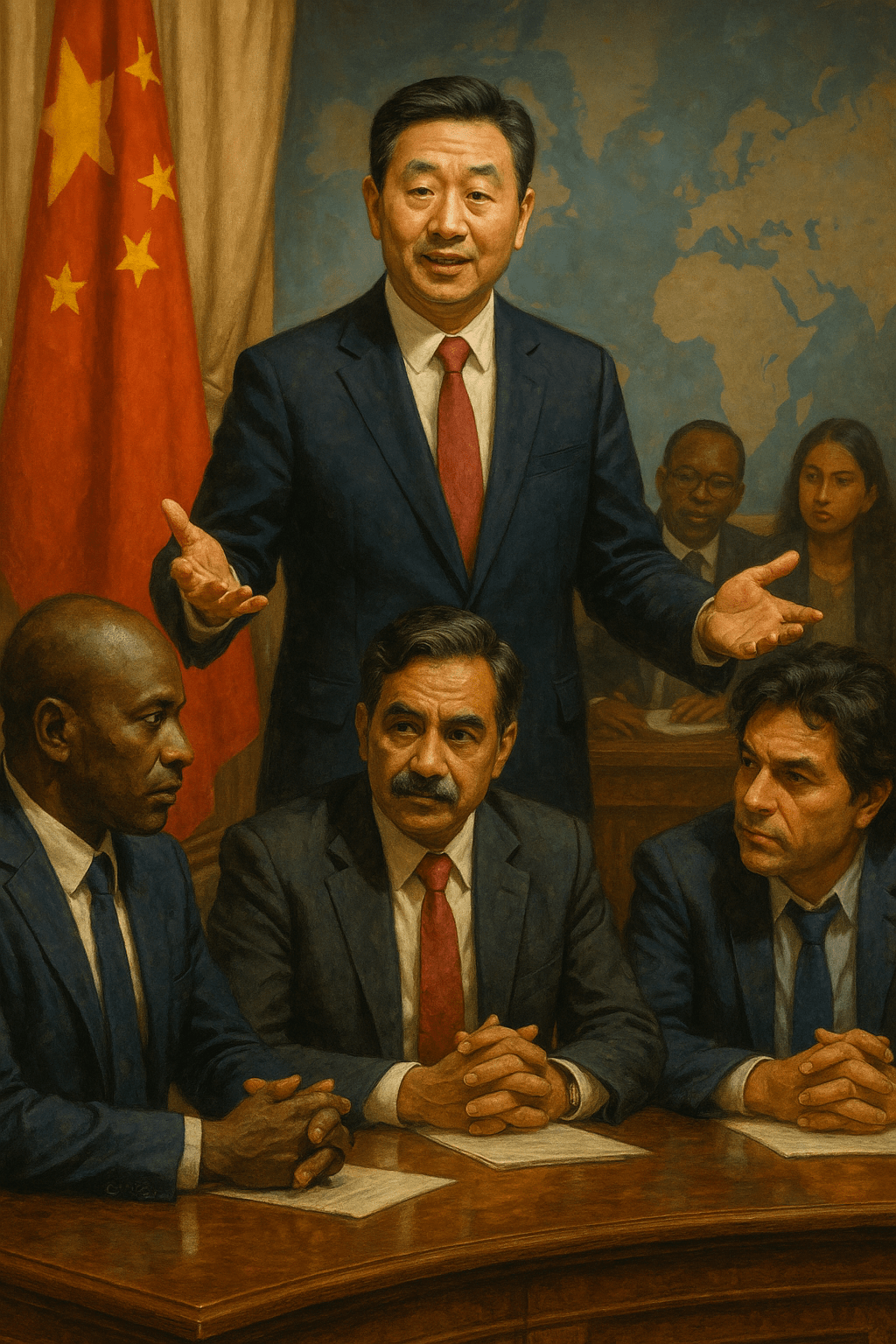
When war is business and law is imperial, diplomacy becomes a revolutionary act. China’s mediation initiative doesn’t just offer peace—it offers the world an exit.
By Prince Kapone | Weaponized Information | May 30, 2025
The Quiet Panic Behind the Neutral Tone
Kanis Leung, the Associated Press reporter behind this piece for ABC News, is no rogue operative. Her class position and professional track record reveal a career deeply embedded in the circulatory system of Western soft power. Trained to present imperial narratives with the sheen of neutrality, Leung has consistently covered the Asia-Pacific region through a lens framed by U.S. security interests and market liberalism. She is a functionary of the press corps that launders aggression into diplomacy and turns the global ambitions of empire into stories of misunderstood good intentions. The outlet she writes for, ABC News, is owned by Disney—one of the most powerful media conglomerates in the world. This is not an independent newsroom but a flagship node in a commercial empire whose profits and narratives are tightly interwoven with the ideological priorities of Wall Street, the U.S. State Department, and the Pentagon. ABC does not report—it stabilizes.
At the ceremonial launch in Hong Kong, we see Wang Yi, China’s Foreign Minister, emphasizing dialogue over domination; John Lee, the top official in a region still demonized by the West for reclaiming its sovereignty; and global law scholars like Yueming Yan and Shahla Ali, who speak with the technical caution of experts but stand amid a quiet tectonic shift. The UN and representatives from fifty countries were present—not just as spectators, but as participants in building something new.
What this article does best is conceal its panic behind procedural language. It doesn’t outright condemn China’s mediation initiative, but it buries it in a grave of bureaucratic jargon: “ceremony,” “convention,” “structured form,” “details yet to be clarified.” That’s not objectivity—it’s deflection. The framing deliberately erases the radicality of what’s happening. Thirty-plus nations—many of them with long histories of being bullied, bombed, or bled dry by Western financial and legal institutions—are banding together to create a new forum for resolving international disputes. Not through Western arbitration courts stacked with corporate lawyers. Not through tanks or sanctions. But through dialogue. That alone should be front-page news. Instead, the tone here is weary, skeptical, and dismissive—designed to cast the whole effort as a sideshow or at best an experimental footnote.
The narrative is also padded with passive-aggressive qualifiers: “Beijing has touted…”, “could open the door…”, “many details are yet to be clarified…” These aren’t just hedges. They are rhetorical sandbags. The article subtly primes the reader to doubt the credibility and seriousness of the project without ever having to say so directly. It’s the journalism of plausible deniability—where skepticism is embedded not in evidence, but in tone. And it works. Because when the imperial order feels its grip loosening, it doesn’t scream—it sneers.
What’s Reported, What’s Missing, and Why It Matters
The article does manage to deliver several core facts, almost despite itself. It confirms that over thirty countries joined China in launching the International Organization for Mediation (IOMed), an intergovernmental body dedicated to resolving disputes through dialogue rather than coercion. It notes the presence of nations like Pakistan, Indonesia, Belarus, and Cuba—each with its own history of resisting or surviving Western pressure—and confirms that the signing took place in Hong Kong under the stewardship of Chinese Foreign Minister Wang Yi. It even acknowledges that around fifty countries and twenty organizations, including the United Nations, participated in the event. So the facts are there. But facts without context can be more dangerous than lies.
What the article refuses to say is that this isn’t just a bureaucratic development—it’s a political earthquake. It omits the long historical arc that makes a mediation body like this both necessary and subversive: centuries of colonial domination, decades of legal manipulation through institutions like the World Bank’s ICSID, and the persistent use of law not as a tool for justice but as an extension of war by other means. There’s no mention of the Global South’s increasing distrust in Western-led legal forums, no reference to Washington’s refusal to be bound by international law unless it suits its interests, and certainly no exploration of how this initiative is part of a broader pattern—one that includes BRICS+, de-dollarization efforts, regional financial architectures, and growing diplomatic assertiveness from states once forced to grovel before imperial power.
The article also flattens Hong Kong into a simple venue for international law. It does not contextualize the decision to host the body there as a strategic reclamation of colonial terrain—transforming a city once ruled by Britain into a symbol of non-Western legal authority. It misses the geopolitical significance of using Hong Kong not just as a city with hybrid legal systems, but as a forward base in the long project of building sovereign institutions outside the grip of U.S. and European domination.
Finally, the article says nothing about the broader conditions shaping this shift. There is no mention of the wars Washington failed to end, the peace processes it undermined, the arbitration rulings it ignored, or the sanctions it continues to impose in place of negotiation. It never connects this initiative to the ongoing failures of Western diplomacy in Gaza, in Ukraine, in Sudan. It doesn’t ask why countries would turn to China unless they had already been burned by the self-appointed peacemakers of the post–Cold War order. It treats China’s growing diplomatic footprint as an anomaly—rather than as a logical response to a system that has delegitimized itself.
A Different Kind of Power: Reframing Mediation as Resistance
This isn’t just about peace. It’s about power—and who gets to wield it. For decades, mediation has been monopolized by the very powers that start the wars. The U.S. and its allies have acted as judge, jury, and executioner, offering “diplomacy” only after the bombs fall, only when it suits their commercial or strategic interests. When the Global South has sought justice—be it through the United Nations, the International Court of Justice, or arbitration forums—it has been met with delay, denial, or outright sabotage. What China is proposing here is not a utopian alternative. It is a practical counterweight: a mechanism that might allow states long brutalized by economic blackmail and military threats to settle disputes without submitting to imperial terms.
The significance lies not just in what this body might do, but in what it represents. It signals that the rest of the world is no longer waiting for the West to reform itself. The colonized aren’t asking for better terms—they’re building new tables. The presence of Cuba, Belarus, and Indonesia isn’t random; these are nations with long-standing experiences of resisting external domination. And China, for all its contradictions, is creating space—through trade, infrastructure, and now mediation—for others to breathe outside the chokehold of U.S.-led global governance.
This is what the imperial press cannot say out loud: that the architecture of domination is crumbling at its edges. That the “rules-based order” was never about rules, only about who had the power to write and rewrite them. By establishing IOMed, China and its partners are contesting not only who gets to mediate conflict, but who gets to define legitimacy itself. That is a direct challenge to the ideological infrastructure of empire.
And make no mistake—this isn’t about trusting China or imagining some benevolent global savior. It’s about opening space for options. It’s about creating diplomatic infrastructure where peace isn’t conditioned on austerity, where sovereignty isn’t traded for loans, and where smaller nations can resolve disputes without being forced to choose between submission and sanctions. That’s not charity. That’s strategy. And for the first time in a long time, it’s not coming from the barrel of a gun.
From Multipolar Diplomacy to Revolutionary Solidarity
This initiative may not be revolutionary in form, but it is insurgent in function. It challenges the monopoly the West has held over international conflict resolution since the end of World War II. For nations in the Global South, it offers more than a new mediation venue—it offers breathing room. For organizers, educators, and workers in the heart of the empire, it opens a new front in the struggle for a different world. If the empire can no longer monopolize diplomacy, then we must not allow it to monopolize the narrative either.
For revolutionaries in the Global South, the path is clear: defend and expand this experiment. Insist on transparency, accountability, and collective governance—so that it doesn’t replicate the same hierarchies it seeks to escape. Push for IOMed to take on cases the West would never allow—on illegal sanctions, on reparations for colonial crimes, on stolen assets and extractive treaties. Forge alliances that transform mediation from elite negotiation into mass defense of national dignity.
For comrades in the imperial core—especially in the U.S., Europe, and Japan—this is a moment to break the spell. We must reject the press narratives that cast China as a threat for daring to facilitate peace. We must challenge the framing that only Western legal systems are legitimate, even after decades of backing coups, whitewashing war crimes, and laundering colonial looting through suits and judges. Organize teach-ins on the history of legal imperialism. Create public campaigns defending the right of oppressed nations to resolve their conflicts without NATO bombs or IMF strings.
And above all, let us recognize what’s happening for what it is: not a sudden miracle, but a material shift. A strategic response by much of the world to the crisis of imperialism. It is a crack in the wall of unipolar dominance. Our job is to widen it. Support the new mediation body not as spectators, but as partisans of a future where peace is not a luxury handed down by the powerful, but a right constructed by the oppressed. In this struggle, even mediation becomes a weapon—when it is wielded against the empire.
 Weaponized Information
Leave a comment