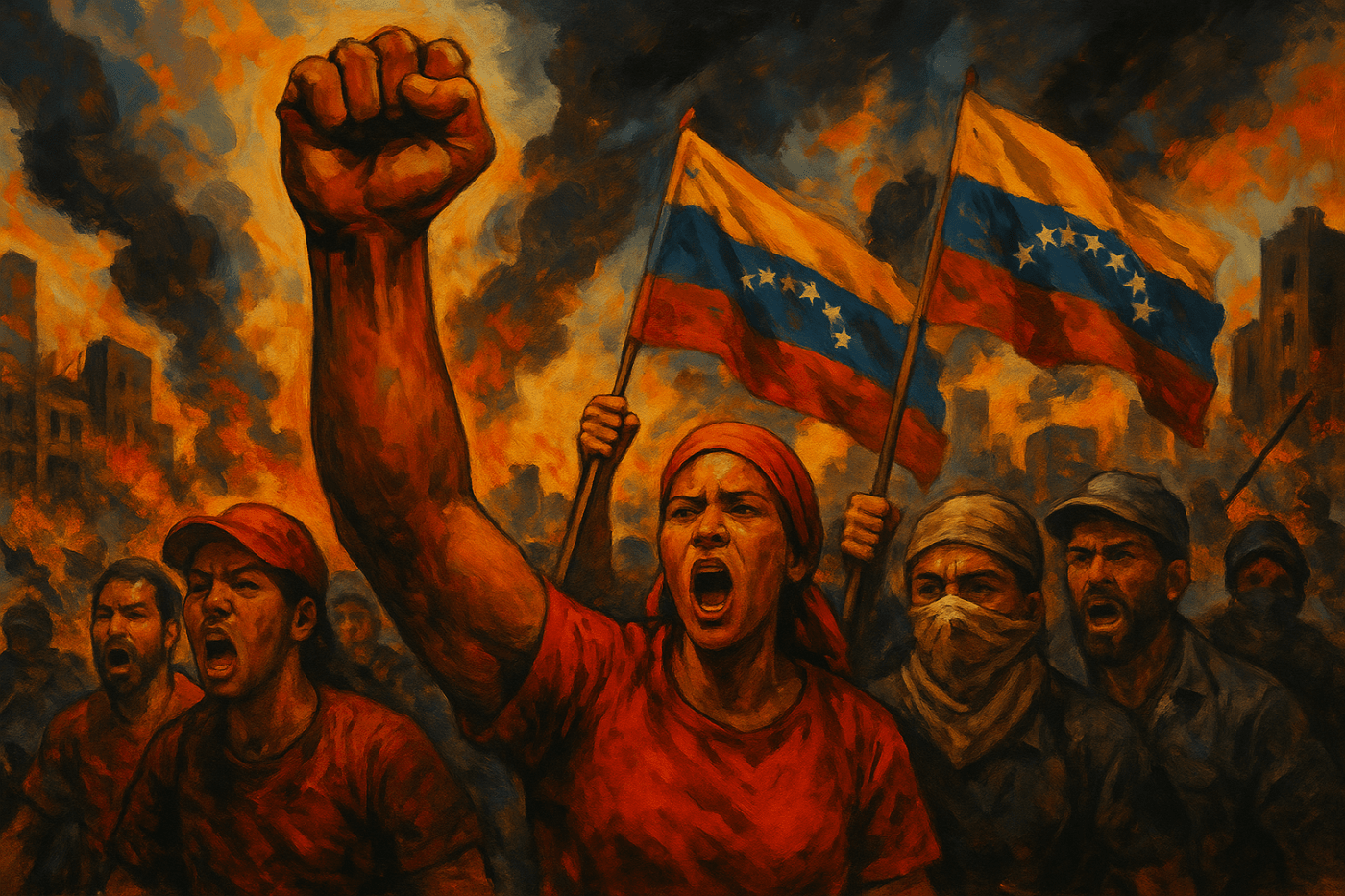
How the Fake Left Parrots Empire, Undermines Sovereignty, and Aids the Siege on Venezuela
By Prince Kapone | Weaponized Information | May 31, 2025
Part I – When “Critical” Becomes Contradictory: Excavating a Manufactured Dissent
The article under examination, titled “The pro-Maduro left’s blind spots: Against the ‘nuancing’ of Venezuela’s disaster” by Emiliano Teran Mantovani, was published on May 30, 2025 by LINKS – International Journal of Socialist Renewal. While cloaked in the language of critical solidarity, the piece functions as a textbook example of ideological triangulation—deploying the rhetoric of the left to discredit a besieged anti-imperialist state, while softening the real violence of the U.S.-led siege against Venezuela. In this section, we excavate the class orientation of the author, the political economy of the outlet, the institutional functions of its amplifiers, and the structural role this narrative plays within the broader machinery of cognitive warfare targeting the Bolivarian process.
Emiliano Teran Mantovani positions himself as a leftist sociologist, but his posture reads more like a man trying to keep one foot in struggle and the other in a fellowship program funded by European NGOs. Though he writes from Venezuela, his political coordinates are tethered to the circuits of international academic recognition—where “critical” means respectable, and solidarity is measured by rhetorical distance from the revolution itself. His recent piece in LINKS – International Journal of Socialist Renewal is not an act of revolutionary critique but a polished exercise in ideological triangulation.
LINKS, the outlet that published his essay, is a Trotskyist-adjacent journal out of Australia, curated by intellectuals who have long treated Third World revolutions as imperfect experiments to be measured against Eurocentric fantasies of purity. Politically, it’s a clearinghouse for disgruntled observers who mistake their own distance from power for moral superiority. Economically, it survives off proximity to Western foundations, anti-Stalinist think tanks, and Cold War holdovers repackaged as “renewal.” In short, it is part of the imperialist media apparatus in “left” clothing.
Figures like Gabriel Hetland, a regular source of academic triangulation against the Bolivarian Revolution, and networks like Green Left Weekly and ecosocialist.org.au serve as soft amplifiers of this line. Their function is to launder delegitimization campaigns through the language of solidarity while hollowing out the actual conditions of imperialist siege. In doing so, they become useful instruments of what we call cognitive warfare: a strategy not to kill the revolution with bullets, but with doubt.
At its core, Mantovani’s piece collapses the fundamental contradiction. By placing internal decay and imperialist aggression on the same analytical plane—if not reversing them—he performs a sleight of hand that replaces anti-imperialist sovereignty with moral panic. His critique is framed as concern for the masses, but it lands as an indictment of their only shield. The piece isn’t about building revolutionary struggle. It’s about narrating its failure into inevitability.
He accuses the “pro-Maduro left” of clinging to a decaying regime, yet nowhere does he mention the unrelenting sanctions architecture, the failed coups, the lawfare seizures of Venezuelan gold and oil assets, or the sabotage of state programs by agents of imperial subversion. Instead, he selectively extracts symptoms from a war-torn economy to accuse the patient of causing their own wounds.
The article deploys the language of “corruption,” “militarization,” and “cronyism” as if these emerged in a vacuum. He speaks of collapsing wages without naming Chevron, of failing services without naming Citgo’s asset theft, and of repression without naming Operation Gideon—the 2020 U.S.-backed mercenary invasion caught in broad daylight. He denounces “preferential treatment” of capital under Maduro, but fails to situate it within a framework of siege survival, where lawfare and embargo leave states with few levers of sovereignty intact. In short, Mantovani offers a critique sanitized of history, absent of class analysis, and useful only to those looking to disarm the Venezuelan resistance from the left flank.
And yet, this is the point. The function of this genre of writing is not to inform—it is to fracture. To erode confidence in struggle while claiming to sharpen it. To wear the garments of the guerrilla intellectual while delivering the message of the imperialist media apparatus in a different accent. In the language of Weaponized Information, this is not “critical solidarity.” It is a subtle but strategic form of ideological counterinsurgency—a Trojan horse in the house of revolution.
In the next section, we will extract the actual facts embedded in this narrative and re-situate them within their proper historical and material context. Because revolutionary clarity does not reject critique—it insists on putting critique in its rightful place: at the service of the oppressed, not the oppressor.
Part II – Facts Under Siege: Extraction and Contextualization
Even imperialist-aligned narratives must traffic in facts—just enough to preserve the illusion of legitimacy. Emiliano Teran’s essay contains such kernels: statistics, admissions, and observations that, once ripped from their imperial scaffolding, tell a very different story. Our task is to extract these fragments from the wreckage of framing and replant them in the soil of material history, class contradiction, and global geopolitics.
Teran notes that Venezuela’s GDP contracted 31.9% between 2013 and 2017, that inflation soared above 400% by 2016, and that oil production, imports, and wages plummeted. These are empirical facts. But without causality, they become cudgels for ideological warfare. He mentions corruption within PDVSA, the collapse of basic services, and the emergence of a new bourgeoisie aligned with sectors of the state. Again—true, in part. But isolated, decontextualized, and presented as internal rot rather than the logical outcome of sustained hyper-imperialist sabotage.
Teran deliberately minimizes the systemic war waged on Venezuela since at least 2015, when the Obama administration declared it a national security threat—activating the sanctions architecture that would metastasize under Trump and be maintained by Biden. The timeline matters. By 2017, financial institutions had been blocked, oil exports strangled, and foreign reserves frozen. Venezuela was ejected from SWIFT mechanisms, denied access to medical imports, and systematically robbed through legal theft orchestrated via lawfare. This wasn’t poor governance—it was financial piracy.
What Teran erases is how this warfare preceded and helped catalyze the very economic collapse he cites. Currency destabilization, the deliberate flooding of the bolívar with counterfeit bills from Colombia, and speculative capital sabotage helped plunge Venezuela into hyperinflation well before the official sanctions. This wasn’t bad policy—it was counterinsurgency by economic means.
Nor does he contextualize the state’s strategic alliances with domestic capital and foreign firms as tactics of wartime survival. Venezuela’s agreements with Chevron or CNPC are not evidence of neoliberal betrayal—they are forced maneuvers in a siege economy. What he calls “preferential treatment” is in reality a series of desperate moves made under blockade, with the goal of generating revenue while circumventing total economic collapse. To ignore this context is not an oversight—it is narrative warfare.
The article also references post-electoral protests in July 2024, citing working-class neighborhoods as the epicenter. It paints these protests as spontaneous eruptions of popular will. What it omits is the timing: within 24 hours of Venezuela’s presidential election, before official counts had concluded, the U.S. and EU rejected the results. This was part of a pre-scripted operation to delegitimize the outcome regardless of the margin—mirroring similar operations in Bolivia (2019) and Nicaragua (2021). The uprisings weren’t popular revolts—they were the kinetic arm of cognitive warfare, timed to cast doubt and trigger destabilization.
Most tellingly, Teran never asks the fundamental question: why does Venezuela remain a target? What explains the multi-decade commitment by the U.S. and its allies to regime change in Caracas? It is not because of corruption, or even mismanagement. It is because Venezuela, since Chávez, dared to construct a model outside of unipolar control, redistribute oil wealth, and ally with anti-imperialist forces globally. Its existence challenges the ideological monopoly of capitalism itself. And that, in the eyes of empire, is the original sin.
In the final analysis, the facts cited in the LINKS article do not indict the revolution. They indict the imperialist world system waging war against it. Our task is not to ignore these contradictions—but to understand them within the totality of a global crisis of imperialism that is attempting to recolonize the hemisphere through blockades, coups, and cognitive subversion.
In the next section, we reclaim the narrative. We will reframe Venezuela not as a failed experiment or a fallen utopia, but as a beleaguered fortress of anti-imperialist sovereignty—flawed, embattled, but still holding the line.
Part III – Holding the Line: Reframing Venezuela as a Fortress of Anti-Imperialist Sovereignty
Let us begin without apology: Venezuela is not a failed state. It is a state under siege. And siege transforms everything. It distorts production, undermines governance, corrodes morale, and sharpens contradictions. But none of these effects are the fault of revolution—they are the cost of daring to pursue one under the barrel of imperialism’s gun. The question is not whether the Bolivarian process has contradictions. The question is whether it remains a living contradiction against empire. And the answer is yes.
To call Venezuela “authoritarian” (the use of such liberal terminology is revealing in itself) without acknowledging the attempted coups, mercenary invasions, cyber attacks, economic asphyxiation, diplomatic isolation, and outright theft of billions is not analysis—it’s ideological gaslighting. To be plain: it’s pseudo-radical bullshit. A revolution that survives two decades of direct and indirect warfare is not a dictatorship. It is a miracle. And the fact that it has not fallen—despite sabotage, starvation sanctions, and lawfare assaults—is a testament to its mass legitimacy, not its repression.
What the imperialists call “hostage diplomacy” is, in fact, revolutionary self-defense. The detentions of U.S. nationals, Chevron executives, DEA informants, and “civil society” agents are not random acts of cruelty. They are strategic responses to foreign infiltration and attempted regime change. Any state that refused to act would not be tolerant—it would be suicidal.
The Venezuelan state is forced to navigate a complex, shifting terrain: one foot in revolutionary legality, the other in tactical compromise. It negotiates with capital because it must—not because it has surrendered. It opens special economic zones not out of neoliberal conviction, but to generate liquidity in a strangled economy. This is not the textbook socialism of well-fed graduate students. This is survival socialism, forged in the furnace of siege.
Mantovani’s accusation that Maduro allies with capitalists, evangelicals, and military sectors omits a simple fact: no revolution proceeds in a vacuum. Every anti-colonial project in history has had to form temporary alliances, make contradictions work, and weather storms with tools not of its choosing. Venezuela is no different. But while it bends, it has not broken. The central institutions of the Bolivarian project—communal councils, public healthcare, popular education, and regional solidarity through ALBA—remain alive, even if wounded.
And if Venezuela is “decaying,” then why does it remain the obsession of the U.S. State Department, the European Union, the IMF, and every Atlanticist media outlet from CNN to The Economist? Why the embargoes, the fake governments, the frozen gold, the weaponized indictments? Because decay is not what frightens empire—sovereignty is. Venezuela’s continued defiance, its refusal to surrender, its loyalty to Chávez’s legacy, and its alignment with a rising multipolar world threaten the very foundations of hyper-imperialism.
This is what the critics can’t accept. That Venezuela, for all its contradictions, remains a beacon of dual and contending power. That its barrios, communes, and militias still believe in the revolution—not abstractly, but concretely, as a condition of their survival. That while elites flee, the poor remain. And that the people most impacted by the sanctions and sabotage continue to resist—not because they are brainwashed, but because they remember what came before: the IMF, the Caracazo massacre, the mass privatizations, and the total abandonment of the poor.
To reframe Venezuela is to break the imperial spell. It is to see the contradictions not as failure, but as dialectical necessity. The state has not been defeated. It has adapted. It has absorbed blows and recalibrated. It has not achieved utopia—but it has not collapsed. And in a world of collapsing empires, that fact alone is revolutionary.
In the final section, we shift from theory to practice—from reframing to responsibility. What does it mean to stand with Venezuela, not just rhetorically, but materially? What forms must our solidarity take in this stage of the global class war?
Part IV – Mobilize the Front: From Clarity to Concrete Solidarity
We do not write these words to win a debate. We write to sharpen the blade of struggle. Venezuela is not in need of sympathy, moral posturing, or academic triangulation. It needs militant solidarity—material, ideological, and organized. Because what is happening in Venezuela is not a domestic failure but a front in the global war for sovereignty. And in this war, the most dangerous enemy is not always the open fascist. It is the “critical” voice that blurs the lines, dulls the contradictions, and hands the enemy its talking points in leftist prose.
The first act of solidarity is clarity. Clarity that Venezuela’s contradictions are born not in a vacuum but under siege. Clarity that lawfare, sanctions, and cognitive warfare are not responses to so-called “authoritarianism”—they are tools of recolonization. Clarity that the Bolivarian process, for all its wounds, remains one of the few revolutionary trajectories to survive the wrecking ball of neoliberalism, the sabotage of the CIA, and the silence of too many so-called allies.
The second act is refusal. Refuse the empire’s language. Refuse to call lawfare “justice,” refuse to call sanctions “policy,” refuse to call destabilization “democracy promotion.” Refuse to let agents of empire—cloaked as aid workers, investors, journalists—enter the conversation without first unmasking the flag they serve.
But solidarity cannot stop at critique. It must act. It must become dual and contending power within the core of empire itself. To break the siege on Venezuela, we must rupture the complicity of our own institutions, our own cities, our own streets. That means taking aim at the choke points of this siege economy and disrupting the flows of looted wealth that fund imperial domination.
Five Tactical Actions for Revolutionary Solidarity
- Expose the Cognitive Warfare Infrastructure: Launch targeted campaigns dissecting “leftist” triangulation articles like Mantovani’s. Name the outlets, map the networks, and reveal how ideological confusion functions as counterinsurgency in academic drag.
- Disrupt Financial Piracy: Organize actions against banks and corporations involved in the theft of Venezuelan resources. Protest Citgo’s auction. Target the Bank of England’s role in freezing Venezuela’s gold. Publicly confront Chevron, Shell, and other benefactors of economic sabotage.
- Build Proletarian Cyber Resistance: Create and support encrypted digital platforms for Venezuelan popular forces to speak directly to the world. Break the monopoly of U.S.-EU platform censorship. Defend the digital sovereignty of anti-imperialist movements.
- Escalate Political Education: Hold teach-ins, propaganda workshops, and digital mass meetings to combat imperialist narratives on Venezuela. Link these to broader educational campaigns on hyper-imperialism, lawfare, and the sanctions architecture.
- Forge Revolutionary Institutions of Solidarity: Establish permanent structures—mutual aid funds, legal defense brigades, and medical aid pipelines—that materially support the Bolivarian process. These must be autonomous, grassroots, and explicitly anti-imperialist.
Revolutionary solidarity is not abstract. It lives in the bodies of those imprisoned by empire and in the hands of those who work to free them. It pulses through the barrios of Caracas, the streets of Managua, the communes of Matagalpa, and the encampments of Chicago. It is built, not wished. And it must be rooted not in guilt or romance, but in strategic unity against a common enemy.
Venezuela is not holding hostages. Venezuela is holding the line. And in that act, it holds open a future for all of us—for every worker resisting austerity, every peasant fighting land theft, every colonized nation clawing toward liberation. To stand with Venezuela is to stand with life, against the machinery of death that calls itself democracy.
In the words of Walter Rodney, “What this means is that the struggle for political power has to be based on the economic realities of the people… there is no other road to liberation.” Venezuela walks that road—not perfectly, not cleanly, but defiantly. Our task is to walk it beside them.
 Weaponized Information
Leave a comment