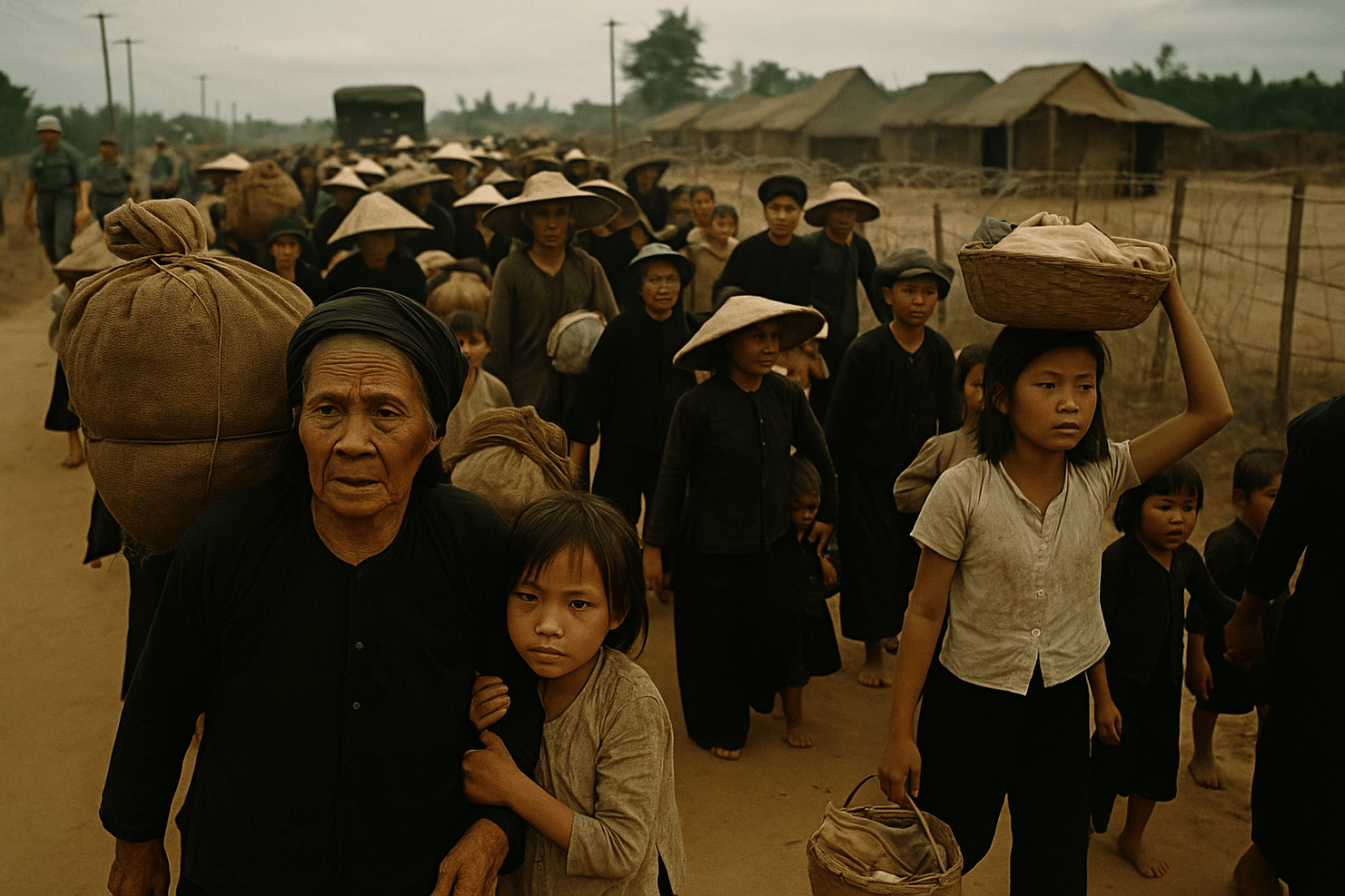
They say Stalin was a monster for displacing hundreds of thousands in wartime. But they say nothing about the 8.5 million Vietnamese peasants forcibly removed by the U.S. military in just two years. This essay rips off the mask of Western humanitarianism and names the real genocidaires.
By Prince Kapone | Weaponized Information
May 26, 2025
Part I – They Call It Development, We Call It Ethnic Cleansing
Let’s start with the numbers, comrade. Between 1961 and 1963, the U.S. government, in collaboration with its puppet regime in South Vietnam, forcibly uprooted over 8.5 million Vietnamese peasants from their ancestral villages. That’s half the rural population of the South. These peasants—many of them rice farmers, land reform advocates, and quiet supporters of the National Liberation Front—were rounded up, their homes torched, their communities dismembered, and their futures enclosed behind barbed wire.
The official name was the Strategic Hamlet Program. But let’s call it what it was: a massive campaign of counterrevolutionary ethnic cleansing. These weren’t voluntary relocations. These were forced internments. Civilians were jammed into U.S.-designed compounds, encircled by fencing, watchtowers, curfews, and military patrols. They were stripped of their land, culture, and autonomy—all in the name of “anti-communism,” that Cold War gospel which justified every atrocity so long as it bled red.
And here’s the bitter irony: the same U.S. empire that orchestrated this wholesale destruction of Vietnamese society dares to lecture the world about Stalin’s “genocidal tendencies.” They count every forced relocation during the Soviet industrial push—Chechens, Crimean Tatars, Volga Germans—and declare it unforgivable. But none of those campaigns, for all their brutality, ever reached even a fraction of what the U.S. did in Vietnam in just two years.
Stalin never deported 8.5 million people in a single campaign. Mao never sealed off half the countryside into militarized compounds. But the United States did—and they called it “nation-building.” They drafted manuals, held press conferences, and paraded Diem’s bureaucrats in Western suits to make it all look benevolent. Behind the scenes? CIA psyops, napalm, and bulldozers ripping through rice paddies and family graves.
And where were the human rights watchdogs? Where was the genocide tribunal? Nowhere. Because when empire commits genocide, it does so under the banner of “democracy.” When Washington draws maps, they call it freedom—even if it leads to the mass internment of an entire people. This is settler logic exported. What they perfected against Native nations in the U.S., they applied to Southeast Asia. It was the Trail of Tears—digitized, modernized, and air-dropped from B-52s.
So let’s be crystal clear: the Strategic Hamlet Program was not a development project gone wrong. It was a war crime—an industrial-scale ethnic cleansing effort that sought to erase the revolutionary backbone of rural Vietnam. It failed. But not before scarring the land and displacing millions. And not before revealing, in full clarity, the genocidal heart beating beneath the liberal mask of American empire.
Part II – Stalin, Mao, and the Empire’s Double Standard
Every time empire feels its grip loosening, it reaches for the same weapon: historical inversion. It doesn’t just smear revolutions—it rewrites their story, swaps cause for effect, and flips truth on its head. That’s how Joseph Stalin becomes the grand architect of genocide, while Lyndon B. Johnson—who incinerated villages from the sky—is remembered as a civil rights hero. That’s how Mao Zedong, who helped liberate a quarter of the world’s population from feudal bondage and colonial servitude, becomes the villain of the century. But what is it they’re actually accusing these men of? Let’s follow the propaganda trail and pull back the curtain.
They accuse Stalin of forcibly relocating ethnic groups. That’s true. Between the late 1930s and 1950s, under wartime conditions and imperialist encirclement, Stalin’s government deported several nationalities—Volga Germans, Crimean Tatars, Chechens, and others—ranging in the hundreds of thousands. These actions were brutal, repressive, and costly in human terms. But never did they rise to the level of 8.5 million people forcibly displaced in a two-year counterinsurgency campaign. Never.
They say Mao “starved millions to death” during the Great Leap Forward. They say collectivization was a death sentence. But they omit key facts: that the PRC was under a full U.S. blockade, that natural disasters ravaged agriculture, and that internal sabotage and logistical failures compounded the crisis. They forget that in the midst of famine, the Chinese state still tried to feed its people—whereas in Vietnam, the U.S. **targeted food supplies**, bombed irrigation systems, and used starvation as a weapon of war.
And yet, every Western textbook paints Stalin and Mao as genocidaires, while U.S. presidents get libraries named after them. This is not accidental. This is how ideology functions when backed by aircraft carriers, Hollywood, and NGO front groups. The purpose is clear: to delegitimize revolutionary attempts to break colonial underdevelopment, while sanitizing the barbarism required to maintain imperial rule.
Stalin’s deportations—harsh as they were—took place under existential wartime threats and involved roughly 2–3 million people over two decades. Mao never carried out ethnic cleansing as defined by the Geneva Conventions. But the United States? It burned over 20,000 Vietnamese villages to the ground, relocated 8.5 million people at gunpoint, and waged a scorched-earth war that killed over 3 million civilians—and they still have the gall to claim the moral high ground.
The truth is, the accusation of “genocide” has become a weapon of counterrevolution. It’s deployed not to prevent mass violence, but to justify it. It’s used to brand decolonization as chaos, to call land reform “tyranny,” and to mask ethnic cleansing when carried out in the name of “saving democracy.” It’s a smokescreen—thick, white, and lethal. Just like the phosphorus shells that dropped on the hamlets of Vietnam.
So the next time they bring up Stalin’s deportations, ask them how many Vietnamese children died in those hamlets. Ask them who trained the torturers. Ask them who built the barbed wire. Ask them who paid for it all. And then tell them: we haven’t forgotten. We keep receipts.
Part III – A Tradition of Cleansing: Empire’s Blueprint for Dispossession
Let’s not pretend Vietnam was an anomaly. The U.S. didn’t invent ethnic cleansing in the 1960s—it merely scaled up a colonial tradition that stretches from the cotton fields of Mississippi to the highlands of Kenya, from the Bengal famine to the Trail of Tears. What the Strategic Hamlet Program represented was not a strategic misstep—it was the modern iteration of an imperial doctrine rooted in displacement, enclosure, and annihilation of indigenous life.
Start with the United States. The settler colony began its history with the forced removal of Native peoples. The Indian Removal Act of 1830 and the Trail of Tears uprooted tens of thousands of Indigenous nations, shattering civilizations to make way for white land speculation and slave-based agriculture. Reservations became the original “strategic hamlets”: fenced-in zones of containment where freedom meant surveillance and rations meant dependency.
Then came slavery—not just a labor system, but a population transfer of genocidal proportion. The transatlantic slave trade trafficked over 12 million Africans, tearing them from kin, culture, and soil. It was ethnic cleansing for capitalist accumulation, coded as commerce. And when slavery “ended,” the U.S. invented new methods: prison plantations, Jim Crow segregation, redlining, and forced sterilizations.
Britain exported similar strategies across its empire. In India, the Crown engineered famines by restructuring agriculture toward export crops. Over 3 million died in Bengal in 1943 alone, while Churchill shipped grain to Europe and told his cabinet, “They breed like rabbits.” In Kenya, the British state locked over 1 million Kikuyu people into barbed-wire concentration camps during the Mau Mau rebellion, complete with torture, rape, and forced labor—all to protect settler land.
In Algeria, the French deployed their own “strategic hamlet” policy, building fenced “regroupement camps” to sever FLN revolutionaries from the rural population. Nearly 2.5 million Algerians were forcibly relocated—again under the rhetoric of “security.” Sound familiar?
And then there’s Israel, whose very existence as a settler state is premised on the Nakba—the ethnic cleansing of over 750,000 Palestinians in 1948. To this day, it continues that legacy in Gaza, the West Bank, and East Jerusalem, backed by U.S. funding and shielded by Western silence.
This is the tradition the United States brought to Vietnam. They didn’t innovate—they repackaged. They turned the village into a battlespace, the peasant into a suspect, and the countryside into a laboratory. Strategic Hamlets weren’t about protecting anyone. They were about breaking a people’s will by uprooting them from the land that gave them power. It’s what they did to the Sioux. It’s what they did to the Kikuyu. And in Vietnam, they just did it on a bigger scale—with helicopters, napalm, and a public relations team.
This isn’t just a pattern—it’s a doctrine. One that understands that to destroy a revolution, you must first destroy the geography that sustains it. Displacement becomes a weapon. Geography becomes the battlefield. And empire gets to call it “stability.”
So let us call it by its name. Not mistake. Not miscalculation. But ethnic cleansing—by design, by doctrine, and by default.
Part IV – Counterinsurgency as Modern Genocide
If genocide once wore the face of open extermination—gas chambers, death squads, firing lines—it now operates in subtler, more bureaucratic ways. Today, genocide often arrives in the language of “counterinsurgency,” that sterile term forged in colonial offices and polished in Pentagon war rooms. It’s the doctrine of displacement without accountability, population control without headlines, mass suffering administered through clipboards and aerial surveillance. And it was born, refined, and deployed across the 20th century to crush every spark of revolution that dared to rise from below.
In Vietnam, the Strategic Hamlet Program was just one node in a broader imperial system. But it embodied the core logic of modern counterinsurgency: separate the people from the revolution, neutralize the geography of resistance, and turn the countryside into a carceral grid. Barbed wire replaced borders. Food became a weapon. Loyalty was measured in biometric data. And the enemy was not just an armed guerrilla—it was any peasant with ancestral ties to the land.
This wasn’t just about Vietnam. The U.S. exported this logic everywhere. In El Salvador, whole villages were “cleansed” and repopulated under the Civil Affairs model. In Iraq, Fallujah was encircled, flattened, and rebuilt as a “green zone suburb.” In Afghanistan, Special Forces operated from forward bases while USAID installed development NGOs as the velvet glove over the iron fist. All of it was Vietnam, redux.
The architects of this model—men like Edward Lansdale, Frank Kitson, and David Galula—openly stated their intention: “Pacify the population, not defeat the enemy.” Translation? Remap social life until no revolutionary possibility remains. That’s what makes counterinsurgency a form of slow genocide: it does not always seek to annihilate a people biologically, but it aims to erase their historical continuity, their geographic rootedness, their political identity. It disassembles the nation from within.
And let us not forget how the concept of genocide itself has been weaponized. When it’s the U.S. burning villages, it’s called “collateral damage.” When it’s Israel flattening Gaza, it’s “self-defense.” But when a socialist revolution reorganizes agriculture under siege, that’s a “man-made famine.” When the Soviet Union resettles a threatened minority during total war, that’s “ethnic cleansing.” The same imperial powers that refused to sign the Genocide Convention for decades now appoint themselves judge, jury, and historian.
Meanwhile, the mass displacement of Black Americans through redlining, urban renewal, and gentrification is never called a war crime. The mass internment of Japanese Americans is chalked up to “wartime panic.” The prison-industrial complex, which cages millions of colonized people in the U.S., is called “justice.” This is how counterinsurgency and genocide are stitched into the domestic fabric of the imperial core—and exported wholesale to the periphery.
So let us name it with clarity: counterinsurgency is the genocidal operating system of the modern imperial state. Its aim is not just to kill, but to crush resistance, to erase history, to unmake people’s power from the roots. It is the long war against the future.
Part VI – The Genocidaires Wear Suits and Call It Democracy
They don’t wear armbands or swing machetes. They don’t goose-step or preach race purity. The modern genocidaires wear tailored suits, sit on think tank panels, chair U.N. committees, and smile behind podiums labeled “leader of the free world.” They speak the language of markets, institutions, and reforms—but their legacy is one of villages torched, cultures erased, and entire peoples uprooted. They call it democracy. But we know it for what it is: counterrevolutionary mass violence, imperial domination, and genocidal restructuring of human life.
Vietnam is not just a country that defeated the most powerful empire in history. It is the graveyard of the myth that Western power brings peace. In trying to crush the Vietnamese revolution, the U.S. revealed its true face: not a beacon of liberty, but a machine of ethnic cleansing dressed up in Cold War rhetoric. The Strategic Hamlet Program was just one cog in that machine—one that displaced 8.5 million peasants in two years, torched thousands of villages, and militarized daily life in ways no so-called communist ever attempted.
And yet the propaganda persists. Stalin is made into a bogeyman. Mao into a monster. The very revolutions that fed the starving, educated the masses, and liberated nations from colonialism are remembered only through the blood-stained lens of Western storytelling. But the bodies beneath the rice paddies, the olive groves, and the refugee camps tell a different tale. They tell us who really engineered death on a mass scale. They tell us who the real genocidaires are.
So let’s set the record straight. Let us reclaim language from the liars and memory from the manipulators. Let us indict the empire—not just for what it did in Vietnam, but for what it continues to do in Gaza, in Haiti, in Honduras, in Jackson, Mississippi. Genocide is not a thing of the past. It’s alive and breathing in eviction notices, drone strikes, food deserts, and climate collapse—all managed by technocrats and sponsored by the same banks and boardrooms.
This essay is not an elegy. It’s a battle cry. A refusal to accept the narrative of the vanquished written by the victors. A declaration that the colonized remember, that the oppressed have receipts, and that one day, real justice will come. Not from The Hague, but from the revolutionary masses of the earth.
The genocidaires wear suits. But history will not forget their crimes. And neither will we.
 Weaponized Information
Leave a comment