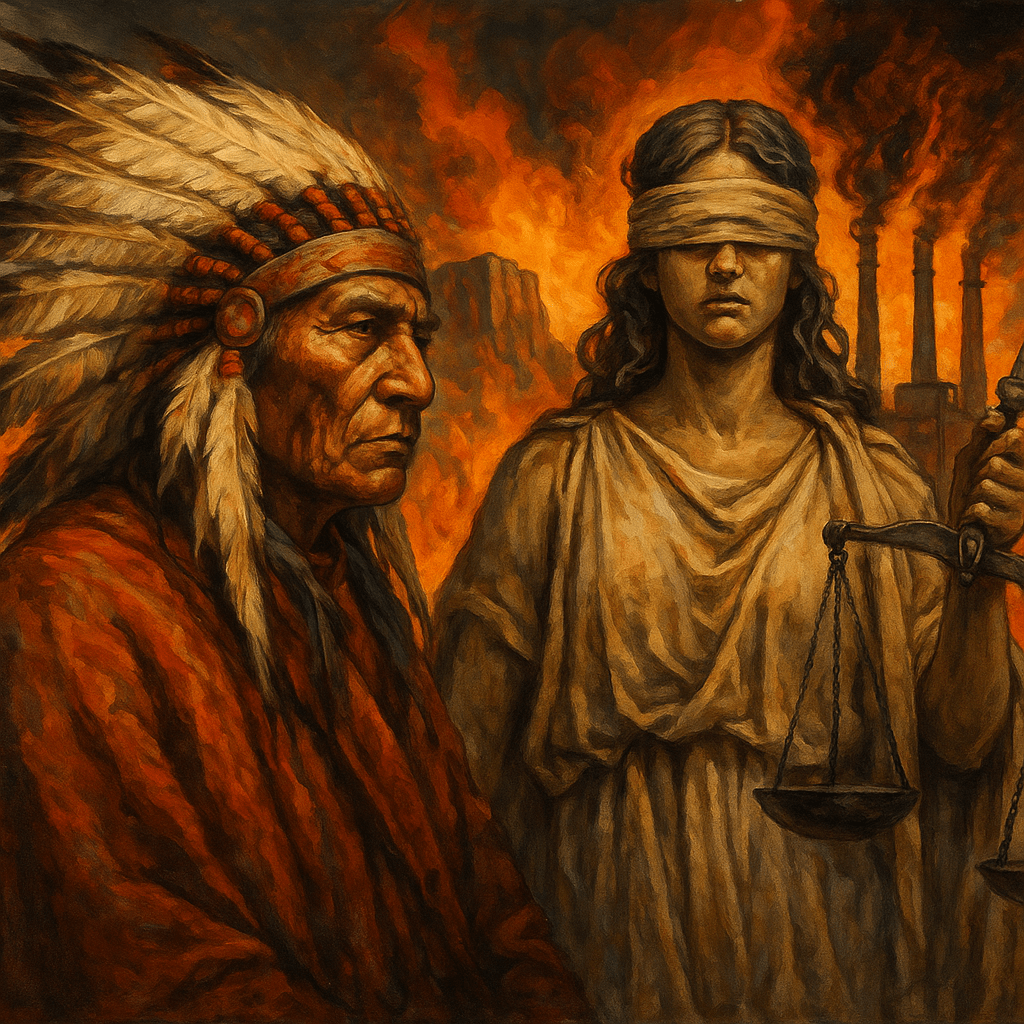
The highest court of the settler-colonial regime reaffirms its true loyalty—not to law, rights, or religion, but to the eternal supremacy of property over people, profits over prayers, and extraction over existence.
By Prince Kapone | Weaponized Information
May 27, 2025
The Court of Capital and the Journalist of Empire
On May 27, 2025, NBC News published an article titled “Supreme Court spurns Native American religious claim over copper mine on sacred land”, authored by senior Supreme Court correspondent Lawrence Hurley. Framed as a balanced legal dispatch, the article reports the U.S. Supreme Court’s refusal to hear an appeal from Apache Stronghold, a grassroots Indigenous organization fighting to protect Oak Flat—a sacred Apache site in Arizona—from obliteration by one of the largest copper mines in the country. But behind the liberal tone and passive syntax lies a far more sinister reality: settler jurisprudence functioning exactly as designed, to legalize theft, sanctify desecration, and disappear Indigenous sovereignty beneath the polished veneer of due process.
Lawrence Hurley has spent the better part of two decades perched in the marbled rafters of U.S. imperial jurisprudence, chronicling the slow-motion collapse of legal credibility as if it were just another procedural update. As NBC’s senior Supreme Court reporter, Hurley serves less as a chronicler of truth and more as a cartographer of empire’s legal theater—mapping the contours of injustice while calling it balance. His beat is not the people but the court: an institution whose function is to translate the blunt violence of capital into the antiseptic language of law. Hurley never questions the legitimacy of the terrain he covers; his career depends on upholding it. That makes him an ideal scribe for a ruling that affirms—in silence—that there is no contradiction between genocide and legality in the American project.
NBC News, his employer, is a polished pillar of the imperialist media apparatus. Owned by Comcast, a telecommunications giant embedded in the sinews of national surveillance and digital control, NBC’s function is ideological management. Its “objectivity” is a brand of narrative sterilization: packaging settler-colonial domination in the garb of respectable reportage. What it won’t say outright, it implies through omission—an editorial technique perfected by the ruling class across all its propaganda platforms. This outlet does not question empire; it choreographs its choreography.
In this saga of desecration and denial, names float by like bureaucratic flotsam: Resolution Copper, Rio Tinto, BHP—transnational profiteers in hard hats and ties; Congress, the legislative realtors of stolen land; and the Supreme Court, the black-robed altar where settler law performs its rituals. These are not neutral actors—they are nodes in a logistical system of settler-capitalist extraction. Each entity plays its role: Congress authorizes the theft, the courts codify it, and the corporations plunder with impunity.
How to Erase a People Without Saying So
The article disguises a land grab as a legal grey zone and reframes spiritual annihilation as a zoning dispute. It bends over backwards to avoid acknowledging the raw fact: Oak Flat is not government property—it is occupied land, violently seized and now being sold to the highest bidder under the pretext of public interest. The so-called “consultations” with Indigenous people are presented as meaningful dialogue, when in reality they are prepackaged consent rituals designed to manufacture legitimacy. Lawrence Hurley repeats Resolution Copper’s lines without challenge, his reporting indistinguishable from a corporate press release.
By framing the Apache Stronghold case as a religious freedom claim, the article de-politicizes what is in fact a struggle for national sovereignty. The Apache aren’t merely fighting for ceremonial space—they are defending the last remnants of their cosmology from being collapsed into a two-mile-wide crater. Yet we’re told this is about “balancing” religious rights against “business interests,” as though genocide can be adjudicated by spreadsheet.
Even Justice Gorsuch’s dissent, seemingly sympathetic, functions as damage control. He performs a theatrical moral contrast—“what if it were a cathedral?”—as if the problem is recognition, not occupation. But Gorsuch’s dissent ultimately leaves intact the legitimacy of the settler-colonial court. His empathy is a trick mirror: it reflects outrage without disrupting the image of justice. His role is to save the court from looking too much like what it is.
This isn’t a story about legal complexity. It’s a story about how the U.S. legal system is structurally incapable of honoring treaties, protecting Indigenous land, or recognizing non-European cosmologies. What we are witnessing is settler-colonial pacification by lawfare: the deployment of legal mechanisms to normalize land theft, spiritual desecration, and environmental catastrophe in the name of “progress.” And the role of media like NBC is to narrate this violence as though it were just another day in the republic.
What the Headlines Conceal, the History Reveals
The corporate media gave us a skeleton. Our job is to restore the flesh, the blood, and the buried bones of history. What the article confirms is this: the U.S. Supreme Court has refused to hear the Apache Stronghold’s appeal to stop the destruction of Oak Flat—a sacred site for Western Apache tribes that lies in what the government calls the Tonto National Forest. Congress handed the land to a joint venture—Resolution Copper, co-owned by the Anglo-Australian mining giants Rio Tinto and BHP—under a 2014 legislative maneuver that was tacked onto a must-pass defense bill. In short: imperial looting disguised as bipartisan governance.
The site, used for centuries for Apache religious ceremonies, is home to spiritual beings called the Ga’an, and functions as the only place where specific rites of passage—like the Sunrise Ceremony marking womanhood—can be held. The environmental impact report admits that the mine will create a crater nearly two miles wide, permanently annihilating these ceremonial grounds. And yet, both a district court and the 9th Circuit ruled that this does not “substantially burden” the tribe’s religious rights. Now the Supreme Court has declined to intervene, essentially endorsing this jurisprudential necrosis.
But what the NBC article fails to provide is the context of settler-colonial jurisprudence. As Ward Churchill reminds us in Perversions of Justice, Anglo-American law has always functioned as an instrument of Indigenous dispossession—not in violation of its norms, but in full conformity with its founding logics. “Juridical mechanisms were tailored to lend legal sanction to conquest and expropriation,” Churchill writes, tracing the lineage of U.S. law back to the Doctrine of Discovery: a medieval papal bull that declared non-Christian lands terra nullius—empty lands—open to seizure by Christian powers.
This doctrine was enshrined in U.S. law in Johnson v. M’Intosh (1823), where Chief Justice John Marshall ruled that Indigenous nations had no legal right to their own lands because they were “heathens.” This legal fiction laid the foundation for what Churchill calls a “systematized structure of white supremacy embedded in law,” where genocide, forced removals, and treaty violations are rendered lawful under the cloak of jurisprudence.
Indeed, Oak Flat itself was guaranteed to the Apache Nation under an 1852 treaty—a treaty that, like over 370 others signed and then violated by the United States, was treated not as a binding agreement, but a temporary tool for pacification. As Ward Churchill documents in Perversions of Justice, treaties were never meant to endure; they were legal facades used to “legitimize seizure while buying time for further encroachment.” In his words, the U.S. government “abrogated or unilaterally altered more than 370 treaties with Native nations—often within years of ratification.” These weren’t agreements—they were tactical pauses in a continuous war of conquest.
The Supreme Court has long played its role in this slow-motion war. In Lone Wolf v. Hitchcock (1903), the Court ruled that Congress could unilaterally abrogate treaties with Native nations—meaning treaties could be broken at will. In Pleasant v. United States (1927), the Court reaffirmed that the U.S. legal system owed no fiduciary obligation to Native people beyond what Congress declared. And today, by refusing to hear the Oak Flat case, the Court continues this lineage—not by ruling against Apache sovereignty, but by disappearing it through procedural silence.
This isn’t just about Indigenous religious practice—it’s about the ongoing project of neocolonial extraction within the boundaries of empire itself. Resolution Copper isn’t mining in a “national forest”—they’re carving profits out of a battlefield of conquest. And the minerals they seek? Copper for “green” energy infrastructure—solar panels, electric cars, battery storage. It’s extraction rebranded as salvation. The empire’s ecological collapse has become its new justification for re-colonizing both the land and the future.
That this land transfer was carried out under the Obama administration and defended by both Trump and Biden reveals a deeper truth: this isn’t partisan corruption, it’s structural imperialism. This is hyper-imperialism in motion—the global alliance of financial, legal, and military power centered in the U.S. and Western Europe, plundering the Global South and internal colonies alike to offset the crises of capitalist profitability.
And the legal rulings? They are the ideological artillery of this war. Under U.S. law, Indigenous sovereignty is always provisional, conditional, and ultimately expendable. The court’s refusal to hear the case signals this clearly: in the legal architecture of empire, there is no sacred, only strategic. And if that strategy demands annihilation in the name of development, the robes will bless it.
This Is Not a Legal Dispute—It’s a Battlefield
What the Apache Stronghold brought to court was not just a plea for religious protection—it was a declaration of national survival. And what the courts handed back was a reaffirmation that in the eyes of the U.S. settler regime, Indigenous nations are not nations, treaties are not treaties, and the sacred is not sacred. The refusal to hear the case is not a procedural shrug—it is a continuation of war by judicial means.
The United States has never been neutral terrain. It is a colonial battlefield dressed up in constitutional drag. Every branch of government—from the executive that signs away stolen land, to the Congress that launders theft through legislation, to the courts that ratify annihilation—is a weapon in a settler arsenal designed to consolidate white capitalist domination over Indigenous life, land, and cosmology.
Oak Flat is not unique. It is emblematic. From Standing Rock to Mauna Kea to Bears Ears, the story is the same: Indigenous nations fight to protect land that sustains life, while corporations backed by courts and guns claim the right to destroy it for profit. This is not legal conflict. This is a struggle between two incompatible worldviews: one that sees land as sacred and communal, and another that sees it as dead capital to be mined, sold, and discarded.
The U.S. Supreme Court is not malfunctioning—it is functioning precisely as it was designed to. As Ward Churchill reminds us, “the American legal system has never been about justice for Indigenous people. It is a system designed to extinguish Indigenous existence while pretending to protect it.” This is best exemplified by the 1903 ruling in Lone Wolf v. Hitchcock, where the Court declared that Congress held “plenary power” to unilaterally nullify treaties with Native nations—without consent and beyond legal challenge. The ruling enshrined the doctrine that Indigenous sovereignty exists only at the pleasure of the U.S. government. Far from being an impartial arbiter, the Supreme Court has always functioned as a colonial enforcer.
What makes this moment particularly insidious is the ideological cover it wears. Resolution Copper frames its operations in the language of clean energy and climate resilience. The Trump regime justifies it under the rubric of “national interest” and “critical minerals.” And liberal media nod along, as if colonization becomes noble when solar panels are involved. It’s the old settler lie with a new ESG rating.
This is the face of technofascism: a form of capitalist governance where corporate power, digital infrastructure, and state authority fuse into a seamless system of control and extraction. In this system, Indigenous resistance is not just a political inconvenience—it is a threat to the entire logic of settler futurity. The attack on Oak Flat isn’t about copper. It’s about clearing the path for a future in which Indigenous cosmologies, sovereignty, and survival have no place.
But resistance persists. The Apache Stronghold, and others like them across Turtle Island, are not just fighting to preserve rituals. They are asserting a living claim to a future beyond the empire’s imagination. One not paved with lithium and copper, but rooted in reciprocal relationships with the earth, ancestral memory, and collective survival. This is not just a fight to stop a mine—it is a front in the broader war to reclaim history, territory, and destiny from a settler regime that has never stopped waging war.
Mobilize or Be Mined: Revolutionary Solidarity with the Apache Nation
This is no time for abstract sympathy or academic mourning. The Apache Stronghold is not a symbol, it is a living front in the anti-colonial struggle. And the question facing every revolutionary today is simple: Will you stand with them in material solidarity, or will you remain a bystander to empire’s machinery?
From the early days of Wounded Knee to the barricades of Standing Rock, Indigenous resistance has carried the weight of this continent’s most principled opposition to empire. These struggles have not been merely “environmental”—they have been class struggles, anti-imperialist uprisings, and declarations of sovereignty from within the belly of the beast. They are led not by nonprofits, not by technocrats, but by oppressed nations asserting their right to life against a settler death machine.
We remember the warriors who chained themselves to earthmovers at Oak Flat. We remember the Water Protectors pepper-sprayed, shot with rubber bullets, and locked in dog kennels at Standing Rock. We remember the stolen land, the burned treaties, the broken bones and broken promises—and we declare with clarity and conviction: our allegiance is to them, not the empire.
Now is the time to act. Revolutionaries must move from commentary to combat—on the terrain of material solidarity. Here are four concrete fronts of engagement:
- Disrupt the Supply Chain of Extraction: Track and expose the financial backers and engineering firms behind Resolution Copper. Conduct targeted digital campaigns, direct actions, or divestment efforts to increase the political and economic costs of land theft.
- Defend the Defenders: Provide legal, logistical, and financial support to Indigenous land defenders. Coordinate jail support, media amplification, and rapid response to repression. Build infrastructure that shields frontline warriors, not just spotlights them.
- Educate and Organize: Hold teach-ins and popular assemblies in workplaces, schools, and neighborhoods. Circulate materials that expose the settler legal system for what it is. Link Oak Flat to local struggles—urban gentrification, environmental racism, police violence—to build unity rooted in shared exploitation.
- Join the Fight on the Ground: When possible, go to Oak Flat. Stand with the Apache Stronghold in person. Document the struggle. Strengthen it. Be a disciplined presence—not a savior, but a comrade in the trench. If you can’t go, organize where you are. Let the flame spread.
And above all: declare ideological unity. Let it be known in every revolutionary space—from labor unions to student coalitions to antiwar networks—that solidarity with Indigenous struggle is not optional. It is foundational. The fight for the future runs through the lands of the colonized. There can be no socialism on stolen land.
We, at Weaponized Information, pledge our full allegiance to the Apache Stronghold and to all Indigenous nations resisting empire. We affirm that their struggle is our struggle. That the same boots that crush them crush us all. That the same corporations that mine their land mine our labor. That the same courts that dismiss their rights dismiss our humanity.
So rise with them. Organize with them. And when the time comes, block the bulldozers, break the silence, and burn the lies to the ground.
Oak Flat is still standing—for now. Let’s keep it that way. Not with hashtags, but with bodies. Not with rhetoric, but with resistance. Not tomorrow, but now.
 Weaponized Information
Leave a comment