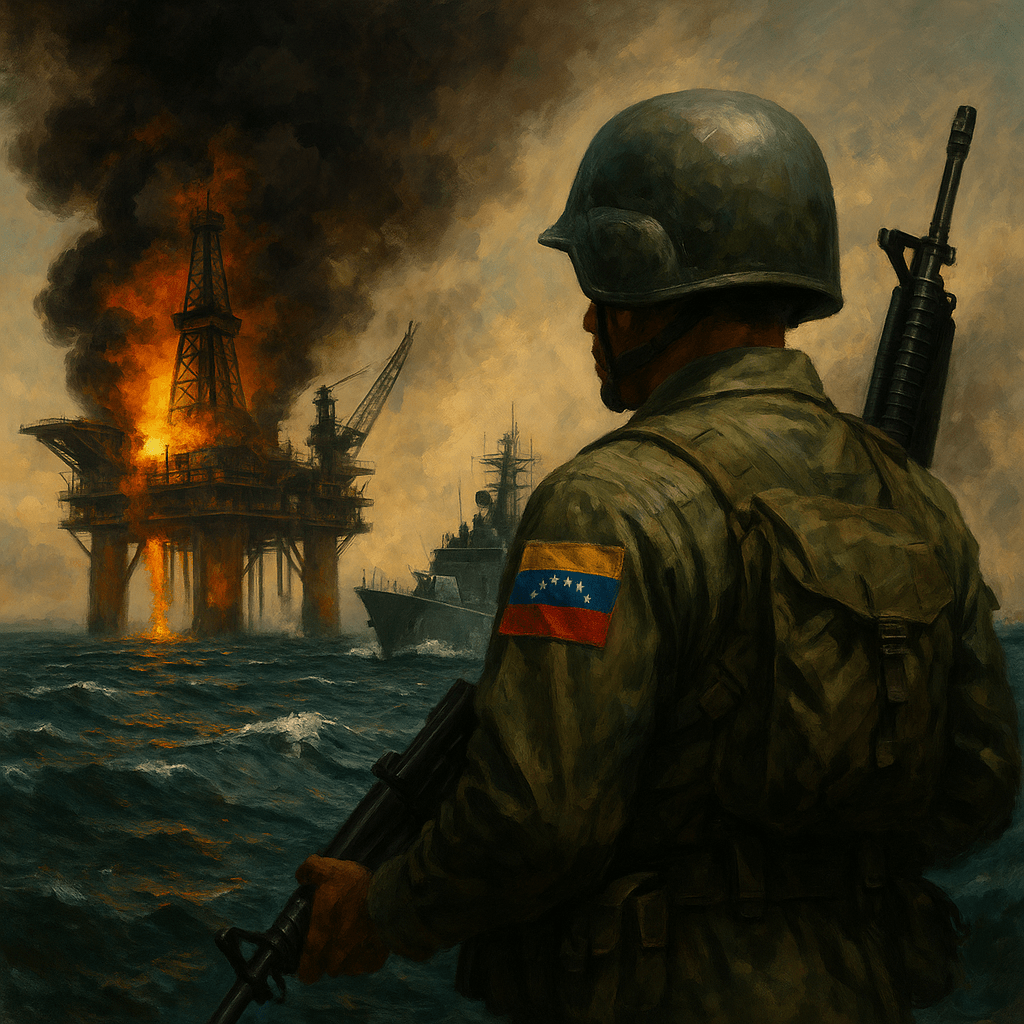
The U.S. isn’t defending Guyana—it’s defending ExxonMobil. And what they fear most isn’t escalation. It’s that Venezuela is still resisting.
By Prince Kapone | Weaponized Information
May 22, 2025
Part I – Crisis by Design: SouthCom, Exxon, and the Manufacture of a Pretext
The article originates from teleSUR, a fraternal outlet aligned with the anti-imperialist forces of the Global South. While the reporting reflects the urgency and clarity of Venezuela’s military and political leadership, our task in this Weaponized Propaganda Excavation is not to debunk the narrative—it’s to deepen it. To extract the structural logic beneath the headline. Because what Venezuelan Defense Minister Vladimir Padrino López laid bare isn’t just a warning—it’s a blueprint. The empire doesn’t improvise. It manufactures crisis like a factory rolls steel.
Padrino López publicly accused the CIA and U.S. Southern Command of orchestrating false flag provocations along the Guyana-Venezuela border, designed to portray Caracas as the aggressor. And we believe him. Not because we take any government’s word as gospel, but because this is the exact script outlined in Oil, Empire, and the Battle for Essequibo and confirmed by a century of imperial sabotage. The U.S. doesn’t need evidence to intervene—just a storyline. And the media, the NGOs, the Pentagon, and ExxonMobil all have their roles in casting, directing, and funding the show.
teleSUR reports the immediate tension: the deployment of 412,000 Venezuelan troops to ensure electoral security; accusations of aggression from Guyana; and Padrino’s call for calm and vigilance. But what’s missing is the imperial choreography behind the scenes. The border provocations are not some random flare-up. They are a counterinsurgency script—a fusion of lawfare, psy-ops, and military posturing crafted to destabilize Venezuela just days before a critical national vote. What’s at stake isn’t just the Essequibo—it’s the Bolivarian Revolution itself, and whether it will be permitted to survive the empire’s siege.
Let’s name the players without euphemism. Behind the accusations of “Venezuelan aggression” stands ExxonMobil—oil-thirsty and deeply embedded in Guyana’s foreign policy. Behind Exxon stands the U.S. Southern Command, with its Caribbean naval presence and its “security cooperation” doctrine aimed squarely at the subversion of Latin American sovereignty. And behind SouthCom, as always, lurks the CIA—still running regime-change operations, just with slicker branding. These aren’t fringe accusations. They’re how U.S. empire works: provoke, narrate, escalate. It’s the same playbook we exposed in Essequibo and the Empire’s Lie.
The Western press will never frame it this way. Their job is to turn Venezuela’s democratic process into a “provocation” and Exxon’s extraction into “development.” Their headlines are the velvet glove over the imperial fist. But when Padrino tells us to beware of distortion, he’s not being paranoid—he’s showing us the frontlines. And the media isn’t just reporting on the crisis. It’s scripting it.
Part II – The Real Map of the Crisis: Oil, Empire, and the Chokepoint Strategy
Here’s what the article lays out: Padrino López warns of “false flag” provocations by the CIA and U.S. Southern Command near the Guyana-Venezuela border. The Venezuelan state is on high alert during national elections, deploying 412,000 troops to protect polling stations and maintain stability. Meanwhile, Guyana—backed by Western media and military alliances—accuses Venezuela of aggression. But this is not a spontaneous regional dispute. It is a deliberate escalation tied directly to the imperial resource play unfolding in the Essequibo.
Let’s extract the deeper structure. As we documented in Siege and Survival, Venezuela is not just a state under pressure—it is a revolution under siege. What’s playing out at the Essequibo border is not a localized conflict. It’s a textbook case of hybrid war, where U.S. imperialism uses diplomatic slander, covert destabilization, and media distortion as substitutes for direct invasion. SouthCom’s provocations are timed to disrupt electoral processes, create media chaos, and generate pretexts for economic or military escalation—all in defense of ExxonMobil’s stake in the region.
The Essequibo isn’t just a disputed territory. It’s a hydrocarbon-rich zone embedded in the empire’s broader chokepoint strategy—the doctrine of controlling critical resource corridors and infrastructure nodes to discipline resistant states and contain multipolar realignments. As we’ve shown elsewhere, U.S. empire no longer rules through consensus—it rules through access: access to ports, pipelines, databases, and energy reserves. Venezuela’s refusal to surrender its claim, its resources, or its Bolivarian process makes it a threat to this model.
The provocation campaign also mirrors the broader U.S. response to the rise of multipolarity. Venezuela has forged ties with China, Russia, Iran, and BRICS+ states—not as a puppet, but as a sovereign actor seeking strategic autonomy. This makes it doubly intolerable to Washington’s technofascist class, which views any deviation from U.S.-controlled infrastructure—financial, digital, or military—as a threat to empire itself. That’s why the referendum is being targeted. It’s not just a territorial claim—it’s a declaration of defiance in a hemisphere still patrolled by U.S. warships and investment treaties.
What’s unfolding in the Essequibo, then, is not just about geography. It’s about the political economy of the hemisphere. Venezuela is being painted as the aggressor for asserting what the U.S. itself claims when it suits them: that sovereignty cannot be arbitrated by foreign powers or courts beholden to the empire. And when the Global South begins to act on that principle, the empire reacts not with dialogue—but with destabilization.
Part III – The Empire’s Smoke and Mirrors: Venezuela Isn’t the Threat—It’s the Example
Let’s clear the fog: Venezuela is not provoking a conflict. It’s being encircled by one. And it’s not the Essequibo that threatens U.S. empire—it’s the Bolivarian refusal to kneel. What the headlines call “border tensions” are, in reality, a desperate move by a collapsing empire to reassert control over a zone it thought it had already conquered—economically, militarily, and ideologically.
The referendum on Guayana Esequiba is not an annexation. It is an affirmation. A sovereign people exercising democratic agency in the face of diplomatic slander, military threat, and economic siege. And that’s precisely why the empire can’t tolerate it. Because what Venezuela is doing—however flawed, however embattled—is modeling a vision of sovereignty that doesn’t pass through the halls of the IMF or the boardrooms of ExxonMobil. It passes through the streets, the communes, the polling stations, and the mass organizations of a people who have survived everything from CIA coups to currency sabotage.
And this is the real danger to the imperial order: that Venezuela refuses to die. That despite sanctions, blockade, and smear campaigns, it continues to chart its own path—aligned with multipolar forces, defending state resources, and asserting the right to define its own borders, economy, and future. That it is building something even in siege. That it is still, somehow, teaching the world that empire is not invincible.
The U.S. media paints Caracas as erratic, authoritarian, reckless. But they don’t show you Exxon’s floating fortresses or SouthCom’s quiet deployment exercises. They don’t show you the Guyanese state operating as a junior partner in Western resource theft. They won’t admit that “international law” is only invoked when empire can control the courtroom. What they fear isn’t escalation—it’s inspiration. If Venezuela can defend its land, its people, and its project under these conditions, what might others do?
So we say it plainly: Venezuela is not the aggressor. Venezuela is the precedent. It is the case study in resistance that empire must erase. And what’s happening in Essequibo is not a border dispute—it’s a global confrontation over the right of the Global South to say: this land is ours, this future is ours, and your courts, your tanks, and your oil companies have no jurisdiction here.
Part IV – The Line Is Drawn in Essequibo: Solidarity Is the Frontline
The empire wants us to see a border skirmish. We see the front line of a civilizational battle. Essequibo is not just a disputed zone—it is a test site for whether the Global South can defend its sovereignty in the age of hyper-imperialism. And Venezuela is not standing alone. It is holding the line for every nation, every movement, and every people who dare to say: no more.
We must act accordingly. Solidarity with Venezuela is not about charity—it’s about defense. Defense of the right to vote against imperial rule. Defense of the right to decide how oil is used, who controls land, and who governs the future. And we declare, with no apology and no hesitation: we stand with the Bolivarian Revolution and its refusal to surrender to ExxonMobil, SouthCom, or the CIA.
Now is the time to turn analysis into action. We call on revolutionaries, workers, students, and anti-imperialist organizers across the globe to:
- Expose the U.S. role in Essequibo: Organize teach-ins, publish counter-narratives, and distribute WPEs that connect the dots between Exxon’s extraction, U.S. military deployments, and the propaganda war against Venezuela.
- Pressure your governments: Demand that elected officials reject U.S. and EU support for Guyana’s militarization and call for diplomatic resolution based on the 1966 Geneva Agreement, not Exxon’s map.
- Target the real aggressors: Protest at Exxon offices, U.S. embassies, and military recruitment centers that serve as logistical arms of the empire. Let them know that Essequibo is not a free fire zone for corporate greed.
- Build Pan-American and Tricontinental alliances: Connect Venezuela’s defense of Essequibo to struggles across the Global South—from Palestine to the Sahel, from Haiti to the Congo. The tactics may vary, but the enemy is the same.
- Defend revolutionary democracy: Uplift Venezuela’s mass referendum as a legitimate act of popular sovereignty, and challenge every media outlet that tries to frame it as an authoritarian stunt.
As we said in Oil, Empire, and the Battle for Essequibo: this isn’t just about who drills where. It’s about who decides the terms of the future. And that future won’t be handed down by courts, congresses, or corporations. It will be built by those who organize to seize it.
The battle for Essequibo is the battle for sovereignty in the 21st century. Not just for Venezuela. For all of us. And history will not remember who stood by—it will remember who stood up.
 Weaponized Information
Leave a comment