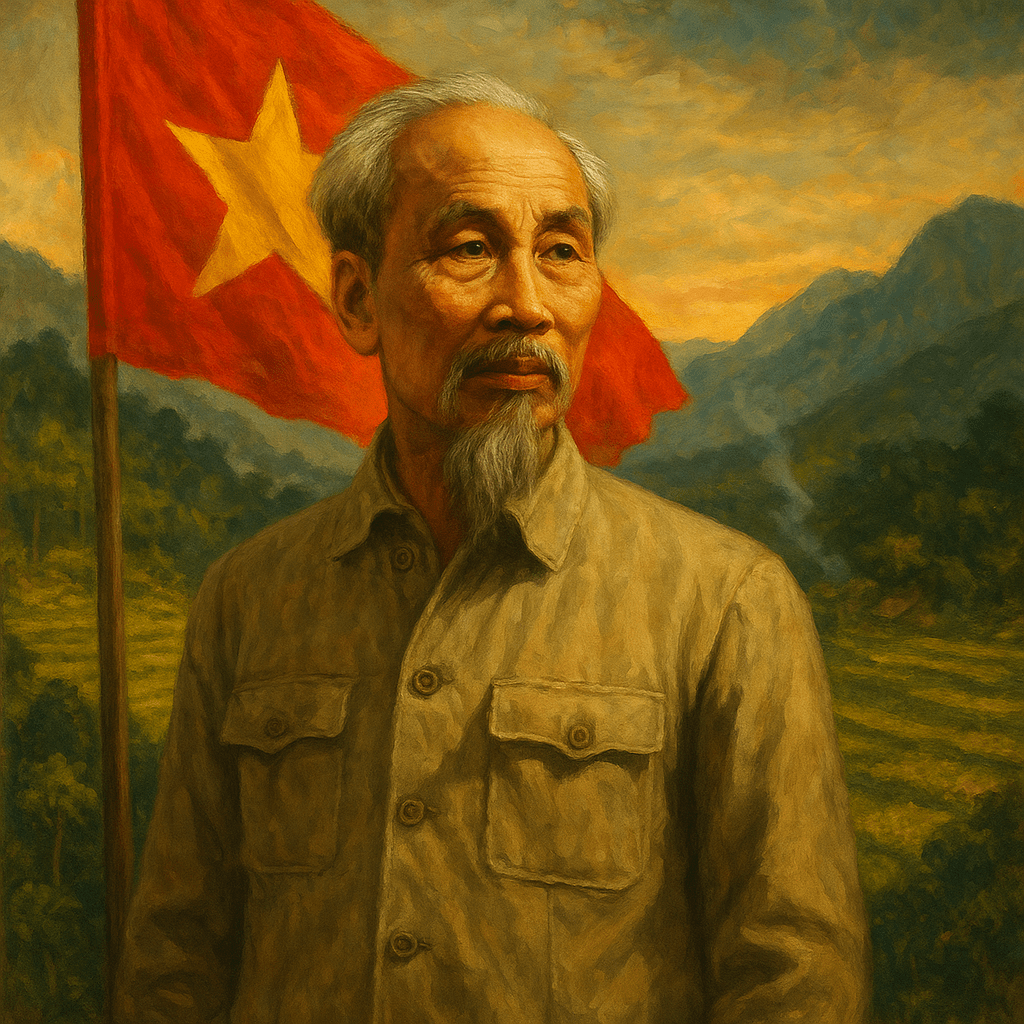
From colonial kitchens to global revolution, Ho outwitted empires with discipline, mass struggle, and political clarity. His victory was not just Vietnam’s—it was a blow struck for the oppressed everywhere.
By Prince Kapone | Weaponized Information
May 19, 2025
A Peasant on the World Stage: Ho Chi Minh and the Making of an Internationalist
Before he ever commanded a liberation army or embarrassed the Pentagon on the battlefield, Ho Chi Minh was just a cook on a colonial steamship, watching the empire feed itself on stolen labor and stolen land. Born in 1890 in the small village of Kim Liên, in what was then French Indochina, Ho—born Nguyễn Sinh Cung—was no heir to privilege. His father, a Confucian scholar turned anti-colonial dissident, raised him with both discipline and defiance. The French had made Vietnam into a colony of rice plantations, rubber fields, and cheap labor. But Ho was already learning to see past the plantation walls.
In 1911, he left Vietnam aboard a French ship, first as a kitchen assistant, then as a sailor, porter, and cleaner. For over a decade, he moved through the imperial core from the bottom rung—Africa, the Caribbean, Europe, the United States. He saw the empire from the boiler room. And what he saw was not civilization. It was cruelty in a thousand languages. Plantation brutality in Senegal. Segregated hell in Harlem. Empty stomachs in France. It didn’t matter the accent—the structure was the same.
Ho didn’t just observe. He studied. He wrote. He asked questions. And in 1912, while working in New York, he encountered a voice that shook the colonial logic to its core: Marcus Garvey. Ho heard him speak. He studied his program. He watched Black workers organize not to integrate into empire—but to reject it, to build their own power, their own nationhood, their own world. It lit something in him. Garveyism was not a blueprint he would copy, but it left an imprint. From that point on, Ho’s affinity for Black liberation in the U.S. became permanent and principled.
He saw in Black America a colonized nation—conquered, ghettoized, policed, and propagandized. Just like the Vietnamese. He didn’t romanticize their struggle, but he recognized it as one front in a global war against white supremacy and capital. He would later speak of African Americans as fellow fighters, writing in support of their revolts, denouncing U.S. racism in the pages of revolutionary papers, and affirming their right to rebel by any means necessary. Long before most white Marxists in the West even acknowledged the Black question as legitimate, Ho Chi Minh was issuing solidarity from Hanoi to Harlem.
He wasn’t just collecting stamps on a passport. He was building a worldview. A revolutionary internationalism from below. One forged not in seminar rooms, but in kitchens, ship hulls, and tenement streets. It’s easy to write about “the global proletariat” from a desk. Ho lived it—in the flesh, with dirt under his nails and calluses on his hands. That’s what made his politics unshakable.
By the time he arrived in Paris in 1919, Ho was no longer a drifting worker. He was a strategist-in-formation. He submitted a petition to the Versailles Peace Conference demanding rights for the Vietnamese people. The French ignored him. Of course they did. So he turned to socialism. But not the European variety that made excuses for colonialism. He turned toward revolution.
This is the soil that birthed the man. Not slogans. Not statues. But lived contradiction. He saw empire from the ground floor. And he made a choice—not to escape it, but to destroy it. That choice would define every breath he took from then on.
Paris, Lenin, and the Colonial Question: From the Red Café to the Red Flag
Paris in 1919 was bloated with hypocrisy. The victors of World War I gathered at Versailles to draw new borders, divide up the spoils, and baptize their theft in the name of peace. Woodrow Wilson spoke of “self-determination” while backing French colonial claims in Indochina. British and French imperialists carved up the Middle East like gamblers splitting a pot. And somewhere in the crowd stood a young Vietnamese revolutionary in the making, trying to deliver a petition on behalf of his colonized people. They ignored him.
That man was Nguyễn Ái Quốc—the alias Ho used at the time. And the snub didn’t discourage him. It radicalized him. He moved into the working-class cafés of Paris, wrote for the socialist newspaper Le Paria (“The Outcast”), and began organizing with African, Arab, and Asian workers—most of whom had fought in the imperialist war and were now dumped back into colonial chains. Ho wasn’t looking to reform France. He was there to study how to bring it down.
He read Marx. He read Engels. But it was Lenin’s 1920 “Theses on the National and Colonial Question” that split the sky open. Here, for the first time, was a European revolutionary who didn’t just see colonial peoples as victims or footnotes, but as active agents of world revolution. Lenin called on communists to support the struggles of colonized nations unconditionally—not paternalistically, not temporarily, but as comrades in arms. Ho later wrote that after reading Lenin, he “wept for joy.”
This wasn’t sentimental. It was political clarity. The Western socialist movements of the time were still infected with chauvinism—supporting workers’ rights at home while ignoring, or even justifying, colonial domination abroad. Ho saw that the only real revolutionary line was one that connected class struggle with national liberation. Anything less was reformism dressed up in red.
In 1920, Ho Chi Minh became a founding member of the French Communist Party. But he didn’t stay in Europe long. The real fight was elsewhere. By the mid-1920s, he was studying revolutionary theory in Moscow, then organizing in southern China, building cells of Vietnamese radicals, training cadre, translating Marxist literature into Vietnamese, and preparing for the long war to come.
He didn’t build theory for debate club points. He built it to win. Ho saw clearly that Vietnam would never be liberated through petitions, polite appeals, or borrowed slogans. It would require an anti-colonial movement armed with Marxism, grounded in peasant reality, and guided by revolutionary patience. He wasn’t in a rush for applause. He was building a line that could end an empire.
Where many leftists in the metropole were trapped in abstraction, Ho was building infrastructure. Cadre. Strategy. Unity between workers and peasants. A deep base, not a fleeting headline. He understood that you cannot defeat colonialism with metaphors. You beat it with mass struggle, guided by theory, sustained by discipline, and carried out by those with nothing to lose but their chains.
It was this fusion—of Marxist clarity and colonial experience—that made Ho Chi Minh into the revolutionary the French feared. And the world would soon come to know that name not as an alias, but as a thunderclap.
Guerrilla Tactician, Diplomatic Chessmaster: The Long War Against the French
By the 1930s, Ho Chi Minh was no longer a student of revolution—he was its architect. After years spent building cells, training cadre, and spreading Marxist theory across Asia, he returned to Vietnam in the shadows. The French colonial authorities had a price on his head. The imperial files knew his name. But Ho was not just a man anymore—he was a node in a growing revolutionary network. In 1930, he helped found the Indochinese Communist Party, fusing Marxist theory with the urgent, burning needs of the Vietnamese people.
By the time World War II erupted, the contradictions of empire were ripe. Japan invaded Vietnam, displacing the French while maintaining their colonial structure. Ho saw the opening. In 1941, he formed the Việt Minh (League for the Independence of Vietnam), a united front organization that merged communists, nationalists, and anti-colonial forces under one banner. He built guerrilla bases in the mountains. Organized political education in the villages. Distributed land to the poor. This was not just a war of bullets—it was a war of legitimacy. And Ho was winning it.
He was no dogmatist. He knew when to pivot. When the Japanese took control, Ho accepted limited aid from the U.S. Office of Strategic Services (OSS)—the precursor to the CIA—who were more than happy to support resistance fighters against Tokyo. But Ho knew better than to trust the imperialists. The day Japan surrendered in 1945, Ho declared Vietnamese independence in Hanoi, standing before a crowd of hundreds of thousands and reading a declaration that echoed the U.S. Constitution: “All men are created equal…”
It was not flattery. It was indictment. He threw the words of Jefferson back in the face of the United States and France. Vietnam, he declared, would be free. But the West had other plans.
The French wanted their colony back. The U.S.—champions of “freedom” in Europe—backed the French recolonization with weapons and funds. The British occupied southern Vietnam to hold it for the French. And the Vietnamese were left with no illusions: they would have to fight the empire again.
So began the First Indochina War (1946–1954). It was a war of trenches, sabotage, and peasant endurance. The Việt Minh, led by Ho and General Võ Nguyên Giáp, developed a guerrilla strategy that bled the French dry. They didn’t just fight on the battlefield—they fought with rice, with loyalty, with memory. They redistributed land, established revolutionary justice systems, and built a parallel state within the shell of colonial Vietnam.
The French believed their firepower and European “superiority” would prevail. But empire is always most arrogant right before it falls. In 1954, at the fortress of Điện Biên Phủ, the French suffered a catastrophic defeat. Giáp’s forces encircled and crushed a force armed with tanks and air support using tunnels, bicycles, and resolve. It was not just a military victory—it was the collapse of colonial legitimacy. Ho had done what few thought possible: he had led a colonized peasant nation to defeat a European empire.
The Geneva Accords followed, temporarily dividing Vietnam at the 17th parallel, with Ho’s revolutionary government in the North and a U.S.-backed puppet regime under Ngô Đình Diệm in the South. But Ho knew the struggle was not over. He didn’t chase medals. He chased liberation. And he knew that the next war—against American imperialism—was coming.
Defeating the United States – A Colony Beats the Core
After Điện Biên Phủ, the French limped off the stage of history—but the United States was ready to take the baton. To Washington, Vietnam was no longer just a colony. It was a battleground in the Cold War’s ideological theater—a place to stop communism, contain China, and prove that white capital could still rule the Third World. But to Ho Chi Minh, Vietnam was still Vietnam. Still colonized. Still under siege. Still determined to be free.
The 1954 Geneva Accords had divided the country, temporarily, at the 17th parallel. Nationwide elections were scheduled for 1956 to reunify Vietnam. Ho was expected to win by a landslide. That’s exactly why they were never held. The U.S. propped up Ngô Đình Diệm in the South—a Catholic autocrat backed by dollars, rifles, and CIA operatives. The Diệm regime crushed dissent, slaughtered communists, and banned any talk of unification. The U.S. called it democracy. The Vietnamese called it occupation.
Ho didn’t respond with speeches. He responded with organization. The National Liberation Front (NLF), better known as the Viet Cong, was formed in 1960 as the southern wing of the revolutionary struggle. It was not a proxy. It was a partner. Guided by the same politics, rooted in the same people, it carried out the long war strategy of encircling the cities from the countryside—a mass line in motion.
The U.S. escalated rapidly. Advisors turned into troops. Napalm rained down. Villages were bombed into craters. Agent Orange poisoned the land. The U.S. dropped more bombs on Vietnam than it had in all of World War II. But Ho and his comrades understood something Washington never could: the people are mightier than the machines. The Vietnamese didn’t fight because they were told to. They fought because they had memory—of the French, the Japanese, the landlords—and now the Americans.
Ho was not alive to see the final victory. He died in 1969, as U.S. troops still occupied his homeland. But he had already won the war of legitimacy. The Tet Offensive in 1968 shattered American illusions of victory. The U.S. public turned against the war. The Pentagon had the guns, but Ho had the people—and history. In 1975, six years after his death, the Vietnamese entered Saigon. The flag of the National Liberation Front was raised. The American war machine had been defeated by rice farmers, factory workers, students, and revolutionaries.
This was not just a military triumph. It was a world-historic rupture. For the first time, a small, underdeveloped country had not only resisted the world’s strongest empire—it had defeated it. Ho Chi Minh, the once invisible kitchen hand, had become the strategist of a victory that inspired every anti-imperialist, every national liberation fighter, every colonized people on the planet.
The Vietnamese didn’t beg for freedom. They took it. And they did so using the very tools Ho had spent his life assembling: theory, mass organization, discipline, and a revolutionary understanding of who their real enemies were—not just foreign invaders, but local collaborators and global capital.
Ho’s victory was not just Vietnam’s. It belonged to Angola. To Palestine. To South Africa. To Black radicals in Oakland and Harlem. It proved what the empire always fears most—that organized struggle from the bottom can win.
Global Reverberations – The Ho Chi Minh Line Across the South
The fall of Saigon in 1975 was not just an end—it was a signal flare. It showed the world that imperialism could bleed, could lose, could be beaten. And the shockwaves weren’t limited to Southeast Asia. Across Africa, Latin America, and the colonized ghettos of the United States, Ho Chi Minh’s name was invoked like a password. His strategy became a model. His victory became a possibility to be replicated.
Revolutionary movements from Angola to Mozambique studied the Vietnamese experience. Liberation fighters in Guinea-Bissau, South Yemen, and Nicaragua cited Vietnam as a concrete example of how to organize guerrilla warfare, build dual power, and survive against a technologically superior enemy. Vietnam proved that winning wasn’t about hardware—it was about line, mass support, and political clarity.
In Cuba, Che Guevara recognized the Vietnamese as the most advanced detachment of the global anti-imperialist struggle. In Algiers, Vietnam was invoked as a beacon during the FLN’s battle against French settler colonialism. And in the Black radical movements of the U.S., from the Panthers to the BLA, Ho Chi Minh’s writings, speeches, and political line were studied with reverence.
Nowhere was this solidarity clearer than in the relationship between the Vietnamese struggle and the Black Panther Party. The Panthers didn’t just support Vietnam from a distance—they recognized the war as connected to their own conditions. Huey Newton and Bobby Seale saw the U.S. military campaign in Vietnam as an extension of the same system that policed, imprisoned, and executed Black people in America. “The Vietnamese are our brothers,” Newton said. “We will support them by any means necessary.”
So when Huey Newton offered to send Panther fighters to Vietnam, it wasn’t a symbolic gesture. It was a sincere act of proletarian internationalism—an offer of blood and arms in solidarity with a colonized people under siege. But Ho Chi Minh, in a deeply comradely response, refused the offer. Not out of arrogance or mistrust, but out of revolutionary principle.
Ho told Newton, in essence: We are fighting our war. You must fight yours. Your battlefield is inside the empire. He understood that the national question could not be outsourced. That Black people in the U.S.—a colonized nation within the empire—had a historic responsibility not to enlist elsewhere, but to struggle from within, to rise from the inside and collapse the beast from its belly. His refusal was not a rejection of unity—it was a strategic affirmation of revolutionary responsibility.
This moment revealed the depth of Ho’s internationalism. He didn’t view solidarity as symbolic gestures or moral sympathy. He viewed it through the lens of material struggle, national self-determination, and revolutionary accountability. Real comradeship, to Ho, meant building your own front—not outsourcing the revolution, but multiplying it.
That’s why Vietnam’s victory reverberated so widely. It wasn’t just military. It was ideological. It tore open the myth of Western superiority. It proved that the peasantry could organize, that Third World people could lead, and that the colonized had the capacity to chart their own course—without white saviors, imperial permission, or capitalist compromise.
For colonized people around the world, Vietnam was not some far-off success story. It was a manual. A prophecy. A mirror. And Ho Chi Minh—modest, disciplined, soft-spoken—became the face of a planetary revolt against empire.
Ho Chi Minh vs. Neocolonialism – Lessons for the Present
Ho Chi Minh didn’t just fight the colonizers of his time—he predicted the next stage of their evolution. Long before terms like “neoliberalism” or “technofascism” entered the vocabulary of the left, Ho understood that the empire wouldn’t retreat—it would rebrand. If direct colonial rule was no longer tenable, the imperialists would settle for something more insidious: neocolonialism.
It wouldn’t wear a soldier’s uniform. It would wear a suit. It wouldn’t declare conquest. It would offer “aid.” The new colonizers would arrive with loans, NGOs, and free-market reforms. They would trade bayonets for balance sheets. Structural adjustment for sovereignty. The IMF would replace the gunboat, and the development bank would do what the army once did: enforce submission.
Ho saw it coming. He warned that revolutions which stopped at formal independence but left economic power in foreign hands were counterfeit revolutions. That winning the war didn’t guarantee liberation unless the material base of society was transformed. For Ho, that meant land reform, the collectivization of agriculture, education for the poor, public health campaigns, and an independent industrial economy planned in the interest of the people.
Vietnam’s post-revolutionary period was never easy. The country was shattered, the soil poisoned, the infrastructure obliterated. Yet even under blockade, embargo, and war fatigue, the Vietnamese government attempted to honor the core of Ho’s vision. They rejected the Bretton Woods trap. They emphasized mass education, medical care, and rebuilding a self-directed economy rooted in socialist principles.
Was it perfect? No revolution ever is. The Đổi Mới reforms of the 1980s introduced market mechanisms that complicated the socialist trajectory. But unlike the sellouts of other postcolonial regimes, Vietnam’s leadership never abandoned the core principles of sovereignty, national dignity, and people-centered development. And the foundation that Ho laid—the clarity, the cadre, the political culture of resistance—ensured that even adaptation didn’t mean capitulation.
Compare this to the fate of many African and Asian nations who won their flags but lost their economies. Independence without socialism led to comprador elites managing local poverty while imperial finance extracted wealth from behind the scenes. Education systems collapsed. Public health disintegrated. IMF loans created generations of debt servitude. And any attempt at genuine resistance was met with coup, sanction, or drone.
That is why Ho’s line must be studied today—not nostalgically, but strategically. He understood that the real revolution is not just about regime change. It’s about power. Who controls the land? The banks? The ports? The data? Who writes the curriculum? Who owns the media? Who benefits from the labor of the poor? These were the questions Ho trained his comrades to ask—and answer through mass political organization and structural transformation.
In this era of digital recolonization, climate apartheid, and permanent debt, Ho’s warnings have become prophecy. The Global South is still under siege—only now the shackles are called contracts, and the garrisons are cloud servers. But the enemy remains the same: imperialism in upgraded form. And the response must be the same as well: revolutionary anti-capitalism rooted in national liberation, led by the oppressed, and guided by history’s hard-earned lessons.
The Bamboo Lenin Lives
They called him “Uncle Ho,” but don’t mistake the softness of his title for the softness of his politics. Ho Chi Minh was a revolutionary with iron discipline and bamboo flexibility. He bent to the conditions but never broke from the line. He moved through contradictions—not with purity tests, but with strategy. And that is why he won.
He didn’t shout. He didn’t chase headlines. He built. Quietly. Systematically. Patiently. He trusted the people, respected the peasantry, and always prepared for the long game. While the imperialists bet on short-term shock and awe, Ho invested in political consciousness, education, and organization. He trained generations to think, fight, and remember.
Today, as the Global South is recaptured by digital debt, food dependency, and foreign-controlled infrastructure, Ho’s legacy is more urgent than ever. He showed us that national liberation is not a romantic idea—it is a material necessity. That sovereignty is not granted by colonial powers, but seized by the organized poor. And that socialism is not an imported doctrine, but a path carved from the specific soil of one’s own land and people.
To invoke Ho Chi Minh today is not to light incense. It is to light fires. To declare that revolution is not obsolete, but overdue. That the empire can be beaten—not by mimicry or moral appeals, but by mass strategy, rooted power, and revolutionary clarity.
He taught us that fighting imperialism from the jungle is different from fighting it from the ghetto—but the principle is the same. Wherever people are exploited, wherever their labor is stolen, their dignity trampled, and their land occupied—there, Ho’s spirit walks. In the rice fields. In the prisons. In the barrios. In the refugee camps. In the data mines.
The Bamboo Lenin lives not in statues, but in strategy. Not in textbooks, but in barricades. And every organizer who studies the enemy, organizes the poor, and dares to fight for a world beyond empire walks in his path.
On this May 19th, we remember Ho not as a relic, but as a revolutionary guide. Because when the people lead, when the poor organize, when the colonized rise—the Pentagon trembles. And somewhere, Ho smiles.
 Weaponized Information
Leave a comment