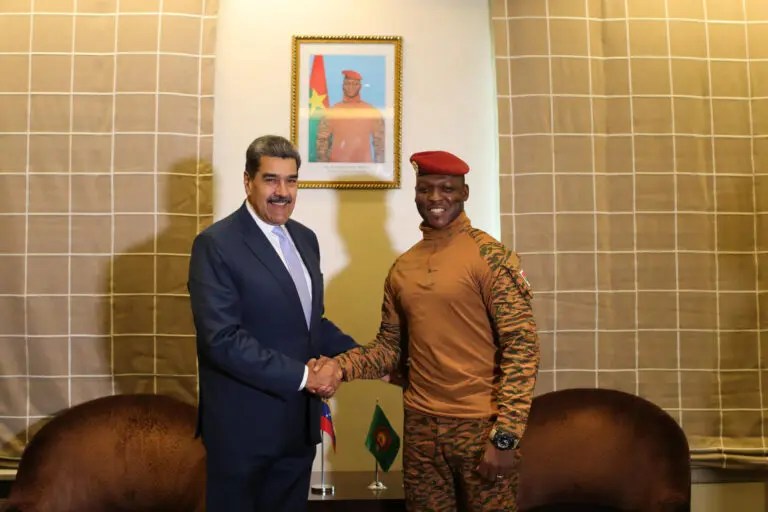
From the barrios of Caracas to the goldfields of Burkina Faso, two revolutions under siege have linked arms—not for diplomacy, but for defiance. This is the infrastructure of anti-imperialist sovereignty being built beneath empire’s crumbling scaffolding.
By Prince Kapone | Weaponized Information | May 8, 2025
Subversive Diplomacy in a Dying Empire
You won’t find this on the front page of Reuters. When two nations under siege link arms against empire, the imperialist media responds with something far more deafening than slander: silence. That’s exactly what happened when Venezuelan President Nicolás Maduro met with Burkinabé leader Ibrahim Traoré on May 8, 2025. No headlines screamed, no editorials wept for democracy. Just a quiet shudder in the halls of Washington, Paris, and Brussels. Because what took place wasn’t just a diplomatic gesture—it was the laying of bricks in a new foundation for global rebellion.
TeleSUR reported the story with clarity and pride: 27 existing bilateral agreements, 14 more under negotiation, spanning everything from energy and mining to education and agriculture. The meeting resurrected and advanced a process first forged by Hugo Chávez and rooted in Thomas Sankara’s revolutionary legacy. But for those of us committed to the study and defense of anti-imperialist sovereignty, this wasn’t just another South-South handshake. It was a material advance in what we call dual and contending power—the emergence of independent political, economic, and ideological institutions from below, in direct confrontation with the colonial-capitalist world system.
In the vacuum left by imperial decay, a new logic is being born—quietly, defiantly. Venezuela and Burkina Faso are not waiting for permission to dream. They are building the architecture of multipolar liberation in real time: joint commissions, technical exchanges, scientific collaboration, and sovereign trade planning. These aren’t just policies. They’re weapons. Weapons forged not from steel, but from solidarity, memory, and revolutionary necessity.
OEC trade data shows that direct economic exchange between the two nations remains modest—$19,700 in Venezuelan exports to Burkina Faso as of 2022, down from $1.76 million in 2017 (source). But this is not a story about volume—it’s about velocity. About direction. The trade that matters most here is political trade: revolutionary knowledge, anti-colonial strategy, and post-imperial coordination.
And it is precisely that which frightens the empire. Because it cannot be sanctioned. It cannot be bombed. It cannot be starved. It spreads by example.
Bloodlines of Resistance, Blueprints for Sovereignty
To understand the gravity of this alliance, we must trace its bloodlines—back through coup plots, sanctions, blockades, and assassinations. Venezuela and Burkina Faso are not just cooperating nations; they are revolutionary states forged in fire, sustained by struggle, and refined in the crucible of imperial war.
In Venezuela, the Bolivarian Revolution ruptured neoliberal hegemony at the dawn of the 21st century. Hugo Chávez didn’t just nationalize oil—he nationalized memory, awakening the ghosts of Bolívar, Zamora, and Martí to haunt the boardrooms of Chevron and Exxon. He built a state rooted in the barrios, in communal councils, in land redistribution and food sovereignty. And for that, the empire came. Coups. Sanctions. Psychological warfare. Currency sabotage. A thousand knives aimed at the throat of a people who dared to govern themselves.
Yet even today—besieged by over 900 U.S. sanctions, cut off from global financial markets, its gold held hostage in the Bank of England—Venezuela stands. Its communes continue to organize. Its people still plan their neighborhoods, choose infrastructure projects, and build survival economies. What survives in Venezuela is not merely a state—it is a revolutionary method. A dialectic of siege and creativity, failure and persistence, fracture and reassembly.
Burkina Faso, too, has walked this path. Thomas Sankara’s four years in power marked one of the most radical experiments in anti-imperialist socialism on African soil. He banned foreign aid dependency, nationalized land and resources, launched mass vaccination campaigns, dismantled patriarchal laws, and called for the end of African debt. He was assassinated in 1987 by a French-backed coup, but his specter never left. It lived on in the memories of peasants, in the rage of youth, in the music of griots, in the whispers of soldiers who still remembered a president who rode a bicycle and refused to sell his soul to the IMF.
Today, Captain Ibrahim Traoré’s government is channeling that memory into motion. Since 2022, he has expelled French troops, broken military ties with Washington, and joined a Pan-African front with Mali and Niger. He has launched a campaign to nationalize the gold industry, reclaim control over national resources, and build partnerships outside the neocolonial orbit. Western media scream “authoritarianism,” but the people call it sovereignty. And the empire’s real fear is not his guns—it’s his vision.
Both Venezuela and Burkina Faso understand the nature of hyper-imperialism: it is not merely military or economic—it is psychological, legal, digital, ideological. It isolates, demonizes, and punishes any state that steps outside its gravitational pull. But these two nations, rising from different continents, are now orbiting each other—gravitating toward a shared future forged in resistance and revolutionary realism.
What They Build, We Must Defend
This is not diplomacy—it is war by other means. Not a war of aggression, but a war of construction. A war of survival. A war of refusal. What Venezuela and Burkina Faso are doing is nothing short of revolutionary: they are building state-to-state relations outside the architecture of imperial law, bypassing the dollar, ignoring Washington’s blacklist, and forging sovereign cooperation without consulting the IMF or USAID. That is a revolutionary rupture.
Every agreement signed—on agriculture, on education, on security—is a blow against recolonization. Every student exchange, every military training partnership, every energy deal is an act of resistance. And every such act proves what empire has spent centuries denying: that the Global South does not need permission to be free. That the colonized can plan. That the oppressed can build. That sovereignty is not a favor—it is a right wrested from the hands of thieves.
And let us be clear: these governments do not pretend perfection. Venezuela’s communes remain uneven. Burkina Faso’s transition is fraught with contradictions. But these are revolutionary contradictions—not moral failings, but political tensions emerging from struggle. And it is precisely in these tensions that a new world is being born. What the empire calls instability, we recognize as transformation.
This is the soil in which multipolarity is planted—not in the boardrooms of BRICS alone, but in the grassroots connections between insurgent states refusing to die. This is not G7 summits and photo ops. This is revolutionary geopolitics: built from below, from the barricades, from the communes and command posts, from the rebels and engineers and farmers who refuse to bow.
To speak of South-South cooperation as if it were a mere development strategy is to misunderstand it entirely. This is not technocracy. This is dual and contending power—internationalized. A counter-sovereign architecture under construction. And it must be defended with everything we’ve got.
Revolutionary Tasks from Below and Beyond
Alliances like this don’t just need analysis—they need protection. And that protection cannot come from governments. It must come from the streets, the classrooms, the warehouses, and the servers. It must come from us—from workers, students, hackers, tenants, organizers, and revolutionaries who know what time it is. Because Venezuela and Burkina Faso are not only defending their sovereignty—they are defending the possibility of ours.
We have seen this solidarity before, and we must build on it. In 2019, when the Trump administration tried to install Juan Guaidó as a puppet president in Venezuela, activists from CODEPINK, the ANSWER Coalition, Black Alliance for Peace, and other anti-imperialist forces occupied the Venezuelan Embassy in Washington, D.C. for over a month—defending it against a coordinated siege by coup supporters, U.S. police, and federal agents. They held the line. They stood in between empire and its target. That was not a symbolic action. It was material defense.
Today, across Africa and the diaspora, popular movements and pan-African organizations are mobilizing to defend Burkina Faso and the broader Sahel insurgency against recolonization. In Mali, Niger, Liberia, and even parts of France, people have taken to the streets to wave Burkinabé and Russian flags, not out of dogma, but defiance—an open rebuke of French neocolonialism and AFRICOM occupation. These are acts of mass internationalism in the 21st century. They must be remembered, studied, and scaled.
We are not starting from zero. But we are nowhere near where we need to be. Here are tactical proposals that revolutionaries in the Global North—particularly in the U.S. and Europe—can take up now, today, to show material solidarity with Venezuela and Burkina Faso in their just struggle:
- Target the Real Enemies: Disrupt operations of French and U.S. corporations profiting from Burkinabé gold and Venezuelan oil. Research, expose, and blockade corporate offices, shipping routes, or mining investments in your area. Launch divestment campaigns where applicable.
- Weaponize Popular Education: Host film screenings, teach-ins, and reading circles on Sankara’s political theory, Chávez’s commune-building, and the imperial war against both nations. Use these as spaces to build local organizational infrastructure and deepen ideological clarity.
- Disrupt the Sanctions Infrastructure: Organize campaigns against banks and institutions enforcing or laundering U.S./EU sanctions on Venezuela. Demand that universities, trade associations, and NGOs sever financial ties with sanctioned entities complicit in imperial enforcement.
- Build Material Networks: Coordinate with solidarity brigades and internationalist delegations. Raise funds for Venezuelan and Burkinabé cooperatives, rural clinics, and commune networks. Donate logistics tools—software, hardware, or communications infrastructure—to counter the digital blockade.
- Organize Cyber Resistance: Leak, hack, and expose the digital infrastructure behind sanctions, AFRICOM operations, and oil/gold extraction contracts. Create or support anonymized platforms to communicate with revolutionary actors in the South.
- Block the Empire from Within: Plan occupations, disruptions, and counter-actions inside the imperial core. Occupy congressional offices demanding an end to sanctions. Blockade embassies. Make the cost of imperial policy felt inside its metropole.
We must treat this alliance as a node in our own revolutionary project. Because what Venezuela and Burkina Faso are doing—building sovereign infrastructure, asserting dignity, constructing a world without Washington and Paris—is the future we must defend if we intend to live free. We cannot be passive observers. We are called to be co-conspirators.
So let this be a new beginning—not just of analysis, but of action. Build a local chapter. Organize a study group. Launch a disruption campaign. Forge ties with the diaspora. Find your front, and fight on it.
Because in Caracas and Ouagadougou, the future is already under construction. It is up to us to make sure it survives—and spreads.
 Weaponized Information
Leave a comment