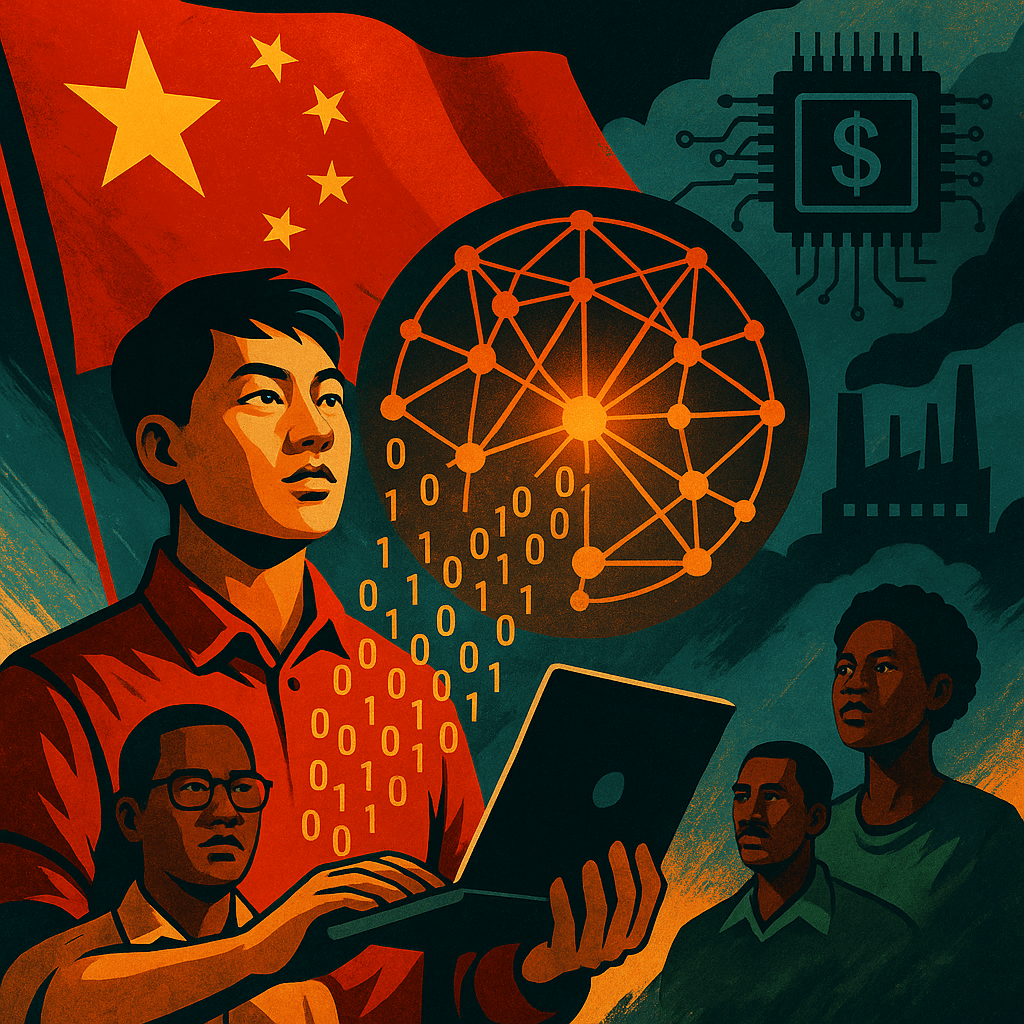
As China breaks the West’s monopoly on innovation, the empire responds not with competition—but with containment, sabotage, and cognitive warfare disguised as journalism.
By Prince Kapone | Weaponized Information | May 7, 2025
Part I: The Data-Driven Disguise — When Infographics Speak for Empire
Visual Capitalist is not a data journalism platform—it is an ideological device of the investor class, engineered to convert capitalist anxiety into digestible visuals. Based in Canada and tailored for financiers, tech elites, and policy wonks, its function is not simply to “inform,” but to shape perception in the interests of monopoly capital. Its slick infographics and clean aesthetics conceal the dirt and blood of empire beneath layers of technocratic polish.
Bruno Venditti, the author of this particular infographic-article, is a commodity analyst turned data propagandist. His work across Visual Capitalist and other finance-oriented platforms centers on abstracting class and colonial conflict into market trends, neutralizing contradictions with the dispassionate tone of corporate analytics. Here, he serves as a relay point for imperial anxiety: the West’s fear that it no longer controls the future of technology.
The piece is titled “How China Caught Up to the U.S. in Innovation,” but it does not celebrate innovation. It laments lost hegemony. By focusing narrowly on R&D expenditure—and charting China’s “rise” only in relation to U.S. dominance—it constructs a narrative of encroachment and threat, not development or justice. The infographic is framed as a success story, but the subtext is unmistakable: China’s ascent equals the West’s decline.
Nowhere does the piece mention that U.S. “innovation” has long been underwritten by military funding, war profiteering, and intellectual property theft from the Global South. DARPA, In-Q-Tel, and the entire military-academic-industrial complex are absent. Instead, we are presented with a market-friendly myth of competition—wherein the U.S. and China are co-equals racing toward progress, rather than one breaking chains while the other tightens them.
The rhetorical strategy here is one of erasure and euphemism. China’s investments in AI, biotech, and semiconductors are described as “strategic”—not sovereign. Its technological capacity is treated as anomaly rather than culmination. Nowhere does the article acknowledge China’s use of state-led development, South-South cooperation, or its resistance to Western tech colonialism. And crucially, the language avoids all reference to multipolarity—because to name it would be to admit that unipolar control is dying.
This is how cognitive warfare operates through design: a bar chart becomes a battlefield. Data becomes doctrine. By embedding imperialist ideology into neutral-seeming graphics, Visual Capitalist trains its audience to see Chinese development as a zero-sum threat, and U.S. dominance as the natural order of things. Innovation is not framed as liberation—it is rebranded as competition, with the unspoken rule that only the West is allowed to win.
Part II: Innovation Is Not Neutral — Mapping China’s Rise Through the Wreckage of Empire
China’s leap from 4% of global R&D investment in 2000 to 26% by 2023 is not a statistic—it is a seismic rupture in the global imperial order. Behind the bar charts and buzzwords lies a tectonic shift: the long colonized, underdeveloped periphery is beginning to seize the commanding heights of technological production. But Visual Capitalist refuses to name the deeper truth: innovation is not a neutral metric—it is a battlefield of class forces, geopolitical blocs, and competing visions of human development.
Let us clarify what R&D means under capitalism. In the U.S., innovation is not driven by public need but by military budgets and corporate monopolies. DARPA laid the groundwork for the internet. In-Q-Tel funds predictive surveillance startups. Google, Amazon, Microsoft—all are extensions of U.S. state power, weaponized for profit and planetary control. When the U.S. spends $784 billion on R&D, it is not “investing in the future”—it is fortifying technofascism: a regime where finance, Big Tech, and military command fuse into one.
China’s $723 billion, on the other hand, is not simply a dollar figure. It represents a different model—still contradictory, still embedded in the capitalist world system, but increasingly oriented toward sovereignty, multipolarity, and South-South integration. China’s R&D surge is structured through state-led planning, targeted development in AI, semiconductors, biotech, and clean energy, and increasingly through partnerships with BRICS+, SCO, and Belt and Road allies. This is not imitation—it is rupture. It is the reengineering of science as a tool of liberation, not imperial management.
That is precisely what Visual Capitalist cannot allow its audience to perceive. The article never asks how China did it. It never acknowledges the rejection of IMF austerity, the investment in rural electrification, or the state’s mobilization of capital for strategic transformation. There is no mention of Huawei’s role in breaking Western telecom monopolies, nor of China’s development of a digital yuan to break free from dollar hegemony. In this way, the infographic performs its true function: flattening political struggle into market fluctuation.
And while the article exalts U.S. supremacy, it stays silent on its sabotage. It omits the CHIPS Act, U.S. export bans on advanced semiconductors, and sanctions targeting entire Chinese tech sectors. It fails to mention that the West’s real “innovation strategy” is containment: block China’s growth, militarize supply chains, and reassert digital colonialism through NATO-aligned tech ecosystems. This is not competition—it is imperialist recalibration.
The global R&D landscape, as mapped by the World Intellectual Property Organization, is not an arena of fair play—it is a terrain scarred by centuries of enforced underdevelopment. That Egypt, Indonesia, and Brazil only recently crossed $10 billion in R&D is not due to lack of talent—it is the result of structural adjustment programs, patent imperialism, and the enforced extraction of raw materials over knowledge production.
China’s rise, then, is not a question of “catching up”—it is a declaration. A refusal to remain an appendage to Western capital. A signal to the Global South that technological sovereignty is possible. And to the empire, it is a warning: your monopoly on the future is over.
Part III: The Weaponized Myth of Innovation — Tearing Off the Empire’s Lab Coat
What Visual Capitalist calls innovation is, in reality, imperial infrastructure. For decades, the West has treated science and technology not as tools for collective advancement, but as weapons to fortify global dominance. From the nuclear bomb to Silicon Valley surveillance, from IMF-enforced IP regimes to DARPA-designed drone warfare—innovation under imperialism has always been about control. The U.S. did not “lead” in R&D—it ruled through it.
But now the myth is fracturing. China’s rise isn’t about “catching up” to the West. It is about redefining the direction of development, grounded in sovereignty, state coordination, and international cooperation outside the chokehold of imperial capital. Beijing’s tech infrastructure isn’t perfect, nor free from contradictions—but it is no longer subordinate. It does not ask permission. That’s why Visual Capitalist frames it as a “surge” that needs to be watched. Not understood—watched. Like a threat.
And yet the data betrays their fear. The West’s unipolar era of innovation is collapsing under the weight of its own contradictions. Silicon Valley can no longer mask its dependency on Chinese manufacturing. U.S. universities—once R&D powerhouses—are now neoliberal shells driven by corporate grants and Pentagon contracts. While the West slashes public research and outsources its productive base, China builds science parks, funds AI laboratories, and trains engineers by the millions—not for profit, but for national power.
What the article dares not say is this: China’s innovation is already fueling a multipolar world. Its tech infrastructure is linking continents. Its telecom satellites cover Africa. Its EVs reshape transport in Latin America. Its vaccines were distributed globally when the West hoarded theirs. This is not merely technological growth—it is geopolitical reconfiguration.
So when Visual Capitalist invites its reader to marvel at the data, it does so in bad faith. The infographic is not a celebration of progress—it is a quiet panic attack from a crumbling empire. Every upward bar in China’s R&D column is a crack in the edifice of U.S. supremacy. Every dollar spent by Beijing is a signal: we can build, we can innovate, and we don’t need your permission.
Innovation belongs to humanity, not hedge funds. And the age where six Western firms and three U.S. agencies controlled the future is coming to an end. The Global South is not asking to participate—it is building new tables, with new tools, on new terms. Let the data show what they will not say: empire is losing its lab coat. And the future is being reprogrammed in Mandarin, Zulu, Arabic, Quechua, and every language that empire once tried to silence.
Part IV: Code, Class, and Solidarity — Building a Global Front Against Tech Empire
Innovation must be reclaimed from the boardrooms of empire. The rise of Chinese R&D is not a threat to “the free world”—it is a breach in the colonial firewall. It represents a possibility: that technology can serve the masses, not the monopolies. That science can be directed toward decolonization, not domination. The question for us, in the imperial core, is simple: will we defend the old world of technofascist control—or will we rise in solidarity with the new world being built by the hands of the formerly colonized?
History offers us guidance. During the 1960s, radical scientists in the U.S. and Europe formed groups like Science for the People, which supported anti-imperialist movements in Vietnam, Algeria, and China. Some leaked research, others sabotaged weapons labs, and many helped build institutions of people’s science from Havana to Hanoi. They understood that scientific knowledge must break from its colonial command chains to serve the needs of liberation.
This tradition continues today. From Palestinian coders working with Venezuelan tech cooperatives, to African tech collectives resisting U.S. internet monopolies, to U.S.-based engineers walking out of Google and Amazon in protest of military contracts—we are seeing the embers of a global movement that refuses to let innovation be weaponized against the poor.
China’s surge in R&D spending is part of a broader refusal. A refusal to remain a sweatshop for Apple, a chip assembly line for Lockheed, a patent colony for Pfizer. The Global South is innovating not just in labs—but in vision. And if we are serious about revolution here in the North, then our solidarity must be strategic, material, and subversive.
- Audit the Empire’s Labs: Expose the military contracts and surveillance funding flowing through universities, think tanks, and “innovation hubs.” Disrupt the pipelines that turn public research into private weapons.
- Build Tech-Worker Resistance: Organize STEM professionals into militant unions and affinity cells that resist complicity with U.S. imperialism. Refuse contracts with DARPA, Palantir, and Israeli cyberwarfare firms. Leak what they hide.
- Forge South-North Tech Alliances: Create encrypted solidarity networks between coders, engineers, scientists, and educators in the imperial core and anti-imperialist institutions in the Global South. Share tools, platforms, and code—free from intellectual property chains.
- Expose the IP Regime: Run public campaigns against WIPO, TRIPS, and other Western-controlled intellectual property systems that strangle scientific sovereignty in the Global South. Demand global knowledge liberation.
- Counter the Narrative: Produce revolutionary tech media that breaks the monopoly of Visual Capitalist, Wired, MIT Tech Review, and other bourgeois platforms. Frame Chinese and Global South innovation not as threat—but as revolutionary rupture.
We are not passive consumers of empire’s data. We are insurgent producers of revolutionary truth. The microchip can be a tool of exploitation—or a weapon of emancipation. The cloud can be a prison—or a commune. And every line of code we write, every lab we disrupt, every alliance we forge—can weaken the technofascist order and help build a world where science serves the people, not the Pentagon.
Solidarity is not sentiment. It is sabotage. It is construction. It is reprogramming the future with new hands. If China’s rise signals the death of innovation monopoly, let our action mark the birth of proletarian science.
 Weaponized Information
Leave a comment