I. Beyond Capital, Back to the Soil
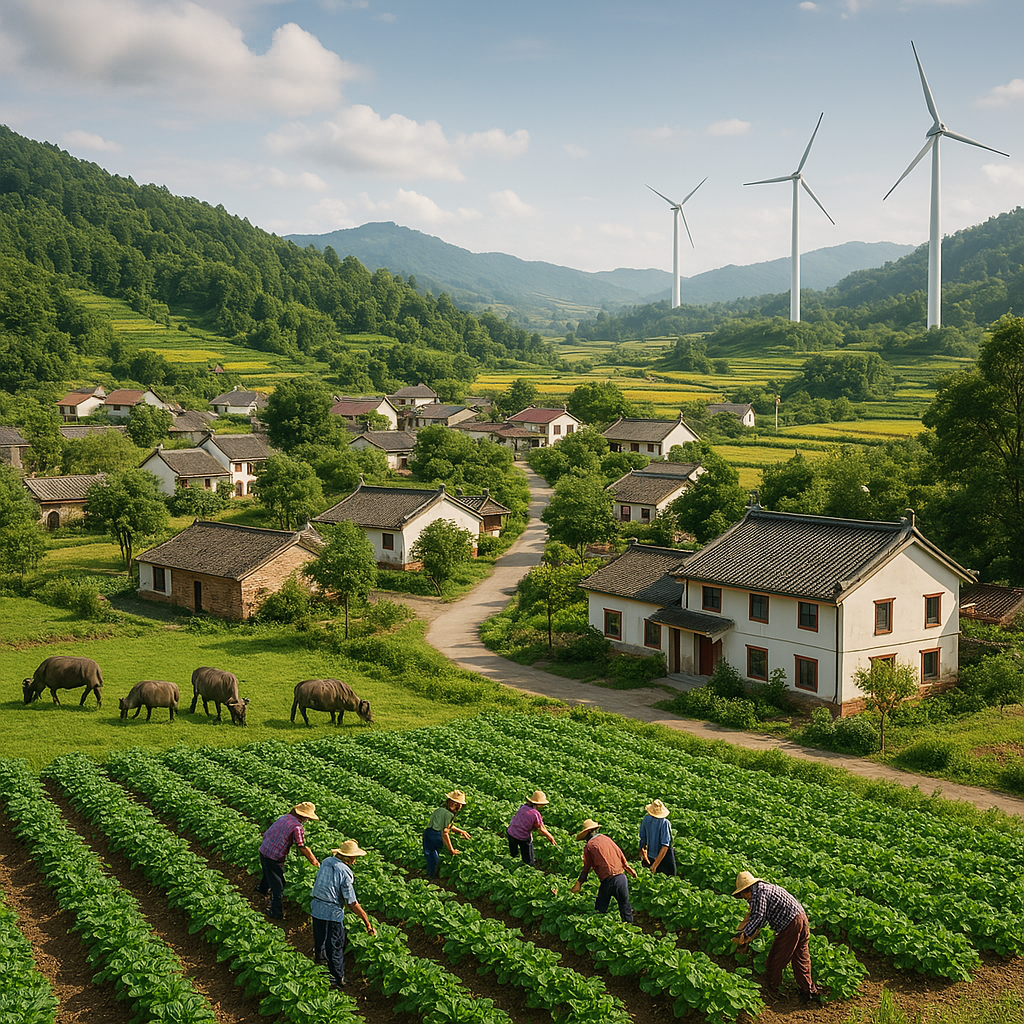
In the mountains of Guizhou, a different kind of revolution is unfolding. Not a return to Maoist slogans, nor a copy of Western green development. Tangyue Village offers something else entirely—a quiet but profound reawakening of the collective spirit in the heart of China’s countryside. Here, amid the scars of disaster and the ruins of market-led disintegration, a new path is being carved: a road back to the commons.
The people of Tangyue, led by grassroots Party cadres, have begun to reassert communal land stewardship, democratic governance, and ecological production in defiance of both neoliberal extraction and top-down developmentalism. This case study explores how Tangyue reflects the possibility of a uniquely Chinese ecosocialism rooted in revolution, renewal, and rural sovereignty.
II. The Crisis That Brought a Commune Back to Life
In 2014, disaster struck. A flood ravaged Tangyue, leaving homes ruined, roads severed, and fields submerged. But rather than await external aid or NGO saviors, the village turned inward—to itself. The local CPC branch organized a mass meeting. With broad participation, villagers voted to pool their land-use rights into a new cooperative. A legal entity was established. Land became shares. Workers became stakeholders.
This was not just reconstruction. It was re-organization. A leap away from capitalist dismemberment and toward the re-collectivization of life (Lu Xinyu, 2023).
III. Neocollectivism in Practice: Land, Labor, and Power
Tangyue’s collective structure now manages agricultural production, animal husbandry, food processing, and infrastructural repair. Unlike the privatized agribusiness models promoted under the “New Socialist Countryside” banner, this cooperative operates under principles of endogenous development and social equality. Local women and returnee migrants play key roles in management and decision-making. Revenues are reinvested in public goods (Lu, p. 93–97).
The ecological results are inseparable from the political structure. Collective land management avoids fragmentation, allowing for agroecological crop rotation, water retention, and integrated pest management. The metabolic rift is not simply studied—it is healed through shared labor.
IV. Party, Peasants, and Ecosocialist Governance
Unlike the technocratic green zones elsewhere, Tangyue is guided not by corporate planners but by the CPC village branch. This is no top-down imposition. As Lu Xinyu documents, the Party’s role was to catalyze collective organization—not to dictate it. It served as vanguard and facilitator, embodying the best of the “mass line” tradition (Lu, p. 91–92).
This comradely model—of Party-organized, peasant-led ecological collectivism—revives the Dazhai spirit in substance, if not in slogan. It affirms that the revolutionary potential of the CPC lies not in central command, but in enabling rural people to govern the land as a commons.
V. Against Green Neoliberalism: A Rural Ecosocialist Horizon
Tangyue resists the dominant paradigm of rural modernization: enclosure, commodification, and integration into global green capital. No monocultures. No land grabs. No ecological gentrification. Instead, it offers:
- A collective metabolism: Where ecology is not separate from society, but interwoven with it.
- Local food sovereignty: Free from dependency on agro-industrial inputs and export markets.
- Anti-extractive planning: Development that preserves use-value over exchange-value.
- Cultural regeneration: Rural labor is honored, not erased. Elders and youth participate as equals.
This is not romanticism. It is revolutionary realism (Lu, p. 99–102).
VI. Conclusion: The Tangyue Road as Ecosocialist Pathway
Tangyue is not a utopia. It is a beginning. A site of struggle and experimentation. But it reminds us that China’s rural future need not be resigned to privatization or ecological spectacle. There is another road—one built with calloused hands, thick with memory, and alive with collective power.
As the Chinese state deepens its eco-civilization strategy, it must look here—not to foreign consultants or carbon markets, but to the soil where the revolution once began. Tangyue does not reject socialism with Chinese characteristics. It fulfills it. By returning land to the people, it points to the next horizon: not the New Socialist Countryside, but the Ecosocialist Commune.
Sources: Lu, Xinyu. Neoliberalism or Neocollective Rural China: A Critique and Prospect. Translated by Yinhao Zhang. Shanghai Jiaotong University Press, 2023.
 Weaponized Information
Leave a comment