By Prince Kapone | Weaponized Information | May 3, 2025
I. Bloodsuckers in Business Attire: The IMF’s Media Fixers Attack Petro
On April 27, 2025, Bloomberg published an article with a headline that reveals more than it intends: “Petro Cites ‘Vampires’ After IMF Pauses Colombia Credit Line.” With one sentence, the outlet tries to flip the script — painting President Gustavo Petro as unhinged, dramatic, and reckless, while casting the IMF as a neutral institution making responsible decisions. This is not journalism. It’s imperial narrative management — a carefully constructed PR campaign designed to protect the financial architecture of U.S. dominance while vilifying anyone who dares challenge it.
The producer of this narrative is Bloomberg, one of the most powerful corporate media arms of transnational finance capital. Its target audience is Wall Street, and its ideological mission is simple: defend markets, discredit sovereign economic policy, and discipline any Global South leader who breaks ranks. The amplifier is the author of the piece, Ryan Hogg, whose byline consistently aligns with elite business interests, delivering polished takes for the professional managerial class. The beneficiaries are obvious: the IMF itself, the Colombian economic elite, foreign investors, and the broader imperial order that relies on “market confidence” as a leash around the neck of nations.
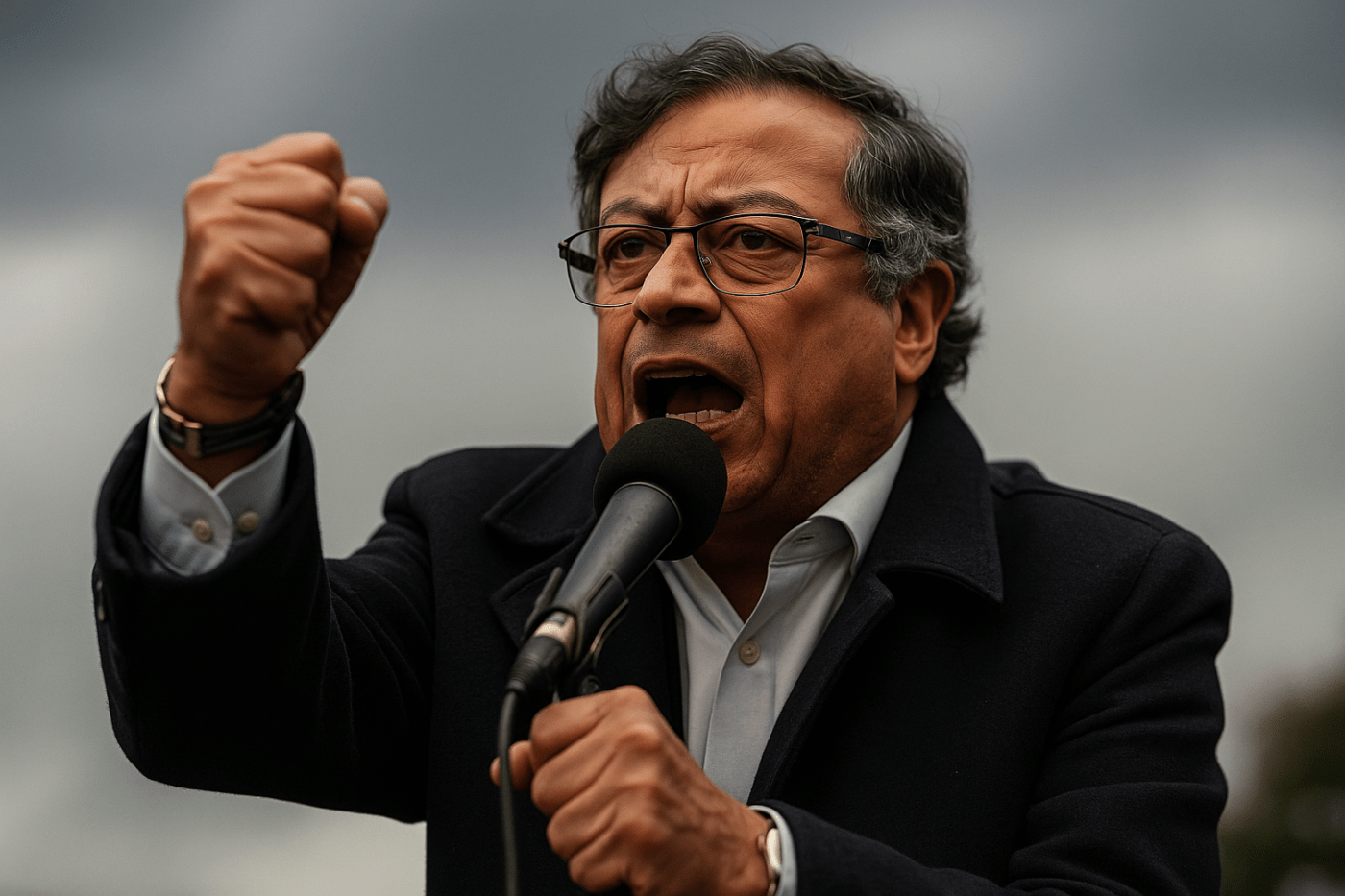
Petro’s statement, in which he referred to the IMF as a “vampire sucking the blood of the people,” is offered with no context — just a tinge of derision. The article doesn’t explain why the IMF paused the credit line. It doesn’t explore Colombia’s debt dependency, or Petro’s efforts to reform a narco-capitalist economy, or the legacy of U.S.-imposed structural adjustment programs. Instead, it repeats the same tired script: Global South leader lashes out, markets wobble, experts warn of instability.
What Bloomberg is really doing is laying ideological cover for an act of economic sabotage. By portraying the IMF decision as routine and Petro’s response as emotional, they reverse reality. The technocrats become victims. The president becomes the aggressor. And the people — whose lives are on the line — are nowhere to be seen. Their hunger, their poverty, their struggle for economic justice are erased in favor of bond markets and investor sentiment.
This is how capitalist propaganda works in the neoliberal core: not through outright lies, but through selective framing, omission, and tone. The article never has to defend the IMF. It just has to discredit Petro. It never has to explain structural debt servitude. It just has to make “fiscal responsibility” sound like common sense. It never has to say “imperialism.” It just lets Wall Street speak through Bloomberg’s keyboard and calls it journalism.
II. Colombia Was Never Sovereign: Narco-Statehood, Counterinsurgency, and the IMF’s Iron Grip
To understand why the IMF is punishing Gustavo Petro — and why Bloomberg is running cover for it — we have to excavate the historical foundations of Colombia’s role in the imperial world system. Colombia has never been a sovereign republic in the full sense of the term. It has long functioned as a counterinsurgency client state — a forward operating base of U.S. imperialism in Latin America. Through decades of war, paramilitary terror, and economic restructuring, Colombia was molded into a neoliberal garrison — a state whose sovereignty was outsourced to Wall Street, Washington, and NATO command.
The roots of this arrangement stretch back to the Cold War, when the U.S. and its proxies began backing death squads, narco-traffickers, and far-right paramilitaries to suppress leftist insurgencies like the FARC and ELN. But the violence wasn’t just military — it was economic. Beginning in the 1980s, the IMF and World Bank imposed structural adjustment programs on Colombia that gutted public services, privatized national industries, and opened the economy to transnational capital. These loans were offered under the guise of development — but their real purpose was to discipline the state into submission.
By the early 2000s, Colombia had become the third-largest recipient of U.S. military aid in the world — behind only Israel and Egypt. “Plan Colombia,” funded by the Clinton and Bush administrations, was sold as a counter-narcotics program but was in fact a massive military buildup to crush internal rebellion. The U.S. armed the Colombian government with helicopters, drones, and battlefield surveillance — all while turning a blind eye to the deep integration of the state with cocaine cartels and right-wing death squads. This is what neoliberalism looks like in the periphery: narco-capitalism protected by imperial guns and IMF debt chains.
Colombia is also the only NATO “global partner” in Latin America, a status it was granted in 2017. This is not symbolic. It formalizes Colombia’s role as the regional enforcer of imperial doctrine. It’s why it has seven U.S. military bases. It’s why it was a launchpad for destabilizing Venezuela. And it’s why, when Petro proposed even modest reforms — like increasing taxes on the rich, slowing fossil fuel exports, and funding public health and education — the IMF and its mouthpieces launched an economic and media offensive to rein him in.
When Bloomberg talks about “paused credit lines,” what they’re really talking about is the enforcement mechanism of debt colonialism. These funds are not gifts — they are tools of control. The IMF offers liquidity in exchange for austerity, discipline, and obedience. And when a country like Colombia dares to challenge that order — even symbolically — the funds are frozen, the capital flight begins, and the media swarms in to blame the victim.
So no, this isn’t about markets being spooked. It’s about imperial command being challenged. Colombia was never supposed to have an independent economic policy. Petro’s presidency — however limited in scope — has disrupted the seamless functioning of empire in the region. And the IMF is doing what it has always done: wielding debt as a weapon to enforce compliance and punish deviation.
III. Austerity Is Violence, Sovereignty Is Resistance: What Petro Is Really Fighting
What Bloomberg portrays as a “credit pause,” and what the IMF dresses up as fiscal prudence, is in fact a direct act of imperial aggression. The freezing of Colombia’s credit line is an economic attack — a form of sabotage meant to discipline Gustavo Petro for attempting even mild reforms that shift power from oligarchs to people. Petro isn’t “radical.” He’s not threatening to nationalize the banks or withdraw from NATO. He’s simply trying to fund social services, raise taxes on the rich, and build a post-carbon future. And even that is too much for the imperial order to tolerate.
Why? Because in Colombia, austerity is not policy — it is doctrine. It is the linchpin of a system designed to protect elite profits and foreign investors at all costs. The IMF isn’t just withholding funds; it’s sending a message: any attempt to deviate from neoliberal orthodoxy will be punished — not with tanks, but with capital flight, downgraded credit ratings, and media demonization. The vampire Petro invoked isn’t metaphorical — it’s structural. And it feeds on blood drawn through interest payments, budget cuts, and privatization mandates.
Petro’s challenge, therefore, is not just to economic policy — it’s to the entire counterinsurgency architecture of Colombian capitalism. By exposing the IMF’s extortion, he exposes the lie at the heart of the liberal order: that economic governance is neutral, that markets are apolitical, and that debt is a path to development. He is pulling back the curtain and showing what every peasant, teacher, and street vendor already knows — that the economy is a war zone, and the bombs are budget lines.
His defiance has not been limited to economic issues. Petro has also been one of the only Latin American heads of state to explicitly condemn Israel’s genocidal war on Gaza, denouncing Zionism as a racist colonial ideology and rejecting complicity in the slaughter of Palestinians. In a world where silence is the price of U.S. favor, this stance has cost him dearly. Just last week, Petro was denied a U.S. visa — a petty yet deliberate insult from Washington, signaling that his criticism of the empire’s Zionist client state would not go unpunished. The message is clear: any head of state who supports Palestinian liberation is persona non grata in the eyes of imperial power.
And make no mistake: Bloomberg’s hit piece isn’t a standalone attack. It is part of a broader offensive to delegitimize left-led governments across Latin America. From Ortega in Nicaragua to Maduro in Venezuela to Sheinbaum in Mexico, the moment any leader attempts to redistribute wealth, assert sovereignty, or challenge extractive capital, the ruling class unleashes its full arsenal: media disinformation, financial sabotage, diplomatic pressure, and, if necessary, coup plots. Colombia, long the imperial stronghold in the region, is now a battleground between technocratic repression and popular sovereignty.
This is why Petro’s rhetoric matters. Calling the IMF a vampire isn’t just political theater. It is an ideological rupture — a rejection of the polite lies that lubricate imperialism. It is a call to the Colombian masses to stop begging for reforms and start demanding liberation. And it is a signal to the rest of the Global South that the time for subservience is over.
What Petro is fighting is not just a funding freeze. He is fighting a system that demands underdevelopment in exchange for survival. A system where schools are starved so debt can be serviced, where healthcare is privatized to keep inflation low, where forests are razed to meet export quotas. In confronting this machine, Petro has done something more powerful than pass a law — he has named the enemy. And in doing so, he’s made it that much harder for the vampires to feed unnoticed.
IV. The Vampires Are Afraid: Colombia’s Struggle and the Coming Storm
The ruling class doesn’t fear Petro because he’s a revolutionary. They fear him because he pulled back the curtain — because he named the IMF for what it is: a vampiric institution that feeds off the lifeblood of the poor. And once you name the vampire, it can no longer hide in plain sight. The IMF’s punishment of Colombia is not a financial matter — it is a disciplinary strike against any attempt by the Global South to chart an independent economic course. Petro’s crime was not fiscal mismanagement — it was disobedience.
But Colombia’s struggle is not unique. The same financial blackmail being deployed against Bogotá has been used to shackle nations across Africa, Asia, and Latin America for decades. From Greece to Ghana, from Argentina to Sri Lanka, the playbook is the same: load countries with debt, enforce austerity, privatize public goods, then blame the victims for the wreckage. What’s different now is that leaders like Petro are starting to say the quiet part out loud. And that is what makes them dangerous — not to “the economy,” but to empire itself.
This is why every worker, every student, every landless peasant and barrio youth must understand: the IMF is not an impartial referee — it is the central bank of counterinsurgency. It is the economic wing of the same empire that trains police forces, supplies drone fleets, and props up Zionist apartheid. Its job is to make revolution impossible — by keeping the lights off, the stomachs empty, and the masses demobilized. And Petro, for all his contradictions and limits, has at least dared to say: no more.
The vampires are afraid because the spell is breaking. From Burkina Faso to Bolivia, from Iran to South Africa, the Global South is waking up. Petro’s words — “vampires” — are more than metaphor. They are a signal flare to every nation still in the jaws of debt servitude, every movement organizing against the bloodsuckers in suits. Colombia’s moment is not just national — it is part of a global tide of resistance against hyper-imperialism, against technofascist economic control, and against a system that must collapse before we can rebuild.
So let this be a warning to empire: your tools of domination are exposed. And to the masses: your enemies are not abstract. They have names. They have headquarters. They have pipelines of capital and propaganda. And they can be confronted — not with appeals for fairness, but with organized struggle, revolutionary clarity, and internationalist solidarity.
Colombia is bleeding — but it is also rising. Petro may be only one front in this war. But every vampire he exposes, every IMF policy he unmasks, every insult he endures for speaking truth — they all add fuel to the fire that will eventually consume the imperial financial order itself.
The age of obedience is ending. And the vampires have nowhere left to hide.
 Weaponized Information
Leave a comment