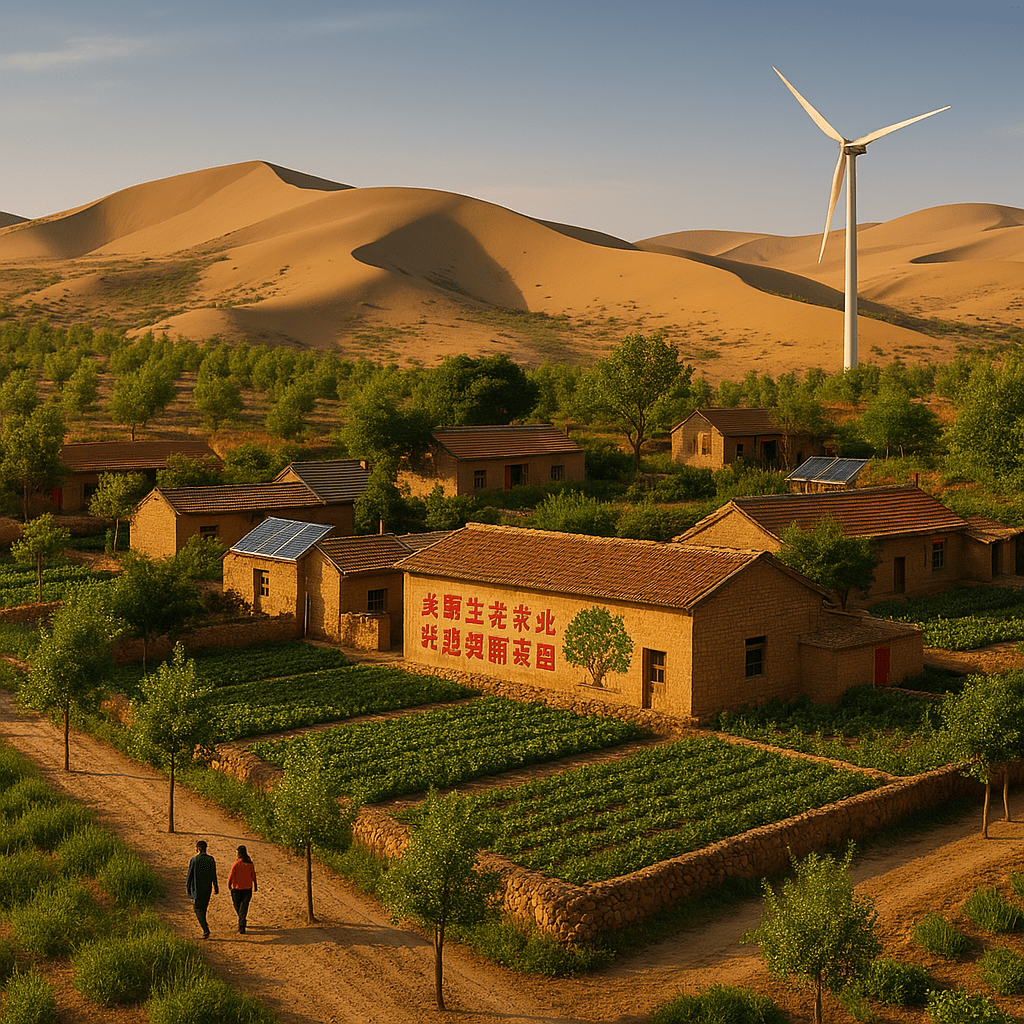
I. The Empire of Sand
The deserts of northern China are not natural frontiers—they are contested terrains. The creeping dunes of Inner Mongolia, Ningxia, and Gansu have long marked the edge of empire, agriculture, and habitation. Once forested and fertile in ancient times, these arid zones have become both ecological battlegrounds and revolutionary laboratories.
Today, they sit at the center of China’s massive anti-desertification campaigns—what the state calls the “Great Green Wall.” But the real question is not whether sand can be held back. It’s whether the battle to reclaim the desert can serve the people—or merely serve the green image of accumulation. This case study looks at the ecological contradictions and revolutionary possibilities buried in the sands.
II. The Desertification Crisis: A Socialist Environmental Emergency
Decades of overgrazing, deforestation, and industrial monoculture—some of it under pre-reform socialist planning, much of it under post-reform capitalist expansion—turned northern China’s grasslands and forests into dustbowls. By the 1990s, over 400 million people were affected by desertification. Sandstorms blew into Beijing. Croplands disappeared. Villages vanished.
This was not simply an environmental crisis—it was a crisis of development. A crisis produced by the breakdown of metabolic relations between people, land, and labor. In response, China launched the Three-North Shelterbelt Program, the largest ecological engineering project in human history.
III. The Green Great Wall: Restoration or Spectacle?
The Shelterbelt campaign has planted over 66 billion trees since 1978. It spans more than 4,000 kilometers. Hillsides have been stabilized, windbreaks erected, and vegetation cover increased.
But while the scale is staggering, so are the contradictions. Many trees are monoculture species. Survival rates are low in places. Projects are often managed top-down, without sufficient input from local communities or herders. Villagers are sometimes displaced or economically sidelined. The “greenification” can become a performance—forests on paper, withering roots in the sand.
The challenge is not the ambition—it’s the governance. And that’s where ecosocialism offers a path forward.
IV. Mass Mobilization and the Memory of Collective Labor
Historically, the Chinese revolution trained the people to transform land through collective labor. In the 1950s and 60s, mass campaigns built irrigation networks, terraces, and shelterbelts—not as policy mandates, but as class struggle on the terrain of ecology. Workers and peasants reshaped rivers and mountains together.
This legacy remains in the memory of older generations. Today’s anti-desertification efforts could build on that history—if they center the people, not just the metrics. The transformation of the land must come with the transformation of social power.
V. Toward an Ecosocialist Desert Strategy
A truly ecosocialist approach to China’s desert frontier would integrate ecological restoration with social emancipation. It would combine science with sovereignty, and central planning with rural power.
Key elements might include:
- Participatory afforestation using native and drought-resistant species selected by local communities
- Agroecological grazing zones for nomadic and semi-nomadic herders, supported by cooperatives
- Decentralized renewable energy systems (solar, wind) that serve ecological villages and frontline workers
- Ecological job guarantees for rural youth to restore grasslands, monitor biodiversity, and steward the commons
- Cultural preservation for ethnic minorities (e.g. Mongol, Hui) who have traditional desert survival knowledge
This is not a rejection of China’s eco-civilization project—it’s its revolutionary deepening.
VI. Conclusion: The Desert Is a Terrain of Struggle
Deserts are often imagined as wastelands. But in China’s arid north, they are also fields of possibility. The sand hides both crisis and capacity. The Great Green Wall can be more than a spectacle of green growth—it can be a wall against exploitation, enclosure, and ecological injustice.
The path forward lies not in managing nature like an enemy, but in reweaving the broken ties between land and people. Ecosocialism in the desert means transforming reclamation into emancipation. It means planting not just trees, but power.
The wind still blows. But so do the seeds. What grows next will depend on who controls the land—and why.
 Weaponized Information
Leave a comment