I. Where the Soil Remembers Revolution
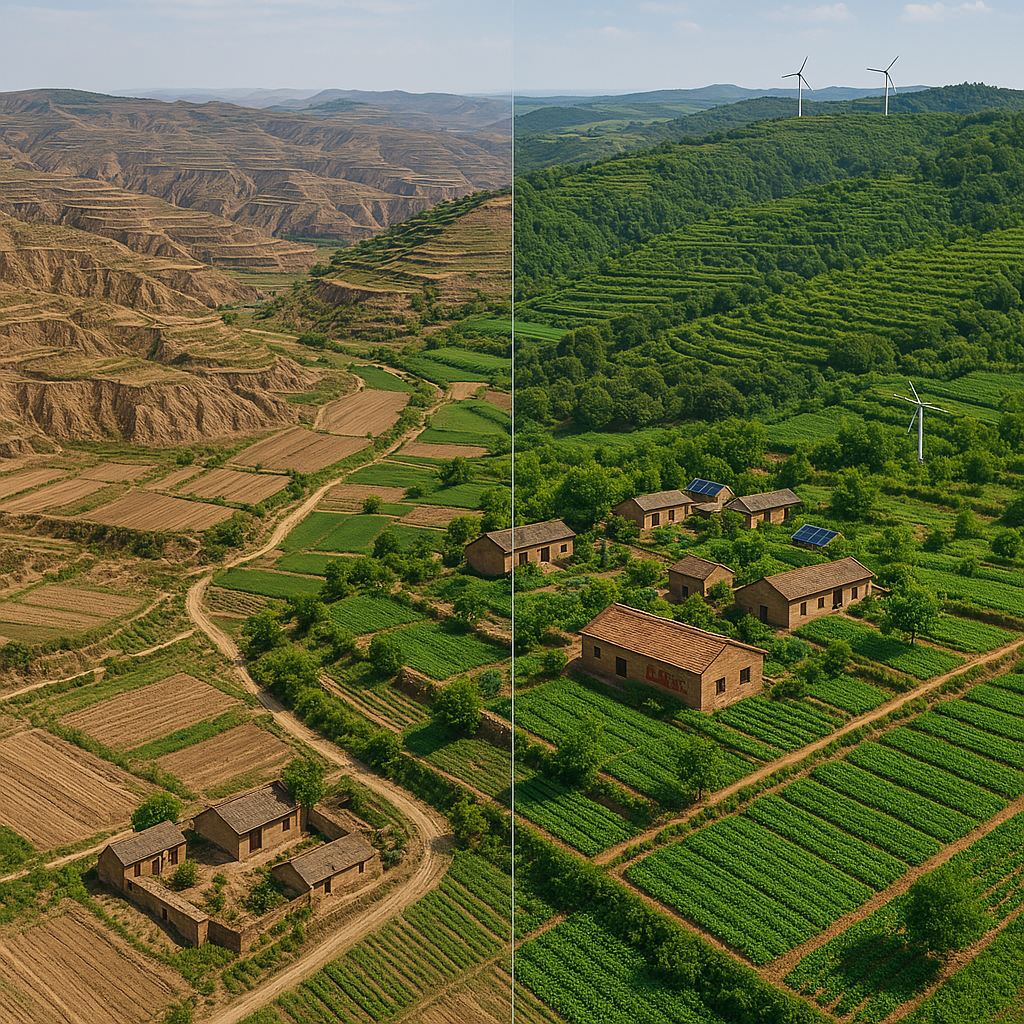
There is a place in China where the land itself seems to testify to history. The Loess Plateau—broad, wind-carved, and deeply scarred—is both cradle and cautionary tale. It is here that Chinese civilization took root thousands of years ago, and it is here that erosion, overgrazing, and war once reduced vast areas to dust. But it is also here that revolutionary transformation has already occurred—not once, but many times.From the anti-Japanese base areas of Yan’an to the vast re-greening programs of the late 20th century, the Loess Plateau has been both a front line and a proving ground for collective land reclamation, ecological repair, and peasant-led renewal. Today, it stands again at a crossroads: will the Green Great Wall and state-directed restoration become the foundation of a deeper, rural ecosocialism—or simply a green mask for accumulation and displacement?This case study examines the Loess Plateau as a living terrain of contradiction—where past and present, restoration and commodification, state capacity and rural power, meet.
II. From Scarcity to Sovereignty: Ecological Ruin and Socialist Resilience
The ecological degradation of the Loess Plateau was severe: centuries of deforestation, erosion, and extractive agriculture had turned it into one of the world’s most devastated landscapes. But it was also one of the first places to test the power of revolutionary planning. The People’s Communes of the Mao era terraced hillsides, built check dams, and mobilized tens of thousands in reforestation and soil conservation campaigns. The slogan was simple: “Turn the yellow earth green.”These efforts were not perfect. But they showed what was possible when mass participation, state coordination, and a socialist ethic of transformation converged. They laid the infrastructural and ideological groundwork for future recovery.
III. The Loess Plateau Watershed Rehabilitation Project: Eco-Civilization in Action
In the 1990s and 2000s, with World Bank support and Chinese state leadership, the Loess Plateau Watershed Rehabilitation Project undertook one of the largest and most studied re-greening efforts in the world. Hills were reforested, farming was moved off steep slopes, and millions of hectares were stabilized. Satellite images now show a transformed terrain—greener, more resilient, and more productive.But behind the success story lie contradictions. Farmers were resettled or incentivized to abandon traditional land uses. Land use was rationalized but not always democratized. Ecological functions improved, but social ownership often diminished. The restoration was real—but it was largely technocratic, not emancipatory.
IIIa. The Yenan Way: Revolutionary Precedent for Ecosocialism
It is no coincidence that Yan’an—Mao’s central base during the anti-Japanese war—sits in the heart of the Loess Plateau. During the 1930s and 40s, the Communist Party turned this harsh and eroded terrain into a revolutionary laboratory. As Mark Selden shows in The Yenan Way, the base area was a prototype for what we might now call ecosocialism.Here, peasants organized collectively to grow food, build terraces, plant trees, and conserve soil. They practiced self-reliance and mobilized ecological transformation through political education and mass line participation. It was a bottom-up model of socialist reconstruction—one where the people rebuilt the land as they rebuilt themselves.The Yenan Way fused ecological repair with political empowerment. It taught that land is not only a resource, but a terrain of liberation. Today’s ecosocialist strategy must revive that ethos: where restoring the earth means restoring popular power.
IV. Green Development or Green Dispossession?
In recent years, the Loess Plateau has become a showcase of eco-civilization: pilot zones for sustainable agriculture, carbon offset schemes, eco-tourism, and green infrastructure. Yet many of these projects mirror the developmental logic they claim to transcend. Land is revalued as ecological capital, and local communities are often displaced or reabsorbed as low-wage caretakers of a new “green” economy.This is the paradox: ecological indicators improve, yet popular power stagnates or retreats. The people who rebuilt the hillsides with their hands are not always those who control their future. Ecosocialism must offer an alternative—not just green restoration, but land justice and collective control.
V. Toward Rural Ecosocialism: Proposals and Possibilities
The Loess Plateau contains more than restored soil. It contains a memory of struggle—and the possibility of renewal. A rural ecosocialist vision would not discard state planning, but deepen it through democratic structures:
- Commons-based land governance rooted in local councils, cooperatives, and peasant federations
- Agroecological transition combining scientific knowledge with Indigenous and traditional practices
- People-centered ecological monitoring and participatory planning tools
- Local food and energy sovereignty through small-scale renewable infrastructure and community-based agriculture
- Reparative justice for displaced communities and ecological migrants
These are not utopian ideals. They are real trajectories embedded in China’s revolutionary history—and still flickering in village experiments and grassroots mobilizations.
VI. A Land That Remembers, A Future Still Possible
The Loess Plateau has been called the most ambitious ecological restoration site on Earth. But it is also one of the most symbolically loaded. If China can regenerate the Yellow Earth, it can regenerate the revolutionary ideals that once animated it. But that will require not just policy shifts, but power shifts.Ecosocialism in the Loess Plateau means giving land back—not just to the trees, but to the people. It means trusting the hands that built the terraces to shape the future. It means remembering that the earth is not only a resource, but a repository of revolutionary will.The yellow earth still holds promise. The question is whether we will let it speak—and whether we will listen.
 Weaponized Information
Leave a comment