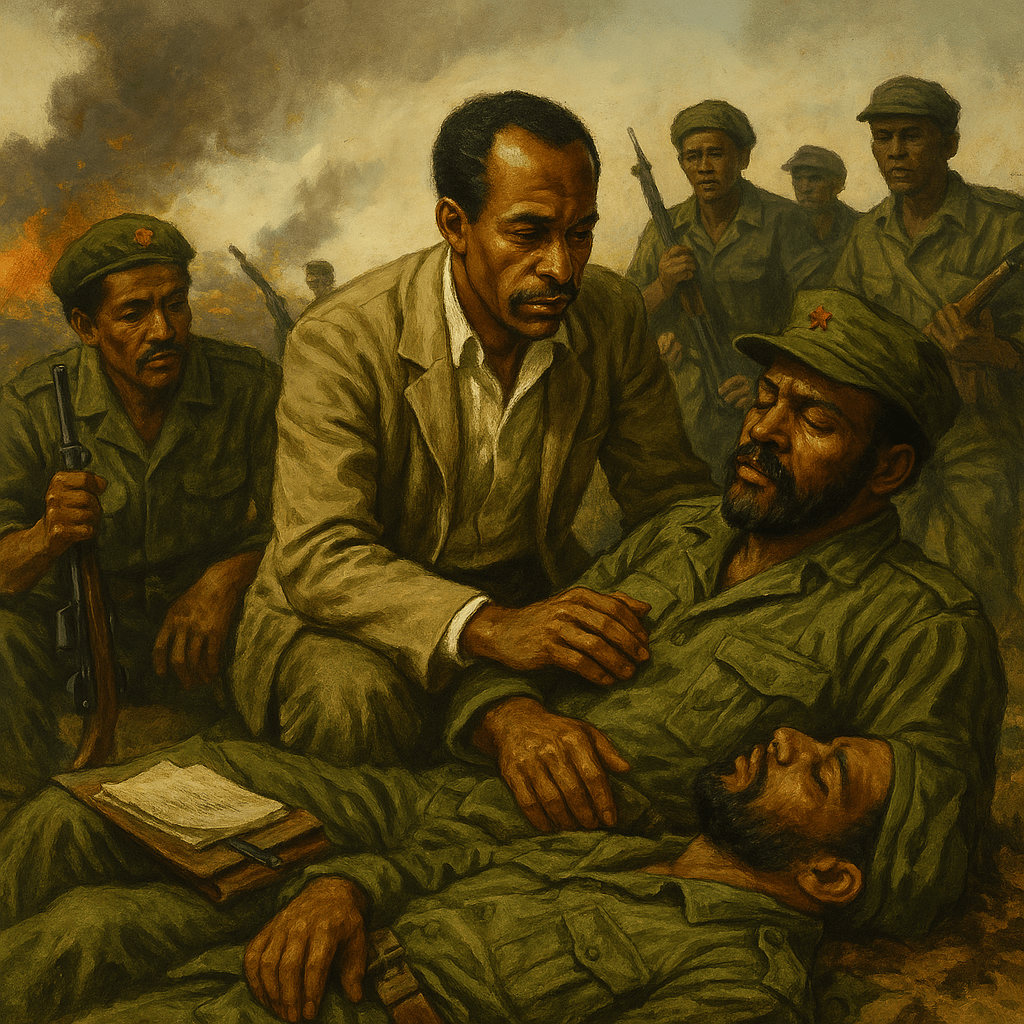
Voice of the Wretched
Frantz Fanon did not theorize revolution from a safe distance. He wrote it in blood, fire, and exile. A Martinican-born psychiatrist turned Algerian freedom fighter, Fanon was not just a critic of colonialism—he was a combatant. He diagnosed the colonial condition not only as a system of domination, but as a pathology—a disease that infected both colonizer and colonized. And he insisted that there could be no cure without rupture.
To the liberal intellectuals of his time, Fanon was dangerous. To the empire, he was subversive. To the colonized, he was a mirror and a machete.
He gave voice to the voiceless, not as victims, but as historical agents. His writings shattered the illusions of gradual reform and exposed the psychic and structural violence of colonial rule. For Fanon, decolonization was not a metaphor. It was material, explosive, and necessary.
He died at 36, but in that short time, he transformed political thought and revolutionary praxis. His words continue to haunt empire and inspire rebellion.
Fanon was no heretic. He was the insurgent intellectual of the Global South—the one who taught the wretched of the earth how to speak, how to fight, and how to become whole again.
Part I: Madness, Medicine, and the Colonial Mind
Frantz Fanon began his revolutionary journey through the corridors of psychiatric hospitals. Trained in France and stationed in Algeria, he did not practice medicine in abstraction. He saw firsthand the psychological trauma inflicted by colonialism. But he also saw how psychiatry itself had been weaponized to justify racial hierarchies and pathologize resistance.
To Fanon, madness in the colonial context was not simply personal—it was political. The symptoms expressed by colonized subjects were often the rational responses to an irrational system. Anxiety, depression, dissociation, rage—these were not disorders of the individual, but manifestations of social and structural violence.
In his clinical work, he encountered Algerians tortured by French forces, wracked by guilt, fear, and humiliation. But he also treated French settlers whose brutality revealed their own psychic fractures. Colonialism dehumanized both master and subject. It distorted the psyche, naturalized violence, and normalized alienation.
Fanon’s medical training taught him how to listen—but it was his political awakening that taught him what to hear. He realized that healing could not occur within the framework of colonial domination. To restore sanity, one had to destroy the system that produced madness.
So he left the clinic and joined the revolution.
He became a spokesperson for the FLN, a writer for its newspaper El Moudjahid, and an ambassador of Algerian liberation to the Global South. But he never stopped diagnosing. He treated the colonial condition as a living pathology—and revolution as the necessary surgery.
In doing so, Fanon transformed psychiatry into insurgent theory and made decolonization a terrain not only of politics and guns, but of consciousness itself.
Part II: Black Skin, White Masks, and the Internalization of Empire
Before The Wretched of the Earth, before he joined the Algerian revolution, Frantz Fanon wrote Black Skin, White Masks—a searing, intimate study of how colonization works through identity, desire, and the psyche.
It was a book born not in theory but in experience. As a Black man trained in French institutions, Fanon navigated a world where whiteness was the standard of beauty, intelligence, and civilization. He dissected what it meant to be Black in a white world—not just politically, but existentially.
Colonialism, he argued, did not simply exploit. It invaded. It took root in the minds of the colonized, convincing them of their inferiority, deforming their self-image, and distorting their dreams. It trained the colonized to wear “white masks”—to speak the colonizer’s language, adopt their mannerisms, mimic their culture—while still being excluded from humanity.
Fanon exposed how racism was more than insult or exclusion—it was a systematic assault on being. It structured love, education, family, even fantasy. And the colonized, seeking dignity, often internalized this violence, turning it inward in shame, mimicry, or self-hate.
But he did not pathologize the colonized. He refused to reduce their condition to mere neurosis. Instead, he showed how what appeared as pathology was rooted in social conditions—and that liberation required not adaptation, but rupture.
Black Skin, White Masks offered no easy optimism. It ended with a call not to become white, or to be recognized by white society, but to create a new human being altogether—beyond race, beyond colonialism, beyond Europe’s deadly illusions.
It was the beginning of Fanon’s most radical idea: that true liberation is not a return to a pre-colonial past, but a leap into a decolonized future—one that must be invented by the wretched themselves.
Part III: The Wretched of the Earth and the Transformative Power of Violence
Frantz Fanon did not glorify violence. He understood it. He analyzed it. He recognized it as the language of the colonizer—and, paradoxically, the only language the colonizer respected.
In The Wretched of the Earth, his final and most incendiary work, Fanon articulated a terrifying truth: that colonialism was born in violence, sustained by violence, and could only be overthrown through violence. Not because the colonized were naturally violent—but because the colonial system offered no other means of redemption or recognition.
Fanon’s argument was not moral—it was material. He wrote from the frontlines of Algeria’s anti-colonial war, where French tanks shelled villages and napalm scorched the land. In that context, appeals to peace sounded obscene.
But he went deeper than political necessity. Fanon believed that violence could be transformative. That when the colonized took up arms, they were not simply killing their oppressors—they were reclaiming their humanity.
Violence, for Fanon, was a cleansing force—not because it purified blood, but because it shattered the internalized inferiority that colonialism imposed. It allowed the oppressed to move from being objects of history to subjects of revolution. It was, at its most profound level, an act of becoming.
Fanon did not fetishize armed struggle. He knew that revolutions could devour their children. He warned against bourgeois nationalism, neocolonial betrayal, and the dangers of authoritarianism. But he refused to deny the liberating moment that comes when the colonized say: no more.
He saw violence as pedagogy, as rupture, as resurrection.
Fanon’s ethics of violence were not a blueprint for brutality—but a revolutionary anthropology of the oppressed. In reclaiming the capacity to fight, the wretched also reclaim the capacity to feel, think, and build a new world.
Part IV: Death, Legacy, and the Living Fanon
Frantz Fanon died in 1961 at the age of 36, consumed by leukemia just months before Algeria won its independence. But his ideas refused to die. They detonated across continents—whispered in ghettos, quoted in guerrilla camps, studied in prisons, invoked in the chants of the wretched.
Fanon left behind no political party, no state, no doctrine. What he left was more dangerous: a method of thinking, a way of seeing, and a refusal to reconcile with empire.
In Africa, his work inspired anti-colonial movements that pushed beyond nationalism toward socialism and pan-Africanism. In Latin America, revolutionary theorists like Paulo Freire and Che Guevara grappled with Fanon’s insistence on praxis. In the United States, the Black Panthers read The Wretched of the Earth like scripture—because it named what they lived.
But the world Fanon diagnosed has not disappeared. The faces have changed, the flags have multiplied, the colonizers wear suits instead of khaki. Yet the neocolonial condition persists—through debt, through borders, through surveillance, through the psychological violence of global capitalism.
And so Fanon lives.
He lives in the young rebel with a rock in her hand. In the community medic building clinics in war zones. In the street intellectual confronting police with words sharper than tear gas. In every struggle that connects healing to revolution, identity to material conditions, theory to action.
Fanon’s legacy is not purity. It is confrontation. It is an invitation to clarity in an age of confusion.
Fanon was no heretic. He was a revolutionary of the mind and the flesh. And in this era of planetary crisis and postcolonial deceit, his voice still echoes—calling the wretched not to wait, but to rise.
 Weaponized Information
Leave a comment