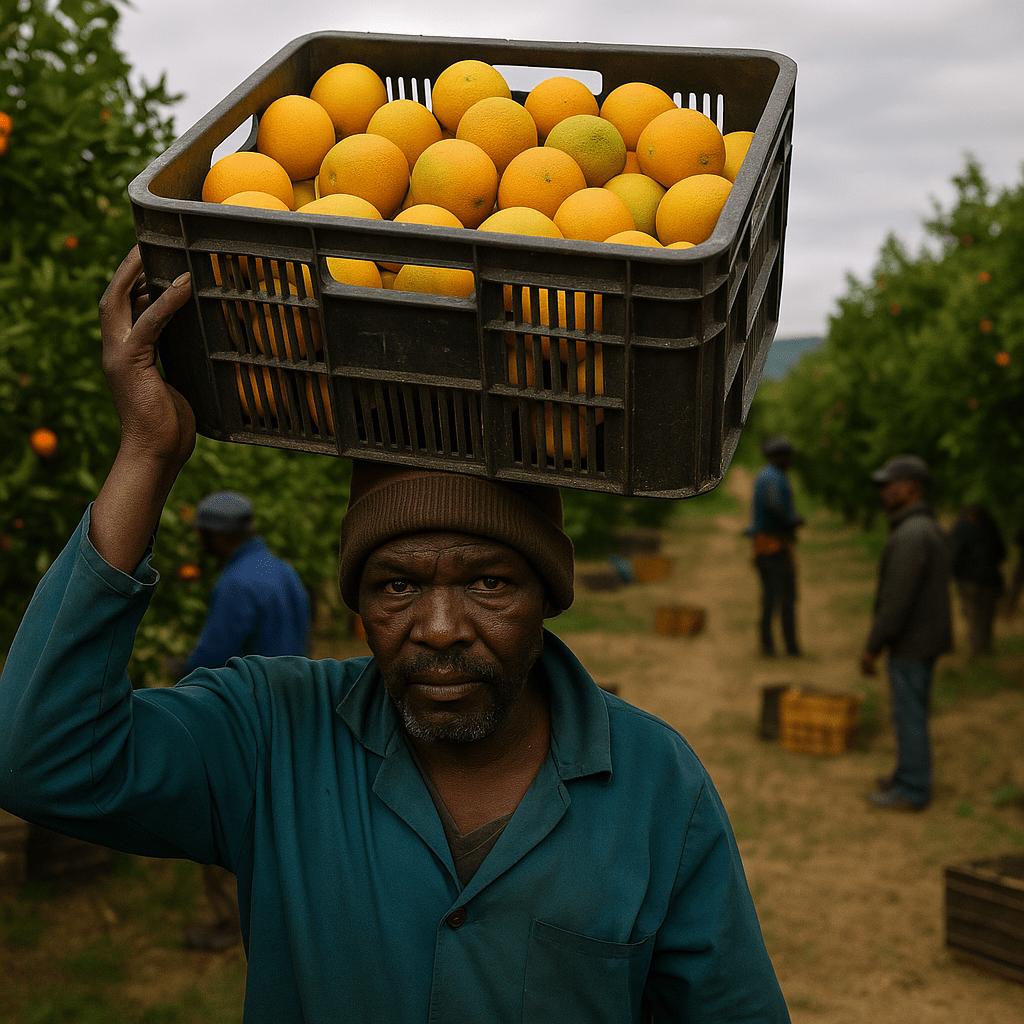
35,000 Black agricultural jobs are under threat—Washington calls it “trade leverage.”
It’s always dressed up in the same words: “trade enforcement,” “national interest,” “economic reciprocity.” But peel back the language of the U.S. State Department and what you’ll find—rotting just beneath the surface—is a weapon aimed directly at the Global South’s agricultural proletariat.
This week, Washington fired another shot in its war against independent development, slapping a 31% tariff on citrus fruit imported from South Africa. The ruling class press calls it a “review of trade preferences.” We at Weaponized Information call it what it is: economic coercion through tariff colonialism.
The South African Citrus Growers Association warned that over 35,000 jobs are now at risk, mostly in rural regions where Black workers, landless and underpaid, still labor in the orchards built by colonial conquest and sustained by apartheid’s legacy. These are not jobs that come with pensions or security. These are survival-level wages paid to workers treated like seasonal machinery—useful in harvest, expendable in surplus.
So who benefits when the U.S. closes its markets? Not American workers. Not the South African poor. This is a move designed purely to discipline—to remind South Africa’s political elite that flirting with BRICS multipolarity, that pushing back even symbolically against Israeli genocide in Gaza, that maintaining relations with China and Russia, will be punished not with bombs (yet), but with hunger and joblessness.
That’s the genius of capitalist imperialism: it makes war feel like paperwork.
The U.S. says it’s reviewing trade benefits under the Generalized System of Preferences, as if that program were a gift from the gods rather than a leash tied to the imperial dollar. South Africa’s reward for decades of loyalty to neoliberalism was a knife to the gut the moment it stepped an inch out of line.
And this is no anomaly. From Lula’s Brazil to Vietnam, the tariff is the soft power prelude to sanctions, the economic blockade that doesn’t need tanks or drones to devastate communities. It’s “civilized” war—a bureaucratic siege dressed in spreadsheets and tariff tables, signed by men in suits who’ve never picked an orange in their lives.
What’s missing in the headlines is who this really hurts. It’s not the ANC leadership or the export tycoons who broker container deals in Cape Town. It’s the tens of thousands of workers—the people who bend their backs for imperial fruit markets and are now told they’ve bent the wrong way.
In the plantation logic of capitalism, even post-apartheid South Africa must submit to the international division of labor: raw goods in, debt and dependency out.
We are told this is how the “rules-based order” functions. But the rules were made by thieves, and the order is that of a plantation overseer.
Let there be no mistake: this is economic violence. Not by accident, not through miscalculation, but by design. And like every act of U.S. imperialism, it is aimed squarely at the very people who have the least power to respond—unless, of course, they organize.
And so we say to every worker pruning trees in Limpopo, every unemployed citrus packer in the Western Cape, every peasant family on the receiving end of Washington’s wrath: your struggle is global. And so is ours. Redlines are being drawn. We know which side we’re on.
Source: Reuters – “US tariffs threaten 35,000 citrus jobs in South Africa” (April 8, 2025)
 Weaponized Information
Leave a comment