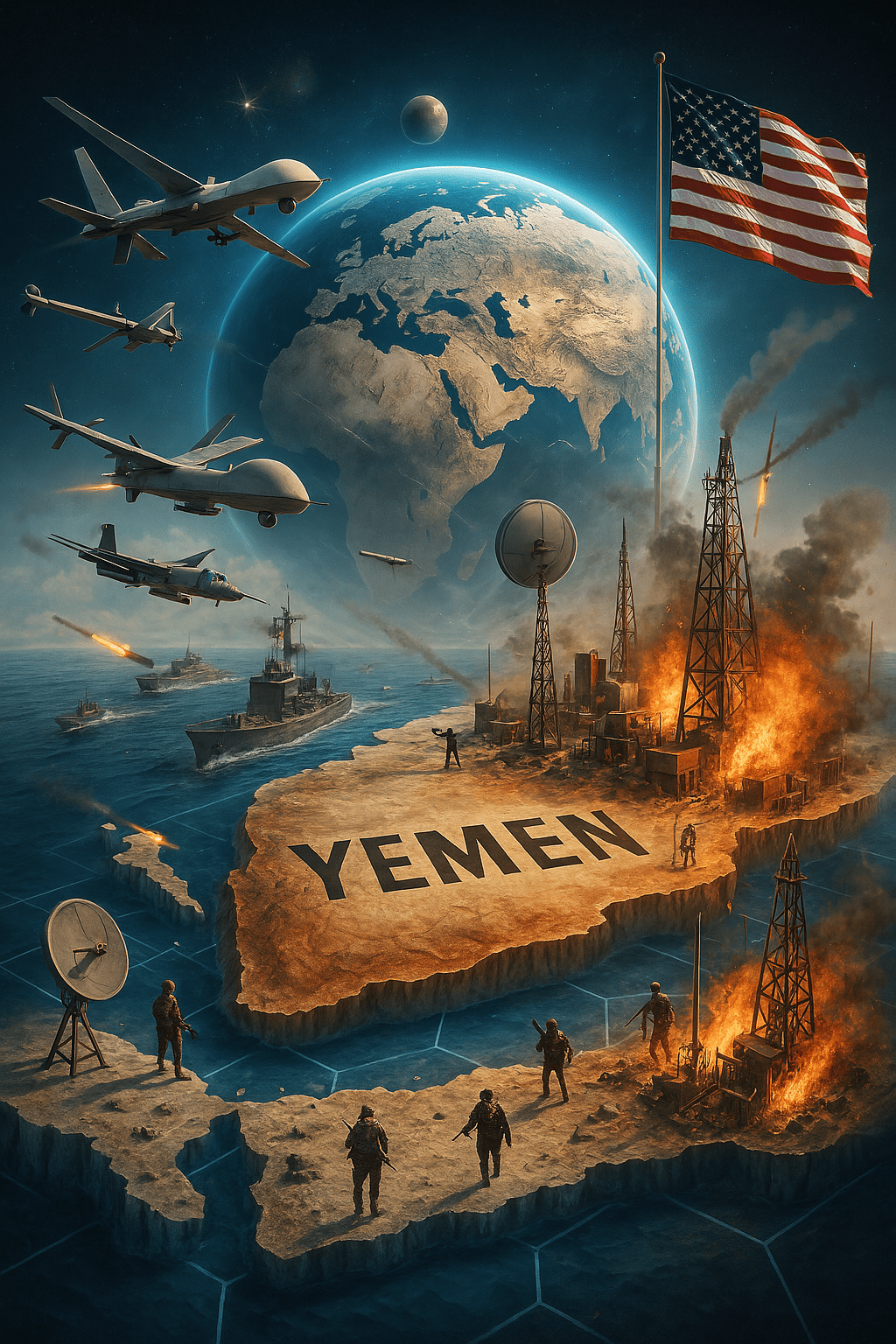
I. Yemen: The Speck That Blocks the Empire
At the southwestern tip of the Arabian Peninsula lies a country that the Western press often portrays as “poor,” “tribal,” and “ungovernable.” Yet this same country—Yemen—happens to sit on one of the most strategic chokepoints in the global capitalist system: the Bab el-Mandeb Strait, through which nearly 10% of global trade and energy flows pass en route from the Indian Ocean to the Suez Canal.
Yemen is not a failed state—it is a targeted state. And that targeting must be understood within the broader collapse of unipolarity. With the rise of multipolar alliances—centered around China, Russia, Iran, and other Global South powers—the U.S.-led imperial system finds itself in crisis. Its response? Imperial recalibration: the tightening of control over key logistical chokepoints, with Yemen emerging as a frontline.
II. Proxy Genocide: The U.S.-Saudi Axis in Yemen
The war on Yemen did not begin in 2015—it merely escalated then. The roots lie in the post-9/11 reorganization of the Middle East under the U.S. “War on Terror” umbrella, which sought to eliminate any autonomous regional force outside U.S.-Israeli-Saudi control.
In March 2015, the Saudi-led coalition, backed fully by the U.S. and UK, launched Operation Decisive Storm under the pretext of restoring the ousted Hadi government. But Hadi had already lost legitimacy on the ground. The real reason was that Ansar Allah (the Houthis)—an armed political movement with nationalist and anti-imperialist leanings—had seized control of Sanaa and rejected U.S. and Gulf domination.
What followed was a genocidal air war. Hospitals, ports, water systems, agricultural sites, and schools were targeted in violation of international law. The UN Development Programme estimated that by the end of 2021, 377,000 Yemenis had died due to the war—through direct violence, starvation, or preventable disease, all intensified by the Saudi blockade with U.S. naval support.
The war was not a Saudi war. It was a U.S. imperialist war outsourced to Riyadh to suppress a sovereign alternative at a vital global chokepoint. Like Ukraine, Libya, and Syria before it, Yemen became a proving ground for imperial counterinsurgency and recalibration.
III. Drone Wars and Technofascism: A Precursor to Hyper-Imperialism
The U.S. war on Yemen predates the Saudi bombing campaign. As early as 2002, under George W. Bush, the CIA assassinated an alleged al-Qaeda operative via drone in Marib, marking the first U.S. drone strike outside Afghanistan.
This was no anomaly. Between 2002 and 2016, U.S. drone strikes and special operations raids killed hundreds of civilians in Yemen under the banner of counterterrorism. One of the most infamous cases was the extrajudicial killing of U.S. citizen Anwar al-Awlaki in 2011, followed two weeks later by the drone strike killing his 16-year-old son, Abdulrahman. No trial. No charges. No apology.
Under the Obama administration, drone warfare was normalized and expanded—supported by real-time surveillance from NSA-linked assets, with data routed through Germany’s Ramstein Air Base, in violation of German law. The technofascist logic was clear: total surveillance + automated violence = imperial control without occupation.
This is what hyper-imperialism looks like in its embryonic form: no ground troops, no accountability, only algorithmic warfare from the skies.
IV. Yemen, Iran, and the Multipolar Rebellion
Yemen’s refusal to be a puppet is not merely nationalist—it’s geopolitically insubordinate. Since the revolution of 2014–2015, Ansar Allah has developed tactical and ideological ties to Iran, integrated itself into the Axis of Resistance, and declared uncompromising opposition to Zionism and imperialism.
When the genocidal Israeli assault on Gaza began in late 2023, Yemen responded with direct action—targeting Israeli-linked commercial vessels in the Red Sea. The U.S. responded by re-militarizing the Red Sea and launching airstrikes in Yemen, yet again demonstrating that freedom of navigation means the freedom of imperial commerce, not the freedom of sovereign nations.
Yemen’s crime, then, is to exist as an independent pole in an emerging multipolar order—one aligned with the struggles of Palestine, Lebanon, Syria, Iran, and beyond.
V. Chokepoint Warfare and Imperial Recalibration
Yemen’s position on the Bab el-Mandeb Strait makes it indispensable to the global trade system. Like the Strait of Hormuz, the Panama Canal, the South China Sea, and Arctic shipping routes, the Red Sea is one of several flashpoints where the global capitalist order is vulnerable.
The U.S. understands this—and so does Wall Street. As multipolar power rises, the Western ruling class seeks to tighten its grip on these arteries through military outposts, proxy regimes, naval patrols, and corporate takeovers. BlackRock, Raytheon, and ExxonMobil are just as invested in securing the Red Sea as CENTCOM or the Pentagon.
This is the material logic of technofascism: the merger of monopoly capital, military domination, and mass surveillance, projected onto the world system as hyper-imperial counterinsurgency.
VI. From the Margins to the Vanguard
In a world increasingly defined by crisis—ecological collapse, financial instability, and imperial overreach—Yemen represents more than a “humanitarian tragedy.” It is a frontline of global resistance.
It is no coincidence that a country so relentlessly bombed, starved, and demonized is also one of the few in the Arab world that has firmly declared its solidarity with Palestine, refused normalization with Israel, rejected U.S. diktats, and maintained the right to strike back.
Yemen, like Venezuela, like Cuba, like Iran, has been marked for destruction because it insists on a world after empire—a world beyond the unipolar, white supremacist, technocratic death machine.
And it is precisely these frontlines that will determine what kind of world is born from the wreckage of the old.
 Weaponized Information
You need a podcast! I love knowing I can trust what I’m reading. Real sad but great read.
LikeLike