
There’s a cruel poetry to it. Volodymyr Zelenskyy, once paraded through the halls of power as the poster boy of Western democracy, now cuts the figure of a man abandoned mid-sentence. His latest visit to the White House wasn’t just a diplomatic formality gone sour — it was a public humiliation.
Gone was the warm embrace of the “hero-president” standing defiant against Russian aggression. The photo-ops looked forced, the words clipped, and the promises of aid were nowhere to be found. Zelenskyy wasn’t meeting with allies — he was standing trial before his patrons. The message couldn’t have been clearer: his usefulness to the Empire has run its course.
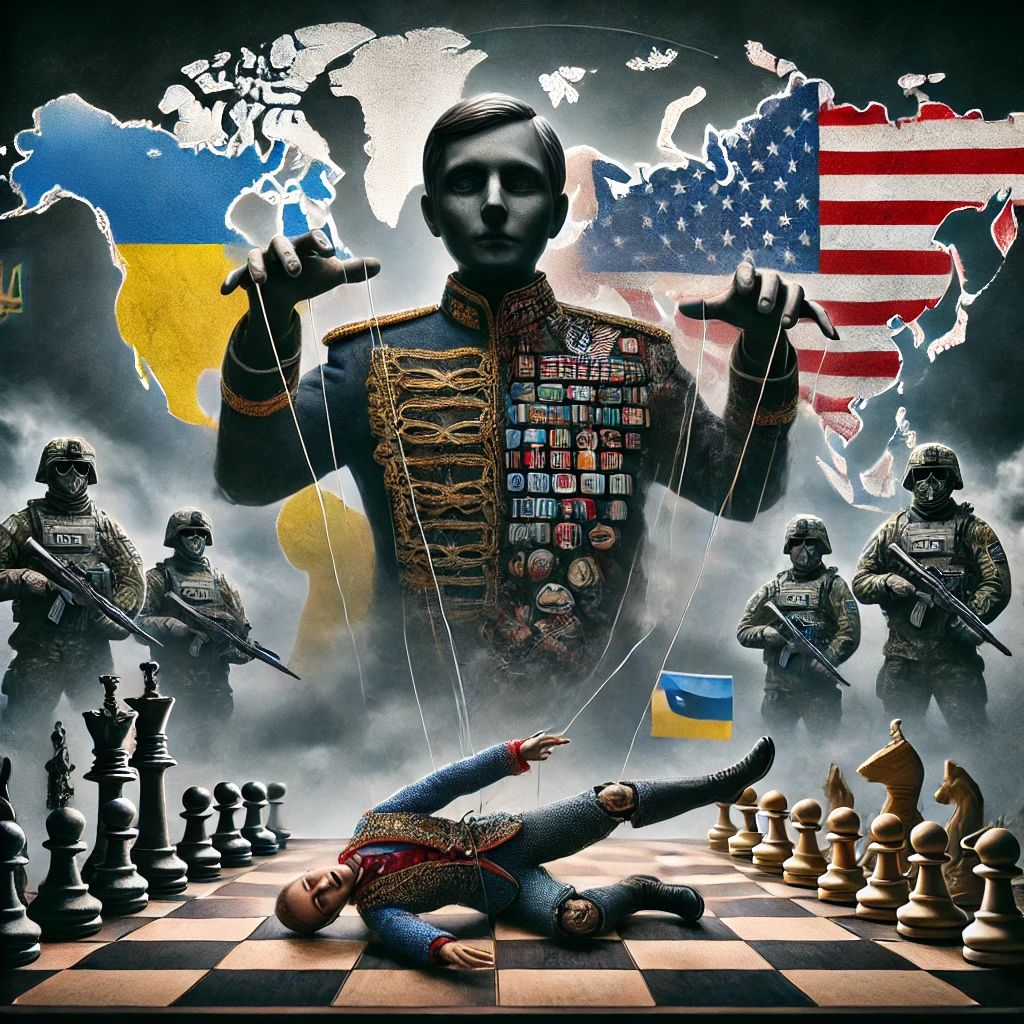
What’s unfolding isn’t just the slow-motion collapse of a man’s political career — it’s the predictable end of a puppet who mistook the strings for wings.
From Hero to Scapegoat: The Empire’s Time-Honored Ritual
It wasn’t long ago that Zelenskyy was a global sensation — the scrappy, camera-ready wartime leader clad in his now-iconic olive drab, speaking at parliaments and gracing magazine covers. He was the West’s perfect creation — a tragic protagonist in a geopolitical drama, a man who could rally public opinion in Washington and Brussels with a carefully crafted plea for weapons and sanctions.
But empires have no use for heroes when the war turns sour.
Ukraine’s much-hyped counteroffensive fizzled. Corruption scandals, long ignored, suddenly became newsworthy. The democratic veneer wore thin as Zelenskyy canceled elections — a move once quietly accepted as wartime necessity now reframed as a troubling sign of authoritarian drift.
Even Zelenskyy’s most loyal backers are slipping away. Senator Lindsey Graham, a man who rarely finds a strongman he doesn’t like, recently suggested it might be time for Zelenskyy to step aside. (New York Post)
The White House meeting sealed his fate. There were no grand announcements of new military aid, no bilateral agreements — not even the critical minerals deal that was supposed to be a lifeline for Ukraine’s battered economy. Zelenskyy looked less like a head of state and more like a man realizing, in real-time, that the trapdoor beneath his feet had already been pulled.
The Empire had made its decision: he was no longer an asset — he was a liability.
Zelenskyy as a Concession to Russia — On U.S. Terms
But why now? Why discard him so abruptly?
The answer lies not in Zelenskyy’s personal failings but in a broader imperial recalibration — one that fits neatly into Trump’s technofascist vision of global control.
Let’s be clear: Zelenskyy’s fall isn’t just a reflection of Ukraine’s failed counteroffensive or his waning popularity — it’s a concession to Russia. But not a concession dictated solely by Russia’s gains on the battlefield. No, this is a preemptive surrender on Washington’s terms — a way for the U.S. to control how Ukraine’s inevitable collapse is managed.
Zelenskyy’s removal allows Trump’s team to pivot without appearing weak, handing Moscow a “victory” but packaging it as a calculated realignment. The U.S. knows it can’t sustain Ukraine’s war effort indefinitely — the military industrial complex is running dry, and public support is fraying — so the new goal is simple: leverage Ukraine as a bargaining chip to drive a wedge between Russia and China.
Trump’s long game is not peace — it’s repositioning.
Divide and conquer: The ultimate U.S. goal is to pry Russia away from its growing alliance with China. Ukraine, in this context, becomes a tool for negotiation — an offering to Moscow in exchange for loosening its ties with Beijing.
Leverage through retreat: By engineering Zelenskyy’s fall and replacing him with figures more palatable to both Washington and Moscow, the U.S. creates a controlled retreat — one that gives Russia a superficial “win” while keeping the real power dynamics firmly in U.S. hands.
Bargaining with borders: Ukraine’s new military leadership — chosen not for democratic credentials but for their willingness to negotiate — becomes a channel through which the U.S. can strike backdoor deals with Russia, ensuring any post-Zelenskyy settlement doesn’t pull Ukraine fully into Moscow’s orbit.
This is Trump’s broader imperial calculus: Russia is no longer the primary threat — China is.
For Trump, the war in Ukraine was never about sovereignty or democracy. It was about boxing Russia into a corner long enough to turn it against China. The U.S. understands that a solid Sino-Russian alliance threatens the very foundation of its global hegemony — creating a vast Eurasian bloc that could challenge both American economic dominance and military supremacy.
By offering Russia a bloodied but symbolic victory in Ukraine — through Zelenskyy’s ouster and controlled negotiations — Trump is dangling a carrot: break with Beijing, and there’s a seat at the table.
It’s a classic imperialist move — not peace, but partition.
The Generals Take the Stage
Zelenskyy’s dismissal of General Valerii Zaluzhnyi earlier this year was more than just a military shakeup — it was the first sign that Washington was preparing for life after Zelenskyy. Zaluzhnyi, once a national hero, had grown too popular for his own good. His replacement, General Oleksandr Syrskyi, wasn’t chosen for his charisma — he was chosen for his loyalty and his willingness to follow the Empire’s orders. (Reuters)
And then there’s Major General Mykhailo Drapatyi, now heading Ukraine’s land forces — another hardliner groomed not for diplomacy but for obedience. (Reuters)
The stage is set for what comes next: the slow militarization of Ukrainian governance.
With Zelenskyy gone, the U.S. can bypass democratic processes entirely. The generals — loyal to Washington — now control both the battlefield and the negotiating table. The question isn’t how to save Ukraine — it’s how to weaponize its collapse.
A Dangerous Friend
And so we return to Zelenskyy — the tragic figure at the heart of this imperial drama.
He wasn’t just betrayed — he was devoured.
The same U.S. officials who once hailed him as the “Churchill of our time” now speak of him as a problem to be managed, a liability to be contained. He is learning, too late, a lesson that countless leaders before him — from Saddam Hussein to Manuel Noriega — learned in far bloodier ways:
It is dangerous to have the United States as an enemy, but deadly to have it as a friend.
Zelenskyy’s fall is not an isolated tragedy — it’s part of the Empire’s broader strategy. His removal allows the U.S. to pivot, to negotiate with Russia from a position of “strength,” and to keep Ukraine as an imperial asset — even as the war sputters to an unsatisfactory end.
But more than that, his ouster is a move in Trump’s larger game — to weaken the Sino-Russian alliance by throwing Moscow a bone, hoping the taste of victory in Ukraine might tempt it to distance itself from Beijing.
Because in Trump’s imperial calculus, Ukraine is just a pawn. The real prize — the real enemy — is China.
And Zelenskyy? He was just collateral damage.
 Weaponized Information
Leave a comment