This review excavates “The Modern Prince” as Gramsci’s prison-forged answer to the West’s revolutionary stall: why fortified capitalism survives crisis through consent, institutions, and “common sense.” It reconstructs his core strategic arsenal—collective will, hegemony, war of position, and the party as the organized brain of the oppressed—against the fantasies of spontaneity and the dead-end of... Continue Reading →
One Nation Under Hostage: The Epstein Archive and the Anatomy of Elite Power
Whitney Webb did not write a book about a scandal. She wrote about a system. In Volume I, she traces blackmail from the Cold War’s underbelly into the bloodstream of U.S. empire, showing how intelligence agencies, financiers, and organized crime learned to discipline one another through leverage instead of law. In Volume II, Jeffrey Epstein... Continue Reading →
Bernal vs. The Aryan Machine: How European Empire Whitened Greece and Called It Civilization
In this Weaponized Intellects book review of Black Athena (Vol. 1), we follow Martin Bernal’s argument that Greece was cut off from its Afroasiatic roots at the very moment Europe was rising to imperial power. We trace how the Ancient Model of Mediterranean entanglement was pushed aside and replaced by the Aryan Model, then cemented... Continue Reading →
Marx’s Grundrisse: Capital’s Global Empire, Labor’s Stolen Time, and the Crisis It Cannot Escape
Marx dismantles liberal political economy and rebuilds the totality from production outward. Exchange and money reveal separation as the architecture of domination. Machinery and the general intellect expose capital’s war against its own measure of value. The world market universalizes crisis while pointing beyond labor time toward free development. By Prince Kapone | Weaponized Information... Continue Reading →
Cedric J. Robinson, Black Marxism and the Colonial Blindspot Inside Western Marxism
Black Marxism and the Colonial Blindspot Inside Western Marxism Cedric J. Robinson did not write Black Marxism to abandon Marxism, but to indict the version of it that emerged safely inside empire. By tracing capitalism’s formation through slavery, racial domination, and colonial war, Robinson forces historical materialism to confront what Western Marxism systematically erased. The... Continue Reading →
Growth Without Development: How Capitalism Produces Abundance, Manufactures Poverty, and Calls It Progress
In The Political Economy of Growth, Paul A. Baran dismantles the myth that growth is neutral or benevolent, exposing it as a class project rooted in surplus extraction and imperial power. He shows how monopoly capitalism turns productivity into waste and development into stagnation, both at home and across the colonized world. Against liberal economics... Continue Reading →
Empire’s Favorite Lie: Michael Parenti, Anti-Communism, and the Moral Alibi of Capital
Anti-communism is not an opinion but an environment. The communist is demonized so empire can call itself innocent. Liberal reason disciplines dissent more effectively than repression. Vietnam exposes anti-communism as an ideology that requires bodies. By Prince Kapone | Weaponized Intellects Book Review | Weaponized Information | January 28, 2026 I. When Anti-Communism Becomes the... Continue Reading →
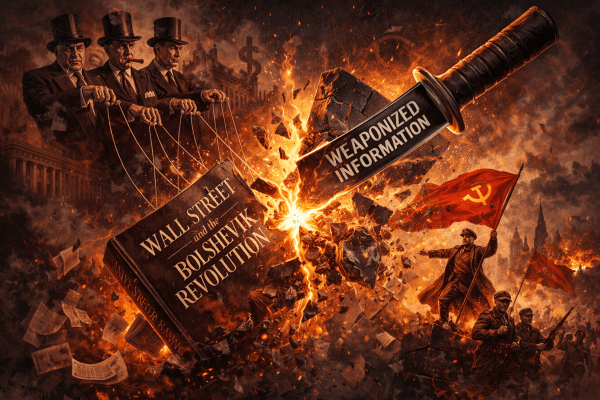
Wall Street vs. the Soviets: Sutton’s Banker Puppet-Show and the Class War He Tries to Hide
Sutton replaces workers, soldiers, and soviets with bankers and boardrooms, turning revolution into elite theater. Trotsky’s travel becomes “proof” of sponsorship, as bureaucracy and wartime chaos are rebranded as capitalist command. Forged documents linger as atmosphere while the real record—bank nationalization, debt repudiation, and trade monopoly—buries the thesis. The book ends where history begins: capital... Continue Reading →
Capital’s Emergency Exit: Michael Parenti, Fascism, and the War on Class Memory
Fascism is not an aberration but a rational instrument deployed when capital loses democratic control. Socialist revolutions expanded freedom for the many and were met with siege, sabotage, and counterrevolution. The restoration of capitalism in the East revealed the market as a system of plunder, repression, and social decay. Anti-communism and class denial function as... Continue Reading →
Walter Rodney’s Guyanese Working People: How Colonial Capital Made the Class It Had to Control
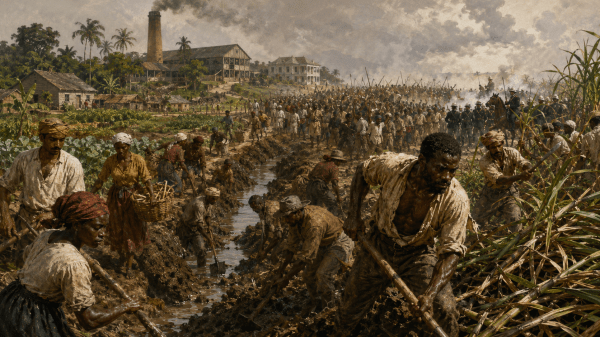
Walter Rodney begins with a colonial society physically reproduced by working people yet organized to deny those same people control over the labor, land, and material conditions that kept it alive. Emancipation shattered slavery’s legal form without resolving capital’s labor problem, forcing the struggle onto new terrain as workers used land, villages, mobility, and subsistence... Continue Reading →