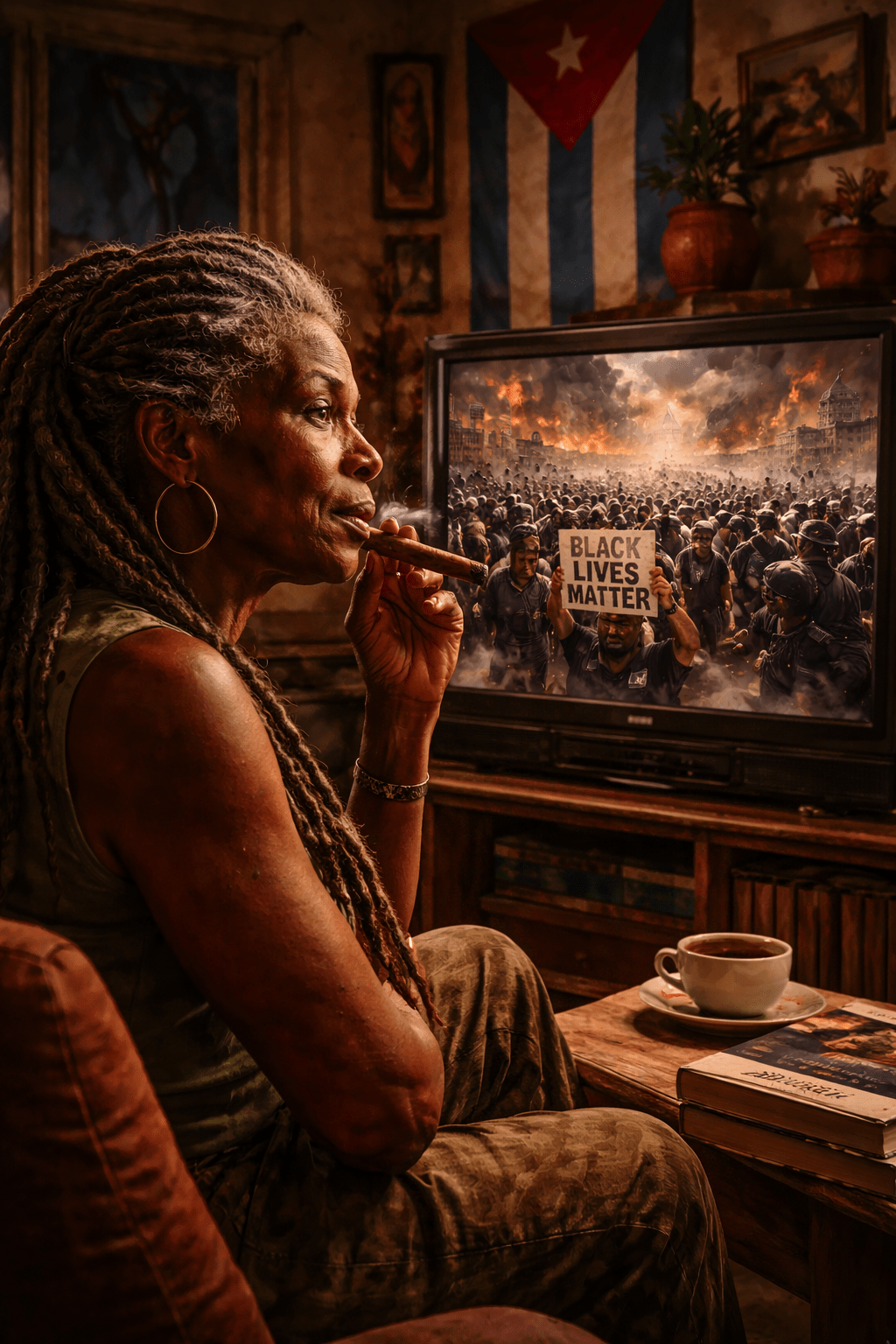
Insurgency inside the empire exposed the structure of repression. Her prosecution revealed counterintelligence as domestic warfare. Her escape redefined political struggle as international. Her exile confirmed that revolution does not end at the prison gate.
By Prince Kapone | Weaponized Information | Black History Matters Series | February 10, 2026
When the Ghetto Became a Colony and the State Declared War
Assata Shakur did not fall out of the sky as a headline. She did not wake up one morning and decide to become what the United States would later call its “Most Wanted.” She was formed in a furnace. And that furnace was the Black urban condition in postwar America — a place where the language of democracy was polished for export while Black neighborhoods were governed like occupied zones.
By the time Assata came of political age, the Great Migration had already transformed the map. Millions of Black families had left the plantations of the South chasing wages and a measure of breathing room in northern and western cities. What they found was not freedom, but reorganization. Segregation without the old signage. Red lines instead of “whites only” signs. Landlords extracting rent from overcrowded apartments. Factories hiring last and firing first. Schools warehousing children for futures already narrowed. And always, always, the police — present not as protectors but as supervisors of the racial order.
The United States congratulated itself on civil rights legislation while maintaining the material architecture of inequality. Voting rights were expanded. Lunch counters were desegregated. But land was not redistributed. Wealth was not shared. Control over schools, housing, and policing remained firmly in the hands of institutions built during slavery and perfected under Jim Crow. Reform, in other words, rearranged the furniture without touching the foundation. The empire prefers symbolic concessions to structural change; it costs less and threatens nothing essential.
Meanwhile, Black working people were living the contradiction daily. Deindustrialization was beginning to hollow out urban labor markets. Jobs that had once absorbed Black migrants were vanishing or being automated. Wages stagnated while rents climbed. Entire communities were declared “blighted” and targeted for clearance rather than investment. And when anger erupted — in Watts, Detroit, Newark — the state did not respond with housing plans and job guarantees. It responded with National Guard troops and armored vehicles. The message was unmistakable: poverty might be tolerated, but rebellion would not.
It is in this atmosphere that revolutionary politics began to look less like extremism and more like common sense. When the police function as an occupying force, when courts routinely process Black defendants through a conveyor belt of conviction, when unemployment and hunger are treated as personal failures rather than structural outcomes, then the conclusion becomes difficult to avoid. The problem is not behavior. The problem is power. The Black Panther Party and related formations did not invent this conclusion in a seminar room. They read it in eviction notices, in arrest records, in the bruises left by nightsticks.
The federal government read it too. And it did not respond with dialogue. It responded with counterintelligence. COINTELPRO was not an overreaction. It was policy. Surveillance, infiltration, rumor campaigns, manufactured charges — the aim was clear: prevent Black political organization from maturing into durable institutions. The word used internally was “neutralize.” Not persuade. Not debate. Neutralize. That is the vocabulary of war. And once the state adopts the language of war against its own citizens, we should be honest about what that means.
Assata’s life unfolded inside this tightening vise. She belongs to a generation that watched reform stall and repression intensify. A generation that saw the gap between American mythology and Black reality widen into a canyon. To treat her story as an isolated criminal case is to participate in amnesia. She emerged from a moment when the ghetto was being administered as an internal colony and when young Black organizers were being treated as insurgents. The state had already drawn its lines. The question was who would step across them.
From Reform to Rupture: The Political Education of a Revolutionary
Assata did not begin her political life underground. She began where many young Black people of her generation began — in classrooms, community meetings, study circles, and street-level organizing. The 1960s did not radicalize people by accident. They radicalized them by exposure. Exposure to police violence. Exposure to war footage from Vietnam. Exposure to the hypocrisy of a government that preached freedom abroad while managing poverty and repression at home. Political consciousness, in that era, did not descend like revelation. It accumulated like evidence.
The early phase of her development was rooted in study and participation. She encountered Black nationalist thought, anti-colonial movements abroad, and socialist critiques of capitalism. This was not theoretical hobbyism. Across Africa, Asia, and Latin America, colonized peoples were defeating European empires. In the United States, Black communities were asking whether their condition differed in structure, if not in form. The question was simple but explosive: if you are policed, surveilled, economically contained, and politically marginalized as a group, what is the proper name for that condition? Many arrived at the word “colony.” Once that word entered the analysis, the political horizon shifted.
Her engagement with the Black Panther Party reflected this shift. The Panthers offered more than slogans; they offered a program. Community survival initiatives, political education classes, armed patrols monitoring police behavior — these were not theatrical gestures. They were attempts to build dual power inside neglected neighborhoods. They were attempts to make theory operational. But the Panthers also faced intense state repression and internal strain. Raids, arrests, assassinations, infiltration — the pressure was relentless. Under such conditions, debates sharpened. Was reform possible? Could open organizing survive sustained counterintelligence assault? What form of struggle matched the scale of repression?
For a segment of militants, including Assata, the answer moved toward clandestine organization. The transition from above-ground activism to underground formation did not occur because violence was glamorous. It occurred because repression was systematic. When offices are raided, leaders imprisoned, and members killed, the political field narrows. Some concluded that survival required a different structure — one less visible, less penetrable, more agile. The Black Liberation Army emerged in that context, not as a spontaneous detour but as a strategic argument: that armed self-defense and clandestine organization were necessary responses to state warfare.
This period in Assata’s life is often flattened into a caricature: a “radical turn.” But the movement from reformist hope to revolutionary rupture followed a logic. When the state treats community organizing as insurgency, it pushes organizers to think like insurgents. When surveillance becomes constant and arrests become routine, politics ceases to be an open debate and becomes a contest of endurance. Assata’s development must be read in that light. She was not searching for violence. She was searching for effectiveness under conditions where legality itself was weaponized.
It is also important to recognize that her generation was not operating in isolation. They studied the writings of Frantz Fanon, the strategies of the Vietnamese liberation struggle, the Cuban Revolution, and the Algerian war against French colonialism. The lesson drawn was not romantic mimicry but structural analysis: when a state responds to political demands with force, the struggle transforms. Western Marxism, often insulated from colonial repression, could afford abstract debates about spontaneity and reform. Black radicals inside the United States were confronting FBI raids at dawn. Theory and survival were collapsing into one.
By the late 1960s and early 1970s, Assata stood within a current of Black revolutionaries who had concluded that the terrain had shifted. Civil rights reform had reached its limit. The state had chosen repression over redistribution. The question was no longer whether change was necessary. The question was what form of struggle could endure the state’s counteroffensive. Her answer, shaped by experience rather than fantasy, moved toward clandestine resistance. The empire would later call this criminality. Those living inside the repression recognized it as escalation in a war that had already begun.
Neutralize, Disrupt, Destroy: How the State Prepared the Case Before the Case
By the time Assata moved into clandestine political life, the United States government had already made a decision about her generation. The FBI did not treat Black revolutionary organizing as protected political activity. It treated it as a domestic threat requiring counterintelligence warfare. The documentation is no longer speculative. Declassified files make the intent plain. The stated objective of COINTELPRO operations targeting Black organizations was to “disrupt, misdirect, discredit, or otherwise neutralize” leadership. The language is surgical. Neutralize does not mean persuade. It means render ineffective by any means necessary.
This campaign did not begin with shootouts. It began with surveillance. Phones were tapped. Mail was opened. Meetings were infiltrated. Informants were cultivated and rewarded. The aim was not simply to gather information but to create instability. Anonymous letters were sent to sow distrust between comrades. False rumors were circulated to intensify factional divisions. Political disagreements were sharpened into fractures. The goal was organizational exhaustion. A movement forced to defend itself constantly has less time to build.
Arrest became another instrument of attrition. Assata was repeatedly detained on charges that collapsed under scrutiny. Armed robbery. Bank theft. Assault. Each case generated headlines, mugshots, and public suspicion. Each case ended in dismissal or acquittal. But acquittal did not restore what arrest had taken. Time in jail cannot be refunded. Legal defense drains resources. Employers withdraw. Communities absorb the psychological cost. The point was not necessarily to win convictions. It was to make political life untenable.
The most revealing element of this pattern is consistency. Across cities — Chicago, New York, Los Angeles — the same structure appeared. Leaders were charged with spectacular plots. Trials dragged on. Evidence unraveled. Meanwhile, offices were raided and cadres imprisoned on lesser charges. The Panthers faced this. So did members of the Black Liberation Army. The criminal code functioned as a flexible weapon. Legality became elastic when applied to Black radicals. Due process bent under the weight of political anxiety.
Assata’s name began circulating in law enforcement circles long before the Turnpike incident. She was identified not as an individual with constitutional protections, but as part of a formation the state had already classified as subversive. When an apparatus as large as the FBI assigns a target, the trajectory narrows. Every interaction becomes evidence. Every association becomes conspiracy. The cumulative effect is to pre-frame the defendant before any formal charge is filed.
This is the atmosphere in which the events of 1973 would unfold. It is critical to understand that the Turnpike confrontation did not emerge from political neutrality. It emerged from years of declared counterintelligence warfare against Black liberation organizations. The state had already invested resources in isolating, monitoring, and prosecuting militants. The narrative infrastructure was in place. The media had been primed. The presumption of danger preceded the facts.
When repression becomes systematic, incidents are never isolated. They are absorbed into preexisting frameworks of suspicion. By the early 1970s, Black revolutionaries were being depicted not as political actors but as criminals by definition. The legal system, under such pressure, does not function in a vacuum. It absorbs the climate. The question was no longer whether a clash would occur. The question was when and how it would be interpreted. The groundwork had already been laid.
The Turnpike: When Counterinsurgency Became a Court Case
On May 2, 1973, a car carrying Assata Shakur, Zayd Malik Shakur, and Sundiata Acoli was stopped by New Jersey State Troopers on the Turnpike. What followed has been recited in headlines for decades. But stripped of hysteria, it was a chaotic roadside confrontation that ended in gunfire. Zayd Malik Shakur was killed. Assata was shot and seriously wounded. Trooper Werner Foerster also died. In the immediate aftermath, the narrative machinery activated with speed and certainty. Assata was identified as the central figure in what was framed as an execution-style killing.
Yet the forensic and testimonial record has always been more complicated than the headlines allowed. Assata was shot in the arm, with her hands reportedly raised. Medical reports indicated nerve damage that would have made it physically implausible for her to fire a weapon in the manner described by prosecutors. No fingerprint evidence tied her to the trooper’s gun. Ballistics were contested. The scene itself was chaotic, with multiple officers firing. The certainty projected in press conferences did not match the ambiguity embedded in the evidence.
But certainty had already been constructed long before the trial began. The political climate of the early 1970s was saturated with fear of Black militancy. Newspapers described the Black Liberation Army as a domestic terrorist network. Law enforcement agencies were under pressure to demonstrate control. Within this environment, the Turnpike incident was less an isolated event than a convergence — years of counterintelligence preparation, media framing, and prosecutorial ambition crystallizing into a single case.
Assata was hospitalized under heavy guard. She was interrogated while injured. Public statements portrayed her not as a defendant awaiting trial but as a symbol of insurgency. The distinction between investigation and condemnation blurred quickly. It is one thing for a state to prosecute a crime. It is another for a state already engaged in a campaign to neutralize a political movement to present a case as confirmation of what it has been asserting for years.
The Turnpike confrontation became the pivot on which the rest of Assata’s life would turn. Not because the facts were simple, but because the political meaning was clear. A Black revolutionary woman, long surveilled and repeatedly arrested without conviction, now stood accused in a case that the state would not afford to lose. The courtroom that followed was not just a site of legal procedure. It was the next theater in a conflict that had been building long before the first shot was fired on that highway.
This Was Not a Trial — It Was a Phase of War
Assata Shakur’s prosecution did not stand alone. It must be read alongside the raids in Chicago that killed Fred Hampton and Mark Clark, the repeated arrests of Huey Newton, the Panther 21 conspiracy case in New York, the New Haven prosecutions, and the long sentences handed down to members of the Black Liberation Army. The pattern is visible to anyone willing to look: surveillance, infiltration, pretrial detention, spectacular charges, media hysteria, and, when necessary, lethal force. The state did not respond to Black revolutionaries as it responds to ordinary defendants. It responded as a government confronting insurgency.
COINTELPRO documents leave little ambiguity about intent. The objective was to “neutralize” leadership, prevent the rise of a Black messiah figure, and disrupt organizational cohesion. Neutralization took many forms. In Chicago, it meant bullets before dawn. In New York, it meant sprawling conspiracy indictments that collapsed under scrutiny but drained years of life from defendants. In other cases, it meant prolonged pretrial incarceration, exorbitant bail, and endless procedural delays designed to exhaust both individuals and movements.
Huey Newton faced repeated prosecutions under intense media pressure. The Panther 21 were accused of fantastical bombing plots and endured the longest criminal trial in New York history before being acquitted. Fred Hampton was drugged, targeted, and killed in a coordinated police-FBI operation later exposed through litigation. Members of the Black Liberation Army were hunted across state lines, prosecuted under expansive liability theories, and handed sentences meant not merely to punish but to deter.
Within this landscape, Assata’s trial functioned as one node in a larger campaign. The state did not need every case to be flawless; it needed the accumulation of cases to send a message. The message was clear: organized Black revolutionary politics would be met with overwhelming force — judicial, administrative, and paramilitary. The courtroom became one of several arenas in which that force was exercised.
What distinguishes political prosecution from ordinary criminal adjudication is not the absence of procedure but the presence of motive. When the defendant is already framed as an internal enemy, the legal process becomes an extension of counterinsurgency. The aim is not only conviction but containment. Not only punishment but example. Assata’s sentencing was therefore not merely about one confrontation on a highway. It was about reinforcing a boundary the state had drawn years earlier: radical Black self-determination would not be permitted to consolidate into power.
Many of her comrades were assassinated. Many others became long-term prisoners. Some, like Assata, were forced into exile. This was not coincidence. It was strategy. The United States government treated Black revolutionary organization as a domestic front in a broader global struggle against anti-colonial movements. Inside that frame, prison was not an aberration. It was policy.
To understand Assata’s conviction is therefore to understand the architecture surrounding it. The trial was not an isolated search for truth. It was a phase in an all-out campaign to dismantle a movement. And like all wars, it left behind its dead, its disappeared, and its prisoners of war — even if the state refuses to use that language.
Prison as Counterinsurgency Infrastructure
After the verdict comes the quieter machinery. The headlines fade. The courtroom empties. But for political prisoners, the real struggle often begins behind the walls. Assata Shakur’s imprisonment cannot be reduced to the fact of incarceration; it must be understood as part of a broader architecture designed to break insurgent consciousness. The modern prison in the United States did not simply warehouse bodies. In the context of the Black Liberation Movement, it functioned as a laboratory of counterinsurgency — isolating leadership, severing communication, and attempting to grind down political will through administrative control.
In the years surrounding Assata’s incarceration, special housing units, control units, and long-term isolation regimes were expanded and refined. Prisoners associated — even allegedly — with revolutionary organizations were classified as “security threats,” subjected to constant surveillance, restricted visitation, and frequent transfers meant to disorient and destabilize. Solitary confinement was not an incidental punishment; it was a method. Lights left on around the clock, monitored correspondence, limited access to reading materials, and arbitrary disciplinary measures formed a pattern recognizable across institutions. These were not random cruelties. They were techniques of political containment.
For Assata, incarceration also unfolded along gendered lines. She entered prison as a Black woman revolutionary at a time when the state portrayed women militants either as manipulated followers or as pathological anomalies. The attempt to strip political identity from women in the movement was systematic. Yet Assata’s writings from prison refuse that erasure. She articulated her captivity not as personal misfortune but as part of a collective struggle against what she described as a racist, patriarchal, and imperial state structure. Her letters and statements from behind bars circulated beyond the walls, transforming prison from a site of intended silence into a site of political communication.
The prison system sought to fragment movements by physically separating their members. But what emerged in the 1970s and 1980s was a counter-current: prisoners who continued to study, write, and develop theory. Across facilities, incarcerated revolutionaries analyzed colonialism, capitalism, and state violence with a clarity sharpened by confinement. Assata’s prison writings reflect this sharpening. They are neither sentimental memoir nor abstract treatise. They are grounded accounts of state power experienced at its most concentrated point — the cell.
The state’s logic was simple: remove leaders, sever networks, exhaust morale. Yet repression has its dialectic. The visibility of harsh confinement, the documentation of medical neglect, and the exposure of retaliatory transfers often clarified rather than obscured the political stakes. When prison conditions mirrored the authoritarianism the movement had denounced, the contradiction became visible. The carceral system, presented publicly as neutral law enforcement, revealed itself as an instrument deeply entangled with racial hierarchy and political control.
To situate Assata’s imprisonment historically is to recognize the expansion of what would later be called the prison-industrial complex. The period following the formal end of Jim Crow saw the rapid growth of incarceration rates, particularly among Black communities. The repression of radical organizations and the broader shift toward punitive criminal justice were not separate phenomena. They developed in tandem. Political prisoners became early occupants of a system that would soon engulf entire neighborhoods.
Assata’s years in confinement therefore illuminate more than her personal endurance. They expose the prison as an extension of counterinsurgency — a domestic mechanism for neutralizing movements deemed threatening to the existing order. If the courtroom declared her guilty, the prison attempted to declare her irrelevant. The historical record shows that it failed in that objective. Her voice, carried through writings smuggled, published, and circulated, outlived the concrete walls meant to contain it.
Breaking the Cage: Liberation as Political Action
Assata Shakur’s liberation from prison was not an accident of lax security, nor an act of individual desperation. It was a coordinated political operation carried out by organized militants who understood incarceration as an extension of war. On November 2, 1979, members of the Black Liberation Army entered the Clinton Correctional Facility for Women in New Jersey, overpowered guards, and removed Assata from custody. No one was killed in the operation. It was swift, disciplined, and deliberate. Within hours, she had disappeared into the underground.
To understand the meaning of this act, one must situate it within the context already established: a state campaign that had assassinated leaders, imprisoned organizers, and neutralized movements through coordinated repression. If imprisonment functioned as counterinsurgency infrastructure, then liberation from that infrastructure was not merely escape — it was counter-counterinsurgency. It was a direct challenge to the state’s claim to permanent custody over revolutionary bodies.
The United States government treated the operation as an affront not simply to prison administration but to sovereign authority. The message was unmistakable: the state does not lose political prisoners without consequence. The scale of the manhunt and the intensity of subsequent prosecutions revealed how deeply symbolic the act was. Assata’s removal from prison punctured the narrative of inevitability. It demonstrated that the apparatus of confinement, however vast, was not invincible.
Strategically, the operation signaled that sectors of the movement had shifted from defensive posture to offensive initiative. In the early 1970s, the state had conducted pre-dawn raids, mass arrests, and assassinations with impunity. By the end of the decade, militants were demonstrating capacity to organize complex actions under surveillance. Whether one agrees with the tactic or not, its political meaning is undeniable: it reframed the balance of agency. The state was no longer the only actor capable of decisive movement.
Internationally, the implications were profound. The liberation of a high-profile political prisoner and her eventual relocation beyond U.S. jurisdiction forced a diplomatic confrontation. It placed the domestic repression of Black radicals onto the terrain of global politics. What had been framed as an internal criminal matter now intersected with questions of asylum, sovereignty, and anti-imperial solidarity. The escape transformed Assata from incarcerated defendant into international figure.
It is important to strip away both sensationalism and sanctification. The operation was risky. It exposed participants to severe reprisal. It intensified state surveillance and prosecution. But it also exposed the political nature of imprisonment itself. If Assata had been merely a criminal defendant, her escape would not have triggered decades of diplomatic pressure and bounty increases. The reaction of the state confirmed what the movement had long argued: this was a political conflict, not a neutral administration of law.
In breaking the cage, Assata’s comrades altered the narrative arc imposed by the state. The prison sentence had been designed as final punctuation — a life defined by walls. The liberation refused that punctuation. It reopened the sentence. It reintroduced motion into a story meant to end in silence. Whatever one’s view of armed struggle, the historical fact remains: her escape marked one of the most audacious acts of political defiance in late twentieth-century United States history.
Exile as Continuation: Cuba, Internationalism, and the Long Arc of Revolutionary Memory
When Assata Shakur arrived in Cuba in the early 1980s, she did not enter hiding as a fugitive seeking quiet anonymity. She entered exile as a political subject relocating within the geography of anti-imperialism. Cuba’s decision to grant her asylum was not sentimental hospitality. It was a sovereign act grounded in the recognition that her prosecution in the United States had unfolded within a climate of political repression. In accepting her, Cuba reframed her status from “escaped criminal” to political refugee. The meaning of that reframing would echo for decades.
Exile did not silence her. It clarified her. In speeches and writings from Havana, Assata sharpened her analysis of the United States as a settler colonial formation sustained by racial capitalism and global militarism. She spoke not as a symbol of victimhood, but as a disciplined revolutionary reflecting on defeat, endurance, and continuity. Her autobiography, written earlier but circulated widely in exile, became more than memoir. It functioned as counter-archive — a reconstruction of the Black Liberation struggle from inside its repression.
In Cuba, she joined a longer tradition of Black radicals who recognized that the struggle of African people inside the United States was inseparable from anti-imperialist struggles abroad. From Malcolm’s international turn to the Tricontinental vision emerging from Havana itself, the logic was clear: the United States could not be understood merely as a domestic democracy with flaws. It had to be understood as an imperial power whose internal racial order mirrored its external domination. Assata’s presence in Cuba made that analysis material. She became a living bridge between Black liberation in North America and revolutionary movements in the Global South.
The U.S. government never relinquished its claim over her body. Bounties were increased. She was placed on federal “most wanted” lists decades after the events of the 1970s. Diplomatic pressure on Cuba persisted. The obsession revealed something deeper than legal persistence. It revealed symbolic anxiety. Assata’s continued freedom represented unfinished history. Her survival contradicted the narrative that the state had fully extinguished the revolutionary generation of the 1960s and 70s. As long as she lived, the story remained open.
Her later years were quieter publicly but not ideologically dormant. She emphasized political education, discipline, and the dangers of romanticizing armed struggle without mass base. In exile she reflected critically on the errors of her era — sectarianism, insufficient consolidation, strategic miscalculations — while refusing to renounce the fundamental legitimacy of resistance to oppression. This intellectual evolution is often ignored by both her critics and uncritical admirers. But it is precisely here that her legacy deepens. She did not fossilize in 1973. She thought, revised, and continued.
When news circulated in 2025 that Assata Shakur had passed away in Cuba, it marked more than the death of an individual. It marked the closing of a living chapter of Black revolutionary history. The last surviving internationally recognized exile of that generation was gone. Yet her death also stripped away the last pretense that the United States would ever “bring her back.” She died beyond its jurisdiction. The empire that had declared her an eternal fugitive could not reclaim her body.
Historical materialism requires sobriety. Exile is not romantic. It is displacement, distance, and the permanent rupture of homeland. Assata lost decades of direct participation in organizing within the communities that formed her. She lived separated from family, culture, and the everyday rhythms of struggle in the United States. That cost must be acknowledged. Yet exile also extended the terrain of struggle. It placed Black liberation within an explicitly international frame, exposing the imperial character of U.S. repression before a global audience.
Her legacy in Cuba complicates Western Marxism’s narrow fixation on European proletarian narratives detached from colonial contradiction. Assata’s life insists that the question of race, nation, and imperialism cannot be subordinated to abstract class schemas. The prison, the ghetto, the colony — these are not peripheral theaters. They are central nodes of capitalist order. Her exile affirmed that analysis materially. She did not seek reintegration into the liberal consensus. She aligned with a state that had openly defied U.S. hegemony.
To remember Assata Shakur only as a defendant in a courtroom is to misunderstand her. To remember her only as a romantic icon of militancy is equally shallow. Her life stretched from student organizer to underground militant to political prisoner to international exile. In Cuba, the arc of that trajectory became visible in full. She embodied the continuity of Black radicalism beyond repression, beyond incarceration, beyond borders. And when she died in 2025, she did so not as a captive, but as a revolutionary who outlived the attempt to erase her.
Revolutionary Continuity in an Age of Counterrevolution
Assata Shakur’s life forces a question that polite liberal memory would prefer to avoid: what does a state do when a colonized population begins to organize not for reform, but for power? The answer is written across her biography with merciless clarity. Surveillance. Frame-ups. Assassinations. Isolation. Psychological warfare. Long sentences. And when all else fails, diplomatic obsession that stretches across decades. Her story is not exceptional because she was uniquely targeted. It is instructive because she was one among many. The repression she endured was structural.
Historical materialism demands that we situate that repression properly. The Black Liberation struggle of the 1960s and 70s did not erupt from cultural grievance alone. It arose from the contradiction between a settler state proclaiming democracy and a racial order sustained by police violence, economic dispossession, and imperial war. When organizations like the Black Panther Party and later the Black Liberation Army linked community survival programs with armed self-defense and anti-imperialist analysis, they crossed a line the state could not tolerate. They were not asking for inclusion. They were articulating dual power — community institutions that challenged the monopoly of state authority.
Assata’s trajectory moves through that moment like a thread through fabric. From organizing in Harlem to underground resistance, from political prisoner to exile, she embodies the arc of a revolutionary generation confronted by counterrevolution. Many were killed. Many remain imprisoned. Some receded into private life. She survived — not because repression failed, but because struggle extends beyond containment. Her life reveals that counterinsurgency is not an episodic event. It is a governing logic of empire.
There is a temptation, particularly within sections of the Western left, to interpret the Black Liberation struggle of that era as tragic excess — brave but premature, militant but strategically flawed. Such readings often center abstract class formulations detached from colonial structure. They treat armed resistance as deviation rather than response. Assata’s life resists that framing. The violence did not originate with her generation. It originated with the plantation, the slave patrol, the lynch mob, the police department, the prison. To discuss tactics without acknowledging the historical monopoly of violence exercised by the state is to misunderstand the terrain entirely.
This does not mean romanticizing every decision made in that era. Assata herself reflected critically on strategic miscalculations and the costs of isolation from mass base. Revolution is not mythic purity; it is contradiction lived at high stakes. But her refusal to renounce the legitimacy of resistance matters. It preserved a line of continuity between anti-colonial struggle globally and Black struggle domestically. She insisted that the ghetto and the colony were linked formations, that police repression at home mirrored military intervention abroad. That analysis has only sharpened in relevance as carceral expansion and imperial militarism have deepened in the twenty-first century.
The state’s enduring fixation on her body — long after the events of the 1970s — revealed another truth. Political memory is dangerous. As long as Assata remained free, the official narrative of total state victory remained incomplete. She was living evidence that revolutionary defeat is never absolute. Counterrevolution can suppress, fragment, and imprison. It cannot retroactively erase the fact that insurgency once threatened the structure of power.
In the present period, where dissent is often channeled into electoral cycles, digital outrage, or symbolic gestures detached from material power, Assata’s life poses a harder challenge. What does organization mean? What does discipline mean? What does it mean to link domestic struggle to global anti-imperialism in practice rather than rhetoric? Her life does not provide ready-made answers for a different historical moment. It does, however, expose illusions. Freedom is not secured by moral appeal alone. Repression is not accidental. And solidarity cannot remain abstract when the state deploys force.
When she died in 2025, the United States lost the ability to parade her as an unresolved fugitive. What remained was her archive — her speeches, her autobiography, the memory of a generation that refused quiet compliance. That archive does not ask for worship. It demands clarity. It demands that we study both the insurgency and the counterinsurgency, the openings and the errors, the courage and the cost.
Assata Shakur’s life is not a relic of a distant era. It is a map of confrontation between a settler-imperial state and a movement seeking self-determination. The map does not tell us to replicate the past mechanically. It tells us to understand the structure we face. And if her story leaves us with anything in 2026, it is this: empire survives by criminalizing resistance and rewriting memory. To study her honestly is to refuse that erasure.
 Weaponized Information
Leave a comment