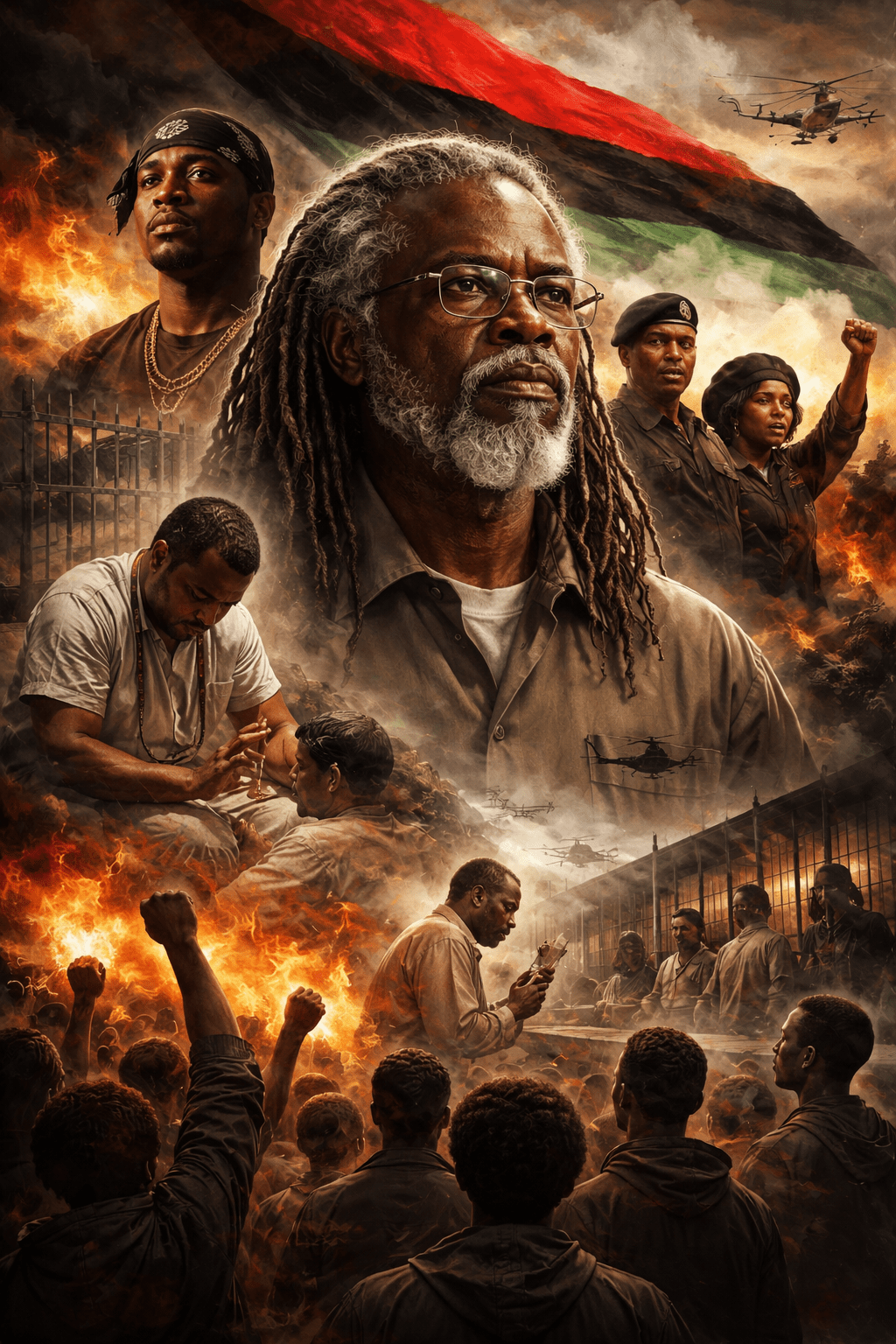
A New Afrikan revolutionary whose life fused care with struggle. A political prisoner held not for what he did, but for what he represented. A case study in how the U.S. state disciplines liberation through time, cages, and memory. His legacy forces a question the system cannot answer: what happens when the oppressed organize to live?
Prince Kapone | Weaponized Information | Black History Matters Series | February 5, 2026
A Revolutionary the System Could Not Rehabilitate
The United States has a well-practiced way of talking about Black resistance: it prefers it either harmless, or insane; either a museum exhibit, or a police file. It can tolerate a symbol that asks for recognition, but it panics at an organizer who builds capacity. That is why the life of Dr. Mutulu Shakur cannot be approached as a “crime story,” a celebrity footnote, or a morality tale about “bad choices.” Mutulu was a New Afrikan revolutionary who moved on the terrain of institutions and struggle—health, community organization, political education, and the hard question that always arrives when reform proves insufficient: what does it mean to resist a system that will not stop harming you simply because you have asked nicely?
Mutulu is dead now. And that fact does not soften the political meaning of his life—it sharpens it. He spent decades in a federal cage, denied freedom again and again, and was released only when the state could tell itself he was no longer a threat in the most literal, physical sense. That is not compassion. That is management. When empires release revolutionaries at the edge of death, they are not admitting guilt; they are trying to close a file on their own terms, to let the body go while keeping the politics buried under bureaucratic language. But politics does not die so easily. The struggle simply shifts its front line—from the courtroom and the prison tier to memory, meaning, and lineage.
To write about Mutulu, then, is to write about the war the state waged on Black liberation in the late twentieth century. Not a metaphorical war—an organized campaign of surveillance, infiltration, prosecution, and long-term captivity aimed at destroying revolutionary continuity. This was the era after the great public peaks of the movement, after the assassinations, after the spectacular raids and the television spectacle of “law and order.” The state learned to do repression with paperwork as well as bullets, to turn political commitments into “risk factors,” and to treat the refusal to renounce one’s beliefs as proof of permanent danger. Mutulu’s case belongs to that history because he refused to convert his politics into apology.
But Mutulu also belongs to another history, one the official narrative cannot digest: the history of revolutionary care. He was not only a militant in an age of repression; he was a healer in an age of social poisoning. He understood that addiction, misery, and premature death are not random misfortunes in Black communities—they are structured outcomes of racial capitalism, concentrated poverty, and state abandonment. Where the system offered punishment and containment, he worked to build treatment and dignity under community control. That is precisely why he mattered. An empire can vilify a gun. It struggles to explain why it must also fear an acupuncture needle, a detox clinic, a disciplined political education circle, a comrade who treats the body as a site of liberation rather than defeat.
This essay does not romanticize, and it does not plead. It studies. It treats Mutulu Shakur as a historical figure shaped by forces larger than any individual—deindustrialization, policing, counterinsurgency, the collapse of liberal promises—and as an agent who chose a line of struggle within those forces. The point is not to build a shrine. The point is to recover a political lesson: when Black liberation organizes itself into institutions and continuity—when it becomes a living practice rather than a protest performance—the state responds not with dialogue but with suppression. Mutulu’s life is a record of that truth. And the work of remembering him is not nostalgia. It is education for a struggle that has not ended.
Forged in a Colony That Called Itself a Nation
Mutulu Shakur did not emerge from a vacuum, nor from the caricature of rage that the state prefers to assign to Black revolutionaries. He was formed inside a very specific historical moment: the collapse of the postwar liberal promise and the rise of a Black radical generation that understood the United States not as a flawed democracy, but as a settler empire with internal colonies. For New Afrikan militants of his generation, the question was not how to integrate more fully into a system that had already revealed its limits, but how to build power, health, and dignity under conditions of permanent hostility. This was the political soil from which Mutulu grew.
He came of age as the victories of the Civil Rights era curdled into disappointment. Formal desegregation did not bring jobs, housing, or safety. Urban Black communities were instead met with deindustrialization, heroin flooding the streets, and a rapidly expanding police presence that treated entire neighborhoods as enemy territory. The language of equality remained, but its material content evaporated. For many, this contradiction produced despair or accommodation. For others, it produced clarity. Mutulu belonged to the latter current—a layer that recognized that what was being administered to Black people was not neglect, but social control.
The New Afrikan Independence Movement provided a framework to name this reality. It argued that Black people in the United States constituted an oppressed nation, not merely a disadvantaged minority, and that their condition could only be understood through the lens of colonial domination. This was not abstract theory. It explained why police functioned like an occupying force, why addiction was managed rather than cured, and why appeals to morality consistently failed. Mutulu absorbed this analysis not as dogma, but as a living explanation of what he saw around him. It allowed him to connect personal suffering to political economy, and individual survival to collective liberation.
Crucially, this tradition rejected the false separation between political struggle and social well-being. Health was not neutral. Addiction was not an individual moral failure. These were battlefields shaped by policy, profit, and repression. Mutulu’s turn toward community-controlled health work—particularly around drug addiction—must be understood in this context. He was not stepping away from revolutionary politics; he was deepening it. To heal people poisoned by a system is itself an act of resistance, especially when the state has chosen punishment and incarceration as its primary response.
This period of formation reveals a key truth about Mutulu Shakur’s trajectory: he was never only reacting to oppression. He was studying it, naming it, and working to build counter-institutions in its shadow. His politics fused analysis with practice, militancy with care. That synthesis would later make him especially threatening to the state. A revolutionary who understands both how to fight and how to sustain life under siege cannot be easily neutralized by co-optation or reform. The foundations laid in this early period shaped everything that followed—his organizing, his commitments, and ultimately the ferocity with which the system moved to remove him from the field.
Healing as Resistance in an Age of Social Poisoning
By the early 1970s, the crisis tearing through Black communities was no longer only police violence or unemployment, but something quieter and more devastating: mass addiction. Heroin spread through neighborhoods already hollowed out by job loss and housing segregation, functioning less like an accidental epidemic and more like a chemical form of social control. The state responded predictably. Rather than treating addiction as a public health emergency rooted in political economy, it framed it as criminal pathology. Punishment replaced care, prisons replaced clinics, and entire generations were marked for containment. Mutulu Shakur entered this terrain with a radically different understanding of what liberation required.
Mutulu helped build community-controlled detoxification and acupuncture programs that treated addiction not as individual failure but as collective injury. These were not charity projects. They were political interventions rooted in the belief that a colonized people must reclaim control over their own bodies if they are to reclaim control over their future. Where the state offered surveillance and incarceration, Mutulu and his comrades offered treatment, dignity, and discipline. Healing became a form of resistance precisely because it interrupted the system’s preferred outcome: broken bodies cycling endlessly through courts, jails, and early graves.
This work placed Mutulu at the intersection of health and politics in a way that unsettled liberal sensibilities. Liberal reform could tolerate social workers and therapists operating under state supervision, but it recoiled at clinics accountable to revolutionary organizations and communities rather than to funding agencies or police departments. Mutulu’s approach insisted that health could not be separated from power. Addiction flourished where people were denied control over their lives; recovery required more than abstinence—it required collective purpose and political clarity. This was a direct challenge to a system invested in managing symptoms rather than confronting causes.
The state understood this threat intuitively. A revolutionary who organizes guns can be portrayed as violent. A revolutionary who organizes care exposes a deeper contradiction: if oppressed communities can heal themselves, then the claim that repression is necessary for “public safety” collapses. Mutulu’s work demonstrated that what Black neighborhoods lacked was not discipline imposed from above, but resources and self-determination. That lesson cut against the ideological foundation of the emerging carceral state, which was expanding rapidly under the banner of order and security.
This phase of Mutulu Shakur’s life shows why he cannot be reduced to a single moment or tactic. He was building infrastructure for survival under siege—institutions meant to keep people alive, conscious, and connected in a period when the state was accelerating its war on Black political life. Revolutionary care was not a retreat from struggle; it was preparation for its long duration. By treating the body and the community as sites of resistance, Mutulu helped carry Black liberation politics beyond protest and into the difficult work of sustaining life in the face of systematic harm. That achievement would later make the state’s response to him not only punitive, but relentless.
When Survival Work Collided with Counterinsurgency
By the mid-to-late 1970s, the political terrain confronting Black liberation forces had hardened dramatically. Open organizing was met with infiltration, indictments, assassinations, and long prison sentences. COINTELPRO had done its work not only by destroying organizations, but by making clear that disciplined revolutionary activity would be treated as warfare against the state. For militants like Mutulu Shakur, this was not an abstract lesson. It was a lived reality, confirmed repeatedly as community programs were surveilled, leaders were neutralized, and every form of autonomous Black power was framed as criminal conspiracy.
This was the context in which some revolutionaries concluded that survival itself required going underground. This decision was not born of adventurism or impatience, but of a sober assessment of the balance of forces. When legal channels are closed, organizations smashed, and political work criminalized wholesale, movements face a grim choice: retreat into depoliticized survival, or adapt their methods to continue resistance under new conditions. Mutulu’s trajectory into clandestine struggle must be understood in this light—not as a personal deviation, but as part of a broader historical pattern in which oppressed peoples confronted a state that had declared their liberation efforts illegitimate by definition.
The underground was not imagined as a substitute for mass struggle, but as a defensive response to counterrevolution. Its logic was shaped by the understanding that the state had already crossed the line from repression to open political warfare. For Mutulu and his comrades, the question was not whether the system was violent—it had demonstrated that repeatedly—but whether resistance would be allowed to exist only on the terms of the oppressor. To accept those terms would have meant abandoning the very communities being devastated by addiction, incarceration, and economic abandonment.
At this stage, Mutulu’s commitments remained consistent even as the terrain shifted. He did not abandon the belief that liberation required institutions, discipline, and collective responsibility. The underground, in this sense, was not a rejection of community work but an attempt to defend the possibility of it under conditions of escalating repression. The state, however, interpreted any refusal to submit as confirmation of criminality. Political intent was erased, and all resistance was reclassified as terror or banditry. This erasure was not accidental; it was the ideological prerequisite for long-term imprisonment and social isolation.
This part of Mutulu Shakur’s life reveals a hard truth about revolutionary struggle under empire: when movements threaten the foundations of power, the state does not negotiate—it seeks to eliminate. The shift from community-based organizing to underground resistance marks the moment when the state’s tolerance fully evaporated. From that point forward, Mutulu was no longer treated as a dissident or organizer, but as an enemy to be neutralized permanently. Understanding this transition is essential, not to celebrate clandestinity, but to grasp the conditions that produce it and the costs that follow when a system leaves no legal space for liberation politics to breathe.
From Manhunt to Cage: How the State Makes Politics Disappear
The capture and prosecution of Mutulu Shakur completed a process the state had been refining for years: the transformation of political struggle into ordinary crime. Once seized, the language of counterinsurgency gave way to the language of courts, indictments, and sentencing guidelines. This shift was not neutral. It was strategic. By stripping context from history and intent from action, the state could present its war on Black liberation as the impartial administration of justice. What had been a political conflict was repackaged as a criminal case, and the broader conditions that produced resistance were rendered legally irrelevant.
Mutulu’s trial exemplified this architecture of disappearance. Jurors were asked to evaluate acts in isolation, severed from the long campaign of repression that preceded them. The devastation of Black communities by addiction, unemployment, and police occupation was treated as background noise. The destruction of organizations, the assassinations of leaders, and the systematic closure of legal avenues for dissent were excluded from consideration. In this courtroom theater, the state appeared as a neutral arbiter, while the revolutionary appeared as an inexplicable anomaly—a dangerous individual rather than a product of historical forces and political choices.
Sentencing completed the erasure. Mutulu was given decades of imprisonment not simply to punish past actions, but to prevent future influence. Long sentences function as political tools: they remove experienced organizers from the field, sever them from younger generations, and signal to others the cost of refusing accommodation. Prison becomes an extension of counterinsurgency by other means, enforcing social death where physical death might provoke resistance. In this way, incarceration replaces the spectacle of assassination with the quiet permanence of captivity.
Yet even inside the cage, Mutulu refused the conversion the system demanded. Parole hearings became rituals of ideological coercion, requiring expressions of remorse stripped of political analysis and denunciations of one’s own past commitments. Mutulu’s repeated denials of parole were not about risk assessment in any meaningful sense. They were about belief. He remained dangerous not because he posed an immediate physical threat, but because he would not renounce the conclusion that the system itself was the source of the harm he had spent his life confronting. The state could imprison his body, but it could not extract the confession it wanted.
This phase of Mutulu Shakur’s life exposes the function of political imprisonment in the modern United States. It is not merely to punish lawbreaking, but to discipline historical memory. By burying revolutionaries under decades of incarceration, the state hopes to teach future generations that resistance leads only to isolation and erasure. Understanding this mechanism is essential for any serious analysis of repression. Mutulu’s captivity was not an aberration; it was the logical conclusion of a system that had already decided that Black liberation, when organized and continuous, must be extinguished rather than addressed.
Time as a Weapon, and Work as a Refusal
The state did not merely lock Mutulu Shakur away; it tried to bury him inside the slow violence of time. Decades in federal prison are not an “outcome” of justice so much as a strategy of counterinsurgency: remove an organizer from his people, sever a lineage from the next generation, and let history fade into a whisper. But this is the part the prison narrative always tries to erase: incarceration did not end Mutulu’s revolutionary work. It only changed its terrain. The cage became another front in the struggle, and he refused to live there as a defeated man.
Inside, Mutulu continued to function as what he had always been—a political educator and a builder of consciousness. Accounts from supporters and movement-aligned outlets describe him organizing political education, advocating for human rights, and providing health-oriented support to fellow prisoners, earning respect across generations inside the facilities where he was held. He did not convert his politics into apology to satisfy parole boards, but he did insist on a disciplined practice of transformation: the kind rooted in collective responsibility rather than in the state’s demand for ideological surrender. This is one reason his imprisonment stretched so long. The system can tolerate a prisoner who “reforms” into compliance. It struggles with a prisoner who matures into clarity and uses confinement as a classroom.
That commitment to education and responsibility also extended beyond the prison walls, into the realm of culture and youth politics. Mutulu’s relationship with Tupac was not merely familial; it became political and pedagogical. He wrote from prison with the voice of an elder who understood that young people surrounded by violence often have their survival instincts criminalized while the social conditions producing that violence are treated as natural facts. In that context, the “Code of Thug Life” appears not as a gimmick, but as an attempt to impose discipline, restraint, and a collective ethic on street life that the state preferred to keep chaotic and self-destructive. Mutulu’s own site credits him, alongside Tupac, with developing that code as a framework meant to reduce harm and enforce conduct—no shooting at parties, no targeting children, respect community spaces—rules that sound like common sense precisely because the empire profits from their absence.
And this is the deeper political meaning of his prison work: Mutulu treated human beings as recoverable, even when the prison system treated them as disposable. He pushed against the prison’s preferred economy of despair—violence, fragmentation, religious-only “programming,” and managed hopelessness—by supporting educational and cultural efforts that helped people move from a criminalized mentality toward liberation consciousness. When those kinds of programs take root, they expose the fraud at the heart of the carceral state: that “security” often means preventing oppressed people from becoming organized, thoughtful, and united. In other words, the prison does not simply punish bodies; it polices consciousness.
So when we say time was used as a weapon against Mutulu Shakur, we also have to say what he did with that time. He turned captivity into continuity. He kept teaching. He kept insisting that healing and discipline are not opposites of resistance but conditions for it. The state wanted his years to dissolve into silence. Instead, he used those years to keep alive a line of struggle—inside the very institution designed to extinguish it.
What Endures After the Cage Opens and the Body Fails
Mutulu Shakur’s death does not close a chapter; it clarifies one. The state released him only when it could tell itself that his body, weakened by illness and age, no longer posed a threat. But this calculation misunderstands how political legacy works. Movements are not powered by bodies alone—they are sustained by lineages of analysis, practice, and refusal. What endures after Mutulu is not a myth of invincibility, but a record of consistency: a life that never separated healing from liberation, or care from confrontation, even when the costs became unbearable.
His legacy lives first in the insistence that revolutionary politics must address the totality of life. Mutulu understood that a people broken by addiction, untreated illness, and daily degradation cannot be organized simply by slogans or outrage. Liberation requires institutions that keep people alive, conscious, and connected. This lesson cuts against a politics that substitutes visibility for capacity and protest for infrastructure. In an era where spectacle often replaces organization, Mutulu’s work reminds us that the slow labor of building community power is not secondary to struggle—it is its foundation.
His life also exposes the continuity of repression across generations. The techniques change—COINTELPRO gives way to terrorism statutes, parole boards replace assassins—but the objective remains the same: to isolate those who refuse accommodation and to sever their influence over time. Mutulu’s decades of captivity teach that the state fears not only armed resistance, but political memory itself. That is why remembering him accurately matters. To reduce him to a crime story is to finish the state’s work for it. To situate him within the long arc of Black liberation is to break that spell.
For the radical left as a whole, Mutulu’s trajectory raises difficult but necessary questions. What happens when reform proves structurally incapable of addressing harm? How do movements sustain care, discipline, and continuity under conditions of repression? And how do we prepare for the reality that the state will seek not just to defeat struggles in the street, but to exhaust them over time? Mutulu does not offer easy answers. He offers a lived example of commitment under pressure and clarity without apology.
To carry Mutulu Shakur forward is not to reenact his choices mechanically or to romanticize underground struggle. It is to absorb the lessons his life makes unavoidable: that liberation is holistic, that repression is patient, and that dignity cannot be granted by a system built to deny it. His death marks the end of a life, not the end of a political problem. As long as communities are managed through punishment rather than care, and as long as resistance is criminalized rather than confronted honestly, the questions Mutulu organized around will remain unresolved. Remembering him, then, is not an act of mourning alone. It is a commitment to continue the work with greater clarity, deeper organization, and an unbroken sense of historical responsibility.
Discipline Against Decay: Building the Social Order the System Could Not Control
What made Mutulu Shakur dangerous to the U.S. state was not simply defiance, but construction. He represented a tradition of New Afrikan revolutionary discipline that directly challenged the social logic of racial capitalism, which depends on fragmentation to govern colonized communities. The system prefers Black life disorganized—broken families, atomized individuals, unmanaged grief, unchanneled rage, and self-destruction packaged as “culture.” Mutulu moved against that current. He treated chaos not as a natural condition but as an administered outcome, and he worked—on the streets and later behind bars—to impose collective ethics where disorder was profitable.
This is why his politics cannot be reduced to militancy alone. Mutulu understood that domination does not operate only through police and courts, but through the internalization of decay. Addiction, interpersonal violence, nihilism, and the erosion of communal obligation are not incidental side effects of oppression; they are functional to it. Revolutionary discipline, in this sense, was not moralism and not respectability. It was strategy: turning survival into responsibility, turning street intelligence into collective principle, and making community safety a matter of people’s power rather than police occupation.
In that light, the cultural work associated with Mutulu—his letters, mentorship, and interventions such as the Code of Thug Life often attributed to his influence alongside Tupac—should be understood as part of the same project: reducing harm, regulating conduct, and asserting a communal ethic against conditions designed to produce self-annihilation. Whether one agrees with every formulation is less important than grasping the political stakes. The state can criminalize a gun with ease. It struggles to explain why it must also fear a code, a clinic, a study group, an elder voice insisting that oppressed youth are not disposable.
This is why parole became a battlefield over meaning. A disciplined revolutionary who returns to the community as an elder—without apology, without renunciation, with credibility earned through sacrifice—poses a different kind of threat than a rebellious youth. He carries continuity. He transmits line. And that is precisely what the state moved to prevent by keeping Mutulu confined: not merely to punish a past, but to block a future in which disciplined liberation politics could circulate again with renewed authority.
Released to Die: How Empire Tries to Close the File on Its Own Terms
Mutulu Shakur’s release and death force us to confront the cold mechanics of state power without the sentimental fog the ruling narrative prefers. He was freed only when terminal illness allowed the system to claim he no longer posed a threat in the most literal sense. This was not reconciliation. It was administrative closure—an attempt to let the body go while keeping the politics contained, to end a decades-long captivity without acknowledging what it was designed to accomplish. The empire’s mercy arrived only after it had extracted what it wanted: time, isolation, and the hope of erasure.
Yet release did not end the struggle over Mutulu. It relocated it. Once a revolutionary dies, the next battlefield is memory: will he be remembered as a “criminal,” a cautionary tale, a confused radical, or as a freedom fighter shaped by a historical war against Black self-determination? This fight over meaning is not secondary. It is central. If the state can control the narrative, it can turn repression into common sense and captivity into morality. If movements preserve the truth, then Mutulu’s life becomes a lesson in how power behaves when challenged—and how liberation must organize itself for the long duration.
What endures from Mutulu is not the myth of invincibility but the record of consistency: a politics that fused care with struggle and refused to separate healing from power. He leaves behind a strategic inheritance for our time: that liberation requires institutions that keep people alive, conscious, and connected; that repression is patient; and that the state does not fear anger as much as it fears organized continuity. To remember him accurately is to refuse the empire’s final demand—that he be reduced to a file rather than carried forward as a lineage.
The Prisoner as Evidence: What the State Confessed by Holding Him
Mutulu Shakur’s decades in federal prison are not only a personal tragedy. They are structural evidence. They reveal what the United States will do when Black liberation moves beyond protest into durable capacity—when it builds institutions, transmits ideology, and produces disciplined cadres. The long sentence functions as a political technology: it removes organizers from the field, severs them from their communities, and attempts to break the chain between generations. In this model, imprisonment is not the aftermath of conflict. It is a continuation of conflict under the cover of legality.
This is why political prisonerhood matters historically. It interrupts the lie that radicalism simply “faded” because it was misguided or unpopular. Mutulu’s captivity demonstrates the opposite: the state invested enormous time and resources to neutralize a revolutionary current, and it did so not only with raids and headlines, but with parole denials, administrative endurance, and the slow grind of isolation. The prison cell becomes a record of the captor’s fear. It tells us that the movement posed enough of a threat to require decades of containment.
Read in this way, Mutulu belongs to a long arc of repression stretching from slavery to mass incarceration—an arc in which the techniques evolve while the objective remains constant: to prevent Black self-determination from becoming structural and irreversible. Recognizing this continuity is not a call to despair. It is a call to seriousness. If the state is willing to wage a long war to defend its order, then movements must build with the same patience: deep political education, durable institutions of care, disciplined ethics, and organizational forms capable of surviving loss. Mutulu’s life, and the state’s response to it, leave us with a clear conclusion: the struggle is not only against poverty and police, but against a counterinsurgency system designed to make liberation impossible.
From History to Obligation: What Mutulu Shakur Demands of Us
To study Mutulu Shakur seriously is to move beyond commemoration and into obligation. His life does not invite passive admiration; it presses a question onto the present: what does it mean to struggle under conditions where the state has already decided that your liberation is illegitimate? Mutulu’s trajectory—from community health work to underground resistance to decades of captivity—forces us to confront the continuity of power, not its exceptions. The system did not malfunction in his case. It operated with consistency, clarity, and patience.
The lesson here is not that every generation must repeat the same forms of struggle, but that every generation must reckon honestly with the terrain it inhabits. Mutulu’s era revealed the limits of liberal reform, the inevitability of repression once power is built from below, and the necessity of institutions that can sustain life under siege. Our era adds new technologies of surveillance, new legal regimes of criminalization, and new spectacles of inclusion that often mask old relations of domination. What remains unchanged is the central contradiction Mutulu confronted: a system that manages harm rather than ending it cannot be reformed into justice by goodwill alone.
Mutulu also leaves us with a standard of seriousness. He did not treat politics as performance or identity as currency. He treated struggle as work—long, unglamorous, and collective. He understood that liberation requires discipline, study, and the willingness to endure isolation without surrendering analysis. This is an uncomfortable inheritance in a political culture that rewards immediacy and visibility. Yet it is precisely this seriousness that made him dangerous to the state and indispensable to the movement that raised him.
If Mutulu’s life teaches anything decisively, it is that memory itself is a battleground. The state hopes that time will turn revolutionaries into cautionary tales or footnotes. Our task is to refuse that framing. To remember Mutulu Shakur accurately is to insist that Black liberation has always produced thinkers, healers, and organizers capable of naming the system and acting against it. It is to recognize that repression does not invalidate a struggle; it confirms its relevance.
The work ahead, then, is not to mourn what was lost, but to carry forward what was clarified. Mutulu’s life makes plain that freedom without power is illusion, that care without control is temporary, and that resistance without continuity is easily buried. To honor him is to organize with those truths intact—to build institutions that heal, educate, and defend; to prepare for repression without fetishizing it; and to understand ourselves as part of a longer historical line. From that standpoint, Mutulu Shakur is not only a figure of the past. He is a measure of the future we are willing to fight for.
 Weaponized Information
Leave a comment