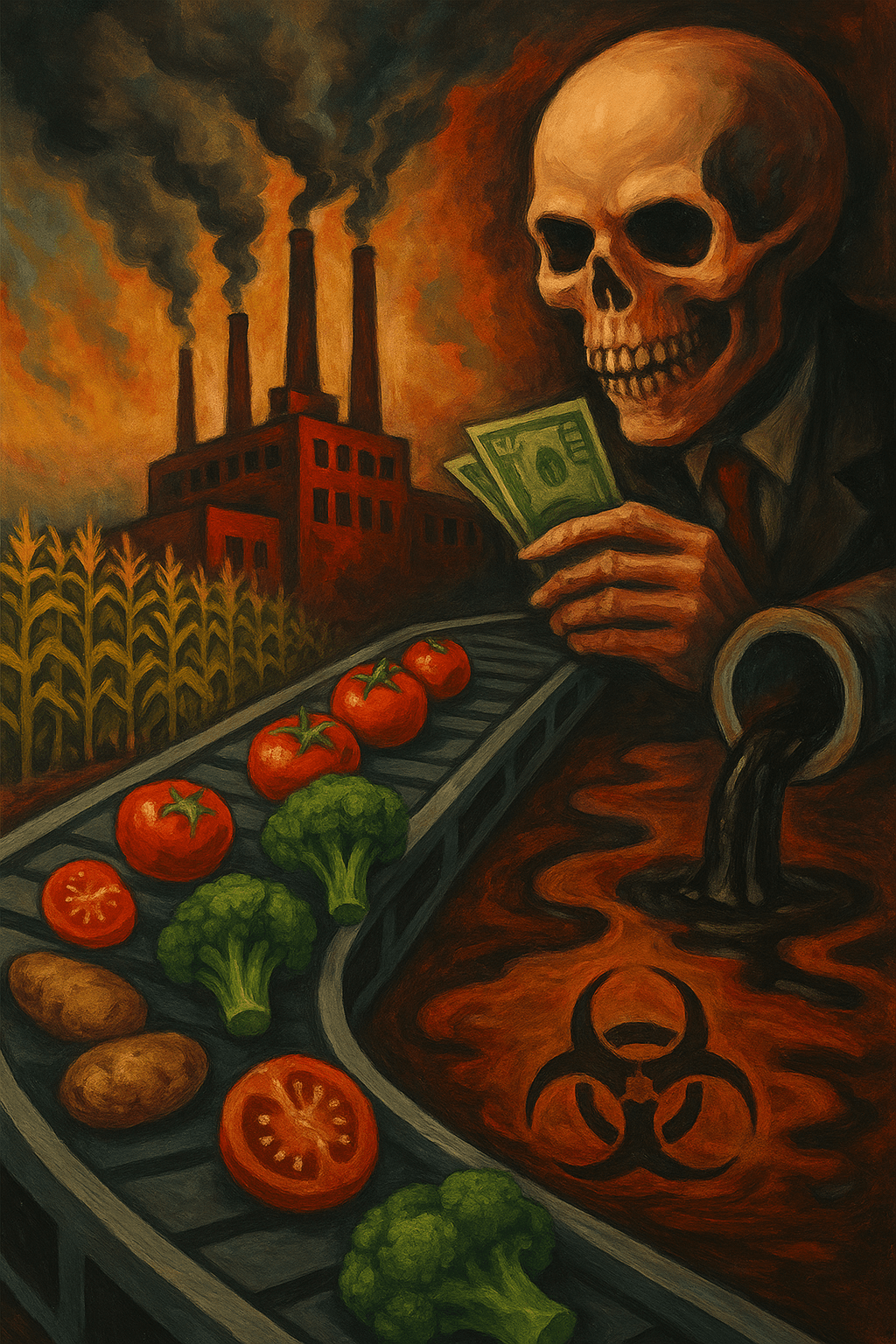
A Guardian report warns of rising toxins in our food—but refuses to name the forces that built, profit from, and globalize the chemical regime. This analysis excavates the facts, restores the missing history, and reframes the crisis from the standpoint of the workers, peasants, and nations who bear its costs.
By Prince Kapone | Weaponized Information | December 11, 2025
How The Guardian Turns a Manufactured Crisis Into a Natural Disaster
In early December 2025, The Guardian published a report warning that a rising tide of synthetic chemicals—phthalates, bisphenols, pesticides, and PFAS—has seeped deep into the global food system, carrying severe health risks for workers and children alike. The piece draws on expert testimony to outline a world increasingly saturated with endocrine disruptors and brain-damaging compounds, presenting a portrait of a food economy quietly poisoned by the very materials meant to sustain it. But even in its most alarming moments, the article hesitates to confront the forces shaping this toxic landscape, leaving readers with symptoms but no system, harms without architects, and a crisis floating free of the politics that produced it.
The Guardian wants you to believe that synthetic chemicals slipped quietly into our food system like uninvited guests, drifting in through the back door of modernity. Its December report on phthalates, bisphenols, pesticides, and PFAS reads like a lament for a world where “somehow” the pantry became poisoned. It’s a familiar performance: the Western liberal press wringing its hands at the consequences while making sure the reader never glimpses the hands that mixed the brew. The tone is urgent but strangely weightless, heavy with worry but empty of accusation—an environmental ghost story told without mentioning the landlord.
At the center of the Guardian’s drama is a world built by unnamed forces, where toxins spread through packaging and agriculture as if guided by fate. The reporter opens the curtain just wide enough for us to see a parade of harmful chemicals—phthalates in the gloves that touch our food, pesticides saturating fields, “forever chemicals” drifting through air, soil, and water. But the story’s architecture carefully avoids placing anyone at the controls. The tragedy is framed as ambient, structural, even cosmic: the cost of doing business in the modern world. No villains, no profiteers, no regulatory engineers—just a vague sense that humanity tripped into a toxic ditch and now must climb out together.
Even the choice of guide reflects this political sleight of hand. The article leans on the voice of a respected pediatric expert, who recounts the rise of non-communicable diseases among children and worries about chemicals that “damage developing brains” and alter bodily systems. He is earnest, thoughtful, and deeply alarmed. But he is positioned as the sole bearer of uncomfortable truths in a story that avoids asking why he has to speak alone. By centering the scientific messenger and obscuring the political machinery behind the crisis, the piece cleverly transforms structural violence into a technical problem. The system is absolved; the chemical catastrophe becomes a matter of inadequate oversight rather than the predictable outcome of how global food production is organized.
The narrative tools sharpen as the article progresses. There is the quiet naturalization of the crisis, where chemicals appear in our food as though they slipped past civilization while no one was looking. There is the dispersal of responsibility, where the harms—cancers, birth defects, endocrine disruption—float untethered to their manufacturers. There is the fatalistic shrug that arrives when the expert warns of “thousands of chemicals about which we know nothing,” as if ignorance were a law of physics rather than a product of political choice. And finally, there is the classic liberal sleight of hand: the focus on vulnerable children that elicits sympathy while diverting our gaze from the institutions and industries that made those children vulnerable in the first place.
If the Guardian has a signature, it’s this: the transformation of power into atmosphere. In this telling, chemical exposure is not the result of corporate design, deregulated markets, or state complicity; it is a tragic fog settling over the world. The article admits fear, confusion, even outrage, but it refuses to anchor them anywhere material. The familiar villain remains offstage, unnamed, untouched. And in this silence—this refusal to identify the forces that turn the global food system into a chemical battleground—the propaganda does its work. It trains the reader to see catastrophe without cause, victims without perpetrators, and a world poisoned by everything and nothing at once.
This is the opening move of liberal environmental reporting: narrating devastation while protecting the system that manufactures it. The Guardian’s story is not a failure of journalism; it is journalism performing exactly as designed. The article invites us to mourn the crisis, fear the chemicals, pity the children—but never, under any circumstances, to name the architects. It is here, in this carefully crafted silence, that the propaganda lives.
Pulling the Hidden Threads: What the Guardian Reveals, Conceals, and Refuses to Understand
Once we strip away the Guardian’s atmospheric storytelling, we’re left with the actual bones of the report—facts that are verifiable, concrete, and quietly devastating. The article identifies four families of synthetic chemicals circulating through the global food system: phthalates and bisphenols in packaging and food-handling gloves, pesticides saturating industrial agriculture from seed to shelf, and PFAS coating everything from greaseproof wrappers to popcorn tubs before drifting into the air, water, and soil. The harms listed are not ambiguous: endocrine disruption, cancers, birth defects, developmental impairment, metabolic disease. The pediatric expert interviewed draws a clear connection between rising exposure to manufactured chemicals and the surge in non-communicable diseases among children. And the article does not shy away from one grim admission: there are thousands of chemicals in circulation about which we know virtually nothing.
But these facts, while important, illuminate only the narrow corridor the Guardian allows us to see. Each one is extracted from a larger structure, a deeper archive of knowledge that the article refuses to bring into view. Because once you pull on any of these threads, you reach a domain the Guardian cannot enter without indicting the very system it serves.
Let us begin with the missing context. PFAS contamination did not arise from neutral “usage patterns,” but from decades of corporate knowledge that was deliberately concealed. Internal studies by DuPont and 3M documenting serious health risks were kept from regulators and the public, a pattern exposed in investigations showing the companies suppressed evidence of PFAS toxicity. Meanwhile, pesticide exposure is not an abstract or distant threat—it is a daily reality for agricultural workers and rural communities across Latin America, where contamination of soil, water, and food has been extensively documented, including research linking pesticide exposure to genotoxic markers and neurobehavioral effects among farmworkers and children. These dynamics—corporate secrecy, political engineering, and the displacement of chemical risk onto vulnerable populations—are entirely absent from the Guardian’s narrative, which treats contamination as environmental inevitability rather than the product of conscious decisions and material interests.
Consider the pressures that have shaped agriculture across Africa, Asia, and Latin America. Structural adjustment policies, imposed by the IMF and the World Bank, forced nations to abandon sovereign agricultural models and adopt chemically intensive export-oriented systems. This history is openly analyzed in Pambazuka News’ documentation of how adjustment programs destroyed African agriculture. These reforms were not neutral; they turned entire continents into laboratories for Western input suppliers—seed corporations, pesticide manufacturers, and petrochemical giants who profited from every hectare converted to monoculture.
The Guardian’s article hints at the dangers faced by children exposed to endocrine disruptors and brain-damaging chemicals, yet avoids acknowledging how widespread and globally uneven these risks are. The Endocrine Society’s scientific materials on endocrine-disrupting chemicals make clear that endocrine disruptors contribute to a global health crisis, with impacts especially severe in regions already burdened by poverty, pollution, and weak infrastructure. Likewise, reporting from Grist’s investigation into PFAS contamination in a Minnesota tribal school shows Indigenous communities disproportionately exposed to PFAS pollution—an echo of the long colonial practice of transforming Indigenous land into sacrifice zones.
And while the Guardian names chemical groups, it steers miles clear of those who manufacture them. The omission is striking when we consider the extensive record of political engineering behind the scenes. Corporate Europe Observatory has documented the scale of industrial lobbying in Brussels, showing in its 2025 briefing on corporate influence over EU PFAS regulation how chemical corporations and their trade associations have sought to delay restrictions, influence policy debates, and shape regulatory outcomes in their favor. This machinery of influence is not a peripheral detail—it is the engine that ensures these chemicals remain in circulation despite the harms they cause.
What emerges from this excavation is a picture fundamentally different from the Guardian’s hazy narrative. The synthetic chemicals in our food system are not incidental pollutants or inevitable byproducts of “modern life.” They are the predictable consequence of a global agricultural order shaped by deregulation, corporate secrecy, forced dependency, and the colonial redistribution of risk. The verifiable facts in the article are real—but they float atop a reservoir of historical and political truth that the Guardian refuses to acknowledge. And it is this submerged truth that reveals the deeper contradiction: a world poisoned by the very system that claims to feed it.
Rebuilding the Story From Below: What the Chemical Crisis Really Tells Us About Empire
When we take the Guardian’s scattered facts and set them back into the world that produced them, a different picture forms—one with edges, actors, motives, and history. The chemicals saturating our food system are not accidents of modernity or unfortunate oversights in the rulebook of progress. They are the residue of a global economic order that treats land, labor, and life as expendable inputs in the endless chase for accumulation. The Guardian describes a world where toxins drift mysteriously into the bloodstream of children; the historical record shows a world where entire populations were pushed into the blast radius of industrial agriculture by debt, coercion, and geopolitical design.
Look closely at the so-called “health burden,” and you begin to see a different logic—one in which harm is systematically transferred downward and outward. Structural adjustment policies forced Global South nations into export-oriented agriculture, dismantling local food systems that once relied on ecological diversity and low-input fertilization. This shift created an agricultural model dependent on industrial chemicals and controlled by foreign suppliers. The drift of pesticides across Latin American fields, the spread of endocrine disruptors through African water systems, the accumulation of PFAS in Indigenous soil and blood—none of this is incidental. It is the predictable outcome of an imperial food regime that centralizes profit and decentralizes poisoning.
The Guardian tells us that thousands of chemicals remain untested, as if the world simply misplaced the research notes. But this “absence of knowledge” has a shape: it protects corporations whose fortunes depend on not knowing—or pretending not to know—how their products travel through bodies and ecosystems. The deliberate production of ignorance becomes a form of governance. When regulators lack data, corporations face no interruption; when communities lack information, they cannot organize effectively; when harms remain diffuse and unmeasured, accountability dissolves into the fog. This is not scientific uncertainty; it is engineered opacity.
Once we frame the problem through these concrete conditions, a new concept emerges from the facts themselves: toxic dependency. Industrial agriculture is designed so that farmers, especially in the Global South, cannot compete without chemical inputs. Seeds demand specific fertilizers. Monocultures require pesticides. Export markets reward uniformity, not biodiversity. Every mechanism pushes farmers deeper into reliance on substances that degrade their soil, their water, and their bodies. The chemicals do not merely accompany the food system—they anchor it. And this anchoring is secured by international trade regimes and financial institutions that enforce compliance at the national level.
From this angle, the rising tide of cancers, developmental disorders, and endocrine diseases is not a series of random tragedies. It is the biological footprint of an imperial economic order. The children losing IQ points are not just victims of invisible contaminants; they are inheritors of a system that extracts wealth from their communities while returning pollution as the bill. The Guardian’s framing obscures this relationship by focusing on vulnerability rather than exploitation. It draws a sympathetic picture of threatened childhood while refusing to reveal the architecture of harm that encircles those children’s lives.
If we bring history back in, the narrative shifts again. The chemicalization of agriculture was first exported through Cold War development programs, then deepened through neoliberal reforms that privatized research, sold off extension services, and elevated agribusiness monopolies to international power brokers. In this world, the global countryside became the testing ground for Western innovation, and regulation became the bargaining chip of trade agreements. The Guardian’s article, stripped of this history, floats above the terrain like a weather report, refusing to acknowledge the storms manufactured by human hands.
But from the standpoint of the global working class and peasantry, there is nothing abstract about this crisis. Farmworkers who breathe pesticides, mothers whose breast milk contains PFAS, Indigenous communities who watch fish die in contaminated rivers—they understand that the violence is organized, not accidental. They know that chemical exposure travels along the same routes as colonial extraction: from powerful centers to peripheral zones, from protected populations to disposable ones. When we adopt their vantage point, the crisis becomes legible as a political economy of harm.
This is the reframing the Guardian cannot perform: naming the food system as a weaponized structure of empire. The article asks us to fear the chemicals; the world asks us to confront the powers that release them. The chemicals are only the surface. Beneath them lie the long shadows of debt obligations, trade agreements, privatized research, regulatory capture, and the old colonial habit of treating certain populations as acceptable sites of sacrifice. Once these forces are brought back into the frame, the story reveals itself not as a public-health puzzle but as a chapter in the ongoing struggle between capital and the people it exploits.
And it is here, when we read the facts through the long arc of imperialism, that the crisis becomes something more than environmental misfortune. It becomes a battlefield—one where the fight for food, land, and life is inseparable from the fight for sovereignty, dignity, and the right of communities to determine how they feed themselves. This is the reconstruction of the story from below: a reminder that the chemical catastrophe is not just a warning about public health, but a call to recognize the political and economic system that creates both toxicity and the conditions for its denial.
From Exposure to Resistance: Building the Forces Capable of Ending the Chemical Regime
Once we understand that the poisoning of the global food supply is not a technological mishap but a political design, the question facing us is no longer academic. It becomes a matter of power: who has it, who wields it, and who is organizing to take it back. The Guardian’s story begins and ends in quiet despair, as if humanity were trapped beneath a rain of toxins with no shelter in sight. But beyond the frame of that article—beyond the polite boundaries of liberal journalism—lives an entire world of struggle. There are movements of farmers, workers, Indigenous communities, scientists, and youth who refuse to live inside a system where food is a delivery mechanism for illness. These movements do not ask us to accept a poisoned world; they ask us to join them in building a different one.
Across the planet, frontline organizations are already fighting the contradictions exposed in this analysis. La Via Campesina—representing more than 200 million peasants—has spent decades confronting the chemical dependency built into industrial agriculture and defending agroecology as a path to food sovereignty. Their struggle is not theoretical; it is lived daily in fields where pesticide drift harms farmers’ bodies and corporate seed contracts strangle their autonomy. In North America, the Indigenous Environmental Network battles the contamination of land, water, and food systems through direct action, community science, and legal resistance, continuing a centuries-long defense of territory against extractive violence. The Pesticide Action Network International works alongside communities in Asia, Africa, and Latin America who face acute pesticide poisoning and chronic exposure, linking local harm to global corporate power.
These are not isolated pockets of outrage; they form the groundwork of a global bloc resisting the chemical regime. And their demands grow directly from the material conditions we have outlined. The spread of synthetic chemicals is the surface expression of a deeper problem: a food system designed to concentrate power in the hands of corporations while externalizing death onto the poor. Any political response worth the name must therefore center the people who live at that frontline—those whose bodies, soil, and water absorb the costs of a system they did not build and cannot escape.
The tactical path forward grows organically from these ongoing struggles. Communities cannot wait for regulators captured by industry to reveal the truth about toxins—so they develop their own community science programs, mapping contamination, testing water, and tracking illness patterns. This grassroots production of knowledge is not simply a diagnostic tool; it is a form of political counterpower. Where the system manufactures ignorance, community science manufactures clarity. Where corporations hide the evidence, residents bring it into the light. And where the Guardian sees only victims, these communities show us organizers.
At the same time, the fight for food sovereignty offers a horizon that moves us beyond resistance into construction. Agroecological networks, urban gardens, seed-sharing programs, and farmer–worker alliances are already generating living alternatives to the toxic food regime. In these spaces, people practice a different kind of agriculture—one rooted in dignity, biodiversity, and collective stewardship rather than chemical dependency. These projects, whether in the favelas of Brazil, the reservations of Turtle Island, or the cooperatives of southern Africa, remind us that liberation is not merely a matter of removing toxins from soil; it is a matter of removing domination from the social relations that govern our food.
For comrades in the Global North, solidarity must be more than moral sympathy. It means aligning ourselves with the forces dismantling the chemical regime at its roots. That may mean supporting Indigenous legal battles against water contamination; joining local campaigns to regulate or ban the most dangerous pesticides; building mutual aid networks that help communities grow their own food outside the grip of corporate retailers; or participating in cross-border coalitions that challenge international trade rules designed to protect chemical profits. It means turning our workplaces, campuses, unions, and neighborhoods into centers of political education on the toxic economy—not with fear, but with clarity and purpose.
The crisis described in the Guardian article is not a footnote in the story of modern life; it is a warning shot fired from the heart of the system itself. The food regime that poisons us cannot be reformed into benevolence—it must be confronted, contested, and ultimately replaced by one built on sovereignty, justice, and the right of all people to nourishment without harm. The movements leading this fight are already in the field. The only question left is whether we meet them there, shoulder to shoulder, ready to turn exposure into resistance and resistance into power.
 Weaponized Information
Leave a comment