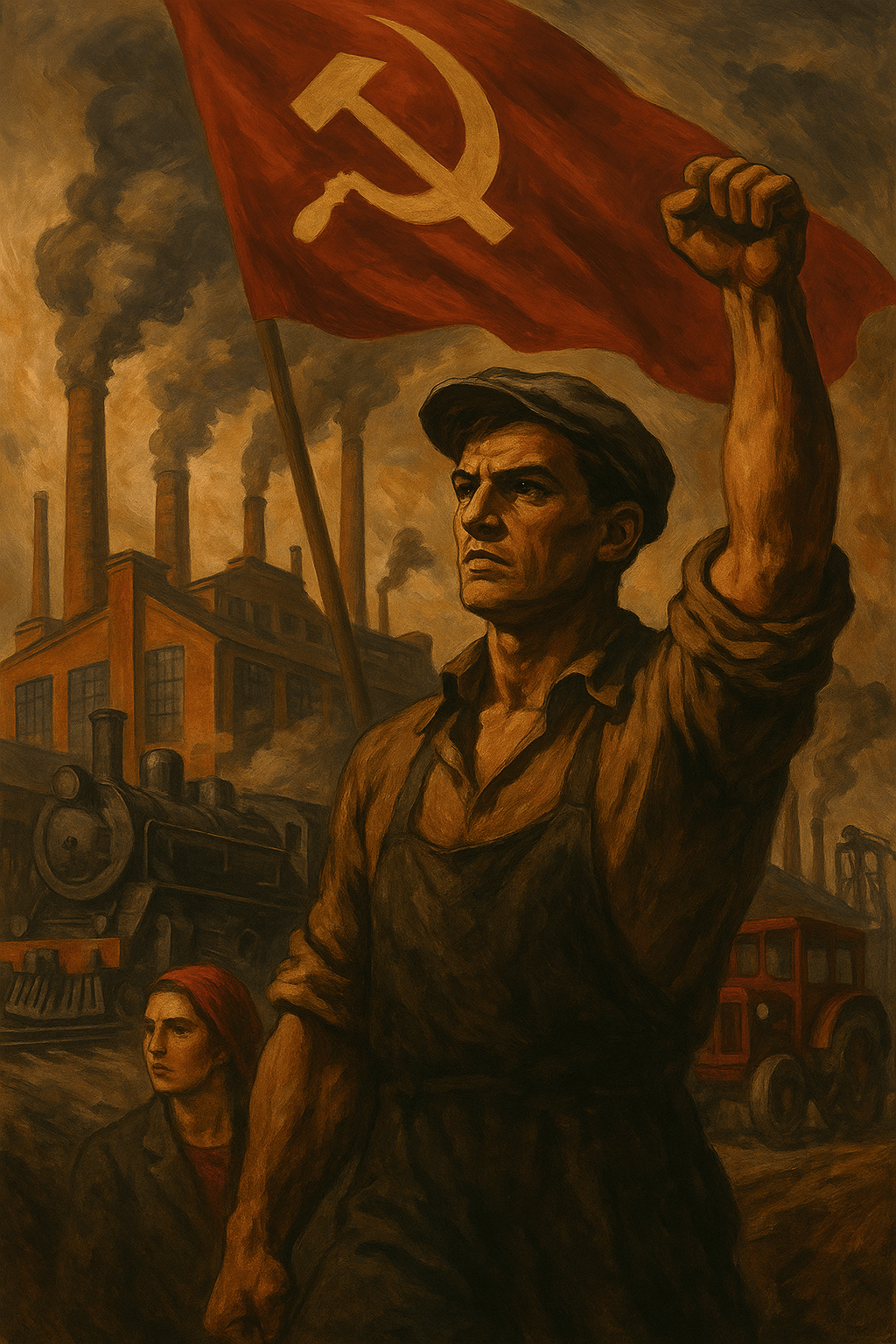
How the Soviet Union shattered capitalism’s mythology and proved that planning—not profit—can build a world.
By Prince Kapone | Weaponized Intellects Book Review Series — October Revolution Installment | Weaponized Information | October 2025
Factories Against the Lie: Reclaiming the Economic Truth of the Soviet Revolution
When Robert C. Allen sat down to write From Farm to Factory, he wasn’t looking to join the pantheon of Marxist economists or rehabilitate Stalin. He was simply following the numbers. But the thing about numbers—honestly collected, rigorously examined—is that they tend to destroy lies. What Allen unearthed in the balance sheets of Soviet history was not the tale of inefficiency and repression that Western propaganda had sold for three generations, but the most extraordinary leap in human development ever achieved by a poor, agrarian society. His “reinterpretation,” as the subtitle politely calls it, is nothing less than an empirical revolution: a data-driven demolition of Cold War mythology.
The official story—the one printed in every Western textbook and repeated by every economist who ever drew a paycheck from the IMF—goes something like this: socialism failed because it crushed freedom, distorted incentives, and replaced markets with madness. Allen’s study reads like a forensic autopsy of that narrative. Using the tools of economic history, he compares Soviet performance not to utopia but to reality: to Britain’s industrial revolution, to America’s Gilded Age, to the slow grind of capitalist modernization across the Global South. The result is stunning. Between 1928 and 1970, the Soviet Union grew faster than any capitalist economy of comparable size. It closed the gap with the industrial world, built an urban working class from the ruins of serfdom, and eradicated illiteracy and unemployment while the capitalist world convulsed in depression and war.
What Allen proves, even without intending to, is that the October Revolution worked. It did what no bourgeois reform could do—it turned a backward colony of European capital into a sovereign industrial power. In a world where colonial economies were stripped for parts and peasants were made to starve for gold, the Soviet Union industrialized through planning, not plunder. It showed that economic growth without imperialism was not only possible but faster, fairer, and more rational. The West responded by calling it tyranny because the alternative was to admit that their wealth depended on theft.
Allen’s analysis begins with the pre-revolutionary baseline: Tsarist Russia, a patchwork of stagnation and dependency. Its so-called “modernization” had been a colonial appendage to Western capital. Productivity crawled, wages withered, and foreign investors siphoned profits out through London and Paris. There was no internal dynamism—only a comprador elite fattening itself on grain exports while millions starved. The “backwardness” of Russia was not an accident of geography; it was the global structure of capitalism working as designed. Lenin had already diagnosed this in Imperialism, the Highest Stage of Capitalism: the periphery is kept underdeveloped so the core can keep extracting. Allen, writing from the safe distance of modern economic history, essentially arrives at the same conclusion by way of GDP tables.
The genius of From Farm to Factory lies not in its sympathy for socialism—Allen is careful to hedge every radical implication—but in its honesty. His statistical models treat the Soviet Union like a patient whose pulse refuses to die no matter how many times capitalism declares it clinically dead. He doesn’t romanticize famine or terror, but neither does he allow the moral hysteria of Western scholarship to obscure the material record. Industrial output, per capita income, urbanization, education, life expectancy—all of it rose dramatically under the planned economy. The Soviet working class, barely literate in 1917, became one of the most technically skilled labor forces on Earth within a single generation. That is not “failure.” That is revolution rendered in steel and electrification.
To read Allen properly, one must strip away the liberal reflex to measure socialism by bourgeois comfort. His question is not whether Soviet citizens ate caviar or owned cars; it is whether they escaped the poverty their ancestors had endured for centuries. They did. And in doing so, they altered the global balance of power. The Soviet experiment forced the capitalist world to reform itself out of fear. Every social democracy, every welfare policy, every concession wrung from capital in the twentieth century—these were not gifts of liberal benevolence but defensive measures against the specter of Soviet success. Allen’s quiet, numerical prose becomes a weapon precisely because it reveals this: the socialist alternative worked too well to be ignored.
In the ideological marketplace of the West, truth is always suspect when it threatens profit. So Allen’s findings were buried under the polite labels of “revisionism” and “reinterpretation.” But in the trenches of global struggle, the significance is clear. What he documents is the economic vindication of October: the moment when planned production defeated market chaos, when peasants became engineers, when a world written off as hopeless dared to build itself anew. This was not catastrophe; it was creation. And to the imperial mind, creation without permission is the ultimate crime.
Before Stalin: Capitalism’s Broken Engine
The story begins not with Stalin’s factories but with the rot that preceded them. Robert C. Allen does what most Western economists refuse to do: he takes Russia’s capitalist past seriously enough to measure it. The result is a forensic portrait of a decaying system whose “backwardness” was not cultural or climatic but structural—an inevitable outcome of imperial capitalism operating on the semi-periphery. Tsarist Russia, Allen shows, was not a “late bloomer” waiting for liberal democracy to ripen it into modernity. It was a dependent limb of European finance, locked in a cycle of extraction and stagnation. If socialism later produced scarcity, it was only because capitalism had already produced ruin.
Allen’s reconstruction of the pre-1917 economy reads like a balance sheet of failure. Productivity in agriculture, the backbone of the empire, barely rose across the nineteenth century. Industrial output expanded unevenly, concentrated in pockets financed by foreign capital and insulated from the domestic market. Workers’ wages stagnated while profits flowed to French and British bondholders. The so-called modernization of the Tsarist period amounted to an import of capital without an export of sovereignty. Russia’s bourgeoisie, weak and comprador, had no interest in transforming society; its fortunes were tied to the rentiers of Paris and London. What Western historians later called the “inefficiency” of socialism was, in truth, the inheritance of this parasitic order.
Lenin understood this long before Allen’s data could prove it. In Imperialism, the Highest Stage of Capitalism, he described how the export of finance capital subordinated entire nations to the industrial core, creating what he called “backward” capitalism—capitalism without its progressive engine. Allen’s empirical work confirms this Marxist insight without ever naming it: Russia’s integration into the world market produced dependency, not development. The Tsarist state industrialized only enough to serve the geopolitical ambitions of empire and the dividend demands of its creditors. The peasantry bore the tax burden, feeding both the landlords and the foreign investors. When famine struck, it was not the failure of planning but the triumph of profit.
The numbers are merciless. By the eve of World War I, Russia’s output per worker lagged far behind Western Europe; its capital stock was externally financed; its trade balance fragile and dependent on raw exports. Allen’s calculations reveal a society where the surplus extracted from the countryside did not build modern industry but serviced foreign debt. Every kilometer of railroad laid was another chain of dependency, every factory another node in a global circuit of imperial accumulation. To call such an economy “backward” is to obscure the mechanism of its subordination. Backwardness was not a failure to imitate the West—it was the condition the West imposed.
This is the foundation from which the October Revolution emerged: a society in which the capitalist class was too weak to revolutionize production, yet too strong to allow anyone else to. The contradictions were ripening. The workers of Petrograd and the peasants of Tambov were not rebelling against socialism’s ration cards; they were rebelling against capitalism’s noose. What Allen’s data restores to history is the material clarity of that revolt. The revolution was not an interruption of progress but its only possible continuation. Where the bourgeoisie failed to build an industrial society, the proletariat would do it itself—through planning, collectivization, and the abolition of profit as the organizing principle of life.
In exposing the limits of Tsarist capitalism, Allen inadvertently dismantles one of the oldest weapons in the anti-communist arsenal: the myth that socialism ruined a prosperous Russia. His evidence leaves no room for nostalgia. The empire that collapsed in 1917 was not a golden age cut short but a brittle oligarchy collapsing under its own contradictions. The soil on which the first workers’ state was built was infertile by design—drained by centuries of exploitation, both foreign and domestic. That the Soviets could harvest anything from it at all is a miracle of human will. But that miracle was no accident; it was the dialectical necessity born from capitalism’s failure to deliver on its own promises.
The Development Problem: Planning as the Science of Revolution
Once Allen has buried the myth of Tsarist prosperity, he turns to the problem that confronted the Bolsheviks in power: how to industrialize without capital. The Soviet Union inherited not a modern economy but a carcass—an empire bled dry by war, blockade, and civil chaos. Industry lay in ruins, railways collapsed, and output had fallen to a fraction of its pre-war level. The question was not whether to rebuild but how. Could a socialist state, surrounded by enemies and starved of investment, create the material base for a new civilization? Allen reconstructs this debate with the precision of an economist and the insight of a historian, revealing that the struggle over “how to develop” was nothing less than a struggle over the meaning of socialism itself.
In the 1920s, the Soviet leadership confronted a dilemma unprecedented in world history. The capitalist road to development—foreign credit, private enterprise, colonial extraction—was closed to them by design. The socialist road had never been built. What Allen calls “the development problem” was the attempt to do what no society had done before: accumulate capital without a capitalist class. His treatment of the economic debates of the 1920s—the competing lines of Bukharin and Preobrazhensky, the gradualists and the accelerators—is not moral or ideological but analytical. He frames them as alternative solutions to the same structural constraint: a labor-rich, capital-poor society trying to industrialize at revolutionary speed.
Allen’s brilliance lies in demonstrating that the logic of planning did not emerge from dogma but from necessity. The market could not mobilize resources fast enough; private capital would not invest without profit; and the peasantry, left to the market, could not generate the surplus to finance heavy industry. The Bolsheviks therefore turned to mathematics—to the Fel’dman model and its successors—to simulate a new kind of economic organism. The plan became a scientific instrument of social will. It measured, allocated, and coordinated production not by price signals but by human purpose. Where capitalism lets the anarchy of profit decide what is built, socialism made that decision consciously. Allen’s reconstruction of this process is technical, but its implications are explosive: the Soviet experiment was not irrational, it was the most rational response to the conditions inherited from empire.
Against the Cold War caricature of “forced industrialization,” Allen’s evidence reveals a different picture. Planning did not simply extract; it transformed. His simulations show that, even under severe constraints, planned investment could raise both output and consumption simultaneously. This directly refutes the Western assumption that socialist development was a zero-sum game between guns and butter. By channeling labor into sectors with the highest productivity potential—steel, energy, machinery—the plan created the infrastructure for future abundance. What bourgeois economists mistook for coercion was, in material terms, coordination. The Soviet state was not starving its people to build factories; it was building factories so its people would never starve again.
Lenin had once said that socialism was “soviets plus electrification.” Allen’s data gives that slogan economic flesh. Electrification, mechanization, and mass education were not ideological ornaments but the pillars of the new accumulation regime. Planning was the electrification of the economy itself—a way of wiring millions of human decisions into a single current of development. It replaced the invisible hand of the market with the visible brain of collective intelligence. The tragedy, of course, is that Western historians mistook this for tyranny rather than progress. They could not imagine an economy directed by human purpose because they could not imagine humanity as capable of purpose beyond profit.
What Allen ultimately reveals—though he never quite says it—is that the real innovation of the Soviet 1920s was epistemological. For the first time, economics ceased to be a priesthood describing the world as it is and became a science for shaping what it could become. The plan was not a spreadsheet; it was a political weapon. It declared war on dependency, scarcity, and chaos. And in that declaration lies the true meaning of socialist development: not the worship of growth for its own sake, but the conscious construction of a future liberated from the blind compulsions of capital. Allen, with his statistical restraint and cautious tone, may not use the word revolution—but his evidence does.
The Peasant Question: Agriculture Between Revolution and Survival
After tracing the intellectual and structural architecture of early planning, Allen shifts the focus to the stubborn foundation of the Soviet economy—the land. Industry might have been the face of modernization, but agriculture was its heart, and that heart still beat to the rhythms of the old world. The Bolsheviks inherited a countryside fragmented by poverty, ignorance, and isolation: twenty million peasant households bound to backward tools and medieval methods. What bourgeois historians romanticize as “the peasant soul” was, in material terms, chronic underdevelopment. The revolution had overthrown landlords, but it had not yet transformed the mode of production. The New Economic Policy left the village half-free and half-feudal, and in that contradiction the fate of socialism itself would be decided.
Allen’s analysis of the 1920s countryside is not sentimental—it is clinical. He studies yields, output, labor inputs, and market behavior to expose the limits of the NEP compromise. Agricultural productivity remained pitifully low, barely above the level of 1913. The land reforms of 1917 had distributed property but not power; millions of smallholders worked their plots by hand, hoarding grain when prices fell and releasing it only when the state’s back was against the wall. The countryside was not a partner in socialist construction—it was a parallel economy, driven by survival rather than solidarity. Allen’s comparative data makes the point brutally clear: a Russian peasant required five times as much labor to produce the same output as an American farmer. This was not laziness; it was the legacy of an empire that had modernized its armies but never its plows.
The genius of Allen’s approach is that he reads the NEP not through ideology but through the material logic of development. He shows that the policy worked only up to a point—it stabilized markets, revived trade, and fed the cities—but it could not solve the deeper contradiction between private farming and planned industry. The industrial sector needed grain, labor, and capital; the peasant sector wanted security and autonomy. The two spheres were joined by trade but divided by class. As industry expanded, demand for food and labor rose faster than agriculture could supply it. Prices swung wildly, and so did politics. The so-called “scissors crisis” of 1923—when industrial prices soared while agricultural prices stagnated—was not a planning mistake but a symptom of this structural divide. The revolution had broken the landlords but not the logic of subsistence.
In Allen’s retelling, this tension between town and country becomes the engine of history. The NEP was a truce, not a strategy. It bought time for recovery but postponed transformation. The peasant market could not generate the surplus required for industrialization; its rationality was individual, not collective. The socialist state, if it was to survive, had to find a way to mobilize the resources of the countryside for the building of industry without recreating the exploitation of capitalism. Allen stops short of calling this a class war, but his data speaks plainly: the NEP stabilized the economy but froze the revolution. The state could not remain neutral forever. Either the market would discipline the plan, or the plan would discipline the market.
What emerges from Allen’s study of the NEP years is the sense of an economic system caught between necessity and possibility. On one hand, the NEP allowed breathing space—a return of trade, a respite from famine, a fragile coexistence between socialist and petty-bourgeois forms of production. On the other hand, it revealed the impossibility of advancing to socialism through commodity exchange alone. Lenin had warned that the market would “grow into capitalism” if left unchallenged; Allen’s tables confirm that warning in statistical form. Agricultural stagnation, urban shortages, and unequal exchange were not temporary setbacks—they were the handwriting of history on the wall.
To Allen’s credit, he resists the Western temptation to treat the peasantry as victims of an overbearing state. He shows instead that the crisis of the 1920s was a systemic impasse, not a moral drama. The peasant household was rational within its own limits, but those limits had to be broken for the society to advance. The question was not whether collectivization would come, but how soon and under what conditions. The NEP’s success in reviving the market made its failure as a socialist strategy inevitable. As Allen’s data makes clear, the contradiction between small-scale agriculture and industrial modernity was reaching a breaking point. The old economy could feed itself, but it could not build the future. And that future—now visible on the horizon—was steel, electricity, and the plan.
Steel, Smoke, and the Plan: The Soviet Industrial Revolution
Having dissected the NEP’s contradictions, Allen now turns to the decisive break—the First Five-Year Plan and the birth of the planned economy. This is the moment where his analysis becomes both most empirical and most explosive, because it demolishes the central dogma of Western historiography: that Stalin’s industrialization was a disaster. Allen does not romanticize the suffering of the period; he measures its results. And what the numbers reveal is nothing short of revolutionary. Between 1928 and 1940, the Soviet Union achieved average annual growth rates of over 5 percent in GDP and nearly 10 percent in industrial output. These are not propaganda figures; they are verified by international comparison. The backward agrarian state that had trailed Europe for centuries was now outpacing it. The so-called “economic miracle” of postwar capitalism was anticipated by a workers’ state under siege.
Allen calls this transformation the “Soviet Industrial Revolution.” The phrase is not metaphorical. In scale, speed, and structural impact, it rivals Britain’s industrial revolution—but with one critical difference. Britain’s took place over a century of colonial plunder and proletarian misery; the Soviet Union compressed it into a decade and did it without empire. Allen’s data show that the USSR mobilized domestic resources—labor, not loot—to build its factories, dams, and steel mills. The key was not exploitation abroad but coordination at home: the systematic redirection of surplus from consumption to investment. The plan functioned as a collective brain, orchestrating millions of labor hours into a symphony of production. The Soviet state, whatever else it was, had discovered a new mode of development: accumulation without capitalists.
The Western narrative portrays this process as a reign of terror—an image of human suffering measured only by moral indignation. Allen’s findings demand a more sober measure. He shows that the driving mechanism of growth was not repression but reallocation: the movement of labor from agriculture to industry, from low-productivity sectors to high-productivity ones. Collectivization, brutal as it was, released millions of workers into the urban economy, where their productivity multiplied. Wages were low, but employment was universal; consumption lagged, but literacy, health, and life expectancy rose. This was not “efficiency” in the capitalist sense—it was social efficiency, the rational use of human capacity to transform a nation. The plan’s coercion was real, but so was its creation. It built, it educated, it electrified.
What Allen’s simulations expose is the inner logic of that creation. Using macroeconomic models, he isolates the variables of growth: investment rate, labor transfer, productivity, and capital accumulation. The results are unambiguous. High investment in heavy industry—backed by state control of finance and labor—produced sustained compound growth. The Soviet economy was not “running on fumes,” as Cold War scholars insisted; it was running on mathematics. Each plan cycle amplified the previous one. The heavy-industry base built in the 1930s made possible the expansion of consumer industries and infrastructure in the 1950s. Capitalism preaches the virtue of short-term profit; socialism demonstrated the power of long-term design.
Allen’s great heresy, from the standpoint of bourgeois economics, is that he refuses to treat the Soviet achievements as statistical anomalies. He compares them directly to their capitalist contemporaries. While the United States sank into the Great Depression, Soviet output doubled. While Britain and Germany cut wages, the USSR built power plants and steel complexes. Where Wall Street produced unemployment, Gosplan produced employment. In Allen’s words, the USSR “caught up” with the industrial world not by miracle but by policy. The plan substituted purpose for profit and coordination for chaos. It was not perfect—no human system is—but it was effective. In the global economy of the 1930s, that alone was revolutionary.
To a liberal economist, this conclusion borders on sacrilege. It means that central planning, under conditions of scarcity, worked better than the market. It means that the Soviet system did not defy the laws of economics—it rewrote them. Allen is cautious; he couches his conclusions in academic restraint. But the implications are radical. He demonstrates that the state, when organized around social priorities, can allocate resources more efficiently than private profit ever could. The five-year plan was not the enemy of rationality—it was its highest form. And this, more than any political repression, explains why the Soviet Union survived a global depression, repelled a fascist invasion, and rebuilt itself in less than a generation. It had mastered the science of survival.
Beneath Allen’s graphs and equations lies a profound political truth: socialism worked because it treated the economy as a human project rather than a natural law. It was not a utopia; it was a workshop. And in that workshop, millions of ordinary workers—engineers, builders, farmers, teachers—became the authors of history. The smoke that poured from Magnitogorsk and Dneprostroi was not just industrial—it was symbolic. It marked the birth of a new kind of power, one that did not flow from colonial conquest or capitalist accumulation, but from collective labor disciplined by a plan. Allen, ever the empiricist, lets the data speak. But what the data says, unmistakably, is that the October Revolution’s promise was not broken—it was realized in steel.
The Human Dividend: Living Standards, Labor, and the Social Wage
If the previous section established the industrial miracle, Allen now turns to its human dimension—the question bourgeois economists love to twist into moral accusation. “Yes,” they admit, “the Soviets built factories, but at what cost?” It’s the kind of question that only an empire can ask, its conscience clean from centuries of exploitation abroad. Allen’s answer is methodical, not rhetorical. He subjects Soviet living standards to the same statistical scrutiny as output, and the verdict is as inconvenient for the West as it is illuminating for history: the standard of living for the Soviet working class, despite the hardships of transition, rose steadily across the 1930s and into the postwar period. For the first time in Russian history, mass poverty was being not merely managed, but eliminated.
The starting point of Allen’s analysis is demographic: population growth, life expectancy, and literacy. In 1913, Russia was still a semi-feudal society—two-thirds illiterate, malnourished, and disease-ridden. By the late 1930s, under conditions of international isolation and economic siege, literacy was nearly universal, urban housing had expanded, and infant mortality had dropped by more than a third. These were not miracles of charity but deliberate outcomes of planning. Education, healthcare, sanitation, and public utilities were treated not as commodities but as instruments of development. The “social wage”—the sum of benefits, subsidies, and guaranteed services—became a material fact of everyday life. The Soviet worker, Allen observes, was poor by Western standards of consumption but rich by any measure of social provision.
This distinction between private wealth and social wealth is what most Western analyses deliberately obscure. They count refrigerators and cars, not doctors and schools. Allen’s data cuts through this bourgeois arithmetic. The Soviet worker of 1938 might not own a Ford, but their children went to school, their rents were low, and they had jobs that would never vanish overnight in a market crash. In a global context where the Great Depression had reduced millions in the capitalist core to unemployment and hunger, the Soviet Union had achieved the unthinkable: full employment, stable prices, and universal education. Allen’s analysis of wage and consumption data confirms that real living standards rose in absolute terms even as the state poured unprecedented resources into heavy industry. The plan did not merely build factories; it built a people capable of running them.
Allen’s treatment of consumption is particularly revealing. He shows that per capita food availability, after the crisis years of collectivization, rebounded and surpassed prewar levels by the late 1930s. Industrial goods—clothing, furniture, household necessities—became accessible to the masses. The consumption structure was egalitarian if modest: fewer luxuries, but no starvation. To the bourgeois economist, this looks like deprivation; to the historian of empire, it looks like justice. The Soviet model redefined the meaning of prosperity away from private hoarding toward collective provision. Where capitalism manufactures wealth through inequality, socialism distributed scarcity through solidarity—and in doing so, began to abolish scarcity itself.
The transformation extended beyond material conditions into social life itself. Allen notes that the rapid expansion of urban employment created an entirely new class structure—an industrial proletariat with a technical education and a political consciousness forged in the plan’s collective discipline. Women, previously confined to domestic and agricultural labor, entered industry and the professions en masse. This was not charity; it was necessity elevated to emancipation. The state needed their labor, and in mobilizing it, granted rights that bourgeois democracies had not. The Soviet Union became, statistically, one of the most literate, gender-integrated, and upwardly mobile societies in the world—an achievement achieved without colonial tribute or capitalist speculation.
Allen’s data makes it impossible to sustain the old cliché that socialism starved its people for ideology. His figures show a steady rise in caloric intake, housing space, and real consumption per capita between 1928 and 1955, interrupted only by the war. Even after the devastation of 1941–45, the recovery was swift and broad-based. By the mid-1950s, life expectancy exceeded prewar levels by more than a decade. Education spending, medical infrastructure, and urban planning continued to expand as part of the same developmental logic that had once prioritized steel and energy. The plan that had industrialized the nation was now being turned inward, toward human development. It was not a retreat from growth but its redefinition—an evolution from quantity to quality, from machines to lives.
To the Marxist reader, what Allen documents here is the maturation of the socialist project: the transition from primitive accumulation to social reproduction. The working class, once the instrument of industrialization, becomes its beneficiary. The state, once the disciplinarian of labor, becomes its guarantor. Bourgeois historians mistake this for bureaucratization, but Allen’s tables tell a different story—it was the socialization of wealth. The Soviet experiment proved that modernization did not have to be paid for with colonial blood. It could be achieved through collective sacrifice, rewarded not with consumer excess but with human dignity. And that, in the cold calculus of imperial economics, is the most unforgivable heresy of all.
The Mechanics of Growth: The Science Behind the Soviet Miracle
Allen now moves from the descriptive to the analytical—from what the Soviet Union accomplished to how it accomplished it. His approach is austere, mathematical, and all the more devastating for it. Stripping away both propaganda and moralism, he models the Soviet economy as a living system—an engine whose efficiency lay not in markets or miracles, but in the planned coordination of labor, capital, and technology. What emerges from his analysis is a portrait of socialism not as chaos, but as order—a rational, calculable, and replicable system of growth. The so-called “inefficiencies” of central planning, Allen demonstrates, were the very conditions that made rapid industrialization possible.
Using growth simulations and historical data, Allen isolates the key variables of the Soviet ascent: the rate of investment, the transfer of labor from agriculture to industry, and the “soft budget constraint.” The last of these, long derided in Western economics, becomes for Allen the beating heart of the planned economy. Under capitalism, he explains, firms are disciplined by bankruptcy: inefficiency means extinction. Under socialism, the state assumes the role of coordinator rather than executioner. Resources are reallocated, not destroyed. The result is a system capable of maintaining full employment and continuous capital formation even under conditions that would bankrupt a market economy. To the capitalist mind, this looks like irrationality; to Allen, it is macroeconomic genius—the transformation of crisis into momentum.
His models confirm that the principal driver of Soviet growth was not terror, not even collectivization, but investment. The state, freed from the profit motive, was able to sustain extraordinarily high rates of capital formation—often exceeding 25 to 30 percent of GDP—without collapsing consumption or employment. This steady compounding of productive capacity generated what Allen calls “endogenous growth”: an internally sustained cycle of development powered by its own infrastructure. Each new plant produced the machinery for the next. The Soviet economy was, in effect, a vast self-replicating organism—less efficient in microeconomic terms, but far more powerful in macroeconomic results.
The secret, Allen argues, was feedback. Planning may have been centralized, but it was not blind. Statistical agencies tracked output, labor use, and capital efficiency with a precision few capitalist states could match at the time. Adjustments were made annually; goals were recalibrated; production bottlenecks were analyzed and compensated for. It was not a free market—but it was a form of cybernetic management, decades ahead of its time. Where capitalism “self-corrects” through unemployment and collapse, the Soviet system corrected through recalibration and redistribution. The result, according to Allen’s econometric reconstructions, was an economy capable of adapting to shocks without implosion. Its inefficiencies were the price of resilience.
This is the point where Allen’s analysis transcends the confines of economic history and becomes a rebuke to bourgeois ideology itself. For nearly a century, Western economists have treated the market as a law of nature and planning as a violation of it. Allen’s findings expose this as superstition. The Soviet Union demonstrated empirically that a non-market system could generate sustained, self-reinforcing growth on a continental scale. The plan did not abolish incentives—it redefined them. Wages, bonuses, and prestige operated within a framework of collective objectives rather than private greed. The calculus of competition was replaced by the calculus of coordination. To the ideologues of capital, this is heresy; to the historian of humanity, it is progress measured in tons of steel, kilowatts of electricity, and years added to life expectancy.
Allen is too restrained to draw out the full philosophical consequence, but it is there, humming beneath the data: socialism worked because it treated the economy as a tool of society, not the reverse. His models show that the Soviet system, by internal design, transformed scarcity into capacity. It directed surplus into the expansion of the social base rather than the enrichment of a class. The “soft budget constraint,” derided as inefficiency, was in fact the economic expression of solidarity—the refusal to sacrifice people on the altar of profit. In this light, the Soviet miracle ceases to be an aberration and becomes a proof of concept: that rational planning, grounded in science and mass participation, can replace the chaos of the market without collapsing productivity.
By the end of this section, Allen’s quiet empiricism begins to sound almost prophetic. His graphs do what polemics cannot: they make visible the logic of collective control. The Soviet economy, whatever its contradictions, proved that humanity could plan its way out of underdevelopment. In the age of automation, climate collapse, and financialized chaos, Allen’s models are not relics—they are warnings. Capitalism is running out of frontiers; socialism, properly understood, was never about frontiers at all. It was about design. And in that design—the conscious coordination of labor and production—Allen locates the most subversive truth of all: the revolution was not a dream that failed, but a science interrupted.
Primitive Socialist Accumulation: Class, Coercion, and Creation
Having mapped the internal mechanics of growth, Allen descends into the engine room of Soviet industrialization—its political economy of accumulation. Here he confronts the question that haunts every discussion of the Stalin era: how was the capital for rapid industrialization obtained? His answer, characteristically empirical, walks a narrow line between moral outrage and material realism. The resources that built the factories of Magnitogorsk and Kuznetsk, he shows, were not conjured from thin air. They were drawn from the countryside, extracted through price controls, taxation, and the reorganization of agriculture into collective farms. In Marxist terms, this was the Soviet answer to primitive accumulation. Where capitalism had built its industrial base on colonial plunder, slavery, and dispossession, socialism built its own by reorganizing production at home. The method was harsh, but its logic was historical: to catch up, the Soviet Union had to internalize what the West had externalized.
Allen acknowledges the brutality of collectivization—the forced requisitions, the famine, the staggering dislocation of peasant life—but he refuses to reduce it to moral theater. He quantifies what most historians sentimentalize. The contribution of agriculture to industrial growth, he demonstrates, was less decisive than commonly assumed. The “agricultural surplus” did not finance the Five-Year Plans to the extent that legend suggests. The real driver remained industrial reinvestment and state planning. Yet, the political importance of collectivization was immense. It broke the structural power of the peasantry as a class and integrated the rural economy into the socialist state. Allen’s analysis strips away Cold War melodrama to reveal a deeper process: the transformation of millions of peasants into industrial workers, the conversion of a countryside into the foundation for modernity. Collectivization, in this light, appears less as an economic formula than as the birth pangs of a new social formation.
This is where Allen’s empiricism converges—unknowingly—with Marxist historical materialism. He shows that primitive socialist accumulation was not an imitation of capitalism’s cruelty but its negation. The goal was not to create a class of exploiters, but to abolish one. The extraction of surplus from the peasantry was transitional, designed to destroy the very relations that made extraction necessary. The bourgeois historian, obsessed with moral equivalence, cannot grasp this dialectic. To them, all accumulation is original sin. But in the Soviet case, the sin was inherited, and the crime was redemption. The plan’s violence was not a lust for power—it was the convulsion of a society trying to remake itself without the tools of empire. Allen’s data silently confirms what Lenin foresaw: that socialism would not arise in pure form but through the ruthless transformation of inherited contradictions.
Yet Allen’s analysis is not apologetic. His statistics reveal the enormous social costs: declining consumption during the early 1930s, the loss of rural labor, the human suffering embedded in the steel and concrete of the first plan. But he forces us to ask the question no liberal economist dares to pose: what was the alternative? A slow, market-driven modernization would have left the USSR defenseless against imperialism. Industrialization under capitalism, as the colonies knew too well, demanded external plunder and internal stagnation. Industrialization under socialism demanded internal sacrifice for collective survival. The difference is moral and material: one fed on others; the other fed itself. Allen’s quiet conclusion is that the Soviet path, brutal though it was, achieved the impossible. It compressed centuries of development into a single generation—and did it without colonies, without foreign capital, without a bourgeoisie.
His analysis of labor migration makes the point concrete. Between 1928 and 1940, tens of millions left the countryside for the cities. The urban workforce more than doubled. These were not slaves but pioneers, pulled by new opportunities as much as pushed by coercion. The factories, schools, and housing that awaited them were crude by later standards but revolutionary by any other. A literate, urban, industrial proletariat emerged almost overnight. For the first time in history, the descendants of serfs operated turbines and locomotives, built bridges and aircraft, and read Marx in their own language. Allen’s charts of output per worker and productivity growth capture this social metamorphosis better than any manifesto could. What Western historians call “forced labor” was, in large part, forced modernization—the wrenching birth of a working class capable of running an industrial civilization.
To the moralizing critic, this reads as rationalization. To the revolutionary historian, it reads as recognition: history does not move without friction. Allen’s quantitative rigor leaves no room for romanticism, but also no refuge for cynicism. The primitive accumulation of socialism, unlike that of capitalism, was finite. Its purpose was not to reproduce exploitation but to abolish it through development. Once the industrial base was established, the same state that once extracted could begin to redistribute—the foundation for the rise in living standards he documents in the following chapters. The furnace of the first Five-Year Plan was a crucible, not a crime scene. What was forged in it was not simply an economy, but a new social order: a working class that had built its own means of existence.
Allen ends this phase of his analysis with a sentence that deserves to be carved in stone: the Soviet industrial revolution “was not costless, but it was effective.” That single line separates the historian from the ideologue. For the former, the task is to understand how a society in ruins remade itself into a superpower; for the latter, the only permissible answer is that it should not have succeeded. But succeed it did. The same Western economists who derided planning as madness would later scramble to explain how a nation of peasants launched satellites and defeated fascism. Allen’s refusal to moralize is his greatest moral act. He shows us, through cold statistics and historical patience, that the Soviet Union did not rise in spite of socialism—it rose because of it. And in the smoke of its factories and the silence of its fields, one hears not the echo of tyranny, but the roar of a world breaking its chains.
From Triumph to Stagnation: The Dialectic of Development
Having charted the heights of the Soviet ascent, Allen turns to the long arc of its slowdown—the period that Western scholars weaponized as “proof” of socialism’s failure. His treatment, disciplined and unsentimental, strips away the mythology that surrounds the postwar decades. He begins from a simple fact: by the 1970s, the engine that had carried the USSR from backwardness to superpower began to lose momentum. Growth decelerated, productivity plateaued, and the command system that once delivered miracles began to ossify. For Cold War economists, this was the inevitable collapse of an unworkable model. For Allen, it was the exhaustion of a developmental phase—a historical, not ontological, limit. The Soviet economy had done what it was built to do: achieve industrial parity with the capitalist world. What came next required not more accumulation, but transformation—and it was here that the system faltered.
Allen’s explanation is neither ideological nor apologetic. He approaches the question through the same instruments that served him throughout the book—data, comparison, and historical context. He shows that by the late 1950s the Soviet growth model, founded on high investment rates and the transfer of labor from agriculture to industry, had run its course. The countryside was already urbanized, the labor reserves exhausted, the infrastructure matured. Industrial expansion could no longer rely on quantity; it now required innovation, flexibility, and technological renewal. But the institutions of planning—designed for mobilization, not experimentation—were ill-equipped for this new task. The same centralization that had once been an advantage became a constraint. The plan, once a revolutionary tool of catch-up, hardened into bureaucracy. The Soviet miracle had outgrown its own method.
This, Allen argues, was not a failure unique to socialism but a structural problem of industrial modernity. Every growth regime built on extensive accumulation eventually faces diminishing returns. The difference is that capitalism solves this impasse through crisis and destruction—liquidating old capital, shedding labor, and expanding through imperial conquest—while socialism lacked such external outlets. The Soviet Union could not expand through plunder; it had to reform itself from within. That it struggled to do so is not evidence of socialism’s bankruptcy, but of its moral and material difference. Allen’s data show that even in “stagnation,” Soviet GDP continued to grow at rates that would have made Western economies envious during the neoliberal era. What declined was not output, but dynamism—the ability of the system to reinvent itself.
Allen’s key insight is that the slowdown was endogenous to success. The industrial structure the USSR had built was optimized for an earlier epoch—the age of steel, coal, and machinery. By the 1970s, the commanding heights of the world economy had shifted toward electronics, computation, and flexible production. The Soviet apparatus, still geared toward mass output, struggled to translate its collective strength into technological innovation. The rigidities of the plan that once prevented chaos now prevented creativity. Research and development were well-funded but poorly integrated; information flows lagged behind material production. Allen likens the Soviet system to a machine that could build anything—except a new version of itself. The economy’s physical capital was modern; its social and institutional capital, increasingly outdated.
Yet Allen’s analysis refuses the easy conclusion of the neoliberal narrative. He does not attribute decline to the “inefficiency” of socialism, but to its institutional conservatism—a pathology shared by every mature industrial system. The United States in the same period faced its own productivity slowdown, inflationary pressures, and fiscal crises. The difference, as Allen notes, was that capitalism externalized its contradictions through globalization, deindustrialization, and debt-financed consumption. The Soviet Union, bound by its moral economy of full employment and social welfare, absorbed its contradictions internally. It maintained social stability at the cost of economic dynamism. The crisis was not of socialism’s impossibility but of its immobility—a system that could not reform fast enough without undermining the very guarantees that defined it.
From a dialectical perspective, this stagnation was not an end but a contradiction seeking resolution. The Soviet model had proven that planned development could lift a nation out of poverty, but not yet that it could continuously revolutionize itself. The forces of production had grown beyond the relations that contained them. The same centralized apparatus that once coordinated growth now suppressed initiative; the same egalitarian ethos that guaranteed stability now dampened innovation. Allen reads this not as tragedy but as transition—the moment where socialism, to advance, would have needed to democratize its planning, decentralize its intelligence, and release the creative energies of its producers. Instead, besieged by external pressure and internal inertia, it froze. What collapsed in 1991 was not the socialist ideal but its first historical form—a society trapped between success and transformation.
Allen’s quiet conclusion carries a revolutionary echo: the Soviet slowdown was not a failure of Marxism but a failure to continue it. Once the urgent task of industrialization was achieved, the next step should have been the socialization of planning itself—the transfer of decision-making from bureaucrats to workers, from ministries to collectives. The plan had built abundance; it could not, by design, build freedom. And yet the data still speak. Even in its decline, the Soviet Union sustained the world’s most equitable income distribution, its highest rates of literacy, and its most universal access to housing and healthcare. Its contradictions were those of a society that had already overcome scarcity, standing at the threshold of a higher form of development it was not allowed to reach.
For Allen, the lesson is clear: history does not repeat its successes without reimagining them. The Soviet experience was proof that central planning could deliver industrial modernity; it was also a warning that no system, however rational, can remain revolutionary without renewal. In this sense, the story of the USSR’s slowdown is not the end of the socialist experiment—it is the beginning of its next stage. The challenge of our century, Allen implies though never states, is to recover the scientific spirit of planning without the rigidity of command, to marry social purpose with democratic participation. The fall of the Soviet Union was not the victory of capitalism; it was the pause between two phases of human development. And if Allen’s numbers mean anything, it is that the first phase, for all its faults, proved the second remains possible.
The Reckoning: The Soviet Miracle and the Myth of Failure
By the time Allen closes From Farm to Factory, his verdict is unmistakable: the Soviet Union, for all its contradictions and calamities, achieved one of the most extraordinary economic transformations in human history. The data do not lie, though empires always do. Over the course of five decades, a semi-feudal empire of peasants became a fully industrialized, literate, urban civilization. It survived invasion, blockade, and isolation. It matched and often exceeded the performance of capitalist economies that had looted the world for centuries. And it did so without colonies, without foreign investment, without Wall Street, and without a capitalist class. Allen’s final chapters are quiet, clinical, but their implications are thunderous: socialism worked—materially, empirically, undeniably.
What Allen demolishes, more effectively than any manifesto, is the moral scaffolding of Cold War ideology—the fantasy that capitalism equals freedom and socialism equals famine. He dismantles the myth piece by piece: first by showing that Tsarist “backwardness” was the inheritance of capitalism, not the failure of socialism; then by demonstrating that planned industrialization achieved levels of growth, productivity, and welfare unmatched by any comparable society. His findings leave the Western narrative in ruins. The Soviet system, far from being an “inefficient command economy,” was the most rapid and egalitarian developmental model in modern history. Even its decline, Allen insists, was not collapse but culmination—the end of a phase, not the failure of a principle. The West did not outlive the USSR because it was superior, but because it adapted to a world the USSR had already made possible.
What emerges from Allen’s analysis is a deeper historical lesson: that industrial modernity itself, stripped of its imperial foundations, was a socialist achievement. The electrified factory, the public school, the planned city, the social wage—all were born from the experiment of collective control. Capitalism appropriated their fruits but never their logic. The bourgeoisie has spent a century writing footnotes to Soviet planning while pretending to despise it. The World Bank, the IMF, the very concept of “development economics”—each is a ghost of Gosplan, repackaged for profit. Allen’s work exposes this inheritance without sentimentality. He does not celebrate Stalin or sanctify the Party; he simply proves, through the dispassionate medium of data, that history’s greatest leap forward was made by those who refused to worship the market.
In the end, the most subversive aspect of Allen’s book is not its defense of the Soviet economy but its method. He refuses to argue on moral terrain; he argues on measurable outcomes. In doing so, he exposes the moral failure of capitalism itself. The West demands to know how many lives socialism “cost.” Allen’s numbers return the question: how many lives has capitalism devoured, from Bengal to the Congo, from Hiroshima to Haiti? How many millions still live in poverty under the same system that condemned socialism for its imperfections? The Soviet Union, for all its sins, left behind literacy, electrification, equality, and survival. Capitalism leaves behind islands sinking into the sea. Allen’s statistics are not just historical—they are accusatory.
For revolutionaries, Allen’s reinterpretation reclaims the terrain of truth from the priests of neoliberalism. His work gives material backing to what Marxists, decolonial thinkers, and the oppressed have always known: that socialism, even under siege, outperforms capitalism in serving human need. He demonstrates that the so-called “failure” of the Soviet Union was not an indictment of planning but a warning about complacency—the danger of halting revolution halfway. The tragedy was not that socialism went too far, but that it did not go far enough: it socialized production but not power, distribution but not decision-making. The dialectic was left unfinished, and the imperial order reemerged to claim the ruins. But the ruins, as Allen’s evidence reminds us, still rest on the most advanced foundation ever laid by human labor.
From Farm to Factory ends not as an elegy, but as a reckoning. The Soviet experiment proved that the working class could command history, that an entire nation could plan its way out of underdevelopment, that progress need not depend on plunder. It proved, in short, that capitalism’s “laws” were not laws at all, only habits enforced by empire. The West will spend another century denying this, because to admit it would be to confess that its own order stands on sand. Allen’s quiet empiricism, weaponized by the reader, transforms into revolutionary ammunition: the numbers themselves become an indictment. They remind us that the choice confronting humanity is the same today as it was in 1917—planning or chaos, cooperation or extinction.
And so, as the book closes, one truth stands unshaken: the October Revolution did not fail. It industrialized, educated, and emancipated a fifth of humanity in half a century, leaving a legacy that continues to structure the world’s productive forces. Its defeat was political, not economic—an interruption, not an end. Allen’s work, though couched in the language of economics, belongs to a larger struggle: the struggle to reclaim the memory of what was achieved, so that the next generation can achieve more. The Soviet miracle was not an exception; it was a beginning. The myth of failure, like the empire that sustains it, will fall. But the numbers—those stubborn, luminous facts—will remain as monuments to the truth: that humanity can build a new world, not by faith in capital, but by the conscious design of labor itself.
 Weaponized Information
Leave a comment