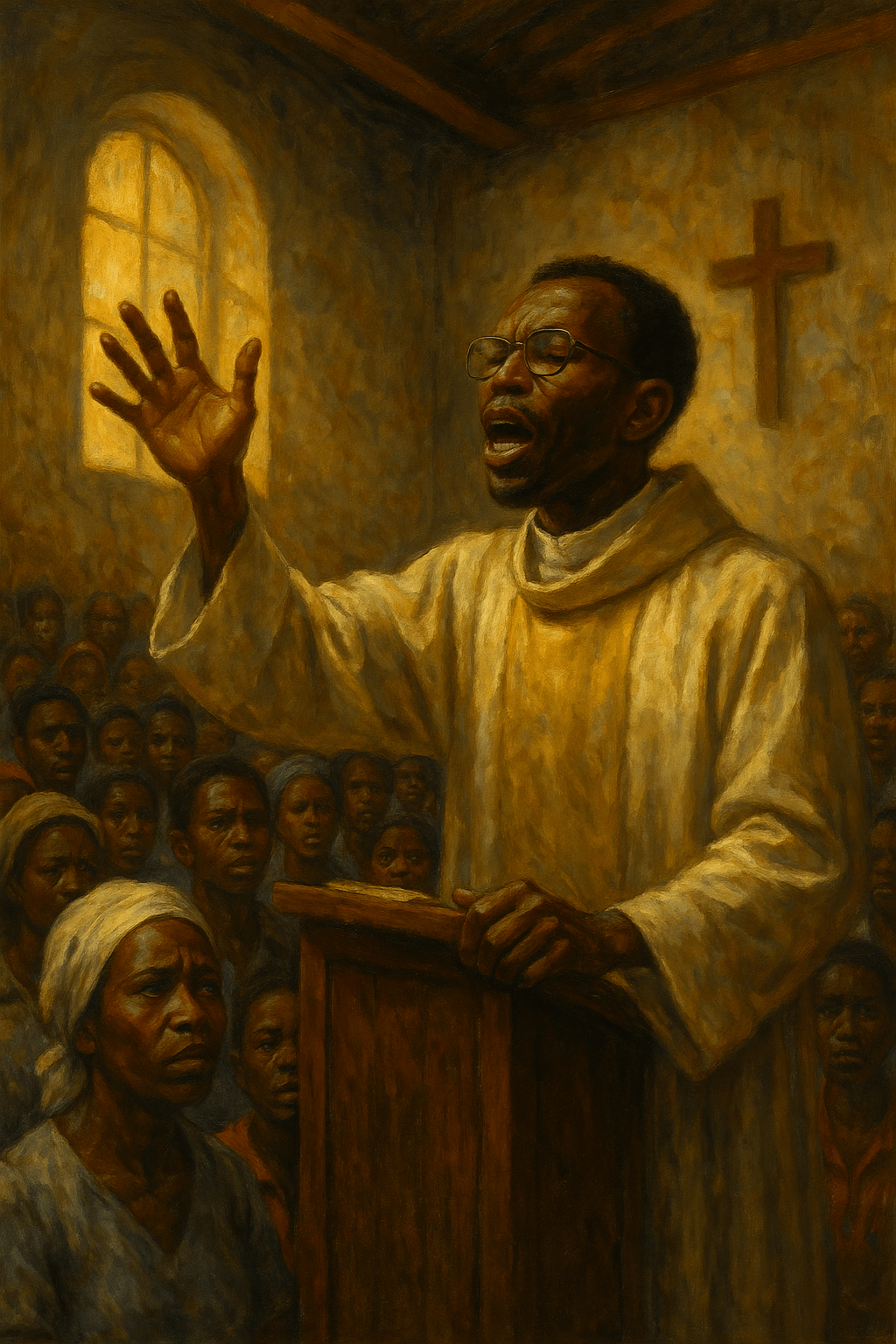
Weaponized Statecraft Series | Jean-Bertrand Aristide at St. Jean Bosco, 1988
How a sermon in 1988 lit the fuse of Haiti’s democracy—and exposed the ruling class that would destroy it.
By Prince Kapone | Weaponized Information | October 21, 2025
In the House of the Poor, A New Power Begins to Speak
Brothers, sisters, workers, and all who have ever felt the boot without ever tasting the banquet—listen. You have been told your whole life that politics is too complicated, that power is too distant, and that you should leave your fate to experts, bosses, priests, presidents, or generals. You have been told that the poor cannot rule, that the oppressed should wait, that the meek should pray, and that history is written somewhere “above” you. But I am here to tell you — and history itself is here to prove — that this is a lie. And Jean-Bertrand Aristide is one of the clearest proofs we have.
In 1988, standing before the poor of Port-au-Prince, Aristide did not preach resignation. He preached sovereignty. He told the people that “you will live in peace when you wrap your faith and your commitment together,” when the poor organize and bring “people’s power to a boil.” Here was a priest who did not narcotize the masses with promises of heaven, but called them to seize the earth. Here was theology not as lullaby, but as insurgent pedagogy — a weapon in the hands of the wretched.
He refused dependency. When the congregation pleaded for God to intervene, Aristide interrupted their helplessness: “The ball is at your feet — kick it across the people’s field.” Imagine that — a man of cloth shattering the politics of begging in a single stroke. No more waiting on bishops who dine “at the table.” No more pleading with generals who “drive the train of state into a tunnel where there are bodies and blood.” Aristide was not offering charity. He was offering power — dangerous power — the kind that overturns tables and governments alike.
And he taught that clarity was the first weapon. Turning to the Gospel of John — “that they which see not might see; and that they which see might be made blind” — he revealed a truth every empire hides: the oppressed are blinded not by ignorance, but by deception. The ruling class “pretend to see,” Aristide warned, and they train us to see the world through their eyes — through the eyes of banks, armies, corporations, and colonial schools. Light, then, is not religious metaphor. Light is class consciousness. Light is recognizing the enemy. Light is learning to say no — and to mean it.
Aristide did not romanticize the poor. He understood the condition: a people shoved “under the table,” surviving off crumbs in a country they built. And he delivered his instruction with the precision of an organizer: “We must organize under the table; we must shake the table until it collapses.” Underline that. Say it out loud. That one line contains an entire theory of revolution. You do not beg for a seat. You shake. You flip. You take back what was stolen, and you build a new table that serves the many, not the few.
He refused shallow unity. “Do not put all the bishops in the same basket,” he said — because a revolutionary must be precise — but he refused to let the Church hide its betrayal behind a handful of good men. And when he insisted that “the church below… is our church,” he was doing more than moralizing. He was transferring legitimacy — relocating authority — from the institution of domination to the people who suffer under it. That is not religion. That is statecraft.
So when Aristide declared, “Let the truth of the Lord be a purgative,” he was not talking about private conscience. He was talking about vomiting out the lies of empire — those “bourgeois leaders whispering in our ears” — the editors, priests, presidents, and professors who domesticate revolt and teach the oppressed to distrust their own power. Aristide’s sermon was a political exorcism: expel the lie, reclaim the voice, seize the future.
This is why we study him today. Not to mourn. Not to mythologize. But to learn. Aristide’s sermon is a manual in miniature — a blueprint for how a revolutionary goes to the bottom of society, listens to the people, speaks in their tongue, and prepares them not just to resist, but to rule. He proved that the oppressed can govern — and that is the one truth the global elites, from Washington to Paris to Wall Street, will never forgive.
So understand this clearly: we do not look back to 1988 for nostalgia. We look back to steal fire. Because the ball, as Aristide said, is still at our feet. And the question now — for Detroit and Port-au-Prince, for Johannesburg and Chicago, for Gaza and Philadelphia, for Kingston and Marseilles — is the same question he asked his congregation: will the poor continue to crawl under the table of empire, or will we stand up, see clearly, and overthrow it in the name of the living?
🟥 Drawing the Line: Splitting the Church, Training the People
Aristide understood a principle that every serious revolutionary must learn: before the oppressed can seize power, they must seize clarity. And clarity begins by splitting the institutions that claim to represent them. In Haiti, the Catholic Church was not a neutral house of God—it was a battlefield. Aristide’s brilliance was that he did not flee the Church, nor did he flatter it. He exposed it. He forced it to reveal its class character before the eyes of the poor.
When he warned of those who “pretend to see,” Aristide was not speaking in abstractions. He was talking about a clergy aligned with Haiti’s ruling class—bishops who condemned the poor’s uprisings while blessing the elites who starved them. He invoked the Pharisees not to make a theological point, but a political one: every institution has a ruling bloc, and that bloc must be publicly confronted if the masses are to break from its spell.
So Aristide did what the ruling class feared most—he named names. He reminded Haiti of Jean-Rabel in 1987, when peasant organizers were massacred by landowners and paramilitaries while the Church hierarchy shielded the perpetrators. He invoked Misyon Alfa, the literacy movement the bishops tried to sabotage because a literate peasantry is a dangerous peasantry. And he invoked Freycineau, when liberation priests were ambushed by reactionary elements tied to Church elites. Each example served one purpose: to teach the poor that institutions can lie about who they serve.
This is why Aristide insisted that unity without truth is surrender. He would not allow the Church to hide behind a few honorable clergy while it functioned as a pillar of oligarchic rule. By making distinctions—between priests and bishops, between hierarchy and flock—he drove a wedge between the institution’s base and its leadership. This is political method. A revolutionary does not abandon the people’s institutions to their enemies. A revolutionary splits them, exposes their contradictions, and wins the base away from the ruling bloc that misleads them.
This lesson extends far beyond Haiti. In the imperial core today, the same tactic applies: split unions from their bureaucrats, churches from their career pastors, communities from their NGO gatekeepers, workers from their “pragmatic” social-democrats, and movements from the media personalities who preach moderation to preserve their brand. The enemy does not maintain power through force alone—it maintains it through trusted intermediaries. To defeat empire, you must first isolate its intermediaries.
Aristide’s sermon, then, was not merely a cry of faith. It was a training lecture for the oppressed: separate the people from their false shepherds, and you separate them from their chains. Once the poor stop mistaking collaborators for leaders, their obedience collapses, and with it collapses the legitimacy of the old order. That is why Aristide became intolerable to Haiti’s elite and their foreign patrons—not because he preached love, but because he taught the poor how to draw lines, choose sides, and reclaim the institutions built on their backs.
🟥 From Flock to Force: Mass Line and the Making of a People
Comrades, it is not enough for the oppressed to see clearly or to expose their betrayers. The next question—the one that separates rebellion from revolution—is this: how do the poor become a political force capable of ruling? Aristide confronted that question head-on. He did not want a flock that followed. He wanted a people that thought, that judged, that organized, and that could wield power in their own name. “The poor have sacrificed for this church,” he declared, insisting on their right “to speak loudly about it,” to judge institutions and leaders instead of bowing before them. In that moment, Aristide crossed a threshold few leaders ever dare to approach: he told the oppressed that they—not the clergy, not the generals, not the state—were the legitimate authors of Haitian history.
This is mass line in motion—the revolutionary method of turning suffering into strategy and spectators into protagonists. Aristide listened to the anxieties, anger, and aspirations of the poor, then returned those sentiments to them in organized form, sharpened into political clarity. He did not scold the people for their wounds or romanticize their misery; he gave them direction, structure, and discipline. This is why the Ti Legliz movement (the “Little Church”) was so dangerous: under Aristide’s influence, Bible study became political study, literacy circles became consciousness circles, and congregations became proto-cadres capable of collective action. The people were no longer an audience. They were becoming a force.
This is where Aristide’s sermon takes on the character of a strategic manual. When he told the youth that they were “the church of the poor,” he was not offering poetic flattery. He was identifying the motor of history. The young—the jobless, the landless, the street hawkers, the students, the hungry—are the ones who must inherit the fight, not as pawns but as the backbone of a new society. The church, like the state, must belong to those who have nothing to lose but their chains. And once the youth accept that role, the ruling class loses its monopoly on the future.
This is the same truth that animated the Black Panthers in Oakland, Sankara’s Committees for the Defense of the Revolution in Burkina Faso, and Chávez’s Bolivarian circles in Venezuela: if the people cannot organize themselves, they cannot defend themselves—and if they cannot defend themselves, they cannot transform society. Mass line is not charity. It is not symbolic representation. It is a process of building the people into a governing subject, capable of collective thought, collective decision-making, and collective power.
And because Aristide rooted his politics in the poorest sectors, he ensured that his program could not be bought off, co-opted, or managed by the “middle forces” that imperialism leans on to suffocate revolutions. He went to the bottom of Haitian society—the slums, the countryside, the literacy circles—not because it was sentimental, but because it was strategic. “God speaks through the people’s voice,” he said, not as metaphor, but as doctrine: truth emerges from the base, not the top. A revolution that is not anchored in the lowest rungs will be overthrown by them—or starved by those above them.
So let us extract the lesson for 2025: every serious revolutionary movement today—from the banlieues of France to the favelas of Brazil, from the reservations and ghettos of the United States to the mining belts of South Africa—must build mass line or be crushed by disorganization and despair. The global working class is fragmented, disoriented, and often convinced of its own powerlessness. Aristide’s method shows us how to reverse that: listen, clarify, organize, and return consciousness back to the people as a weapon they can wield together. That is how a flock becomes a force. That is how the poor learn not only to resist, but to rule.
🟥 Truth is a Sword: Division, Courage, and the Coming Storm
Every sermon has a moment when comfort must give way to clarity. Aristide reached that moment when he invoked the words of Jesus: “I have come into the world for judgment… to make a distinction.” He did not present Christ as a gentle referee of polite disagreements, but as the one who divides truth from lies, justice from hypocrisy, and the people from their oppressors. This was not a call to harmony. This was a warning that liberation is a blade, not a lullaby. And blades, once drawn, provoke fear among those who feast upon the suffering of others.
In this sermon Aristide prepares his congregation for inevitability: that once the poor become a political subject, the servants of the old order will strike back. When he says, “Even if they kill two, three, four—continue the struggle,” he is not being poetic. He is teaching the people that repression is not a possibility but a certainty. The forces he named in the sanctuary that day—the bourgeoisie, the army, the hierarchy—were not shadows. They were the very institutions that would later unleash bullets, embargoes, and coups the moment the poor dared to govern.
Aristide’s insistence on division is key. He rejected unity built on silence and obedience. “Unity in untruth is not unity,” he told them. There can be no reconciliation between those who bless massacres and those who bury the dead. There can be no shared table between the landlord and the landless unless the landless are the ones who dictate the terms. By demanding clarity, he was preparing the people for the next stage of struggle: the leap from the church floor to the political arena, where truth must confront state power itself.
This is why Aristide returned again and again to Moses. He was not merely invoking scripture; he was mapping strategy. Moses did not reform Pharaoh. Moses did not negotiate better whips, better chains, or kinder overseers. Moses organized a people, exposed their oppressor, and led them out through fire. Aristide’s sermon carries the same logic: deliverance is a confrontation, not a compromise. Liberation is not granted by the powerful—it is seized by the organized.
And the reactionaries heard him. In the pews sat the poor, listening with hope. But in the barracks, in the embassies, in the chancelleries, in the boardrooms of Haiti’s mercantile elites, there were others listening with dread. They understood before many on the Left did that Aristide was not simply preaching faith—he was producing power. He was weaponizing truth, literacy, and dignity into mass organization. He was preparing a nation that had been enslaved, occupied, and looted for two centuries to walk upright into history.
This is why, when Aristide urged his congregation to “pray for the bishops” but still insisted that the people “will no longer live a lie,” he was modeling a dangerous political balance: reject hatred, but refuse submission. He kept the moral high ground without surrendering the political battlefield. But that same posture contained an unavoidable consequence: once the people rejected submission, the ruling class would reject democracy.
In that moment—1988, two years after the fall of Duvalier—Aristide was already anticipating the storm that would gather around his future presidency. The same Church hierarchy that crushed Misyon Alfa, the same military that protected the landowners of Jean-Rabel, the same elites who sent thugs to Freycineau would, only a few years later, unite with foreign backers to overthrow the man elected by Haiti’s poor in 1990. The coup of 1991 was not a tragedy of misunderstanding. It was the counterattack Aristide predicted in this very sermon: the revenge of those who feared a people becoming sovereign.
So let us take heed to this lesson: truth is not neutral—it is a dividing sword. Aristide used it to separate the people from their manipulators, to separate faith from domination, and to separate unity from capitulation. But once the people choose truth, they must be ready to defend it. For after consciousness comes confrontation, and after confrontation comes the decisive struggle for power—the struggle that Haiti’s poor marched toward in 1990, and that their enemies answered with tanks, priests, and generals in 1991.
🟥 The People Will Remember: Aristide, Democracy, and the Road Ahead
Brothers and sisters, a sermon is only ever half-finished when it is spoken. The other half is written by history—and by the hands of the people who choose to act on its message. In August 1988, when Aristide stood before the youth of Ti Legliz and declared that truth must divide, that the poor must organize, and that courage must outlast terror, he was not closing a chapter. He was opening a path. Two years later, that path would take the poor of Haiti to the ballot box, where they would do the unthinkable in the Western Hemisphere: elect one of their own. Aristide won not because the powerful endorsed him, but because the people remembered the sermon.
In that moment, the “church of the poor” became more than metaphor. The literacy circles, the base communities, the singing youth, the widows of Jean-Rabel, the street vendors of Port-au-Prince, the cane cutters and dock workers and market women—those who were “under the table” stood up and seized the table itself. The 1990 election was not simply a democratic transition. It was the political expression of the very theology Aristide had preached: the last shall be first, if the last can organize.
And yet, just as Aristide predicted, the crucifixion followed the resurrection. The same forces he named in the sermon—the bourgeoisie, the army, the hierarchy—returned in 1991 to finish what they had begun at Freycineau, at Jean-Rabel, and in every backroom where Haiti’s future had been bought and sold. They could tolerate elections as ritual. They could not tolerate democracy as power. The coup was not merely an attack on a president. It was a counterattack on a sermon—on the idea that the poor could govern themselves and, worse still, govern their rulers.
This is why we study Aristide—not to sanctify him, but to understand the razor’s edge of liberation. He revealed three enduring truths for any people that dare to rise. First: Consciousness without organization is sentiment. Second: Organization without courage is bureaucracy. Third: Courage without power will be massacred. Aristide mastered the first two; the third would be tested by blood and exile. But Haiti’s poor had already crossed a threshold of no return. Once a people learn how to see, they cannot be blinded again.
And so, the final word of this essay is not about Aristide the man, but Aristide the method. It is the method of building the political from the spiritual, the strategic from the ethical, the organized from the abandoned. It is the method of turning faith into discipline, community into cadre, and truth into a weapon that no empire can fully kill. This method will outlive every coup, every occupation, and every lie told about Haiti’s dignity. For as Aristide told his congregation, “God speaks through the people’s voice.” And once the people believe that, no general, bishop, or president-for-hire can ever sleep soundly again.
So let the record show: the sermon of August 1988 was not a footnote in Haiti’s story. It was a prophecy and a blueprint. The struggle for Haiti’s liberation did not begin or end with Aristide, but he proved—if only for a moment—that the wretched of the earth can stand, speak, and rule. The task remains unfinished. The table has not yet been overturned. But the poor remember. And when the poor remember, history remembers with them.
 Weaponized Information
Leave a comment