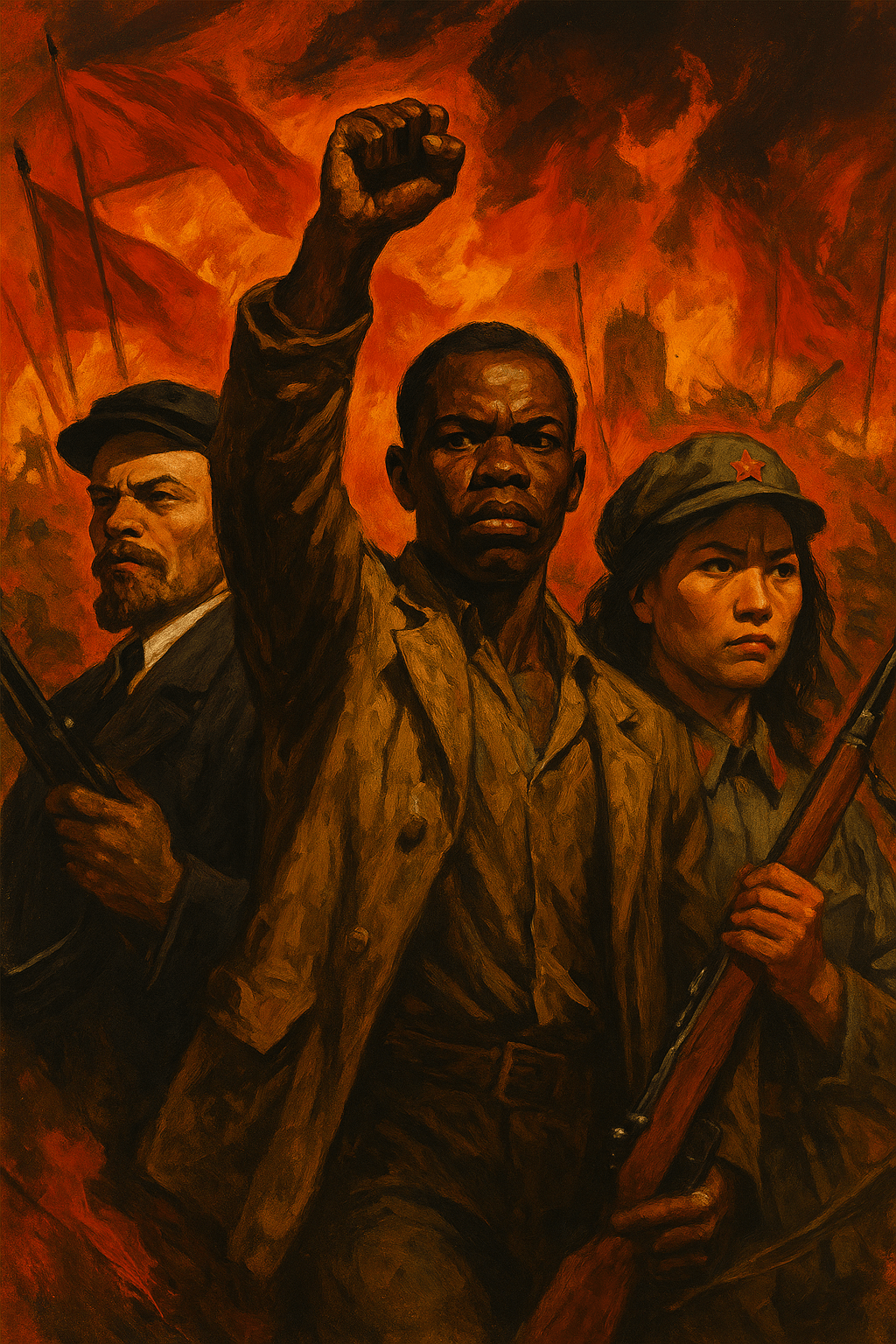
A revolutionary review of Class Struggle: A Political and Philosophical History by Domenico Losurdo—exposing how Western Marxism buried the revolution, betrayed the colonized, and became the ideological arm of empire.
By Prince Kapone | Weaponized Information | August 26, 2025
They Waged Class War First
Long before Marx put pen to paper, long before any revolutionary waved a red flag, the ruling class was already at war. This is the opening argument of Domenico Losurdo’s Class Struggle—and it’s a bomb with a long fuse. What he lays bare in the first two chapters isn’t just a historical point about timelines. It’s a challenge to the entire framework of Western Marxism, which treats class struggle as a reactive force, a righteous eruption from below. Losurdo flips that script. The real story of class struggle begins at the top—with the bourgeoisie, the aristocracy, the colonizers—consciously organizing, legislating, and brutalizing to build a world in their image.
The “prehistory” of class struggle, he argues, is written in blood and fire—from the enclosure of the commons to the Atlantic slave trade, from settler conquest to colonial extraction. The ruling class didn’t wait for theory. They waged war with lawyers, whips, treaties, and guns. They built prisons before the people organized cells. They built borders before we built barricades. Theirs was a class war fought to make exploitation legal, to naturalize inequality, and to sanctify theft. Every act of primitive accumulation was an act of war. And yet, in the hands of Western Marxists, this history becomes footnote, backdrop, or worse—irrelevant.
This is where Losurdo breaks ranks with the Euro-left canon. He names what they forget. The French Revolution wasn’t a clean rupture—it was soaked in bourgeois terror against the poor. The American Revolution wasn’t a fight for liberty—it was a settler revolt to protect slavery and land theft. The birth of liberalism was also the birth of class war from above. And yet, from Althusser to Žižek, from Frankfurt to Verso, Western Marxists tiptoe around this. They mourn the collapse of the Left but never indict its betrayals. They analyze “late capitalism” like it’s a board game—not a world system built on centuries of colonial plunder and domestic repression.
What’s at stake in this opening section is the very terrain of struggle. Losurdo reminds us that the ruling class doesn’t wait for elections. They act. They unify. They rewrite law, reshape consciousness, restructure space. Class war is their default operating system. And until revolutionaries internalize that, we’re not fighting—we’re reacting. The bourgeoisie didn’t invent modern democracy to share power. They invented it to contain revolt. They didn’t write constitutions to emancipate—they wrote them to expropriate, to enslave, to institutionalize dominance. Every compromise they offer is a counter-insurgency tactic.
Western Marxism, by contrast, approaches class like it’s a classroom debate. It searches for ethics in a system founded on genocide. It deconstructs revolution but never constructs it. It treats October 1917 as trauma, not triumph. It asks how we feel about oppression, not how we destroy it. Losurdo’s first chapters rip this illusion to shreds. He doesn’t romanticize violence—he historicizes it. And in doing so, he clears the ground for something Western Marxists fear most: clarity.
If the bourgeoisie waged class war first—and they did—then the question isn’t whether the oppressed should fight back. The question is why so many “Marxists” are terrified to say so. That’s where this book begins. And that’s where our reckoning with Western Marxism must start.
The Counter-Revolution Was the Plan All Along
By the time the oppressed began to organize against exploitation, the ruling class had already written the playbook for counter-revolution. That’s the core lesson from Chapters 3 and 4 of Losurdo’s Class Struggle. The bourgeoisie didn’t simply win history—they rigged it. Every major upsurge of proletarian resistance was met with a swift and systematic backlash, not as exception but as design. The cycle of revolution and counter-revolution isn’t a deviation from liberal democracy—it is liberal democracy functioning exactly as intended. Western Marxism, in its obsession with theory over struggle, treats this like a tragic rhythm. But Losurdo makes it plain: this is how class power is maintained.
After 1789, the Jacobins fell to the guillotine. After 1848, reaction swept Europe. After the Paris Commune, came the mass executions. After Reconstruction, came the lynch mobs and chain gangs. After Bolshevism, came fascism and Hitler. And yet, Western Marxists still speak of “democracy” as if it floats above class. They mourn the losses but won’t indict the structures that made the losses inevitable. They universalize “bourgeois rights” and “civic freedoms” without asking: whose rights? Whose freedoms? At whose expense? They want the romance of revolution without the rupture.
Losurdo instead insists on material analysis. He names the class character of every so-called reform, every expansion of the franchise, every liberal gain that came hand-in-hand with violence against workers, peasants, and the colonized. He shows how even the rise of industrial capitalism was paved with rural starvation, pauperism, and police repression. The bourgeoisie didn’t grant labor the vote out of moral awakening—they conceded only when forced by fear of revolt. And when revolt subsided, they took it back.
In this light, fascism appears not as a freakish rupture from bourgeois order, but as its loyal son. When capital is threatened, democracy is suspended. Rights are revoked. And the middle class—long fantasized by Western Marxists as potential allies—often sides with repression, not revolution. Losurdo demolishes the myth of a stable progressive arc. The “progress” of capitalism is the consolidation of counter-insurgency. And the state, far from being a neutral terrain, is a weapon forged by class enemies to defend the property line.
The Western Marxist tradition cannot handle this truth. That’s why it treats every revolution as a tragedy, every revolution as “betrayed,” every state-building process as authoritarian deviation. It freezes in the face of contradiction. It rejects the dirty, dialectical reality of revolutionary power. Losurdo calls that cowardice by its name. The revolution didn’t fail because it became repressive. It became repressive because it was under siege. The bourgeoisie never stops struggling. They never stopped declaring war on the poor. It’s only the Marxists in the West who surrendered.
So this isn’t just about revising history—it’s about recovering strategy. Class struggle is not a slogan. It’s not a book title. It’s not a vibe. It’s a protracted, escalating war against a ruling class that has never taken its boot off our necks. To treat it as anything less—as Western Marxism consistently does—is to join the counter-revolution in spirit, even if not in name. Losurdo came to remind us: we are at war. And only one class is fighting like it knows it.
Who Holds the Gun? Lenin, the State, and the Terms of Struggle
There’s a reason Western Marxism fears Lenin more than the bourgeoisie does. He didn’t just theorize the class struggle—he gave it teeth. Chapters 5 and 6 of Losurdo’s Class Struggle return us to the battleground that polite Marxism tries to erase: the state. Not as abstraction. Not as bureaucracy. But as an armed instrument of class power, forged through struggle and wielded in war. Lenin understood something Western Marxists would rather forget—that the state is never neutral. It’s never “ours” to take over and operate like a cooperative. It’s a fortress that must be seized, shattered, rebuilt. And until that happens, we live under the dictatorship of the bourgeoisie.
Losurdo defends Lenin not as dogma, but as realism. The state, he reminds us, is the condensed expression of class antagonism. It’s not a stage for moral persuasion or electoral pageantry. It is the organized violence of one class against another, dressed in the language of law. Every prison, every police force, every court, every regulatory agency—even in its “democratic” form—is shaped by the long arc of class struggle and designed to reproduce domination. That’s why, after every revolution, the ruling class fights like hell to get its state back. And that’s why every revolution must build a new one—or be buried.
Western Marxism recoils from this. Its theorists love to quote Gramsci but fear the “war of position” when it gets too close to actual power. They fetishize spontaneity, romanticize uprisings, and reduce socialism to cultural gestures. They mourn the consolidation of revolutionary states as if permanence itself were betrayal. But Losurdo shows how this allergy to power is not radical humility—it’s ideological submission. When the oppressed win, they must rule. That’s not authoritarianism—it’s dialectics. If the dictatorship of the bourgeoisie is real (and it is), then the dictatorship of the proletariat is not a moral flaw—it’s a necessity.
Here is where the chasm opens: Western Marxists want socialism without sovereignty, revolution without repression, power without enemies. But Losurdo exposes this as fantasy. The Paris Commune was drowned in blood. So was the Haitian Revolution. So were the Soviets, the Chinese communists, the Korean resistance, the Vietnamese fighters, the Angolans, the Nicaraguans. Every socialist breakthrough has been met with sanctions, sabotage, assassinations, and war. And yet the Western Left still cries tyranny when a revolution defends itself. They treat the contradictions of socialism as worse than the certainties of capitalism.
Losurdo dismantles that lie. He argues that the class struggle does not pause after victory—it intensifies. The state must be seized precisely because it will be attacked. The enemy does not disappear when we win elections. They regroup. They weaponize media. They unleash inflation. They invoke “human rights” to justify intervention. And if all else fails, they send in the Marines. Only a revolutionary state—backed by the masses, disciplined by organization, and led with clarity—can survive that onslaught.
Lenin knew this. So did Mao. So did Fanon. So did Amílcar Cabral. And every colonized revolutionary who took up arms in the 20th century knew it, too. What Losurdo offers is not nostalgia for the past, but a roadmap for the future. If we refuse the question of the state, we refuse the question of power. And if we refuse power, we cede the world to those who already hold it. Western Marxism made that choice. The rest of us are done choosing defeat.
The Peasant, the Colonized, the Proletarian: Class Struggle Beyond the Factory Gates
What happens when the frontlines of class struggle don’t run through the shop floor, but through the rice field, the plantation, the desert, or the prison yard? What happens when the revolutionary subject doesn’t look like a European male worker in a boiler suit, but a barefoot peasant with a rifle? In Chapters 7 and 8 of Class Struggle, Losurdo expands the terrain and exposes the blind spots. He demolishes the narrow economism that has shaped Western Marxist theory—its obsession with wage labor, its Eurocentric mapping of class, and its chronic inability to recognize how capitalism’s development depended on the super-exploitation of the colonized world.
This is where Mao reenters the frame—not just as a thinker, but as a general in a world war. Losurdo restores Mao’s rightful place in the Marxist tradition as the strategist who grasped that the “South-East passage”—the revolutionary arc across the colonized world—was not a deviation but a deepening of class struggle. Peasants were not backward—they were the base. Anti-colonial war was not distraction—it was the main event. And the internal contradictions of socialist society didn’t mean betrayal—they meant the class struggle was still unfolding, even under the dictatorship of the proletariat.
Mao’s insight was dialectical: contradictions do not vanish after revolution—they mutate. The enemy adapts. New class forces emerge. Old habits return. Struggle must continue. Western Marxism recoiled at this, preferring the comfort of critique to the messiness of construction. They read Mao as dogma or dismissed him as a rural romantic. But Losurdo sees what they refused to see: that Maoism was not a sideline—it was a lifeline for the global poor. It taught that class struggle must be waged against bureaucracy, against complacency, against colonial residues, and against the restoration of capitalist relations even under socialist rule.
Losurdo doesn’t stop there. He turns to Hegel’s “struggle for recognition” and repurposes it—not as the liberal project of self-esteem politics, but as the revolutionary demand of the colonized to be recognized as full human beings through the act of revolt. Recognition here is not a substitute for redistribution—it is inseparable from it. The enslaved didn’t just want better conditions—they wanted emancipation. The colonized didn’t just want representation—they wanted sovereignty. To struggle for recognition is to struggle for power. And to separate the two, as Western Marxists have done, is to neuter both.
The result is clear: Western Marxism cannot comprehend a Haitian revolution. It cannot explain a Mau Mau insurgency. It cannot situate the Black Panther Party or the Viet Minh or the Sandinistas. Because to do so would mean confronting the fact that class struggle in the real world doesn’t conform to the Euro-left’s ideal type. The revolutionary subject is often Black, brown, female, poor, peasant, or prisoner. And the Western Marxist canon has no place for them—unless it is to be pitied, aestheticized, or theorized from a distance.
Losurdo reclaims that terrain. He shows that the class struggle is always racialized, colonized, feminized—that it is global, not European. And in doing so, he strips the Western Marxist project of its last alibi. No more excuses. No more posturing. If your theory doesn’t make sense to a barefoot mother defending her village from occupation, it’s not Marxism—it’s masturbation. The revolution will not be peer-reviewed.
The War for Memory and the Myth of the Singular Subject
Class struggle isn’t waged only in factories or on picket lines—it’s waged in textbooks, museums, documentaries, and political memoirs. In Chapter 9, Losurdo makes this point with surgical precision: history itself is a terrain of class warfare. What we remember, what we forget, who we call heroes and who we call monsters—all of it is shaped by the ruling class’s need to obscure the real story of revolution. And nowhere is this more visible than in the way Western Marxists have become historians of failure.
In their hands, revolutions are not ruptures but regrets. Robespierre is reduced to a bloodthirsty fanatic, Lenin to a cold manipulator, Mao to a deluded despot. The masses become props—naïve, duped, or disposable. Losurdo calls this what it is: ideological counterinsurgency. It’s not a mistake or a misunderstanding. It’s class struggle by other means. The historical revisionism of the Western left functions to disarm the working class, to make revolution seem tragic and inevitable defeat seem noble. It’s not about truth. It’s about containment.
What’s more, this revisionism isn’t neutral. It masquerades as moral critique but conceals a deep class hostility to the actual seizure of power. Western Marxists recoil from the mess of revolution because it implicates them. They want to be right, not victorious. They want a Marxism that can get them tenure, not a Marxism that can build a dual power structure. Their obsession with denouncing revolutions is a way of proving their respectability to the very class they claim to oppose.
In Chapter 10, Losurdo deals the next blow: the revolutionary subject has never been singular. There is no monolithic “working class” in the way Western theory pretends. The Haitian slave, the Chinese peasant, the Algerian guerrilla, the Black Panther, the Vietnamese farmer with a rifle—they were all the working class. They were all insurgent proletarians. But the Western tradition didn’t see them. Or worse, it saw them and recoiled. Because to acknowledge their centrality would mean admitting that revolution had already left Europe.
Losurdo doesn’t pander to liberal identity politics. He insists on a dialectical understanding of recognition and class. He shows how, under conditions of slavery, colonialism, and patriarchy, the class struggle assumes plural forms—each one emerging from material exploitation and structural domination. But Western Marxism dismissed these struggles as nationalist detours or racial distractions. In doing so, it aligned itself with empire, not against it.
This is the hidden violence of Western Marxist orthodoxy: it universalizes its own historical particularity, then condemns the rest of the world for not conforming. It erases the actual subjects of revolution in the name of class, while protecting its own status in the name of theory. It clings to a dead Europe and calls it internationalism.
Losurdo doesn’t just correct this narrative—he shatters it. He exposes how historical memory is manufactured, how revolutionary plurality is denied, and how Marxism itself has been colonized by the very forces it was meant to destroy. In doing so, he doesn’t just write history—he reopens the path to revolution. Not by looking back with regret, but by looking forward with clarity.
Populism Without Power: Recognition, Revisionism, and the Retreat from Class Struggle
In Chapters 11 and 12, Losurdo doesn’t just diagnose a crisis in Western Marxism—he reveals its ideological disarmament. What appears today as a flourishing of “left discourse” is, under scrutiny, the wreckage of a revolutionary tradition abandoned mid-battle. These chapters trace how populism, when detached from class struggle, mutates from insurgency into appeasement. It trades strategy for spectacle, material transformation for moral vocabulary, and power for the illusion of recognition.
At the heart of Losurdo’s critique is the notion that “recognition”—a concept born from genuine struggles for human dignity—has been co-opted by the West’s petty-bourgeois left into a pacifying substitute for revolution. He doesn’t dismiss the struggle of the oppressed to be seen and heard; he insists that such struggles become reactionary when divorced from the imperative to overthrow the systems that deny that recognition in the first place. In his words, recognition without revolution becomes “a surrogate of the struggle for liberation” rather than its instrument.
Losurdo shows how the political vocabulary of “the people” can easily become an empty cipher, drifting ideologically from left to right, especially when unmoored from a class-based, anti-imperialist anchor. He traces how populist rhetoric has historically been used to blunt revolutionary fervor—from the Weimar Republic to neoliberal regimes of the late 20th century—replacing confrontation with class compromise and inflating “anti-elitism” into a stand-in for anti-capitalism. The left’s infatuation with this rhetoric, Losurdo warns, ends not in insurrection, but in impotence.
This critique cuts deep into the heart of Western Marxism. The substitution of vague populism for revolutionary program, of decolonial citation for anti-imperialist sabotage, of cultural analysis for material transformation—these are not neutral intellectual shifts. They are the ideological surrender of a class that has lost the will to win. They reflect a Marxism that no longer organizes workers or seizes the state, but drafts conference papers and tweets from the safety of empire.
Chapters 11 and 12 also expose the growing chasm between recognition and redistribution. Losurdo does not reject identity politics wholesale—he understands that every revolution, from Haiti to Cuba to Vietnam, emerged from the revolutionary agency of oppressed identities. But what he condemns is the way recognition has been decoupled from expropriation, and how it is weaponized by neoliberalism to discipline the very movements it once inspired. In this reconfiguration, Marxism becomes just another liberal school of thought—polite, performative, and non-threatening.
The populist drift, then, is not just a tactical misstep—it’s a structural symptom of a Western Marxism that has lost its revolutionary subject. Without the proletariat—especially the colonized, the racialized, the landless—class struggle becomes a metaphor. Losurdo refuses this drift. He reminds us that revolutionary subjects are not conjured through academic language or social media visibility. They are forged in struggle, in the furnace of contradiction, against a state and a class that will not yield without force.
His warning is clear: recognition politics, stripped of class content, becomes a moral discourse of complaint rather than an organizational program for liberation. Populism, without revolutionary teeth, becomes reactionary. And Marxism, if it abandons its role as the theory and practice of proletarian revolution, becomes not a weapon—but a costume. A brand. A performance that leaves the ruling class intact, smiling, and unthreatened.
The Final Blow: Revolutionary Memory and the Betrayal of the West
Losurdo closes Class Struggle with a clarion call—not to return to some purified ideal, but to recover the revolutionary tradition in all its concrete, often uncomfortable, material history. Chapter 13 is not a summary. It’s a confrontation. A final polemic against the West’s selective amnesia. For Losurdo, the most insidious site of class struggle today is historical memory itself. And on this front, the Western left has not merely faltered—it has capitulated.
The betrayal he outlines is not abstract. It is specific. Intellectuals who disavowed socialism at the very moment it came under fire. Movements that chose moral high ground over solidarity. Academics who rewrote revolutions as errors to preserve their own ideological cleanliness. Losurdo shows how the tradition of Marxism, particularly in the West, became detached from the global struggles that gave it life—from Petrograd to Hanoi, from Havana to Harare. What was once a living doctrine of liberation became a museum piece—curated, decontextualized, and depoliticized.
Losurdo insists that revolutionary memory must include not only the great victories, but also the hard choices: collectivization, war communism, party discipline, armed struggle. Not as moral endorsements, but as historical realities. To disown them in the name of a sanitized socialism is to participate in the ideological counterrevolution. In the name of avoiding Stalin, the Western left abandoned Lumumba. In its fear of authoritarianism, it allowed liberal imperialism to pose as freedom. And in distancing itself from real power, it forfeited the ability to shape history.
What Losurdo demands is a restoration—not of nostalgia, but of revolutionary continuity. He links the Five-Year Plan to the Algerian war of liberation, the Great Leap Forward to the literacy campaigns of the Sandinistas, the revolutionary festivals of Cuba to the community clinics of the Black Panther Party. These are not disconnected episodes. They are chapters in the same book: the ongoing story of global class war. And every time the West dismisses them as “authoritarian,” it joins the enemy.
Most damningly, Losurdo exposes the infrastructure of Western Marxism itself. The publishing houses, the journals, the universities—all shaped by Cold War funding, ideological policing, and imperial soft power. The result was a Marxism that could survive in the West only by amputating its revolutionary limbs. It could speak of critique, but never of conquest. It could quote Mao, but only to scold him. It could analyze the state, but never build one. It could mourn Gaza, but never sabotage the arms shipments.
And yet, as Losurdo reminds us, the revolutionary impulse lives. In the rubble of Palestine. In the barricades of Burkina Faso. In the strike waves of South Africa and the factories of Guangdong. The class struggle never ended—it only shifted zones. The task now is not to theorize this shift from afar, but to enter it. To return to revolution not as seminar topic but as practice. To remember, not as historians, but as combatants.
This is Losurdo’s final challenge: a Marxism that wages war, not just analysis. A Marxism that reclaims the banner of Lenin, Fanon, Sankara, and Leila Khaled—not in portrait, but in purpose. A Marxism that refuses the comforts of critique and embraces the brutal, beautiful burden of building something better. That means breaking with the West—not just politically, but epistemologically. It means treating Western Marxism not as guide, but as obstacle. And it means, above all, remembering what empire wants us to forget: that the oppressed can win.
 Weaponized Information
Leave a comment