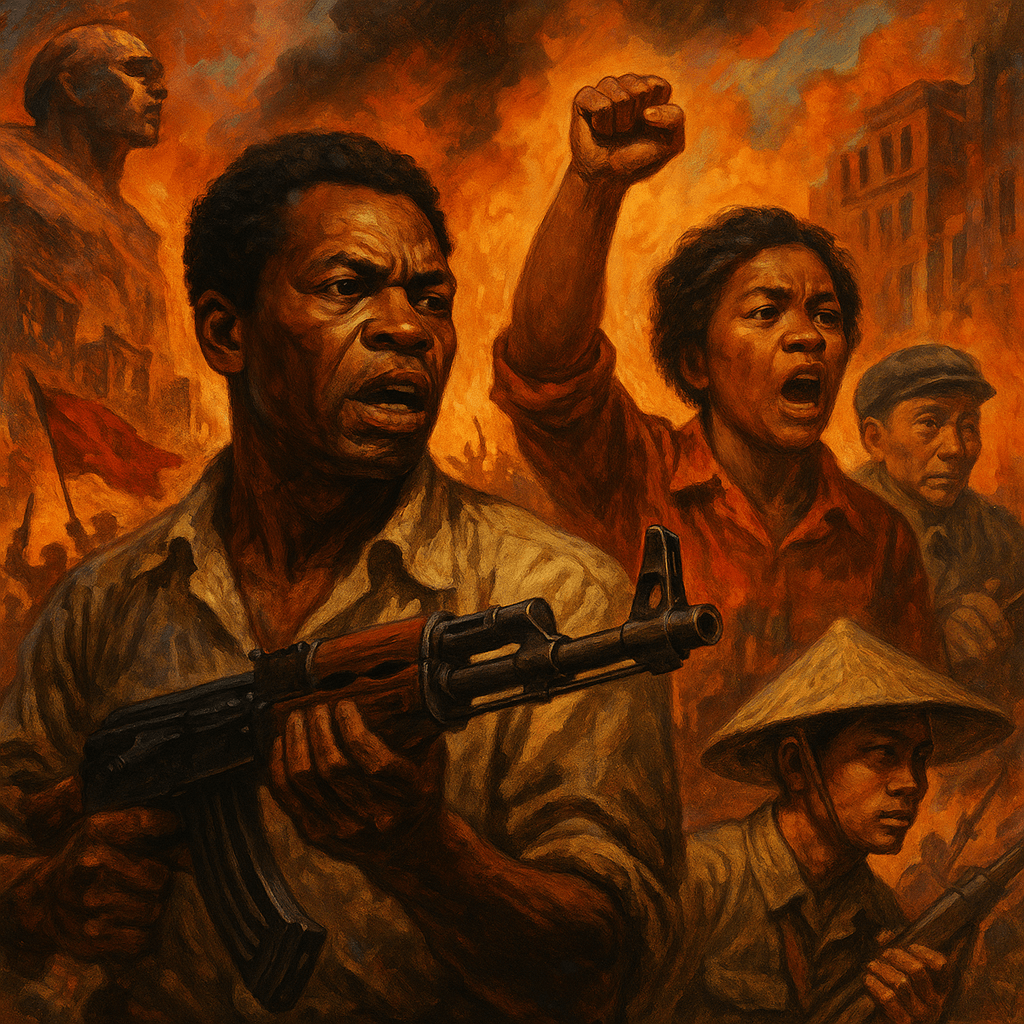
By Prince Kapone | Weaponized Information | August 18, 2025
The Future Belongs to Those Who Dare to Become
There’s a reason Western Marxism doesn’t talk much about James and Grace Lee Boggs. It’s not because they weren’t brilliant enough, or radical enough, or rooted enough in struggle. It’s because they violated the central taboo of Western Marxist orthodoxy: they refused to treat revolution as a metaphor. They believed people could change. That we must. And they spent their lives figuring out how.
In the academic towers of the Western world, Marxism has become a mausoleum. A place to mourn revolutions long past, romanticize defeats, and theorize failure into a profession. Here, revolution is a style, not a strategy. A performance, not a process. You can quote Lenin but never build a party. You can cite Fanon but never pick a side. You can speak endlessly about “praxis” while doing absolutely nothing to confront empire or serve the people. It’s a ritual of critique performed safely within the walls of institutions designed to defang it. And its priests—tenured, grant-funded, career-secure—are allergic to anything that smells like transformation.
That’s why James and Grace Lee Boggs are such a threat. Not just to capitalism, but to Western Marxism itself. Because they weren’t content to critique the world—they committed themselves to changing it. Not in theory, but in practice. In the streets of Detroit. In the organizing rooms. In the long, slow, disciplined process of struggle. They understood that revolution isn’t a one-time event—it’s a process of becoming. Becoming human. Becoming conscious. Becoming organized. Becoming free.
Revolution and Evolution in the Twentieth Century is not a retrospective. It’s a rupture. A Marxism that walks on two legs: one in theory, one in the lives of the people. It is not a eulogy for lost utopias—it is a toolkit for constructing a future that Western Marxism has already given up on. And it emerges not from the ivory towers of Frankfurt, Paris, or New York, but from the belly of the imperial core, where the contradictions of U.S. empire are sharpest, and where the necessity of transformation is not abstract, but existential.
The Boggses start from a simple premise, but one that sends most Western Marxists running for the exits: the masses are not static. They change. And the revolutionary must change with them. If your theory can’t grow, it can’t lead. If your politics can’t evolve, it becomes reactionary. This is the dialectic stripped of pretense and put to work. It is a rejection of Marxism as dogma, as doctrine, as a museum of sacred texts. It is a living, breathing, fighting Marxism—one that refuses to be embalmed.
What makes this book even more dangerous to the West’s Marxist mandarins is its clarity: the 20th century was not just a sequence of revolutions, it was a crucible in which humanity tried to become something new. The Russian, Chinese, Vietnamese, Cuban, Algerian, and Guinean revolutions were not “exceptions” or “detours.” They were the main road. They showed that the people, when organized, can not only topple empires—they can begin to build a different world. Not a perfect one. But one that belongs to them.
And yet, while peasants stormed the palaces of feudalism and workers seized the gears of capital, the Western Left clung to its precious pessimism. Adorno couldn’t bring himself to see hope in Vietnam. Sartre talked a big game but never built a base. Althusser mistook abstraction for depth. And today’s critical theorists keep the tradition alive, tweeting critiques from the comfort of settler academia while mocking anything that dares call itself a revolution.
The Boggses broke with all of that. They knew the stakes. They saw the collapse of industrial labor, the rise of automation, the degeneration of the U.S. labor aristocracy, and they didn’t whine about it. They adapted. They evolved. They insisted that revolution was still possible—but only if it was rooted in the evolving consciousness of the people. Only if it rejected the colonial categories of Western theory. Only if it broke decisively with the backward, Eurocentric assumption that revolution is only real when it looks like Paris in 1848 or Petrograd in 1917.
That break—material, ideological, and strategic—is the opening salvo of this book. It’s a declaration that the future of Marxism will not be written in seminar rooms or published by Verso. It will be written by those who dare to struggle with the people, among the people, as the people. And that’s what James and Grace Lee Boggs did. Not perfectly. Not always successfully. But with courage, clarity, and love. The kind of love that builds, organizes, and demands we become more than what this system has made us.
So let this review begin with a burial: not of revolution, but of the ideological corpse called Western Marxism. The one that turned critique into career. That sneered at the Third World. That mocked mass struggle while milking Marx for royalties. That treats “becoming human” like a slogan, not a task. Let it rest. And let the Boggses stand not just as revolutionaries—but as reminders that Marxism, when liberated from empire, is not just a theory of capitalism. It’s a theory of transformation.
From Seizure to Stagnation: The Bureaucratic Tragedy of the Russian Revolution
The Boggses open their examination of the Russian Revolution not with slogans, but with contradictions. They do not seek to bury the revolution, nor to resurrect it. They place it under dialectical review. Their method is not Cold War moralism or revolutionary romanticism—it’s political autopsy. They honor the necessity of 1917, while interrogating the trajectory that followed. Lenin’s seizure of power was, in their words, a “world-historic” moment. But what came next—war communism, civil war, isolation, centralization, and the entrenchment of party rule—foreclosed the deeper evolution of socialist consciousness among the masses.
For the Boggses, the problem was not the violence of revolution, but the substitution of the vanguard for the people. The Soviets, which once pulsed with participatory energy, became hollow shells. The dictatorship of the proletariat became the dictatorship of the party. Bureaucracy smothered initiative. State planning replaced self-organization. Human beings became units of labor to be organized for industrial production. The goal was no longer transformation, but survival—and survival became ossification.
Western Marxism absorbed this trajectory like a virus—but instead of learning from its contradictions, it weaponized them against revolution itself. These so-called Marxists do not mourn the fall of the bourgeoisie—they mourn its failure to fully consolidate power in February. They canonize the Left SRs and Mensheviks as democratic martyrs while glossing over their alliance with landlords, reactionary generals, and imperialist invaders. They romanticize the Constituent Assembly, as if its restoration would have brought liberation rather than white terror. And when they speak of the Workers Opposition or the Kronstadt sailors, they do so not to deepen the revolution—but to delegitimize it entirely. They never indict the Riutin Platform for its outright call to restore capitalism. They never indict the counterrevolution—they indict the revolution.
Against this drift into abstraction and betrayal, the Boggses draw a line. They reject both liberal critiques that accuse socialism of being “unnatural,” and mechanical Marxists who measure revolution only by steel production and electrification. The Soviet Union industrialized, yes—but so did the United States. That was not the measure. The revolution had to transform the human being, not just build dams. It had to cultivate new forms of consciousness, not just administer economic growth. But the Soviet path, they argue, too often left the people behind.
They write: “The experience of the Russian Revolution and its degeneration proves conclusively that it is not enough to smash the old state apparatus or to nationalize the means of production. Unless the human being is transformed, the new society will become a replica of the old.” This is the crux of their analysis. The Soviet system turned socialism into something one receives, not something one builds. The people became spectators of their own revolution.
Yet they do not throw the revolution away. They recognize that it gave birth to a global anticolonial wave, inspired generations of fighters, and broke the back of tsarist reaction. But its failure to move from political seizure to human evolution left a vacuum—a vacuum eventually filled by contradictions that subsequent revolutions would confront directly. Maoism, Cabralism, people’s war—all these emerged not as breaks from Leninism, but as continuations that Western Marxism refused to study.
For revolutionaries today, the Boggses’ analysis is not merely historical. It is a weapon. The Russian Revolution is not a blueprint to be copied or discarded—it is a stage to be studied and transcended. Revolution is not a one-time seizure—it is an ongoing transformation. When the people are bypassed, the revolution risks decay. When they are centered, new stages of liberation become possible. And when the lessons of history are buried by Western Marxist nostalgia or defanged by liberal revisionism, it is our task to dig them back up—and put them to work.
Putting Politics in Command: Maoism and the Humanization of Revolution
When the revolutions of the 20th century outgrew the seminar rooms of Europe and erupted in the rice fields, the jungles, and the favelas of the colonized world, Western Marxism folded its arms and turned away. It couldn’t stomach the idea that the vanguard of history would speak Chinese, or wear straw hats, or speak of peasants as subjects of their own liberation. But James and Grace Lee Boggs had no such hang-ups. In Revolution and Evolution in the Twentieth Century, they saw in the Chinese Revolution something that Western Marxists refused to: not a dogma, but a leap forward in the theory and practice of human transformation. Maoism, for them, was not about slogans or stars on a flag—it was a revolutionary method that demanded the masses take command of their own becoming.
This is where the Boggses break with the Western tradition so sharply you can hear the ideological bones snap. Against the technocratic degeneration of the Russian experiment—where production quotas replaced revolutionary subjectivity—the Chinese Revolution put politics in command. That is, it insisted the transformation of the people was not a secondary outcome, but the very purpose of socialism. The Chinese masses were not passive recipients of policy. They were the authors of their own emancipation, forged through struggle, mass line, criticism and self-criticism, and the Cultural Revolution. And this terrified the bourgeois academicians in the West, because it meant revolution could no longer be theorized as a European export—it was now a Third World science.
For the Boggses, the Cultural Revolution was not a disaster. It was a historic and necessary rupture—a recognition that socialism without ideological transformation would decay into a new form of domination. The Western Left, ever addicted to institutional stability, saw chaos. But what the Chinese were doing was wrestling with the hardest contradiction of all: how do you build socialism without reproducing the alienation of capitalist relations inside your own party, your own state, your own revolutionary organization? Mao answered not with a blueprint, but with a battle cry: “Bombard the Headquarters.” Challenge power, even your own. Especially your own. Put theory into the hands of the masses. Let the people struggle through the contradictions of socialism as an active, dialectical, historical process.
Western Marxism, insulated by tenure and book deals, recoiled at this. It denounced the Cultural Revolution as “mob rule,” as “excess,” as proof of Chinese backwardness. But the Boggses saw what was really happening: revolution was refusing to ossify. Maoism wasn’t a break with Marxism—it was Marxism’s maturation outside the shadow of Europe. And in this, the Chinese revolution exposed the rot at the heart of Western leftism. While Adorno was theorizing the “administered world,” Chinese students were smashing bureaucracy. While Sartre was lamenting bad faith, barefoot doctors were bringing healthcare to villages for the first time in history. While Althusser spoke of structural overdetermination, the Red Guards were debating the contradictions of class inside a workers’ state.
This is not to romanticize. The Boggses don’t peddle utopia. They study struggle. They understood that revolution is messy, contradictory, and unfinished. But they saw in China a genuine attempt to root socialism not in doctrine but in the people. And that is precisely what Western Marxists could never accept. Because it meant the working class of Detroit had more to learn from the peasants of Hunan than from the philosophers of Frankfurt. It meant that revolution was not a discourse—it was a weapon. And it meant that if Marxism was to survive, it had to evolve. It had to shed its Western garments and walk barefoot with the masses.
The lesson is clear: revolution is not a thing you win once and then administrate forever. It’s a process of constant struggle—not just against the enemy, but against the seeds of the enemy that live in us, in our habits, in our institutions, in our very conception of what liberation means. Mao understood this. The Boggses understood this. And it’s time we did too. Because if Western Marxism has anything to teach us at all, it’s what happens when you forget that the people are not a subject to be written about. They are the storm that rewrites history.
Peasant Power and the Moral Weapon of Vietnam
There’s a reason U.S. generals still have nightmares about Vietnam. It wasn’t just a military defeat—it was a civilizational humiliation. The most technologically advanced empire in human history was outmaneuvered, outorganized, and outmoralized by a peasant army armed with little more than will, discipline, and conviction. And while Western Marxists treated the war as either a geopolitical miscalculation or an unfortunate distraction from the “real” class struggle, James and Grace Lee Boggs understood what was actually happening: Vietnam was the crucible of revolutionary development in the 20th century. A people’s war that shattered the myth of American supremacy and exposed the moral bankruptcy of Western Marxism in the face of Third World resistance.
The Vietnamese revolution wasn’t just about national independence. It was about constructing a new human being through collective struggle. The Boggses make clear: what defeated the United States wasn’t simply guerrilla tactics or Soviet arms. It was the sheer depth of political consciousness among the Vietnamese masses. The women, the farmers, the students, the elderly—all organized, all unified, all willing to endure the unimaginable because they believed in something greater than themselves. It was this collective moral force, this organized will, that turned the tide of history. And it is precisely this element that is absent from the sterile analyses of Western Marxism, which continues to reduce revolution to industrial strikes, party resolutions, or critical theory footnotes.
But the Boggses saw Vietnam as a living dialectic. They understood that the strength of the Vietnamese wasn’t found in abstractions. It was found in their capacity to organize life in the midst of death. They built underground schools while bombs fell from the sky. They cultivated crops between air raids. They preserved culture, taught literacy, trained medical cadres—all under siege. This wasn’t just military resistance. It was spiritual resistance. The kind that can’t be measured in casualty statistics or GDP growth, but only in the ability of a people to look empire in the face and say: we will outlive you.
And still, the Western left failed to learn. It praised Vietnam in passing, but rarely studied its methods. Rarely applied its lessons. Rarely asked: what made the Vietnamese people so resilient, so organized, so deeply unified in struggle? The Boggses did ask. And what they found was that Vietnam didn’t just resist capitalism—it built something different in real time. Something rooted in cultural renewal, in ethical discipline, in socialist reconstruction from below. A new society forged in the fires of war. A revolution not as theory, but as practice—fought, lived, and won.
That’s why Vietnam matters. Not just as a victory over U.S. imperialism, but as a template for what people’s war can look like when it’s guided by revolutionary vision and mass participation. It reminds us that you don’t need F-35s to defeat empire. You need consciousness. You need organization. You need a people who understand that liberation is not granted—it is seized, defended, and built every single day. And you need a political tradition that doesn’t sneer at the “masses,” but trusts them enough to lead.
That tradition is not Western Marxism. It is the tradition of the Vietnamese revolution. It is the tradition of Fanon and Cabral, of Mao and Sankara. It is the tradition the Boggses align themselves with—not in name, but in spirit, in method, in commitment. And that’s the tradition Weaponized Information stands in. Because when the cities are burning and the drones are circling, it won’t be your bookshelf that saves you. It will be the people. And Vietnam proves that when the people rise, no empire—not even one with napalm—can stop them.
Build While You Burn: Amílcar Cabral and the Revolution That Taught as It Fought
While Western Marxists pontificated about revolution from the ivy-walled comfort of their seminar rooms, Amílcar Cabral was busy making it—barefoot, Black, and armed with a hoe in one hand and a rifle in the other. In Revolution and Evolution in the Twentieth Century, the Boggses center Cabral’s struggle in Guinea-Bissau as a revolutionary counterpoint to every theory of deferred development. His movement didn’t promise the people liberation after the war. They built liberation inside it. Clinics, schools, communal farms, women’s councils, political education—this wasn’t the postwar reconstruction plan. It was the war plan.
Cabral’s genius, as the Boggses affirm, was not just military. It was human. He understood that the colonial condition had to be broken not only through combat but through consciousness. Every liberated zone became a testing ground for a new society. People who had never seen a classroom learned to read under mango trees. Women, long confined to domestic life, were leading militias and medical brigades. The very act of survival became an act of transformation. Struggle wasn’t postponed for socialism. Struggle was socialism, in embryo.
This is what makes Cabral such a threat to the Western Marxist imagination. He discredits the dogma that revolution must first seize the state before it can change lives. In Guinea-Bissau, the people developed power not through abstract “critique” but through concrete construction. They made revolution materially real—no footnotes required. Theories weren’t debated. They were tested. And the results spoke for themselves: entire regions liberated from Portuguese control by peasants who had once been considered too “backward” to govern anything.
But perhaps what enrages the Western left most is that Cabral did it all without their permission. No NATO-funded publishing house. No conference panel in Berlin. No need for European validation. He began not from theory but from the needs of his people. And that meant agriculture came before aesthetics. Clinics before critique. Guns before grants. Cabral flipped the dialectic upside down—not by rejecting Marxism, but by rooting it in the soil of Africa and watching it grow into something the metropole could no longer control.
The Boggses saw in Cabral a model of revolutionary leadership that prioritized political development over personal glory. He rejected militarism as an end in itself. He disciplined his forces, demanded ethical conduct, and insisted that every comrade become a teacher as well as a fighter. “Mask no difficulties,” he wrote, “tell no lies, and claim no easy victories.” This was not a slogan. It was an ethos. And it stands in bitter contrast to the posturing radicalism of the West, where critique is easy because nothing is built and no one bleeds.
Cabral’s revolution, as the Boggses make clear, was not just anti-colonial. It was prefigurative. It anticipated the society it aimed to create by practicing it in the crucible of war. This was the opposite of the technocratic counter-revolutions that came later—revolutions managed like companies, with bureaucrats in charge and the people on mute. In Guinea-Bissau, the people didn’t just fight for freedom. They rehearsed it. They built it. They lived it.
And that’s why Western Marxism has no place for Cabral in its canon. Because he didn’t theorize liberation. He practiced it. He didn’t aestheticize struggle. He organized it. He didn’t wait for socialism. He planted it, defended it, and died for it. And in doing so, he shattered every illusion the West held about who gets to make revolution, and how.
The Boggses understood this. They held up Cabral not as a romantic figure, but as a dialectician in the field. A leader whose every move wove together war and welfare, ideology and infrastructure. And they did so to remind us: if your revolution can’t build in the ashes, if it can’t feed people while it fights, if it can’t transform consciousness under fire—it isn’t a revolution. It’s a performance.
That’s the lesson of Cabral. And in an age where struggle is once again becoming a necessity, not a slogan, it’s time we learn from the revolutionaries who built while they burned.
Dialectics Is Not a Debate Club: Thinking as a Weapon
There’s a reason Western Marxists love to quote Hegel but refuse to organize their own apartment building. They’ve turned dialectics into a parlor trick, a linguistic flex, a prestige seminar performance piece. But James and Grace Lee Boggs drag it back down to earth, where it belongs—into the streets, into the factories, into the contradictions of daily life. Dialectics, for the Boggses, is not a puzzle for armchair philosophers. It’s the method of revolution itself. A tool for thinking through rupture. A weapon for building a new world out of the ruins of the old.
This chapter is a dagger in the heart of academic Marxism. The Boggses indict not only the liberal mystification of dialectics but also its reduction by sectarian Marxists into doctrinal deadweight. They remind us that dialectics is not about quoting Engels in the original German—it’s about understanding how contradictions sharpen, how transformation emerges from struggle, how theory must evolve alongside practice. In their hands, dialectics becomes a living method: grounded in motion, shaped by the masses, and directed toward power.
What the Boggses make clear is that revolutionary thought must be forged in the heat of material conditions—not in the cold sterility of university libraries. Dialectics is not a spectator sport. You don’t watch revolution unfold and then publish a critique. You engage it, get burned by it, let it shape your thinking. As Grace Lee Boggs writes, “Ideas have consequences.” But only when they are tied to action. Detached from practice, ideas rot into slogans. And Western Marxism is a graveyard of slogans.
This is where the Boggses part ways with the entire Western tradition of Marxism-as-therapy. Too many so-called radicals treat dialectics like a therapy couch—somewhere to process their despair while refusing to organize their coworkers. They treat contradiction as aesthetic, struggle as tragic, and the working class as a theory. The Boggses flip the table. They show us that dialectical thinking is not an intellectual luxury—it’s the beating heart of revolutionary evolution. It’s how we make sense of setbacks. How we generate new strategies. How we refuse to get stuck in dogma or nostalgia.
This chapter is a manifesto for political growth. The Boggses insist: we must constantly rethink, retool, revise. Not because we are unsure of our principles, but because the terrain of struggle is always shifting. We don’t need eternal truths. We need living ideas that can move masses. That can transform pain into power. That can take the chaos of late empire and forge it into revolutionary clarity. Dialectics is how we do that. But only if we wrest it back from the Western Marxists who drained it of all life and left us with footnotes and performance theory.
At Weaponized Information, we treat dialectics like the Boggses did: not as scripture, but as science. A science of struggle. A method for movement. A compass that always points toward the people. We reject the idea that revolution is a theoretical exercise. It’s a transformation of being. A leap in human development. And dialectics, when rooted in the masses, becomes our method of becoming free. Not in theory—but in motion. Not someday—but now.
No Founding Fathers, No Sacred Cows: Rediscovering the American Past
The Boggses don’t just rip pages out of U.S. history—they reassemble them into a blueprint for revolution. Chapter 7, “Rediscovering the American Past,” is a political excavation of America’s foundational contradictions, an ideological counteroffensive against the Western Marxist impulse to either ignore U.S. history altogether or interpret it through the sterile lens of European categories. What James and Grace Lee Boggs deliver is far more radical: a dialectical, homegrown, anti-colonial rereading of the American experience rooted in Black struggle, settler contradiction, and revolutionary becoming.
Western Marxism, ever allergic to anything not written in German or French, treats U.S. history like a theoretical embarrassment. When it’s not downplaying its exceptional settler-colonial formation, it’s busy trying to retrofit the American working class into some version of the European proletariat. The result is a political hallucination: a Marxism that dreams of a white industrial revolution that never came, while ignoring the centuries of plantation labor, Indigenous genocide, and Black resistance that actually defined the terrain. The Boggses torch this nonsense with precision. They don’t pretend the U.S. working class was ever one unified mass. They locate the central contradiction at the intersection of race, nation, labor, and land—the colonial contradiction, the anti-Black contradiction, the contradiction of stolen people on stolen land.
This isn’t just a critique of the settler past. It’s a challenge to build a different future. The Boggses frame American history as a sequence of revolutionary ruptures and betrayals: the slave revolts, the Civil War, Reconstruction, the Black migration north, the rise of industrial labor, the Black Power movement. They read these moments not as linear progress or inevitable decline, but as dialectical leaps and counter-leaps—unresolved struggles that continue to shape the present. To them, history is not a museum. It’s a battlefield of unfinished business. And the task is not to reclaim America or redeem its origins—it’s to complete the revolutions that were crushed, to finish the insurgencies that were cut short.
For Western Marxists, who treat the U.S. as a theoretical exception or a hopeless case, this is blasphemy. But for revolutionaries in the belly of the beast, it’s a lifeline. The Boggses force us to study this empire not as a stable power but as a decaying contradiction. They dare us to dig into its history not to find heroes, but to locate rupture. They remind us that the American project has always been contested by those it tried to bury: Indigenous resisters, Black fugitives, immigrant laborers, radical women, and rebellious youth. And they insist that a revolution in America will not be made by appealing to its founding documents, but by rejecting them entirely—and writing new ones in the blood of struggle.
Rediscovering the American past, in this sense, is not about nostalgia. It’s about strategy. It’s about knowing which rebellions were crushed, which alliances betrayed, which moments contained revolutionary possibility—and how we might learn from them. It’s about refusing the fantasy of an innocent nation and seeing clearly the settler-colonial beast that has always been at war with the world. But more than anything, it’s about locating ourselves in that history—not as spectators, but as agents. As the ones who will either bury the last revolutionary attempts or become the spark that reignites them.
A New Stage of History, A New Kind of Human
The old maps no longer work. Marx drew his lines in the dirt of 19th century Europe. Lenin charted the trenches of World War and imperial collapse. Mao carved paths through rice paddies and revolutionized what it meant to make revolution. But as James and Grace Lee Boggs declare in Chapter 8 of Revolution and Evolution in the Twentieth Century, we are somewhere else now. A different terrain. A different epoch. A new contradiction.
They call it a “unique stage in human development,” and they’re not speaking metaphorically. Technological advances have outpaced political imagination. Economic growth has broken free from any semblance of human necessity. In the United States, capital no longer needs the masses to work—it only needs them to obey, consume, and submit. The result is a world where jobs vanish but alienation intensifies, where automation expands while human potential withers. We’re living in what the Boggses diagnosed decades ago: a society that has solved the question of production, but not the question of humanity.
This is where Western Marxism collapses under its own nostalgia. Still clinging to industrial working-class fantasies, still quoting factory-based metaphors in a world of gig apps and prison labor, it refuses to adapt to the new contradiction. The Boggses don’t make that mistake. They see clearly that the old revolutionary subject is no longer sufficient. The task is not to resurrect the past, but to confront the present with new clarity. The enemy is not just exploitation—it is spiritual death, the erosion of purpose, the disappearance of community, the suffocation of the human soul under the weight of capital.
For them, revolution is no longer primarily about seizing the means of production. It’s about transforming the purpose of production itself. It’s about evolving human beings into agents of a new future—not just as workers, but as conscious, creative, ethical forces. This is not utopianism. It’s revolutionary realism in an age where the ruling class can maintain power without mass employment, where consumption replaces participation, and where politics is managed by algorithms and spectacle.
The Boggses issue a warning and a challenge: we will either evolve or perish. The future will not be determined by slogans or party lines but by whether human beings can rise to the level of the contradictions they face. In the U.S.—a country technologically rich and politically retarded—this means breaking with every comforting tradition, including much of what passes for Marxism. It means rejecting the idea that revolution is a return to something, and embracing the idea that revolution must be a leap forward in consciousness, in creativity, and in collective life.
The coming revolution is not just against empire—it is against the death of the human spirit. And for that, the Boggses insist, we must become something new. Not just better workers. Not just better organizers. But better humans.
Burn the Blueprint: New Concepts for New Realities
If Marxism has a religion, it’s orthodoxy. A priesthood of theorists quoting old scriptures to solve new crises. But James and Grace Lee Boggs aren’t disciples of tradition. They’re guerrilla intellectuals breaking out of ideological prisons. In Chapter 9 of Revolution and Evolution in the Twentieth Century, they argue that revolution today demands not just new strategies, but new concepts. We must think differently, speak differently, and struggle differently—because the terrain itself has changed.
This is a full-scale indictment of static Marxism. Of those who treat class struggle as a frozen formula, labor as an eternal category, and revolution as a European export. The Boggses don’t just update the playbook—they burn it. Their method is dialectical: if the world changes, our theory must evolve. If the mode of production transforms, so must the mode of resistance. If automation, imperial collapse, and ecological breakdown have altered the battlefield, then new weapons—intellectual and practical—must be forged.
Their examples are pointed. They reject outdated notions of labor that cling to wage work as the sole site of struggle. They challenge the masculinist definitions of revolution that glorify violence while ignoring care, community, and reproduction. They reject inherited Cold War binaries—capitalism versus socialism—and instead ask what kind of society would actually make us more human. They force us to reframe our understanding of the political, the economic, and the ethical in ways that respond to this moment, not yesterday’s.
And they do so from inside the heart of empire. That’s what makes this chapter so dangerous to Western Marxism—it offers a model of theory grounded not in Parisian cafés or Ivy League departments, but in Detroit streets, Mississippi churches, Chinese communes, and the liberated zones of Guinea-Bissau. This isn’t a theory of spectators. It’s a living method of people transforming their world in real time. A way of thinking that is accountable to reality, not doctrine.
In a world suffocating under the weight of inherited categories, the Boggses’ call is clear: burn the blueprint. Start from where you are. Study the contradictions around you. Don’t mimic revolutions—make one. Not by copying the past, but by building the future. On your own terms. With your own people. Using concepts forged in the fire of your own conditions.
Western Marxism may offer you theory. But the Boggses offer you tools.
No Promised Land: The Revolution Has No Arrival Point
James and Grace Lee Boggs end their revolutionary manual with a thunderclap: there is no promised land. No arrival. No neat resolution to the contradictions we live and fight through. In Chapters 10 and 11 of Revolution and Evolution in the Twentieth Century, they demolish the liberal illusions that so often creep into even radical movements—the fantasy that struggle will one day be over, that we’re marching toward a utopia pre-mapped by history. That myth, they argue, is deadly.
They take aim at the false gods of American political life. War, which the U.S. glorifies as the highest form of patriotism, is revealed as the dead end of empire—an instrument of spiritual and moral decay. Work, which liberals treat as salvation and capitalists treat as extraction, must be reimagined entirely if it is ever to serve human development. Welfare, far from being a revolutionary demand, has become a pacifying strategy—managing the poor while insulating the rich. And women’s liberation, severed from class and community, is too often reduced to the freedom to serve empire in equal measure.
These critiques aren’t just polemics. They’re part of a larger truth the Boggses insist we confront: revolution is not a singular event or destination. It’s a process of becoming. A permanent evolution of the human spirit, born from material struggle. We don’t fight to arrive—we fight to become. Each generation must remake the world anew. Each revolution must birth not only new structures, but new selves.
This is where Western Marxism falls flat. Obsessed with theory, fetishizing past revolutions, it treats liberation as a schema to be followed, rather than a human struggle to be lived. The Boggses reject that model. Their vision is harder—and more liberating. They tell us: don’t wait for the perfect plan. Don’t search for the promised land. Build where you stand. Transform who you are. And know that even when you win, the work continues.
Because the revolution doesn’t end with the seizure of state power or the drafting of a constitution. It doesn’t end with land reform or a five-year plan. It only ends when we’ve transformed the very nature of being human—how we relate to one another, how we produce and live, how we care and struggle, how we dream. Until then, there is no arrival.
There is only the road. And the road, the Boggses remind us, is made by walking.
 Weaponized Information
Leave a comment