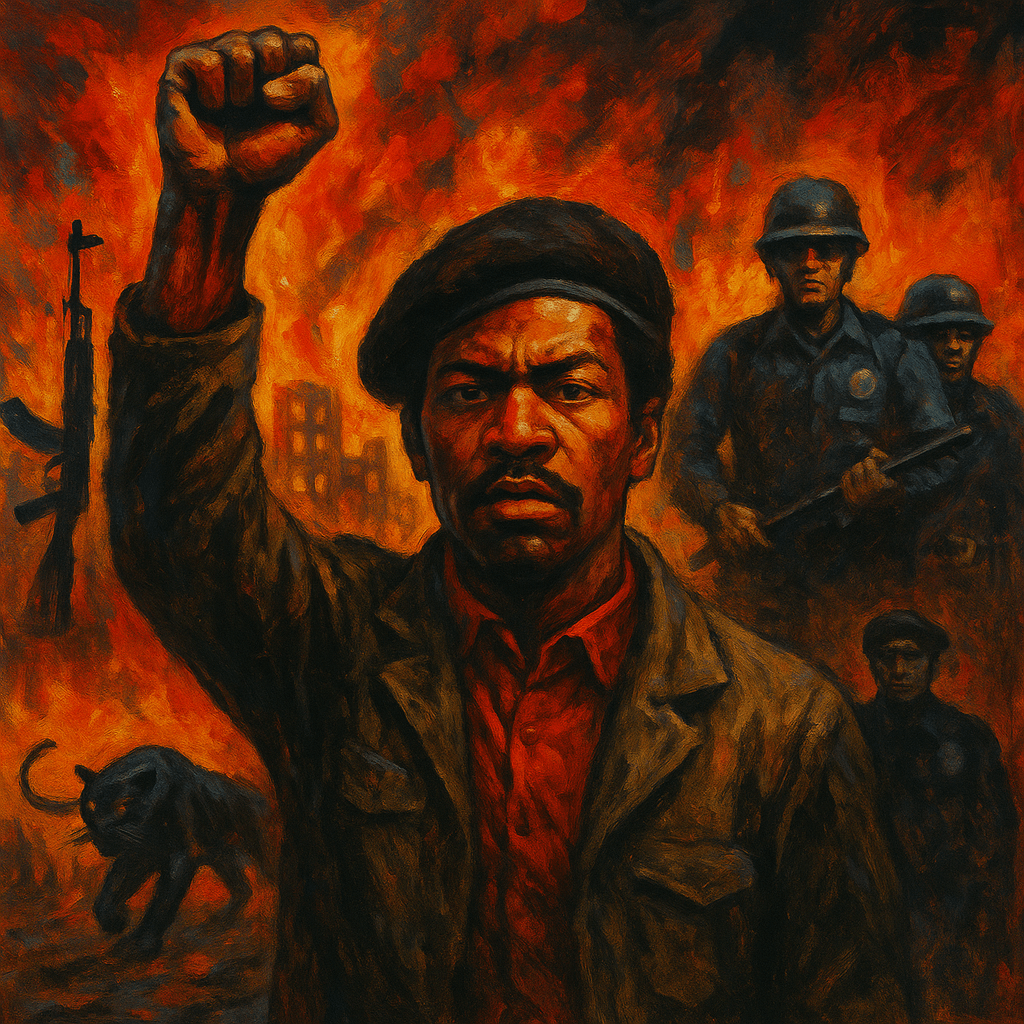
Reviewing Maxwell C. Stanford Jr.’s Revolutionary Action Movement (RAM): A Case Study of an Urban Revolutionary Movement in Western Capitalist Society — a buried manual of revolutionary insurrection and a mirror to the failures of Western Marxism.
By Prince Kapone | Weaponized Information | August 2025
This is not a book review. It’s a charge sheet. The defendant is Western Marxism; the evidence is the Revolutionary Action Movement; the crime is disappearance. For sixty years the imperial left has perfected a parlor trick: praise the poetry of revolt while burying the people who actually revolt. They turned the Black working class into a metaphor, the ghetto into an allegory, and the long insurgency of African people in the U.S. into a teachable moment for tenure. Meanwhile, RAM wrote plans, trained cadre, armed communities, and set a strategic horizon the university still refuses to name out loud: the destruction of the settler regime and the birth of Black socialism on stolen land. If that sentence makes certain readers flinch, good. That flinch is the sound of ideology breaking.
Maxwell C. Stanford did not file a thesis to impress a committee. He filed a field report from occupied territory. He mapped the internal colony with the cool precision of a mechanic—class structure, police function, propaganda flow, the colonial state’s logistics of control. He read the slave revolts as doctrine, Malcolm as method, Robert F. Williams as proof of concept, and Latin American urban guerrilla theory as a toolkit for a war the U.S. swore didn’t exist. RAM took the mask off “domestic policy” and named it for what it was: counterinsurgency against a nation inside a nation. That clarity is why they were repressed. That clarity is why they were erased. And that clarity is why we’re here.
Let’s say it plainly, since the euphemisms have done enough damage: in the United States, socialist revolution does not pass around the Black working class—it passes through it. Through the factory floors and loading docks where migrants and Black workers bled for surplus; through the housing projects designed as kettles; through the prison blocks built as replacement plantations; through the Southern Black Belt where land, labor, and law still rhyme with 1865. Western Marxism, perched comfortably above this map, preferred melancholy to method. It could mourn the dead of Birmingham and Jackson and Attica, but when living militants organized clandestine cells, studied guerrilla logistics, and spoke of an independent Black socialist republic, the theorists of defeat became moralists of order. RAM made socialism practical; the West made socialism palatable. You can guess which the state found more dangerous.
The indictment runs deeper. RAM’s synthesis—Black nationalism disciplined by Marxist-Leninist science and fused to Third World internationalism—should have redrawn the imperial left’s compass. Instead, the seminar domesticated it. “Race” was elevated as discourse while the colony persisted as structure; class was abstracted into taste while wages of whiteness went uncollected from the ledger of history; “violence” was lamented in essays while the police perfected it in practice. RAM refused all three evasions. They insisted that the Black proletariat is not a symbol but a subject; that the U.S. is not a flawed democracy but a colonial machine; that liberation is not a feeling but a program. And programs demand organization, security, infrastructure, and, when necessary, the disciplined use of force. Western Marxism could not forgive them for being serious.
What, then, is our task? To exhume the weapon the state buried and the academy paved over. To restore RAM not as footnote to the Panthers or preface to the prison movement, but as a strategic school in its own right—the link between maroon camps and modern cells, between Reconstruction’s aborted land revolution and a Southern socialist horizon, between Malcolm’s internationalism and the concrete mechanics of urban insurgency. We are not here to translate RAM into gentler language for fragile readers in the core. We are here to indict the tradition that taught those readers to fear the only force in this country that has ever consistently pushed history forward: the Black working class in motion. If your Marxism cannot say that without trembling, it does not need revision. It needs replacement.
II. Dialectics of Emergence: RAM as Product and Catalyst of the 1960s Revolutionary Tide
RAM did not emerge in a vacuum, nor was it the spontaneous creation of a few militant minds. It was born from the collision of global decolonization, the mass migration of Black people into Northern cities, and the tightening noose of postwar domestic repression. This dialectic—movement and counter-movement—shaped the organization’s character: a product of its time, but also a force that pushed the tide of struggle forward with its own clarity of purpose.
In Western Marxist accounts of the 1960s, this kind of formation barely registers. At best, it is reduced to “identity politics” or romanticized as cultural rebellion. Such frameworks fail precisely because they refuse to grapple with the colonial nature of the U.S. state. They treat the Black liberation struggle as an adjunct to the “real” class struggle, which they imagine unfolding primarily among white industrial workers. RAM’s existence explodes that myth. Its program and practice placed the internal colony at the center of revolutionary strategy, insisting that the liberation of Black people in America was not a secondary question but the key to the empire’s collapse.
Stanford is explicit: RAM drew equally from Robert F. Williams’ doctrine of armed self-defense and Malcolm X’s revolutionary internationalism. This synthesis was not an academic exercise—it was an operational blueprint. While Western Marxists were still debating the “correct line” on national liberation in seminar rooms, RAM was building structures for urban guerrilla warfare, studying the strategies of Marighella, Guillén, and other Third World revolutionaries, and preparing for confrontation with the state. Here, theory did not float above the struggle; it was embedded in the struggle, sharpened by the lived conditions of the colonized.
To call RAM an “organization” undersells what it was. RAM was a praxis—mass-based, anti-imperialist, grounded in the internal colony, and in active dialogue with revolutions abroad. This orientation placed it outside the comfortable categories of Western Marxism, which privileges movements that fit its own Eurocentric class schema. RAM refused that frame, and in doing so, revealed its limits. Its emergence is proof that revolutionary strategy in the U.S. cannot be imported wholesale from European models—it must grow from the soil of anti-colonial struggle here, in the belly of the beast.
III. Black Guerrilla Warfare in the Belly of the Beast
When RAM called for an “independent Black socialist republic in the South,” it wasn’t indulging in utopian daydreaming—it was naming a concrete military and political objective rooted in the geography of Black life, the legacy of Reconstruction, and the unfinished project of decolonization. This was not the reformist language of “representation” or “equality under the law.” It was the language of secession from empire, of revolutionary rupture.
Western Marxism, with its fixation on parliamentary struggle and the patient accumulation of reforms, had no theoretical or practical space for this kind of program. To most of its adherents, guerrilla warfare was something exotic—appropriate for the jungles of Vietnam or the mountains of Cuba, but unthinkable in the streets of Detroit, Harlem, or Watts. RAM annihilated that assumption. It studied the urban guerrilla strategies of Marighella, Guillén, and Santucho not as foreign curiosities, but as applicable lessons for fighting an occupying force in America’s Black urban cores.
Stanford’s analysis of police, prisons, and surveillance as instruments of colonial occupation—not as neutral or even flawed domestic institutions—was decades ahead of its time. Where Western Marxists tended to treat police violence as a symptom of capitalist inequality, RAM saw it as an intentional structure of domination designed to maintain white settler control over the internal colony. That clarity flowed from its materialist grounding in Black conditions, not from abstract theorizing about “the state” in general.
Today’s militarized policing, predictive algorithms, and surveillance grids are the logical descendants of the systems RAM confronted. The difference is that Western Marxist currents have largely been content to critique these technologies in isolation—as privacy concerns, as corporate overreach—while refusing to name the colonial logic that underpins them. RAM’s approach leaves no such escape route: if these forces are colonial in nature, then dismantling them is inseparable from dismantling the empire itself. Anything less is capitulation.
IV. Revolutionary Synthesis: RAM’s Dialectical Materialist Method
RAM’s strength was never just in its militancy—it was in its method. Stanford’s work reveals an organization that understood revolutionary theory as a living weapon, not an academic ornament. RAM’s approach was grounded in Maoist dialectics and historical materialism, honed by the conditions of the internal colony, and tested through organizing in the streets, workplaces, and campuses of Black America. It was a praxis forged in the crucible of struggle, not the seminar room.
Western Marxism, by contrast, had long retreated from this kind of integration between theory and action. Having abandoned revolutionary defeatism in the imperial core, it often treated the colonial question as an optional “special topic” rather than the pivot of global class struggle. In its frameworks, the liberation of Black people was too often reduced to moral outrage or abstract “solidarity” rather than recognized as the decisive contradiction within U.S. capitalism. This detachment was not neutral—it functioned as an ideological shield for the settler order, allowing white radicals to posture as revolutionaries without ever breaking with their own colonial privileges.
RAM refused such evasions. It synthesized class, race, and national oppression through the lens of internal colonialism, making it clear that the struggle in the U.S. was not a battle within a shared democracy but a war between a colonized nation and a settler empire. It rejected the integrationist illusions that Western Marxists were often willing to entertain—illusions that the empire could be pressured or reformed into justice. For RAM, liberation required dismantling the U.S. state itself.
Stanford’s emphasis on mass political education, cadre development, and disciplined clandestine organization stands in stark contrast to Western Marxism’s preference for open, discursive, and largely unstructured “movements.” Where the latter values intellectual debate as an end in itself, RAM valued it only insofar as it sharpened the blade of action. That difference is not a matter of style—it is a line of demarcation between revolution and performance.
V. State Repression and the Anatomy of Counterinsurgency
The U.S. state did not treat RAM as a protest group. It treated it as an enemy formation. From the moment RAM articulated a strategy for Black self-determination backed by armed capacity, it was met with the full arsenal of counterinsurgency: infiltration, surveillance, harassment, arrests, assassinations. This was not an overreaction—it was a recognition by the settler state that RAM’s program, if realized, would strike at the structural heart of U.S. empire.
Stanford’s account is unsparing in showing how COINTELPRO worked: not merely to punish individuals, but to dismantle networks, sever political relationships, and poison the soil in which revolutionary movements could grow. RAM’s fate was sealed not by internal weakness alone, but by a coordinated state project to preempt, disrupt, and criminalize before the organization could consolidate into a durable national force.
Western Marxism has never grappled seriously with this reality. In its narratives, state repression of Black revolutionary movements is acknowledged—sometimes even lamented—but rarely analyzed as central to the maintenance of capitalist power in the imperial core. By framing the class struggle as primarily an economic conflict within a shared political space, Western Marxists sidestep the fact that the U.S. state wages a colonial war against Black people inside its borders, and that COINTELPRO was not an aberration but the domestic front of that war.
RAM’s early warnings about the emerging prison-industrial complex, decades before mass incarceration reached its peak, underscore its strategic acuity. Where Western Marxists often treated prisons as marginal to the capitalist system—a site of injustice, yes, but not a central pillar—RAM saw them as the counterinsurgent replacement for chattel slavery, designed to neutralize Black political agency and extract labor under a new legal form. This clarity came not from theory abstracted from reality, but from a revolutionary analysis rooted in the lived experience of the colonized.
To study RAM is to understand that counterinsurgency is not reactive but structural, and that any revolutionary project in the U.S. must prepare to face it from day one. To ignore this, as Western Marxism has habitually done, is to write the script for defeat before the first shot is fired.
VI. RAM and the Weaponization of Memory
When the state could no longer physically dismantle RAM—when its members were scattered, imprisoned, or driven underground—it moved to erase them from historical consciousness. This is the quieter phase of counterinsurgency: the rewriting of the past so that the dangerous lessons of revolutionary struggle are blunted, domesticated, or forgotten. In the liberal academy, this meant elevating safe, integrationist figures into icons while consigning RAM to a footnote or omitting it entirely. In popular culture, it meant turning the 1960s into a story of moral awakening rather than revolutionary confrontation.
Western Marxism played its part in this burial. By refusing to center the internal colony in its analyses of U.S. capitalism, it could treat RAM’s armed struggle as either a tragic miscalculation or an exotic deviation from the “real” class struggle. This erasure wasn’t accidental—it allowed white radicals to imagine themselves as inheritors of the revolutionary tradition while disowning the actual organizations that had waged uncompromising war against the settler state. In the sanitized Marxist histories, RAM becomes invisible, not because it lacked importance, but because its existence indicts the Eurocentric frameworks those histories defend.
Stanford’s thesis is an act of rebellion against that erasure. It is not the detached work of a historian cataloging artifacts; it is a political intervention meant to keep RAM alive as a strategic and ideological reference point. To read it as a mere “case study” is to miss its function—it is an insurgent archive, a manual for future struggle disguised as academic research.
The lesson here is sharp: history is not just written by the victors; it is weaponized by them. The ruling class rewrites the past to secure the present, and the left—especially its Western Marxist currents—often abets this process through its own silences, omissions, and theoretical evasions. Resurrecting RAM’s legacy is therefore not nostalgia; it is counter-counterinsurgency, the reclaiming of memory as a weapon in the ongoing war.
VII. Lessons for the Present: RAM as Blueprint in the Era of Technofascism
In an age where the state has digitized COINTELPRO, where predictive algorithms replace informants and drone fleets replace police helicopters, the lessons of RAM are not historical curiosities—they are survival strategies. Stanford’s record of RAM’s work reads today like a blueprint for organizing in the belly of a far more technologically sophisticated beast: build clandestine structure, anchor yourself in a mass base, maintain political clarity, align with international liberation struggles, and arm the oppressed—materially and ideologically—for self-defense.
For Western Marxism, this is still foreign territory. Its organizational forms remain overwhelmingly public, legalistic, and easily surveilled; its political culture still clings to open assemblies and programmatic manifestos as if repression were an afterthought. It treats technofascism as a glitch in democracy rather than as the perfected form of imperialist rule in crisis. RAM’s method makes clear that this is a fatal error: you cannot reform a system designed to annihilate you, and you cannot defeat a counterinsurgency with transparency and moral appeals.
RAM’s insistence on the internal colony thesis is perhaps its most urgent lesson. In the 2020s, much of the white left—and the NGO-industrial complex that funds it—has retreated into a depoliticized anti-racism that seeks inclusion in the settler system, not its destruction. Meanwhile, Western Marxist currents continue to frame racial oppression as secondary to class exploitation, ignoring the reality that in the U.S., class is racialized through the colonial relation. RAM’s analysis obliterates this false hierarchy: liberation for the Black nation is not a “subset” of class struggle; it is the cutting edge of it in the imperial core.
Translating RAM’s line into today’s terrain means rejecting the pacification of the post-Obama era, the corporate-friendly theater of BLM’s liberal wing, and the NGO-managed “resistance” that funnels militancy into grant cycles. It means treating digital surveillance, militarized police, and endless imperial war as part of one system of control—a system that cannot be negotiated with, only dismantled. This is where RAM stands as a permanent challenge to Western Marxism: it demands that revolutionaries in the core take the colonial contradiction as primary, or else resign themselves to irrelevance.
VIII. Conclusion: RAM Was Right—And That’s Why They Buried It
RAM did not simply dream of liberation—it planned for the seizure of power. It treated the U.S. state not as an arena to be lobbied or reformed, but as an enemy to be overthrown and dismantled. This alone made it intolerable to the settler order. But it also made RAM a thorn in the side of Western Marxism, which has, for decades, been defined by its aversion to the very idea of conquering state power. For Western Marxists, the state is to be “pressured,” “contested,” or “democratized”—never captured and repurposed for the revolutionary transformation of society. In this respect, RAM’s uncompromising clarity marked a line that Western Marxists would not cross.
This is what made RAM so easy to ignore, to distance from, to condemn in the language of “ultra-leftism” or “adventurism.” To take RAM seriously is to admit that revolution in the imperial core is not a debate club proposition—it is a war. And wars have enemies, targets, and the necessity of organized force. The very willingness of RAM to name the enemy, to identify the terrain, and to train for the fight placed it beyond the pale of a left more comfortable with critique than confrontation.
The state buried RAM physically through arrests, assassinations, and exile; it buried RAM ideologically through erasure and misrepresentation. Western Marxism helped dig the grave by defining the boundaries of acceptable left politics in ways that excluded precisely the kind of revolutionary militancy RAM embodied. To resurrect RAM, then, is not just to remember—it is to break those boundaries wide open.
We do not study RAM as historians. We study it as comrades recovering a stolen weapon. Its theory, praxis, and organizational discipline remain dangerous because they remain relevant. In an era of technofascism, mass surveillance, and global counterinsurgency, RAM’s strategic clarity is not a relic—it is a map. And if we refuse to follow that map, we will find ourselves, like so many Western Marxists before us, wandering the same circles while the empire sharpens its knives.
RAM was right. That is why they buried it. And that is why we dig it back up—not to admire the bones, but to wield the sword.
 Weaponized Information
Leave a comment