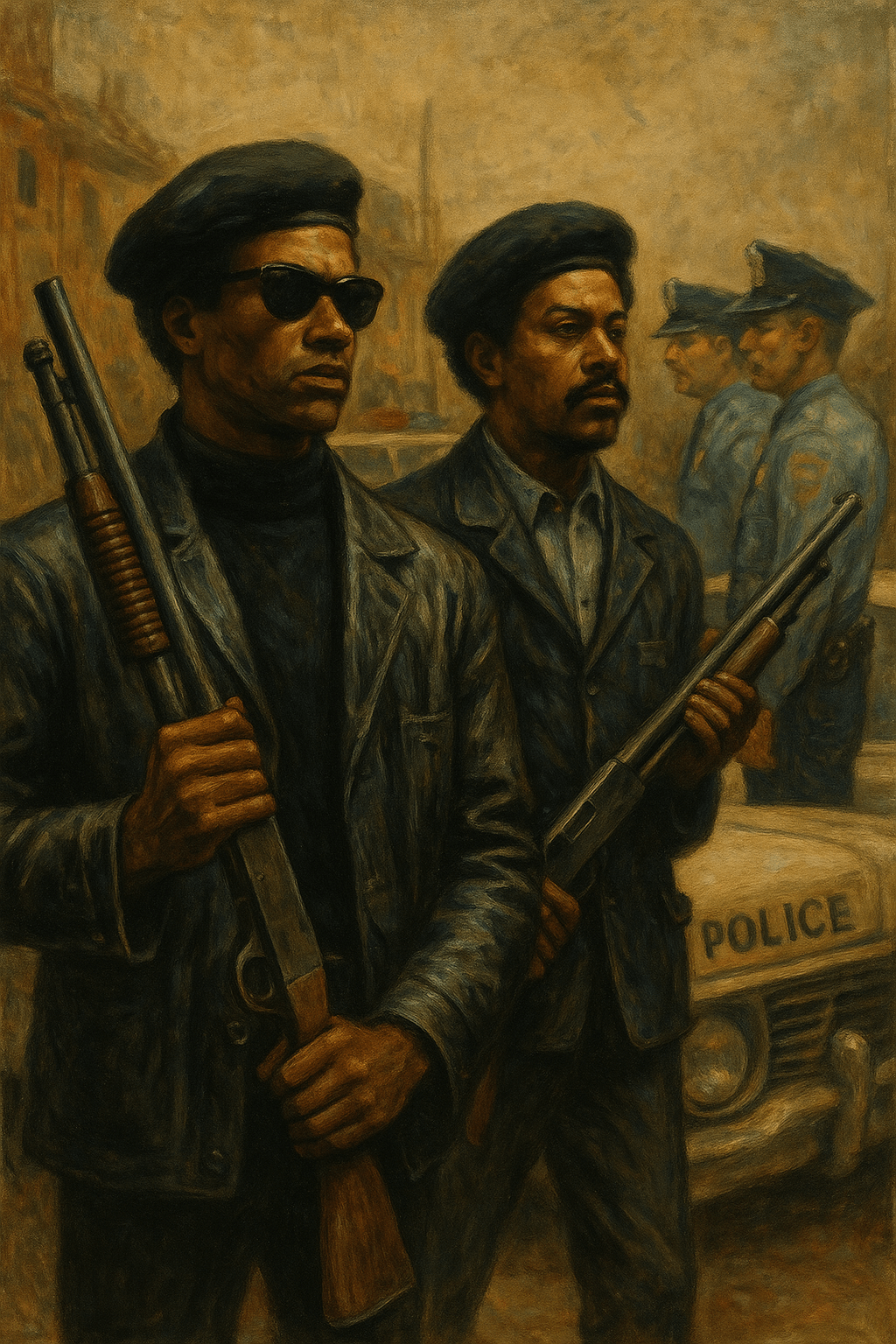
We crack open Revolutionary Suicide—Huey P. Newton’s battle cry from inside the belly of the beast—not to light candles for the past, but to pull weapons from it. This is Newton as he was: street-hardened, self-taught, and dead serious about smashing capitalist power. And it’s an indictment of the Western Marxists who keep treating revolution like a grad school seminar, flinching every time the struggle picks up a gun.
By Prince Kapone | Weaponized Information | August 14, 2025
I. Born Under Occupation: Childhood in the Colony
Huey Percy Newton entered the world in 1942, in Monroe, Louisiana, a small Southern town where the smell of pine trees mixed with the stink of Jim Crow. His family carried the dust of the South to Oakland, California, chasing the half-myth of wartime jobs and West Coast freedom. What they found instead was the same plantation logic, wrapped in industrial smoke and redlined neighborhoods. Newton’s childhood was not one of romanticized hardship; it was a laboratory of colonial survival.
The segregated schools in Oakland didn’t just fail him—they refused him. By the time he graduated high school, Newton was functionally illiterate, an indictment not of his intellect but of the colonial education system’s design. Western Marxists talk about alienation in the workplace; Newton lived alienation before ever clocking a shift—alienation from knowledge itself, the first step in ensuring that the colonized remain subjects, not citizens.
The real curriculum was in the streets. The “brothers on the block” schooled him in the politics of the corner, the economy of the hustle, and the science of reading a man’s intent from across the avenue. This was not the romantic lumpen mystique of Parisian cafés or the sanitized proletarian of Western Marxist imagination. This was the lumpenproletariat of the colony: captives in a stolen land, trained in the arts of evasion and confrontation because the police were a standing army of occupation.
Newton’s petty crimes were not the cause of his political awakening—they were the symptoms of a society that had already declared war on him. Stealing was not pathology; it was redistribution at the level of bare necessity. Every police stop, every handcuff, every night in a holding cell was an education in the material force of the state. Where Western Marxism sees the state as an abstract apparatus to be analyzed in journals, Newton met it in the form of billy clubs and pistols.
This is where the first seeds of revolutionary suicide took root—not in death wish, but in the recognition that the system would kill him slowly if he didn’t choose the terms of the fight. The West’s Marxists rarely speak of this. They theorize “class struggle” as if it were an elective course, not a daily struggle to stay alive. Newton understood that in the colony, every day you draw breath without submitting is an act of rebellion. In that reality, there is no “pure” proletariat untouched by colonial relations—only the colonized poor, fighting to turn survival into politics.
From the start, Newton’s life was a living refutation of the Western Marxist habit of abstraction. There was no seminar to enter, no union hall to join, no intellectual club to validate his analysis. There was only the block, the cops, and the necessity to outthink and outmove both. It was in this crucible that the man who would found the Black Panther Party for Self-Defense began to form—not as a “leader” preordained by theory, but as a colonized man who refused to die quietly.
II. The Education of a Revolutionary: From Illiteracy to Law Books
Newton’s second birth did not happen in a hospital—it happened in the Oakland Public Library. After graduating high school unable to read at a college level, he refused to accept the role society had assigned him: a permanent inhabitant of the ghetto, fit only for hustles, prisons, or graves. He taught himself to read by wrestling with Plato’s The Republic and poring over law books until the language of the oppressor bent to his will. Every page was an act of theft—stealing back the tools that white supremacy had denied him.
In Western Marxist circles, “self-education” is too often romanticized into a quaint intellectual pastime. For Newton, it was a matter of survival. The books were not ends in themselves; they were weapons. He learned the law not to admire its architecture but to use its own statutes as a shield—and when necessary, as a spear. He understood that knowledge in the hands of the colonized must be both defensive and offensive, because in the colony the law is not neutral terrain—it is enemy territory.
This was the foundation upon which the Black Panther Party for Self-Defense would be built. Newton’s study of law, history, and revolutionary theory was not a retreat from the streets but a return to them with sharper tools. He absorbed Marx, Lenin, Mao, and Fanon, but never as sacred texts to be recited at conferences. For Newton, the test of theory was whether it could stop a cop from cracking your skull or plant a breakfast program in the neighborhood. Western Marxists read revolution as literature; Newton read it as a manual.
It was in this period that he connected deeply with Bobby Seale, a fellow Oakland native with a shared understanding of what it meant to live under constant police occupation. Their friendship was forged not in cafés or lecture halls, but in the urgency of street corners and community meetings. Together, they studied revolutionary movements worldwide—not to imitate them wholesale, but to translate their lessons into the language of Black Oakland.
In these years, Newton developed the kernel of his most devastating critique of white left orthodoxy: that Western Marxism’s class analysis, stripped of the colonial question, is a dead letter for the colonized. A strike in Paris or a factory occupation in Chicago may unsettle capital, but in the colony, the front line runs through the tenement hallway and the police cruiser’s spotlight. Newton’s education was not in “pure” class struggle, but in colonial war, and he knew the white left would never lead that fight because they did not live it.
By the mid-1960s, Newton had armed himself—not with rifles yet, but with the kind of knowledge that made rifles politically effective. He was ready to turn study into structure, friendship into organization, and rage into a disciplined vanguard. The Black Panther Party was about to be born, and with it, the most serious challenge to the settler state from within its borders since Reconstruction.
III. From Law Books to Loaded Rifles: Founding the Black Panther Party
The founding of the Black Panther Party for Self-Defense in October 1966 was not an abstract leap from theory to action—it was the inevitable next step for men who had studied the enemy’s rulebook and found its weak points. Newton and Bobby Seale, armed with law books, political theory, and a working knowledge of Oakland’s streets, drafted a ten-point program that fused the uncompromising demands of the colonized with the universal principles of socialist transformation. It was, in essence, the declaration of a government-in-exile—one that spoke for a people whose citizenship had always been a legal fiction.
The armed patrols that followed were not random acts of bravado. They were a dialectical synthesis of Newton’s street experience, his legal training, and his study of global liberation movements. California law permitted the open carry of firearms, and Newton understood that legality could be weaponized—not as a shield of compliance, but as a trap for the state. Panthers would follow police patrols, rifles slung over their shoulders, law books in hand, reciting statutes that limited police authority. The message was simple: the days of colonial impunity were over.
This tactic struck terror into the police because it exposed the gap between the letter of the law and its enforcement. For white gun owners, the Second Amendment was a sacred shield; for Black revolutionaries, it was a provocation to be met with batons, bullets, or new legislation. The Mulford Act, signed by Governor Ronald Reagan in 1967, made open carry illegal in California—a law drafted specifically to disarm the Panthers. In a single stroke, the state confirmed Newton’s thesis: the law bends to preserve white supremacy.
Here lies one of the starkest lines between Newton’s praxis and Western Marxism’s paralysis. While Western Marxists held seminars on “the state as an instrument of class domination,” Newton sent a contingent of Panthers into the California State Capitol with rifles to demonstrate the point. Theory without such praxis is not merely incomplete—it is complicit, because it allows the colonial order to proceed unchallenged in the streets while remaining a debating society in the academy.
The Panthers’ visibility was as strategic as their firepower. Newton understood that imagery could be as potent as bullets. The iconic photograph of him seated in a wicker chair, spear in one hand and rifle in the other, was not accidental—it was revolutionary theater, an inversion of colonial iconography. Western Marxists often scoff at “symbolism,” yet the colonized understand that symbols are themselves a battlefield. The wicker chair was not comfort—it was throne, tribunal, and firing line.
In these opening years, the Panthers embodied a total rejection of both liberal reformism and Western Marxist abstraction. They moved in disciplined formation, legally armed, legally informed, and politically clear. They were not a protest movement begging for inclusion; they were the embryonic form of a counter-state. And for that, the U.S. government would soon declare them the single greatest threat to its internal security.
IV. Blood on the Streets, Bars on the Windows: Prison, Trial, and COINTELPRO’s Open Season
The night of October 28, 1967, shattered whatever illusions remained about the “legality” of Black self-defense in America. Newton, driving in West Oakland, was pulled over by Officer John Frey. The confrontation escalated in seconds. Shots were fired. Frey lay dead, another officer wounded, and Newton himself was bleeding from the stomach. The details, disputed and distorted by police and press alike, mattered less to the state than the opportunity they presented: here was the perfect chance to remove the Panther’s central strategist from the field.
The arrest turned Newton into a lightning rod for the contradictions of U.S. justice. His trial was a legal lynching dressed in courtroom procedure. The state wanted a conviction not simply for the killing of a cop, but for the audacity of arming Black people, organizing them into a disciplined force, and making them visible on the world stage. Newton’s cell became both a cage and a pulpit. He read voraciously, wrote strategically, and turned his own incarceration into an indictment of the prison-industrial counterinsurgency—a system Western Marxism often treats as a metaphor rather than a battlefield.
Outside the walls, the “Free Huey” campaign became a mass rallying cry. Rallies of thousands took place in Oakland and across the country. Celebrities, students, radicals, and revolutionaries wore buttons with Newton’s face, turning his captivity into a political spectacle the state could not fully contain. This was not a cult of personality—it was a concentrated expression of solidarity around a political prisoner whose fate symbolized the colonial condition of Black America. Newton understood that his own survival depended on this external pressure; he also knew that the campaign was an organizing school in its own right.
Behind the scenes, the FBI’s COINTELPRO program was moving with surgical precision. J. Edgar Hoover labeled the Panthers “the greatest threat to the internal security of the United States” and set in motion an all-out war to dismantle them. Infiltrators spread lies, stoked factional splits, and manipulated existing tensions. Police raids escalated from harassment to outright assassinations, as in the murders of Fred Hampton and Mark Clark in Chicago in 1969. The aim was total neutralization: to make leadership paranoid, rank-and-file fearful, and the public confused about who the Panthers really were.
It’s here that the fault line between Newton’s revolutionary realism and Western Marxism’s safe distance yawns open. Newton’s life under siege was not an academic case study—it was a counterinsurgency operation in real time, waged with informants, courtrooms, rifles, and chemical dependency as weapons. To read Revolutionary Suicide without absorbing this is to miss the marrow of the text. Newton’s reflections on his trial, on the “logic” of the state, and on the necessity of political clarity under fire are not mere autobiography—they are a manual for surviving repression that Western Marxists have never dared to test in their own contexts.
By the time Newton was released in 1970 after his conviction was overturned, the battle lines were redrawn. He walked out of prison to a hero’s welcome, but the war had already shifted. The Panthers had grown in numbers and visibility, yet they were already bleeding from within—wounds inflicted by the state and widened by the contradictions of building revolution under siege. For Newton, the question was no longer whether the state would come for them again—it was how to organize when the enemy was already inside the gates.
V. Survival Pending Revolution: From Patrols to Programs, from Spectacle to Structure
When Huey Newton emerged from prison in 1970, the Black Panther Party was no longer just a band of armed militants patrolling the streets of Oakland. It had become a national force—chapters in dozens of cities, an international office in Algiers, and a name recognized in every newsroom and FBI memo. Yet Newton knew that firepower and bravado could not alone sustain a revolutionary movement under siege. The spectacle of the gun had opened space; now, that space had to be fortified with the infrastructure of dual power.
The Panthers rolled out their “Survival Programs” with the precision of a military campaign. Free Breakfast for Children fed tens of thousands every morning. Free health clinics offered screenings for sickle-cell anemia, a disease largely ignored by the white medical establishment. Clothing drives, free busing to prisons for family visits, legal aid, liberation schools—each program was a small breach in the walls of capitalist neglect. Newton called them “survival pending revolution,” a phrase that refused both reformist delusion and adventurist fantasy. These were not charity; they were organized, disciplined acts of self-determination under siege.
Western Marxism—ever allergic to praxis that isn’t filtered through the seminar—has often dismissed this turn as a retreat from armed struggle, a lapse into community service. Newton saw it differently: without a mass base that felt the revolution in their stomachs and in their children’s bodies, the vanguard was a hollow shell. Guns without bread were a dead end. Bread without guns was surrender. The dialectic required both, and the Panthers, for a time, managed to walk that razor’s edge.
But the state’s counteroffensive never paused. Police raids targeted clinics and breakfast sites with the same ferocity they had shown toward armed patrols. Informants whispered lies about theft, favoritism, and ideological betrayal. Newspapers recast the programs as propaganda stunts. Even success was turned into a weapon against them: the more people the Panthers served, the more the state feared their legitimacy, and the harder it moved to crush them.
Newton, reading Mao and Fanon alongside the day’s intelligence reports, understood that survival programs were not a substitution for revolution—they were training grounds for the masses and a shield for the Party. Every bowl of oatmeal, every blood test, every legal defense was a seed planted in hostile soil. Yet he also understood the danger: survival could become its own horizon if the revolutionary engine stalled. The challenge was to keep the political horizon in view while feeding a generation born into empire’s famine.
This was a lesson Western Marxists refused to learn then and refuse still: that the material needs of the oppressed are not a detour from revolutionary theory—they are the ground from which it grows. The Panthers’ survival programs were a living negation of the ivory-tower detachment that treats revolution as an intellectual debate rather than a sustained confrontation with the structures of deprivation.
In Revolutionary Suicide, Newton threads these programs into his own life story, showing how his political imagination had been sharpened not only by armed patrols but by the concrete act of meeting people’s needs. This was the science of revolutionary suicide in practice: risking annihilation not only in the gunfight but in the daily grind of building an alternative society under the gun of the state.
VI. The Long Fall: Repression, Disintegration, and the Cost of Vanguard Life
By the late 1970s, the Black Panther Party was a shadow of its former self. The war waged by the U.S. state—through COINTELPRO, local police terror, and unrelenting media demonization—had done its job. Comrades were murdered in their beds, locked away for decades, or driven into exile. The rest faced a daily grind of harassment, infiltration, and engineered factionalism. No movement, no matter how disciplined, could emerge from such a sustained counterinsurgency unscathed.
Huey Newton bore the weight of this collapse personally. In Revolutionary Suicide, his tone shifts from the audacity of armed patrols to the isolation of a man whose ranks have thinned, whose trust has been eroded, and whose days are marked by courtrooms and funerals. The Panthers’ community programs—once the beating heart of their strategy—were gutted by raids and dwindling resources. Chapters folded. The international office in Algiers closed. A movement that had once struck fear into the core of empire now fought just to survive the next police raid.
The pressure was unrelenting. Newton’s exile in Cuba—intended as a refuge—became a cage of displacement. His return to Oakland brought no relief. By the early 1980s, he was entangled in the quicksand of drug addiction, caught between the memory of revolutionary glory and the crushing reality of political defeat. Western Marxists, from the safety of tenured chairs and NGO offices, would later point to Newton’s descent as proof of personal failure, a moral collapse. But this is the coward’s critique. It ignores the reality: the vanguard had been left for dead by a Left that refused to share its risks, and smashed by a state that knew exactly how to kill a revolution without ever admitting to murder.
Even in the spiral, Newton’s mind remained sharp. He spoke candidly about his mistakes—about the dangers of centralizing too much authority, the corrosive effect of suspicion under siege, and the toll of trying to lead a war while under constant surveillance and threat. His final years were marked by flashes of brilliance, but also by the loneliness of a man who knew too much about what it costs to challenge empire seriously. That loneliness would end violently: in 1989, Newton was shot dead in West Oakland by a member of the Black Guerrilla Family, another casualty of a fractured movement and a poisoned terrain.
In the Western Marxist imagination, “failure” is a moralized abstraction—something to dissect in books, assign to students, and file away as a cautionary tale. For Newton, failure was material: comrades buried, organizations dismantled, dreams deferred by a bullet or a cell. To indict him without indicting the state that engineered his fall is to participate in the counterinsurgency.
Revolutionary Suicide does not hide this trajectory. It forces the reader to confront the inevitability of death—whether slow or sudden—when confronting a system built on genocide and exploitation. Newton’s life, in its rise and its collapse, is a warning and a challenge: you can survive by submitting, or you can risk everything for liberation. Either way, the system will come for you. The difference is whether you meet it on your knees or on your feet.
VII. Weaponizing Revolutionary Suicide for the 21st Century Frontlines
To read Revolutionary Suicide today is to confront a problem that has only deepened since Huey Newton walked Oakland’s streets with a law book in one hand and a shotgun in the other: the vast gulf between those who talk about revolution and those who live it. Newton was not interested in performance politics, in slogans detached from material struggle, or in the moral pageantry of Western Marxism’s seminar rooms. He lived in the crackling space between life and death that every genuine revolutionary must inhabit—where the question is not whether you will die, but how.
Western Marxism treats revolution as a hypothetical, a literary genre, a distant ideal that can be endlessly theorized without ever being tested. Newton’s memoir annihilates that comfort zone. He takes the reader into the back of police cars and into the holding cells, into the cramped Panther offices and the tense silences of a stakeout, into the joy of watching a child eat a free breakfast and the anguish of identifying a comrade’s body. He collapses the distance between “politics” and survival. There is no separation. They are the same.
For the Black Panther Party, survival was not a retreat from militancy—it was militancy. The community programs, the armed patrols, the political education classes, the international solidarity work—each was a weapon. Each was an act of building dual power under siege. And each, when stripped of its context and rebranded by liberals, became the very mythology Newton warned against: a de-fanged, museum-ready Panther that exists only to inspire, never to threaten.
In the wreckage of the 21st century—where empire is in open decay but doubling down on its technofascist machinery—the lessons of Newton’s life are not optional reading. They are operational directives. Organize with discipline, because the state will exploit every crack. Serve the people materially, because rhetoric alone will not feed a hungry child or defend a vulnerable community. Be prepared for the full weight of repression, because the moment you matter, you will be marked. And above all, understand that revolutionary suicide is not about seeking death—it is about refusing to live on your knees.
Newton wrote for a generation that was already under siege. We live in one where siege is the default condition for anyone opposing the ruling order. The question he poses—implicitly and explicitly—is whether we will continue to die reactionary deaths in isolation, in addiction, in quiet despair, or whether we will embrace the only death worth having: the one that comes from confronting this system with our whole lives. In that choice lies the only path to liberation.
Revolutionary Suicide is not a relic. It is a live weapon. The only way to honor Newton is to pick it up, aim it at the heart of empire, and fire.
 Weaponized Information
Leave a comment