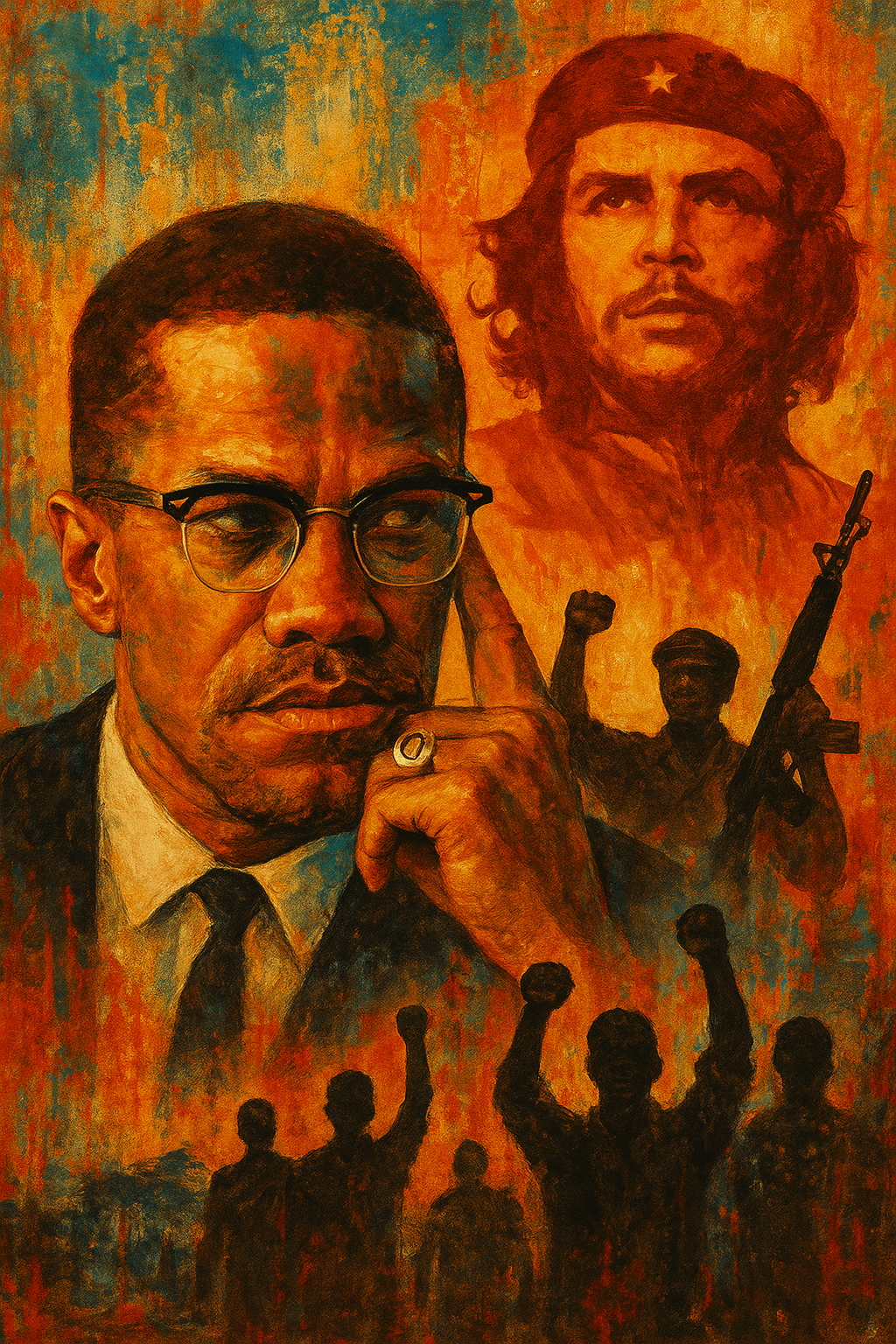
Ghosts in Our Blood exhumes the internationalist, anti-imperialist, and Grenadian roots of Malcolm X, smashing the museum glass of liberal iconography and Western Marxist distortion to return him to the world struggle that claimed him.
By Prince Kapone | Weaponized Information | August 12, 2025
I. Bringing Malcolm Back to Earth — Out of the Museum, Away from Western Marxism
Jan Carew’s Ghosts in Our Blood is more than biography—it is a jailbreak. Not just from the liberal glass case where Malcolm X has been mounted as a safe, tragic icon, but from the other mausoleum where his body lies: the Eurocentric seminar room of Western Marxism. In both spaces, Malcolm is abstracted and disarmed. The liberal version turns him into a poster for “Black pride” divorced from revolutionary praxis. The Western Marxist version preserves some of his anti-capitalism but amputates the colonial contradiction, sanding down his nationalism, his Pan-Africanism, and his insistence that the U.S. is a settler-colonial empire. In their telling, Malcolm is an angry social critic of capitalism at home—never a strategist of global liberation abroad.
This is not accidental. Leading Western Marxist voices, from Trotskyist integrationists to academic theorists, have treated Malcolm as a political cousin to be praised for his militancy yet kept at arm’s length. They often emphasize that “Malcolm was not a Marxist” and reject his framing of Black people as a colonized nation. His 1964–65 turn toward Africa, the Muslim world, and human rights is politely noted but politically dismissed. In their frameworks, the real engine of world revolution remains the European and Euro-American working class; colonized peoples are important, but only as adjuncts to the metropolitan struggle. This is why Malcolm’s own organizational alliances—like his quiet exchanges with the Revolutionary Action Movement—rarely appear in their narratives: such relationships point to a revolutionary process centered in the colonies, not the metropole.
Carew’s intervention is a direct rejection of that erasure. His Malcolm is not a symbolic “voice of the voiceless” for a domestic audience but the living product of Grenadian Garveyism, African resistance, and the diasporic working-class tradition. Carew does not treat Malcolm as a curiosity to be analyzed but as a comrade to be armed. His method—rooted in oral history, matrilineal narrative, and political memory—defies the sterile authority of white-liberal historiography and Western Marxist textualism alike. Where they dissect Malcolm’s speeches for universalist soundbites, Carew restores the insurgent coordinates: Harlem to Accra, Mecca to Mississippi, London’s diaspora to the UN floor.
Bringing Malcolm back to earth, in Carew’s hands, means planting him firmly in the soil of the global South and the streets of the internal colony. It means refusing to let the Eurocentric left turn him into an honorary European Marxist or an exotic moralist. It means reclaiming him as a strategist whose target was not simply Jim Crow but the entire imperialist order. This is the Malcolm Western Marxism cannot handle—and the Malcolm we must take into battle.
II. The Grenadian Root: Louise Little and the Blind Spots of Western Marxism
Carew begins where both liberal historiography and Western Marxism tend to avert their gaze—at the matrilineal source of Malcolm’s politics. Louise Langdon Norton Little was not simply Malcolm’s mother; she was a Grenadian Garveyite, a disciplined organizer, and a living conduit of the Caribbean radical tradition. She brought into Malcolm’s childhood home the politics of African redemption, anti-colonial struggle, and self-reliance. To recover her is to recover the foundational terrain on which Malcolm’s revolutionary consciousness was built.
That terrain has been systematically erased. In the liberal record, Louise is reduced to a tragic figure—destined for institutionalization, a victim of poverty and state harassment. In Western Marxist treatments, she is often invisible altogether, a silence born of two blind spots: the patriarchal dismissal of women as political actors, and the Eurocentric undervaluing of the colonial Caribbean as a crucible of revolutionary theory. By ignoring her, they strip Malcolm’s politics of its diasporic and anti-colonial grounding, allowing them to reframe him as an American radical with a “racial” grievance rather than a product of an internationalist tradition.
Carew refuses this erasure. Through oral history and family memory, he reconstructs Louise Little’s political life—her work in Marcus Garvey’s Universal Negro Improvement Association, her role in organizing community self-defense against white vigilantes, her fierce commitment to African identity. This is counter-history in action: Malcolm did not “fall out of the sky” into revolutionary politics. He emerged from a lineage of working-class, diasporic Black radicalism that stretched from St. George’s to Harlem, and from the docks of Grenada to the farms of Michigan.
In Western Marxist narratives, such matrilineal radicalism is rarely acknowledged as a site of political theory. But to omit Louise Little is to miss the fact that Malcolm’s later critique of white supremacy and imperialism was grounded in an upbringing that already treated empire as the primary enemy. Carew’s excavation reestablishes the Caribbean as a political homeland in Malcolm’s story—an origin point that undermines Eurocentric Marxist fantasies of the “pure” revolutionary subject arising in the metropole. In doing so, he restores the very roots that Western Marxism has tried, consciously or not, to cut away.
III. From Nation to Liberation: Malcolm’s Break with the Boundaries of Western Marxism
The final fourteen months of Malcolm’s life mark one of the most rapid and profound political transformations of the twentieth century. In 1964, he left the Nation of Islam—not to retreat from politics, but to deepen them. His pilgrimage to Mecca and his travels across Africa, the Middle East, and Europe expanded his field of vision from the condition of Black America to the condition of the colonized world. Out of this experience came the Muslim Mosque, Inc. and the Organization of Afro-American Unity—vehicles not for cultural affirmation alone, but for revolutionary coordination between the oppressed inside the U.S. and liberation fronts abroad.
In Western Marxist accounts, this turn is often treated as a curiosity or a detour—acknowledged but rarely integrated into the core of his political identity. This is because Malcolm’s trajectory exposed a weakness in their framework: their inability, or unwillingness, to fuse revolutionary nationalism with socialist strategy. For much of Western Marxism, nationalism in the colonies is tolerated as a “stage” to be surpassed, not a revolutionary engine in its own right. Malcolm’s embrace of Pan-Africanism, his insistence that the Black struggle was part of a worldwide fight against imperialism, and his growing alliances with armed liberation movements challenged the Eurocentric assumption that revolution’s center of gravity lies in the industrial working class of the metropole.
Carew captures this pivot not as an abandonment of Black America but as a repositioning of it—no longer an isolated struggle for civil rights, but a front in the global war against empire. His Malcolm is not begging entry into U.S. democracy but standing in Accra, Algiers, and Dar es Salaam to declare solidarity with Vietnam, the Congo, and Palestine. This was the Malcolm who saw the U.S. as part of a single imperial system and Black people in America as a colonized nation within it—an analysis that resonates with, but is rarely embraced by, Western Marxists whose theoretical maps center Europe.
It is no accident that this period also saw Malcolm engage with the Revolutionary Action Movement, a clandestine Marxist-Leninist group advocating armed self-defense and national liberation. Such alliances defy the Western Marxist preference for “safe” coalitions within parliamentary or labor frameworks. RAM’s praxis—rooted in the colonial contradiction—aligned more closely with Third World Marxism than with anything emanating from the metropole. In amplifying this aspect of Malcolm’s work, Carew points us toward the revolutionary synthesis that Western Marxism has persistently failed to achieve.
IV. London, Mecca, Accra: Dismantling the Metropolitan Fixation
When Malcolm stepped onto the global stage in his last year, he was not performing diplomacy for its own sake. London, Mecca, and Accra were not symbolic backdrops—they were active fronts in a revolutionary itinerary designed to connect the Black freedom struggle in the U.S. to the anti-imperialist movements reshaping the world. In Britain, he met with Afro-Caribbean and African activists, exposing the shared colonial logic behind London’s West Indian ghettos and Mississippi’s Delta towns. At the London School of Economics, he spoke directly to the diaspora, articulating a politics that refused to be trapped in the narrow grammar of U.S. civil rights.
From Mecca, Malcolm absorbed an internationalist Islam that reinforced his commitment to racial unity across the colonized world. His Hajj did not dissolve his nationalism, as Western liberal mythology suggests—it strengthened his understanding that Black liberation was inseparable from the liberation of all peoples under imperial rule. In Accra, the capital of Kwame Nkrumah’s Ghana, he walked among African revolutionaries who were dismantling European colonialism in real time. These encounters anchored him in a Third World revolutionary framework that Western Marxism, with its metropolitan fixation, has consistently underestimated or dismissed.
For Eurocentric Marxists, the heart of class struggle beats loudest in the factories, unions, and parliaments of the imperial core. Malcolm’s presence in London’s activist circles, his solidarity with African liberation fronts, and his outreach to the Muslim world disrupted that map. He did not treat these arenas as peripheral to “real” revolution; he treated them as its central engine. This was a rebuke to the idea that the colonies were merely raw material for theory-making in Europe. By working directly with diasporic networks, Malcolm was positioning the U.S. Black struggle as a strategic node in the global South’s offensive against imperialism.
Carew’s recollections of conversations with Malcolm in London strip away the filters of both liberal iconography and Western Marxist abstraction. They show a man forging a synthesis between Islam, Pan-Africanism, and Third World Marxism—without waiting for approval from the metropole. It is precisely this Malcolm, unmoored from the gravitational pull of Western theory, that Carew insists we remember: not a visiting speaker from America, but a revolutionary operative in the world’s most decisive battlefields.
V. The Puppetmaster and the Rifleman: Counterinsurgency, Not Just Conspiracy
Carew treats Malcolm’s assassination not as an unsolved mystery, but as the predictable endgame of a revolutionary who had crossed the imperial red line. By 1965, Malcolm was no longer merely a domestic threat to white supremacy; he was an international operative linking the Black colony inside the United States to anti-imperialist fronts in Africa, the Middle East, and Asia. He was moving toward the creation of a unified Pan-African bloc capable of indicting the U.S. for human rights violations before the world. For the state, this was intolerable. The rifleman in the Audubon Ballroom was only the final instrument; the real architect was a counterinsurgency machine that combined federal intelligence, local police, and infiltrated organizations into a single, coordinated apparatus.
Western Marxist narratives, when they address Malcolm’s assassination, tend to focus on the role of the Nation of Islam or to frame it as an isolated tragedy. This reduces the killing to a sectarian feud and leaves intact the liberal fantasy of the U.S. as a system occasionally marred by internal violence, rather than one defined by its systematic liquidation of colonized leadership. What they often omit is the fact that Malcolm was already under FBI surveillance, that his communications were being intercepted, that COINTELPRO-style disruption was aimed directly at the coalitions he was building. To name this is to acknowledge that his death was not a “Black-on-Black” crime, but an act of imperial warfare.
Carew recalls Malcolm’s own prophetic clarity: he knew he was marked for death—not solely by NOI dissidents, but by the U.S. state itself. He understood the reach of its puppet networks, the way it could weaponize existing tensions inside movements to do its work. His analysis fit squarely within the lived experience of liberation leaders from Lumumba to Cabral, all targeted when they threatened to unify national liberation with socialist construction. This is the continuity Western Marxism rarely follows to its conclusion, because it forces an uncomfortable truth: the metropole is not merely an arena of class struggle, it is the headquarters of counterrevolution.
Malcolm’s assassination sits within the long arc of imperial policy: to identify, isolate, and eliminate any force capable of fusing domestic colonial liberation with the global anti-imperialist struggle. Carew names this reality without euphemism, and in doing so, breaks the polite silence of Western Marxist accounts. This is not nostalgia—it is reconnaissance. We study the method of his killing because it is the same method arrayed against Black radicals and Third World revolutionaries today.
VI. History from Below: Breaking the Historiography Monopoly
Carew’s method is as political as his subject. Ghosts in Our Blood is not stitched together from declassified files, distant archives, and the detachment of the scholar’s desk. It is built from oral histories, family testimony, matrilineal memory, and the recollections of comrades. In the hands of liberal historians, these sources are often dismissed as anecdote—too subjective, too “unreliable” to be counted as legitimate evidence. In the hands of Western Marxism, they are often ignored altogether, replaced by the comfort of textual analysis and theoretical exegesis. The result is the same: the lived, breathing networks that produced Malcolm are erased in favor of frameworks that keep him abstract and safe.
Carew refuses that erasure. He listens to Tanta Bess, to Wilfred Little, to the community voices that remember Malcolm not as a statue but as a son, a nephew, a comrade. These are the archives of the oppressed—oral traditions that have preserved revolutionary history in the face of state destruction and academic theft. In Western Marxist historiography, the “serious” record is built from sources controlled by the very institutions Malcolm fought: police reports, court transcripts, official party documents. Carew’s record comes from below, from the very social strata that generated Malcolm’s politics.
This is more than a methodological choice; it is a political stance. To privilege oral and community history is to acknowledge that the working class and the colonized do not need permission from the metropole to define their own revolutionary lineage. It is to reject the monopoly of white-liberal scholarship and its Marxist-adjacent variants over the meaning of Malcolm X. For Western Marxism, such testimony is useful only when it can be slotted into pre-existing categories. For Carew, it is the category—the ground zero of analysis.
In recovering these voices, Carew undermines the academic-industrial complex that profits from Malcolm’s legacy while stripping it of anti-imperialist teeth. He restores the agency of those who knew Malcolm as part of their own struggle, not as a case study in someone else’s theory. It is here, in the cadence of oral memory and the stubborn precision of the survivor’s account, that Malcolm comes back to life—and where Western Marxism’s detachment is exposed as a form of quiet collaboration with the very forces Malcolm fought.
VII. Weaponizing Malcolm for Today’s Struggle
Black August is not a month for empty commemoration. It is a season of political sharpening, a time when the memory of working-class Black martyrs must be reloaded as ammunition in the struggle they died fighting. Carew’s Ghosts in Our Blood makes clear that Malcolm’s life cannot be left in the museum of liberal iconography or the seminar room of Western Marxism. Both have turned him into a palatable abstraction—one a civic saint, the other an “incomplete” radical whose politics must be reframed to fit Eurocentric schemas. Carew smashes both glass cases and returns Malcolm to his proper terrain: the global battlefield of the oppressed against the imperialist core.
In Carew’s hands, Malcolm is not a moral lesson for America’s conscience but a strategist for the dismantling of empire. He is a bridge between the internal colony in the United States and the revolutionary uprisings of Africa, Asia, and Latin America. His alliances—from Harlem street corners to Accra’s corridors of power, from secret meetings with RAM militants to speeches before the Organization of African Unity—form a living map of how to fight imperialism in its totality. This is precisely the Malcolm that Western Marxism cannot accommodate without gutting his analysis of the colonial contradiction.
To weaponize Malcolm today is to reject the fragmentation of his legacy into “cultural,” “economic,” or “international” compartments. It is to see—as he did—that the Black liberation struggle in the U.S. is one front in a single global war. It means refusing the Western Marxist comfort zone that sidelines national liberation as a “stage” on the way to a universal revolution centered in the metropole. It means taking seriously Malcolm’s call to bring U.S. imperialism before the world court, to link our battles to those of Vietnam, Palestine, and the Congo, and to prepare for the repression that such alliances will invite.
Black August is not remembrance—it is reconnaissance. To read Ghosts in Our Blood is to brief yourself on the political life of a man the state assassinated because he was building an infrastructure of liberation that crossed every border the empire drew. Carew hands us that blueprint not to study, but to use. The only honest way to honor Malcolm is to pick up the weapon he carried, to continue the march he began, and to fight the same enemy he named without apology.
 Weaponized Information
Leave a comment