By Prince Kapone | Weaponized Information | August 2, 2025
Sanitized Saints and Raids Without Empire: Politico’s Performance of Concern
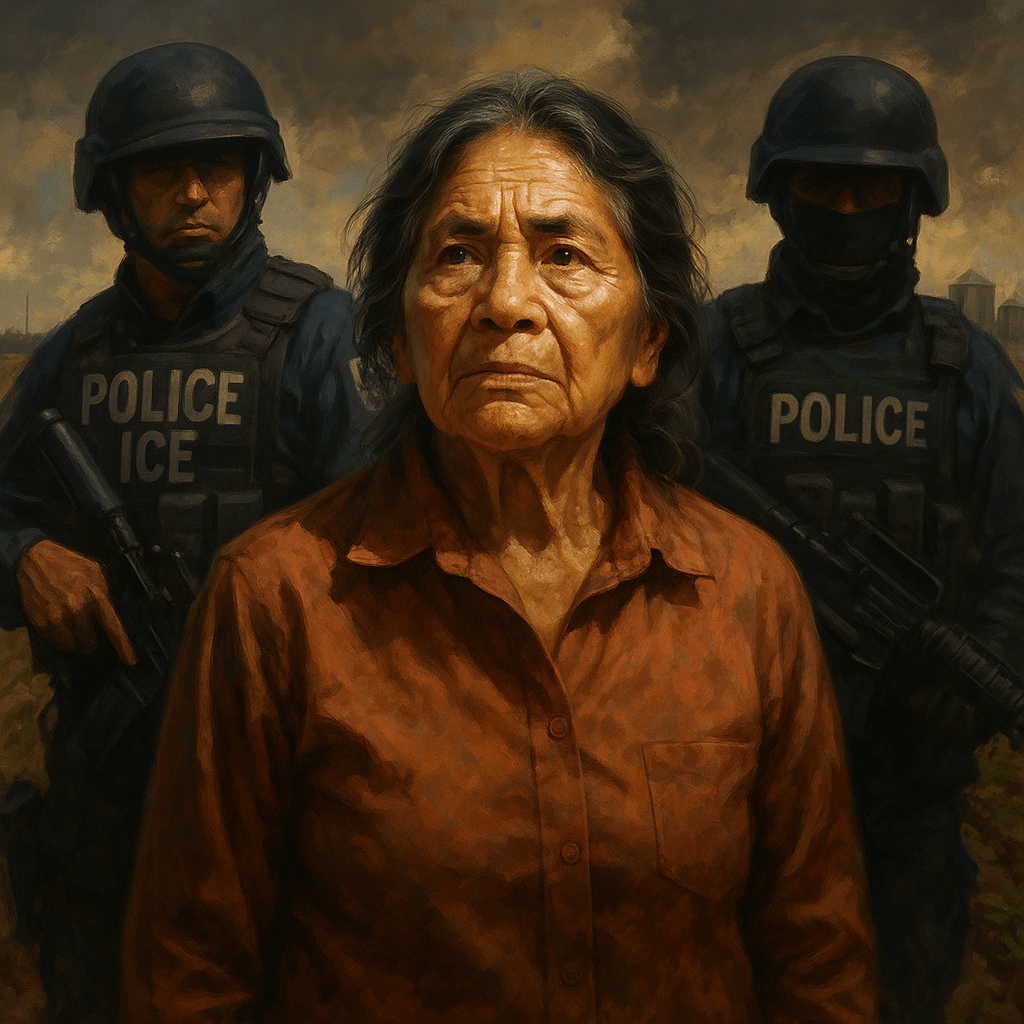
On August 2, 2025, Politico published an interview by Samuel Benson with Dolores Huerta, the 95-year-old farm labor icon, reflecting on recent immigration raids under the Trump administration. In the article, Huerta denounces the cruelty of workplace enforcement actions and calls for undocumented communities to remain politically engaged—especially through youth organizing and participation in elections. Benson frames the conversation as a personal lament from a beloved elder, offering pathos over politics, grief over confrontation. And in doing so, Politico performs its classic function: to render imperial violence mournful, but never accountable.
Samuel Benson, the article’s author, is a young white journalist whose portfolio skews toward uncontroversial coverage of civic figures and bipartisan consensus. He is not a reporter of confrontation, but of curation. The piece reads like a soft-focus portrait session, not a political interrogation. Huerta is handled gently, as one might handle fragile porcelain—a subject to admire, not a figure to unleash. Benson’s writing allows space for grief and indignation, but offers no challenge to power, no confrontation of contradiction. His job, and he performs it well, is to cradle dissent within the safety of the American civic religion.
Politico, Benson’s publisher, is owned by Axel Springer SE, a German media conglomerate bankrolled by the U.S. private equity giant KKR. Axel Springer’s editorial charter commits it to supporting the transatlantic alliance and “free market” values—which is to say, NATO, U.S. empire, and global finance capital. Politico does not exist to inform the masses but to massage elite consensus. It packages crisis as manageable, suffering as unfortunate, and resistance as passé. In this piece, Politico functions exactly as designed: the empire’s therapist, whispering that everything hurts but nothing’s wrong.
The article’s sentimentality begins with its framing: Huerta’s sadness, not structural violence, becomes the emotional center of gravity. Benson opens with her calling recent immigration raids an “atrocity,” describing the situation as worse than the past. But the atrocity remains undefined, untethered from its architects. We are guided to feel dismayed, not enraged. The problem is made moral, not political. This emotional management displaces analysis. Huerta’s disappointment is rendered deeply human but politically weightless.
Selective nostalgia compounds the effect. Benson draws heavily on Huerta’s history with Cesar Chavez and the grape boycotts, invoking the 1960s labor movement with reverent simplicity. But the past is offered as artifact, not ammunition. There is no mention of surveillance, infiltration, or the brutal suppression of farmworker militancy. The reader is bathed in a warm glow of movement memory, untroubled by the sharp edges of that history. The past is curated for comfort, not clarity.
Most insidiously, the article deploys identity as a shield against deeper scrutiny. Huerta’s presence as a revered Latina activist substitutes for analysis. Her words are treated as inherently radical, regardless of content. This is diversity-as-containment: the weaponization of representation to foreclose system-level critique. Because a beloved brown icon is featured, no further interrogation is deemed necessary. Identity is used to authenticate the liberal order, not challenge it.
Finally, the piece culminates in a civic fairy tale. Huerta urges undocumented workers to vote, echoing the eternal liberal refrain: that salvation lies in participation. The idea that the same system orchestrating deportations will redeem itself through ballots is presented without irony. It is the triumph of pageantry over politics. No mention of state repression, electoral disenfranchisement, or the bipartisan machinery of border violence. Just a vote, and a hope, and a nation presumably waiting to change.
This article is not an indictment. It is an elegy. It mourns injustice without naming its perpetrators, celebrates history without confronting its suppression, and exalts agency while prescribing obedience. It is, in the final analysis, a performance of concern. And like all imperial performances, its purpose is not to ignite, but to contain.
From the Fields to the Freezers: The Machinery of Migrant Suppression
Strip away the nostalgia and you find a ruthless machine beneath the sentiment. Beneath the soft lens through which Politico viewed ICE raids under Biden lies a sharpened weapon now wielded by Trump 2.0 with brazen clarity. Since his return to power in January 2025, the Trump regime has escalated the use of workplace raids, biometric surveillance, and mass deportations—not as a correction to Democratic softness, but as the cornerstone of his domestic labor war. These are not policy errors. They are market signals. These are not moral failures. They are economic weapons.
The original article reported that Dolores Huerta lamented the “cruelty” of Biden-era immigration raids, even suggesting they were “worse” than Trump’s. But the framing was psychological, not structural. Her disappointment became the emotional center of gravity—as though it were Huerta’s feelings, and not the global conditions of capital, that explained the spike in ICE operations. Even before Trump’s reinstatement, these raids were already functionally embedded in U.S. labor strategy. Now, they’ve become the calibrated expression of a regime that openly celebrates coercion as competitiveness.
Let’s begin with what the Politico article does say. Huerta criticizes immigration raids, calls attention to undocumented farmworkers’ vulnerability, and endorses youth organizing. She encourages voting as a response to repression. But none of these statements are situated in a political economy of repression. There is no system analysis—only sentiments. The entire architecture of cross-border dispossession is blurred behind the soft glow of elder regret.
Here’s what was left out. According to the Wharton Budget Model, mass deportations would reduce U.S. wages by 1.7% over a decade and contract the GDP. Deportations cause economic dislocation, not recovery. A Carsey School study tracking 2008–2015 found that the removal of 454,000 undocumented workers caused wage declines for U.S.-born workers—demolishing the lie that deportations protect “American jobs.” In reality, these raids manufacture labor scarcity, depress wages, and shift the bargaining terrain in favor of capital.
This is not about border control. It’s about discipline. Deportations are used as tactical disruptions in the broader campaign to fragment the working class. A Fitch Ratings report from April 2025 emphasized that undocumented labor is essential to multiple industries. ICE raids don’t protect jobs—they weaponize instability to lower wage expectations and kneecap union capacity. This is class war dressed up as immigration enforcement.
But the strategy doesn’t begin at the border. The United States destabilizes homelands through economic sabotage—like NAFTA’s destruction of Mexican small-scale agriculture, which displaced campesinos by flooding Mexico with subsidized U.S. corn. This economic violence pushed millions into exile. Similarly, the 2009 U.S.-backed coup in Honduras triggered widespread repression and economic collapse, forcing mass migration outflows. These destabilizations are not accidents of history—they are deliberate mechanisms of U.S. empire. As independent research confirms, U.S. interference directly shaped the political and economic landscape of Honduras post-coup, turning displacement into survival.
This isn’t migration. This is forced dislocation followed by militarized sorting. Migrants are not crossing borders—they are being pushed across them, and then extracted like labor ore.
And the foundational lie of the entire narrative is this: that these workers are “foreigners” in the first place. Nowhere in Politico’s article is it acknowledged that the very farmland being patrolled by ICE—the Central Valley, the Imperial Valley, the rio grande corridor—is stolen land. Land annexed by the United States through the treaty of guadalupe hidalgo, land that belonged to Mexico, worked by Indigenous and mestizo peoples for centuries. The undocumented are not trespassing—they are returning. Criminalized for laboring on territory their ancestors once cultivated. Their illegality is not legal—it is settler-imposed.
The term “farm raid” makes it sound like these are isolated incidents. They are not. These are state-sanctioned counterinsurgency campaigns aimed at suppressing one of the most vulnerable—and potentially militant—sectors of the proletariat. From food processing to logistics to construction, undocumented labor powers U.S. industry while remaining structurally rightless. That is not an accident. It is a design.
And here’s the logic: to make America viable for production reshoring, you have to recreate Global South labor conditions inside the core. That means raids to generate fear, deportations to break organizing, and devaluation of all labor beneath the veneer of national renewal. It’s not about jobs for citizens. It’s about restoring maquiladora conditions in Ohio and Alabama.
What Politico omits is not an oversight. It’s the thesis. This article is not about immigrant dignity—it is about obscuring the economic role of repression. It makes ICE a villain, but never names its investors. It laments the cruelty but shields the capital flows. Because when the farm raid is understood as a tool of domestic labor recalibration, the lie of humanitarian concern collapses. And what’s left is this: a government disciplining labor with weapons drawn—and the press asking us to cry, not organize.
Domestic Labor Recalibration and the Technofascist Border Regime
Now that the propaganda has been stripped away and the facts dragged into the light, the contradiction comes into full view. ICE raids are not political missteps or tactical overreaches. They are core infrastructure in a system recalibrating itself for 21st-century crisis. And under the Trump 2.0 regime, that recalibration is no longer disguised. It is broadcast. The raids Huerta mourns, the biometric surveillance programs Biden merely expanded, and the militarized borders Trump now openly weaponizes—these are not disconnected phenomena. They are elements of a single coordinated strategy of Technofascism.
What does that mean? It means the fusion of digital surveillance, racialized policing, and imperial labor discipline into a domestic warfare architecture. It means algorithmic deportation engines, facial recognition policing, predictive labor crackdowns. And it means every raid on a poultry plant or construction site is not just an enforcement action—it’s a warning shot to the entire working class: get in line, stay grateful, or disappear.
At the center of this formation is a process we must name precisely: Domestic Labor Recalibration. This is the real meaning of the farm raid. To prepare the U.S. for “reshoring” manufacturing and logistics capacity, the regime must engineer third-world conditions inside the core. That requires the strategic removal of hyper-exploited undocumented labor in order to generate panic, fragment resistance, and force down expectations for the entire workforce. It is not about removing labor. It is about reprogramming it.
This is where the scientific concept of Superexploitation becomes unavoidable. Undocumented workers—by virtue of their criminalized status—are rendered structurally rightless. Their labor power is extracted at maximum intensity for minimum cost, with no recourse to formal protections. And when that surplus population begins to resist, the state removes them—not just to make room, but to make a point. Their disappearance is not just about labor management. It is a spectacle of class terror.
But this spectacle requires infrastructure. That infrastructure is what Weaponized Information names the Labor Discipline Architecture: a system of biometric databases, workplace audits, E-Verify systems, sting operations, and surveillance subcontractors like Palantir and Anduril. This isn’t just repression. It’s industrialized, digitized, and synchronized repression—designed to reinforce stratification and kill the possibility of solidarity before it can germinate.
Yet beneath this architecture lies a deeper scaffolding: the colonial contradiction. The U.S. border itself is not simply a labor-management zone—it is the fortified edge of a settler-colonial empire. The undocumented are not merely exploited workers; they are the dispossessed of conquest, the surplus humanity created by stolen land, imposed borders, and imperial war. Whether Indigenous to the continent or displaced from colonized nations in the Global South, their criminalization is not incidental—it is essential to the maintenance of stolen territory. The border does not exist to protect the nation. It exists to protect the settler project. And in this light, the Labor Discipline Architecture becomes a mechanism not only of capitalist recalibration, but of colonial containment.
None of this can be understood without the global feedback loop of U.S. imperialism. The very migration flows that Trump now criminalizes were engineered by U.S. policy: Sanctions Architecture, neoliberal treaties, narco-coups, and rural displacement campaigns. NAFTA didn’t just send corn north—it sent campesinos fleeing annihilation. The 2009 coup in Honduras didn’t just depose a president—it detonated a wave of privatization, violence, and extractive looting that forced tens of thousands to run. The U.S. created the crisis, and now militarizes the fallout.
What does this mean for “reform”? When Dolores Huerta says “vote,” it’s not just naïve—it’s a misreading of terrain. The ballot box has already been absorbed into the technofascist circuit. Trump 2.0 doesn’t need voter suppression to win. He has biometric suppression, algorithmic enforcement, and a public increasingly conditioned to accept the criminalization of migration as economic necessity. Huerta is not wrong for remembering struggle—but the system she once confronted has mutated. And the enemy no longer wears a uniform. It wears a dashboard. It carries out class warfare through contracts and code.
From the standpoint of the global proletariat, this moment must be read as a strategic recalibration of imperial domination. As U.S. supremacy fades abroad, it must be reasserted internally through austerity, labor fragmentation, and digital repression. This is not just immigration enforcement—it is settler capitalism preparing itself for multipolar decline by engineering a permanent underclass to manage both production and rebellion.
The undocumented are not outliers in this system—they are the prototype. They are the first to be tracked, caged, dehumanized, and discarded. And if the system is not dismantled, everyone else will follow. The working class will not be lifted up by immigration reform. It will be dragged down by militarized labor control unless we build something else. The real Huerta—if she were allowed to speak outside Politico’s glass box—would likely agree: the only solution to this machine is not nostalgia. It’s insurrection.
From Border War to Class War: Building the Frontlines of Solidarity
We do not stand at the threshold of a crisis. We stand inside a carefully managed labor regime designed to discipline the colonized workforce and stabilize empire in decline. Every ICE raid is a labor recalibration. Every biometric scan is a form of counterinsurgency. Every detention center is a weapon of war against the poor. But war invites resistance—and across history, colonized people have never failed to rise.
In the 1960s, Chicano revolutionaries declared the U.S. Southwest to be occupied territory. Rodolfo “Corky” Gonzales and the Crusade for Justice invoked the legacy of Aztlán—not as folklore, but as political geography. Their 1969 Plan Espiritual de Aztlán did not ask for inclusion—it demanded liberation, land back, and cultural sovereignty. Around the same time, Reies López Tijerina and the Alianza Federal de Mercedes led an armed courthouse raid in Tierra Amarilla, seeking to reclaim stolen land grants under the Treaty of Guadalupe Hidalgo. This was not symbolic protest—it was a material confrontation with the settler state. Their demand was simple: the land belongs to the people who work it.
In Brighton, Colorado, Chicana workers like Guadalupe “Lupe” Briseño organized the Kitayama Carnation Strike—chaining themselves to gates, confronting police, and laying bare the triple yoke of racial, gendered, and class exploitation. These struggles, though erased from liberal memory, remain blueprints for today’s resistance. They knew the land question was a colonial question. They knew that immigrant labor was not marginal—it was central to capitalist accumulation. And they knew that the path to justice ran not through ballots, but through barricades.
That lineage lives today. In San Diego and Los Angeles, Unión del Barrio is leading a new wave of Chicano resistance—organizing community patrols to counter ICE raids, activating barrio defense, and reviving the language of national liberation. In California’s Central Valley, networks like EMAC Stockton, NorCal Resist, and the The Central Valley Black, Indigenous and People of Color Coalition are coordinating rapid-response squads, legal accompaniment, food drops, and direct confrontation with state violence. These are not service organizations—they are insurgent formations operating under siege.
Across the country, tenant unions, land defense networks, and abolitionist collectives are linking immigration raids to evictions, gentrification, and environmental enclosure. They are mapping the overlap between labor precarity and colonial property regimes. They are not asking for reform. They are building dual power. This is what resistance looks like when it remembers where it comes from.
Four immediate tactical fronts emerge from this terrain of struggle:
- Campaign Target: Launch divestment drives against Palantir Technologies and its network of digital surveillance contractors. Target universities, pension funds, and local governments invested in predictive policing infrastructure. Disrupt the financial bloodlines of ICE’s algorithmic war machine.
- Mutual Aid & Logistical Support: Channel resources to frontline formations like Unión del Barrio, EMAC Stockton, and borderland accompaniment collectives. Supply food, medicine, emergency transportation, and legal defense for those resisting deportation and enclosure on the ground.
- Cyber Resistance: Expand encrypted communication networks, develop and distribute open-source counter-surveillance tools like FaceBlocker and Location Obscurer, and build clandestine digital infrastructures for migrant and Indigenous communities operating under technofascist observation.
- Political Education & Revolutionary Memory: Launch study circles, teach-ins, and working-class schools centered on the legacy of the Plan Espiritual de Aztlán, Tijerina’s courthouse raid, Briseño’s strike, and the IWW’s immigrant-led uprisings. Reconnect today’s housing, border, and labor struggles to the colonial foundations of property and empire.
None of this is speculative. These tactics are already alive, already unfolding in the colonized spaces of the United States. The only question is whether we will scale them. Because the border is not just a line on a map. It is a battlefield between labor and capital, between the settler state and the colonized poor. And every deportation, every eviction, every raid is a reminder: we are still on stolen land. And that land, if it is to be liberated, must be taken back—not with paperwork, but with power.
 Weaponized Information
Leave a comment