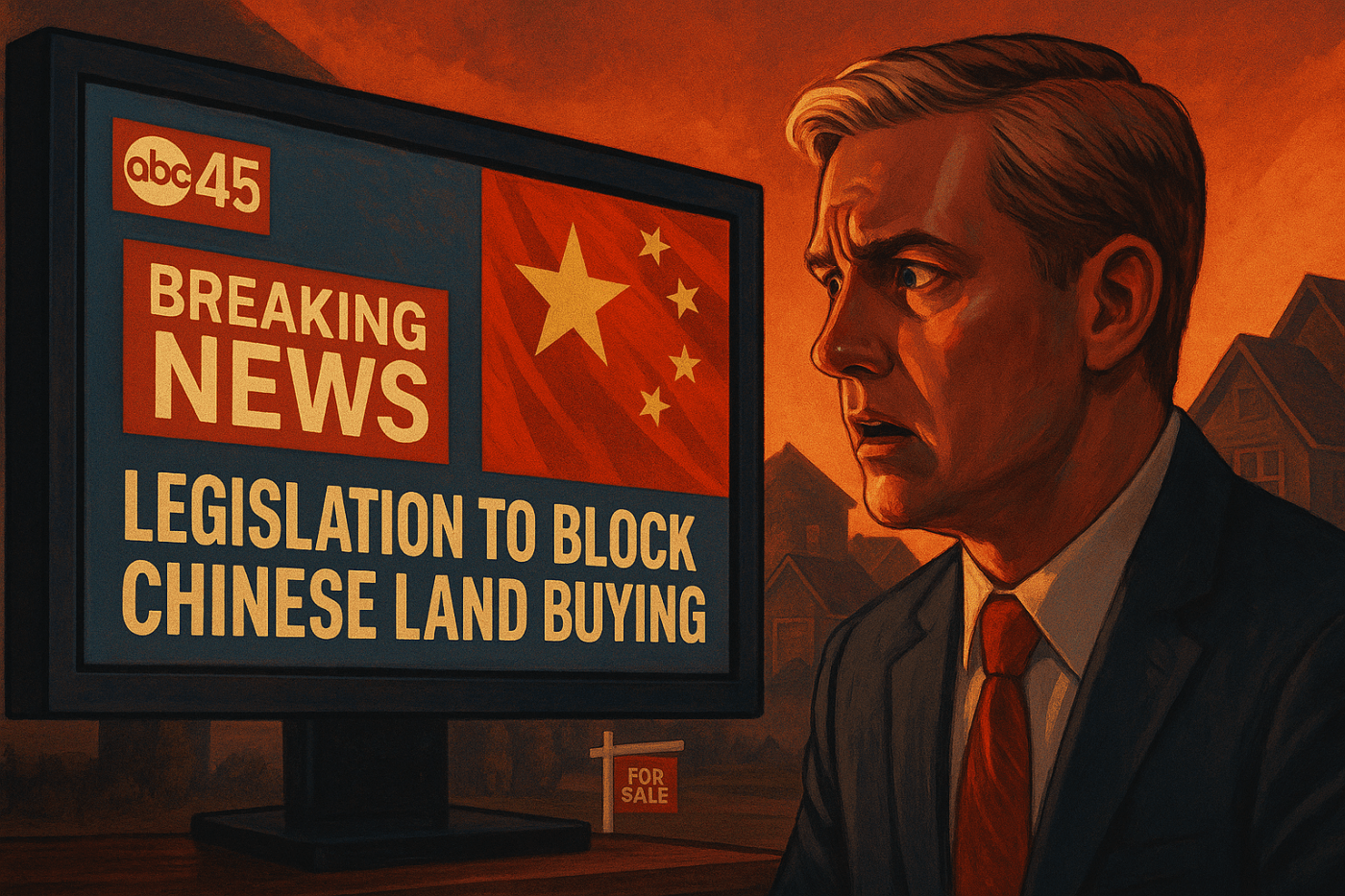
Propaganda creates the panic. Wall Street makes the purchase. China is the scapegoat. The people lose the land.
By Prince Kapone | Weaponized Information | July 27, 2025
I. Manufactured Panic, Real Estate Profits
On July 26, 2025, ABC45 ran a headline soaked in panic: “New Legislation Aims to Block Chinese Ownership of US Farmland and Homes.” The article came courtesy of Thérèse Boudreaux at The Center Square, the flagship media outlet of the Franklin News Foundation—a rebranded operation originally called Watchdog.org. This isn’t a grassroots newsroom. It’s a political weapon. Nearly all its funding comes from Donors Trust and Donors Capital Fund, the “dark-money” banking arms of the Koch empire, funneled through the State Policy Network to wage ideological warfare against labor, regulation, and the public sector. These aren’t journalists holding power to account—they are mercenaries for monopoly capital.
And it doesn’t stop at authorship. The article was syndicated and amplified by ABC45, a local affiliate of Sinclair Broadcast Group—one of the largest right-wing media conglomerates in the country. Sinclair beams identical scripts into over 180 U.S. markets, functioning less like a broadcaster and more like a propaganda relay. The kicker? Sinclair is partially owned by BlackRock and Vanguard—two of the very same investment firms gobbling up farmland and housing stock nationwide. In other words, capital is funding the story, airing the story, and benefiting from the panic the story produces. What we’re watching isn’t news—it’s a closed-loop ideological laundering machine.
The first sleight of hand is the fear headline. The word “China” isn’t used analytically—it’s used theatrically. What should be a policy issue is inflated into a threat to national survival. A few real estate purchases become an act of war. You don’t get facts—you get atmosphere. The whole headline is calibrated to trigger anxiety before the first sentence even lands. It’s not reporting. It’s stage lighting for the security state.
The second trick is guilt by suggestion. In a story supposedly about land purchases, we’re suddenly warned about Chinese exchange students voting illegally, smuggling biological agents, and spying on U.S. military bases. None of it is tied to the subject of the article. None of it is verified. But that’s not the point. The point is to build a mood: suspicion, dread, foreign invasion. The racist logic is old, but the delivery is updated for syndication. This is ideological malware, not information.
The third maneuver is ventriloquism. The article gives the floor to Brooke Rollins, Josh Hawley, and Mary Miller—without scrutiny, without fact-checking, without dissent. Their soundbites are served straight, as if press releases now qualify as gospel. There is no journalism here—only transcription. And given that Rollins herself is an America First Policy Institute veteran, Miller a Christian nationalist, and Hawley a Yale-pedigreed populist in cosplay, the effect is less like a news article and more like a closed-door strategy memo made public.
But here’s the real con: the very firms warning you about Chinese buyers are the ones buying everything up. Sinclair’s shareholders—BlackRock and Vanguard—own staggering stakes in U.S. land and housing. Koch money bankrolls the outlet that blames China for real estate woes. The politicians quoted are backed by the same corporate lobbies fueling the enclosure of farmland and the eviction of tenants. This isn’t hypocrisy. It’s choreography. The article is just another tool in a much bigger operation—one designed not to protect the people, but to clear the path for capital’s next land grab.
II. The Landlord Is Not Chinese: Extracting Truth from the Rubble
Once you strip away the patriotic panic and red-scare headlines, what remains are a few numbers hanging in isolation. The article claims that Chinese nationals bought $13.7 billion worth of U.S. residential properties from April 2024 to March 2025. It states that Chinese entities own 277,335 acres of farmland in 30 states. It warns us, ominously, that some of these entities have ties to the Chinese Communist Party. It praises a plan from Brooke Rollins to restore “farm security,” and it cites new legislation from Senator Hawley and Representative Miller that would ban further Chinese land purchases and force existing owners to sell.
What it doesn’t tell you is far more important.
Let’s start with scale. The United States has over 895 million acres of farmland. As of 2023, Chinese entities owned just 277,336 acres—down from approximately 383,935 acres in 2021. That’s a 27% decline in two years, now totaling barely 0.02% of all privately held U.S. agricultural land. To put that in perspective, a single U.S. billionaire—Bill Gates, who owns nearly 270,000 acres—controls nearly as much through opaque trust networks. Meanwhile, Chinese residential investment, spread across a housing market worth $43 trillion, is still just pennies in the larger Wall Street economy.
But you won’t hear any of that in the article—because the truth ruins the script. The real estate crisis plaguing the U.S. is not the work of Chinese buyers. It’s the work of U.S.-based private equity. Corporations like Blackstone, Pretium Partners, and Invitation Homes have gobbled up hundreds of thousands of properties since the 2008 crash, converting foreclosures into high-rent rental units. Blackstone now owns 300,000 residential units across the U.S. across the country, operating through a maze of LLCs and shell companies.
In cities like Phoenix, Atlanta, and Charlotte, working-class tenants find themselves trapped in corporate slums—where rent hikes come quarterly, maintenance requests go unanswered, and eviction notices arrive like seasonal newsletters.
This selective outrage is not an accident. It reflects a deeper ideological maneuver: the conversion of a structural crisis of capitalism into a racialized morality play. It is not just misleading—it is counterinsurgency on the ideological terrain.
What’s omitted is not just data. It’s history. Anti-Asian land hysteria has deep roots in the American settler imagination. The Alien Land Laws of the early 20th century were designed to stop Japanese, Chinese, and other nonwhite immigrants from acquiring property. These laws didn’t protect “the people”—they protected the white settler aristocracy from competition. And when we see today’s legislation demanding divestment from “CCP-affiliated” buyers without defining what that means, we are looking at the digital-age revival of that racist legal architecture—dressed up in national security drag.
The article also fails to place these events within the broader geopolitical rupture taking place. This legislation isn’t emerging in a vacuum. It’s arriving at a time when U.S. global dominance is slipping. Since the financial crisis of 2008—and accelerating after the pandemic—the world has begun drifting away from the U.S.-led unipolar order. The expansion of BRICS, the rise of bilateral trade in local currencies, and the construction of Southern-led development banks all point toward a new multipolar configuration. As outlined by the Tricontinental Institute’s report on hyper-imperialism, this shift has pushed the U.S. ruling class into a mode of systemic counteroffensive.
In this context, Chinese overseas investments are not acts of conquest—they are maneuvers within a shifting world system. But for the declining hegemon, any deviation from U.S. supremacy is perceived as sabotage. Hence the explosion of bipartisan anti-China rhetoric, bipartisan tech bans, bipartisan military escalations. This article is part of that same toolkit—a propaganda front in the larger campaign to preserve the architecture of Western monopoly capital.
But the material contradictions don’t stop at geopolitics. They stretch into the fields and neighborhoods of the U.S. itself.
The corporate consolidation of farmland is not new—it is a feature of late-stage agribusiness capitalism. Cargill, Archer Daniels Midland, and other behemoths dominate not only the production and distribution of food but also land and water rights. As documented in Cargill’s own land-and-water ESG reporting, these firms consolidate control over agricultural resource systems to steer supply chains and policy.
The Gates Foundation—under the cloak of philanthropy—has promoted GMOs, patented seeds, and global land acquisition as “solutions” to hunger, all while partnering with firms like Monsanto. The consequences of this are laid bare in GRAIN’s investigation into the Gates Foundation’s role in African food system capture. The result is not food security—it is food dependency, ecological collapse, and the displacement of peasant producers across the Global South.
Meanwhile, in the urban core, gentrification is nothing short of structural eviction. The financialization of housing—driven by speculation, asset inflation, and short-term profit maximization—has made shelter unaffordable for millions. Rents have risen at double-digit rates in many cities, while wages stagnate and public housing is defunded. Working-class families, particularly Black and Brown ones, are pushed out, criminalized, and replaced by luxury condos and tech campuses. And yet none of this is acknowledged in the article. Not even a whisper. Because its function is not to inform—it is to misdirect.
Finally, we must name what all these omissions are protecting: the weaponization of “national security” to expand capitalist control. The same Brooke Rollins who claims to defend the American farm is an alum of the Heritage Foundation—a think tank whose mission is to dismantle public infrastructure, break unions, and privatize the commons. Her “Farm Security Action Plan” is not about safeguarding crops—it is about militarizing food production and extending surveillance infrastructure into rural America. This is where Technofascism begins—not with soldiers, but with legislation. Not with tanks, but with title deeds.
This article, then, is not a journalistic aberration. It is a product of empire under stress. A psychological shield for monopoly accumulation. A nationalist distraction from class war. Its silence is strategic. Its omissions are weaponized. And its narrative is part of a larger offensive to recolonize land and redefine sovereignty in the service of capital—not people.
III. The Real Threat Is Domestic: Reframing the Crisis from Below
Let us begin not with Beijing, but with Bill Gates. Let us begin not with spies, but with speculators. When we look soberly at the terrain, the threat to the U.S. working class, to rural farmers, to tenants in cities and small towns alike, does not emerge from the Chinese state. It emerges from a homegrown class of financial predators—hedge funds, billionaire philanthropists, real estate trusts, and policy architects of dispossession. This is not a Chinese incursion. This is an American expropriation.
This isn’t about restoring the world of white picket fences, G.I. Bills, and cul-de-sac patriotism. That era is gone—and the ruling class knows it. They’re not rebuilding Mayberry—they’re strip-mining it for parts. The settler colonial order is being dismantled—by the very class that once relied on it. What we are witnessing is financial piracy stripped of its racial redistributive mask: a naked regime of accumulation where even the Euro-American base is discarded. The crumbs are gone. The land is being hoarded, digitized, and auctioned by the white ruling class to itself. This is still settler colonialism—but not the frontier fantasy or the Cold War housing boom version. It’s settler colonialism in terminal mutation: a regime shedding its old beneficiaries while sharpening its teeth on the backs of the colonized. It is the capitalist endgame of plunder, where whiteness buys no guarantee and loyalty buys no land.
In this upside-down narrative, monopoly capital wears camouflage, and the billionaire landlord is recast as a protector of sovereignty. But the mask slips when we examine who actually controls the terrain. Bill Gates alone owns more farmland than all Chinese buyers combined. BlackRock, Vanguard, and Blackstone are buying up homes, squeezing renters, and evicting families across the country. Tech oligarchs are swallowing up rural land to build smart city infrastructures wrapped in biometric surveillance. If this is sovereignty, it’s one that serves no people, no nation—only portfolios. This is technofascism: the convergence of militarized borders, surveillance real estate, and racialized lawfare designed not to protect land, but to digitize it, commodify it, and extract from it perpetual profit.
And yet, the propaganda persists because it serves a function: it masks a deepening crisis of imperialism. As U.S. global power declines, its ruling class is forced to consolidate control domestically. That means cracking down on labor, tightening surveillance, disciplining dissent, and reconsolidating its economic base through land, logistics, and agriculture. China becomes the perfect foil—not just as a geopolitical rival, but as a racialized cipher through which the state can justify authoritarian consolidation. Trump’s anti-China real estate ban is not about homes or food. It’s about imperial recalibration. It is a class war disguised as border protection, a billionaire land grab covered in stars and stripes.
This is not a new chapter of settler-colonial pacification. In fact, it marks its obsolescence. While the Trump regime appeals to settler nostalgia—white farmers, frontier myths, Christian dominionism—the structural logic now unfolding is one of technofascist consolidation. The mass settler base is no longer rewarded with land or ownership—it is managed by eviction notices, biometric surveillance, and digital enclosure. Property has been re-centralized at the highest levels of capital, and even white Americans who once benefitted from settler capitalism are being abandoned. They are no longer needed—only policed.
From the Alien Land Laws of the 1910s to the redlining maps of the 1930s to the housing raids of the post-9/11 era, the U.S. has always deployed race as a weapon to manage property, ownership, and space. But today, the law no longer secures settler ownership—it secures capital’s. That’s why bans on “CCP-affiliated buyers” don’t require proof of affiliation. They rely on a structural paranoia: the foreigner is always suspect, the Asian always alien, and the land always white—even as that land is being sold to private equity. This is not new law—it is the performance of sovereignty on a privatized stage.
Beneath this nationalist theater lies a deeper contradiction. The same Trump regime that warns of Chinese property purchases also opened the floodgates to corporate land acquisition, deregulated Wall Street’s hold on housing, and actively gutted environmental protections that restrict agricultural speculation. The goal is not to keep land in the hands of “real Americans”—the goal is to keep land in the hands of the ruling class. “Foreign threat” is just the brand name on this new enclosure movement.
The real danger is not Chinese landholding—it is the advance of a weaponized infrastructure regime that treats land not as life, but as asset class. It is the hoarding of farmland while millions go hungry, the vacancy of housing while thousands sleep on the street. It is the conversion of food into profit, shelter into leverage, land into ledger. And it is defended through lawfare, where legislative bans are backed by data surveillance, biometric borders, and an increasingly violent police-military apparatus. You will not own a home, they tell us, but you will wave the flag while they sell the soil beneath your feet.
So what does a revolutionary reframing look like? It begins by rejecting the nationalist question—“How do we protect American land from foreign buyers?”—and posing the class question instead: Who owns the land, and in whose interests? The answer will not be found in banning Chinese students or seizing Chinese homes. It will be found in dismantling the corporate architecture that allows land to be treated as speculative property in the first place.
The land belongs to those who work it, live on it, and defend it—not to billionaires with foundations, not to investment banks with algorithms, and not to governments that criminalize foreignness while legalizing foreclosure. Food sovereignty, housing rights, and land justice are not nationalist concerns. They are revolutionary imperatives. And they will not be won through border walls or red tape. They will be won by breaking the death grip of capital over the soil—and returning it to the people who make it grow.
This is the reframing we must hold to: that the true trespassers are not Chinese homeowners, but Wall Street land barons; that the true threat is not foreign influence, but domestic empire; and that the land, if it is to be free, must be liberated from capital—not colonized by it under a different flag.
IV. Land Back, Not Land Bans: Toward a Strategy of Revolutionary Solidarity
We already know who owns the land. It’s not Chinese students or foreign farmers—it’s Blackstone, Vanguard, Bill Gates, and the U.S. ruling class. The real foreigner is capital itself. It doesn’t speak Mandarin or English—it speaks in eviction notices, rent hikes, and foreclosure courts.
But all over this country, people are fighting back—not through flag-waving or fear, but through collective struggle. In Kansas City, KC Tenants is organizing renters into a base with real political teeth. In Oakland, Oakland Community Land Trust is reclaiming homes from speculation. Moms 4 Housing showed what it means to liberate stolen shelter. And tenant unions from Brooklyn to Minneapolis are turning rent strikes into people’s defense campaigns.
These aren’t just defensive moves. They are the beginning of dual and contending power—real alternatives to landlord rule and state abandonment. Every land trust, every eviction blockade, every tenant council is a brick in a new foundation. We’re not just saying “no” to dispossession. We’re building the power to take it all back.
Because the landlords already know what time it is. Now it’s time we act like it, too.
 Weaponized Information
Leave a comment