By Pablo Katari | Weaponized Information
July 27, 2025
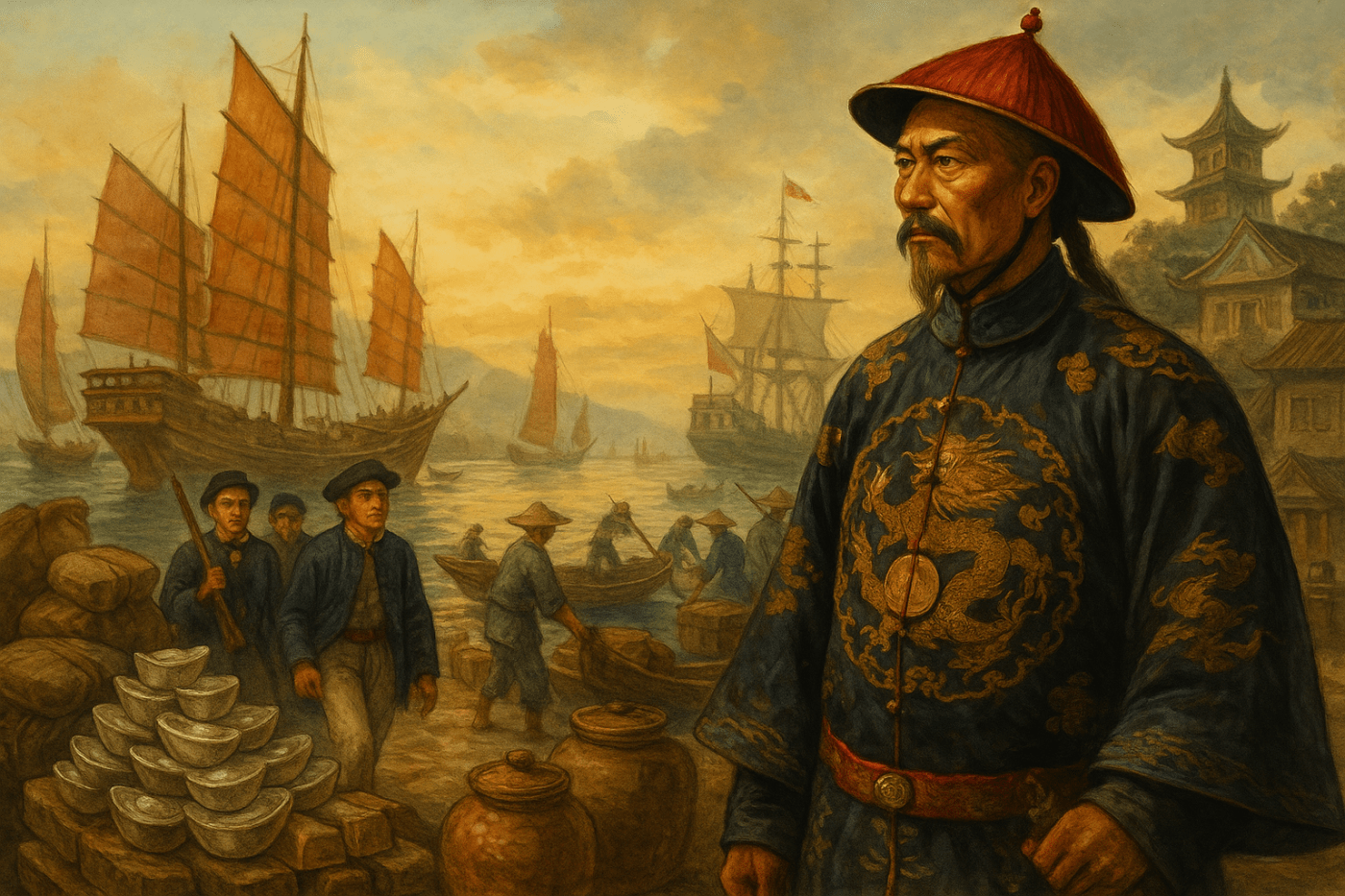
Before the gunboats came the bullion. This essay reconstructs the tributary world-system of Qing China before its forced integration into the capitalist world economy, tracing how global silver flows, comprador betrayal, and imperialist encirclement collapsed a sovereign social formation that had once stood at the center of the earth.
All Under Heaven: The Tributary Core of a Non-Capitalist World-System
It is a peculiar illusion of the bourgeois epoch to mistake the globe itself as the natural womb of capitalism, and to cast all other historical formations—communal, tributary, or otherwise—as failed apprentices to the one true doctrine of accumulation. Thus, it was written in London and Paris, that China, vast and venerable, slumbered at the margins of history until awoken by gunboats and commerce. But what Europe found upon its arrival was not sloth, but a sovereign social metabolism. Not stagnation, but a deliberate refusal to subordinate life to profit. And that is why it had to be destroyed.
The empire of the Qing, inheritor of dynastic centuries and steward of an unbroken civilizational lineage, did not exist for the purpose of profit. Its foundations rested not on the wage-form, nor on the commodification of labor-power, but on the regulated extraction and redistribution of surplus through the state. This was the tributary mode of production—in which the peasant, though subordinate, remained rooted to land not as private property, but as usufruct. The surplus did not circulate to private capitalists; it ascended to the throne, whence it returned in the form of grain storage, hydraulic maintenance, famine relief, and the ritual pageantry of a moral order. The Mandate of Heaven, that ideological veil of class power, nonetheless demanded a social rationality absent from the bourgeois state: that the ruler feed the people, suppress usury, and punish corruption in the collection of rents.
To speak of China, then, is not to narrate the childhood of capital, but to unearth the memory of another mode—a non-capitalist world-system, organized not for profit, but for subsistence and reproduction. From the floodplains of the Yangtze to the dry loess of the northwest, millions of peasant households labored not for market exchange but for communal survival. Their productive forces, while regionally uneven, were adequate to their social aims. And their surplus, mediated through granaries and magistrates, remained tethered to a civilizational logic that refused the speculative anarchy of capitalist value.
Indeed, China’s economy exhibited the peculiar feature of high productivity without capital accumulation. This is the scandal it posed to Western economists: an empire that enriched itself not through the exploitation of foreign colonies, but through the internal coordination of agricultural cycles, craft production, and the mobilization of human labor under collective forms. Land was not a commodity but a sacred ecology; labor, though divided and gendered, was not yet alienated by the wage. The empire minted silver but disdained debt. It encouraged literacy but feared the abstract equivalence of commodity fetishism. What appeared to the European eye as inert tradition was, in fact, the refusal to commodify life.
And so it was that the West, in its embryonic phase of industrial gestation, found itself dependent on the East. The Chinese market—vast, disciplined, and opaque—became the gravitational center of global silver circulation. From Potosí to Manila to Canton, the arteries of early capitalist expansion bled treasure into the tributary heart of Asia. Yet China refused reciprocity. It absorbed the bullion but rejected the commodity. It welcomed embassies but denied equal exchange. This was not arrogance, but sovereignty—the rational instinct of a civilization that sensed, in the frantic gestures of Europe, the coming plague of accumulation.
Here lies the contradiction. For capitalism can tolerate no exterior. It must universalize itself or perish. And the very self-sufficiency of the Qing order—the absence of proletarian labor, the indifference to foreign manufactures, the stability of agrarian life—rendered it intolerable to the world market. In the language of Marx: that which cannot be subsumed must be destroyed. The celestial empire, far from being backward, was too sovereign, too sufficient, too incompatible with the logic of capital. And so it was marked for integration—not through mutual intercourse, but through narcotics and cannonade.
Let us then begin our inquiry not with the myth of China’s decline, but with the record of its refusal. Not with its failure to modernize, but with its successful obstruction of capitalist encroachment. What follows is not the elegy of a vanished world, but the autopsy of a system murdered in the name of free trade.
Unequal Exchange Before Empire: Silver, Manila, and the Latin American Connection
The conquest of the Americas, often narrated as the heroic dawn of European civilization, was in fact the genocidal prelude to a world economy forged in blood and silver. With the mines of Potosí and Zacatecas, Spain unearthed not merely wealth, but the material basis of a new planetary order—one in which bullion, ripped from the Andes by enslaved labor, would circulate eastward to purchase the commodities of an older, more rational world. The so-called “Age of Discovery” was not a voyage into the unknown; it was the violent incorporation of territories, peoples, and lifeways into an emerging capitalist world-system whose core imperative was accumulation by dispossession.
The extraction of silver from the Americas, under conditions of unimaginable brutality, produced a tidal wave of monetary metal that flooded the Atlantic and seeped through every pore of the European economy. But it did not remain there. For the bourgeoisie of Europe, still nascent and lacking the industrial productivity of its later maturity, had little to offer the world but precious metals and stolen labor. And so the silver flowed—out of Europe, across the oceans, and into the waiting mouth of China.
The Manila Galleon system, inaugurated in the late 16th century, functioned as a colonial umbilical cord connecting New Spain to the Qing empire. Spanish silver, mined by Indigenous and African labor, was shipped from Acapulco to Manila, and thence to Canton, where it was exchanged for silk, porcelain, tea, and the other treasures of the East. By the 17th century, China had become the terminal point of the world’s silver circuits. It is estimated that between one-third and one-half of all New World silver found its way into Chinese coffers. The Celestial Empire, in this sense, stood not outside the world economy, but at its very heart—yet it did not belong to it.
This paradox is decisive. China absorbed silver not to expand capitalist accumulation, but to stabilize its monetary system under the Single Whip Reform, which had commuted all taxes into silver payments by the peasantry. The influx of bullion was thus drawn into a tributary structure—it lubricated agrarian reproduction, strengthened imperial revenues, and underwrote the state’s role as redistributor. There was no inflationary crisis, no speculative mania, no debt-fueled overproduction. Silver entered, but the commodity form did not take root. Money, in China, remained a means; it did not become an end.
Here we encounter the first antagonism between the capitalist and the tributary orders—not in the battlefield, but in the logic of exchange. Europe, now increasingly addicted to Chinese goods, found itself hemorrhaging treasure to an economy that offered no reciprocal market for its manufactures. This one-sided flow of bullion constituted the first great trade deficit of the modern world—not for China, but for Europe. It is no exaggeration to say that China’s self-sufficiency induced a structural crisis in early European capitalism.
Thus emerged the problem of unequal exchange—a concept later systematized by dependency theorists in the Global South, but already visible in embryo here. The capitalist core was unable to penetrate the tributary periphery with commodities or capital; it could only send bullion and await goods in return. China, without colonies, without wage labor, without industrial revolution, had nonetheless inverted the relation: Europe depended on Asia, not the other way around. This was intolerable.
The solution, in time, would be found not in production but in poison. But even before the opium strategy had crystallized, the contradiction was evident: China could no longer remain immune. Its centrality in the global bullion economy, its refusal of capitalist reciprocity, and its sheer gravitational mass made it the absolute other to the emerging world market. And the world market, like any god in ascendancy, demanded sacrifice.
It is therefore essential to reject the bourgeois illusion that China’s integration into the global economy was the result of passivity or backwardness. China was not passive—it was sovereign. It was not backward—it was incompatible. And that incompatibility, that stubborn persistence of an alternative logic of life, was the very reason why it had to be subjugated.
The Canton System and the Limits of Capitalist Penetration
Every mode of production erects borders, not only geographic but social, economic, and ideological. These borders mark the limit beyond which the dominant logic ceases to function. For capitalism, such limits are intolerable. The Canton System, devised by the Qing dynasty in the mid-18th century, was precisely such a limit: a mechanism of containment designed to regulate foreign trade, maintain sovereignty over surplus, and prevent the metastatic spread of capitalist social relations. It was a bulwark against capital in its infancy—a cordon sanitaire drawn across the southern coast of China, through which goods might pass, but not commodification itself.
Under this system, foreign trade was confined to a single port—Guangzhou, known to Westerners as Canton—and a single season. All foreign merchants were subject to the oversight of the Cohong, a guild of Chinese intermediaries licensed by the imperial state. No direct access to inland markets was permitted. No property could be owned by foreigners. No consulates established. No missionary incursions tolerated. Even the language of trade was mediated through designated interpreters, preventing ideological infection through commerce. In short, it was a regime of strict asymmetry, designed to preserve tributary order from capitalist contagion.
From the vantage point of the bourgeoisie, this was heresy. Commerce, they believed, must be free—free not only from regulation, but from meaning. The commodity must circulate unimpeded, indifferent to the social relations it destroys in its wake. But in China, commodities were not sovereign. The state held primacy over the market, and trade was tolerated only insofar as it served the reproduction of imperial order. This was not “mercantilism” in the European sense, but a tributary rationality: the empire as the central node of moral-political authority, presiding over a world of regulated flows.
The English, frustrated by their exclusion from inland markets and their mounting trade deficit, denounced the Canton System as “despotic,” “corrupt,” “obstructionist”—the usual ideological arsenal of capital against any regime it cannot dominate. But behind this liberal rhetoric lay a deeper structural antagonism. China did not refuse trade—it refused subordination. It permitted exchange, but not investment. It allowed silver, but not capital. It admitted merchants, but denied them power. It maintained the sovereignty of labor, land, and governance against commodification. In short, it committed the cardinal sin in the eyes of the world market: it remained external.
Hence the Macartney Mission of 1793, in which Britain sought to establish a permanent diplomatic presence, expand trade, and open additional ports—all under the banner of “friendship.” It was rejected. Lord Macartney, refusing to perform the ritual kowtow before the Qianlong Emperor, symbolized more than personal arrogance; he embodied the incompatibility of two world systems. The mission failed, not because of miscommunication or cultural misunderstanding, but because the demands of capital could not be reconciled with the sovereignty of a tributary order.
And yet, the pressure mounted. Outside the walls of Canton, British traders developed illicit channels of opium importation, corrupting the Cohong and establishing smuggling networks along the southern coast. Foreign merchants, especially those of the British East India Company and its affiliates, began to chafe at the limitations of the Cohong monopoly. Liberal economists in London decried the loss of profits, while military planners quietly prepared alternatives to diplomacy. The world market, once rebuffed, would now return with a vengeance.
Let there be no doubt: the Canton System was not a failure of modernization, but its alternative. It was an architecture of sovereign exchange, constructed to prevent the wholesale absorption of Chinese society into the metabolism of capital. Its existence refutes every bourgeois fairytale of “natural” market expansion. That it was later dismantled through force does not demonstrate its inadequacy—it proves its threat.
The Rise of the Comprador Class and the Internal Betrayal
No imperial conquest is ever purely external. The bayonet and the gunboat may open the gate, but it is the traitor within who holds it ajar. In the unfolding drama of China’s forced integration into the world market, the foreign capitalist was never alone. His advance was abetted by a class of intermediaries—merchants, interpreters, moneylenders, local elites—who came to profit not from production, but from brokering their homeland’s submission. This class, indigenous in form but foreign in function, was the comprador bourgeoisie.
The comprador does not build, he sells. He does not develop, he intermediates. His wealth does not derive from peasant labor, craft production, or domestic exchange, but from the circulation of foreign capital and the facilitation of imperial penetration. In the case of Qing China, the compradors emerged from among the Cohong guilds and coastal mercantile families—those with proximity to foreign trade, linguistic access to European merchants, and the political cunning to manipulate both sides of the exchange.
Initially licensed by the state, these intermediaries soon grew beyond its control. Opium, that foul narcotic of capitalist necessity, provided the vehicle. With the British East India Company offloading its Bengalese cargoes on Chinese shores, the Cohong and their networks became smugglers in all but name. Silver flowed outward once more—but this time, not into the imperial treasury, but into private hands. The state, robbed of bullion, weakened its capacity for public works, famine relief, and military upkeep. Corruption, long the tolerated lubricant of bureaucracy, became a hemorrhage.
The comprador class did more than profit—they rewired the tributary order from within. Their accumulation was not reinvested in agrarian reproduction or handicraft industry, but in speculation, land acquisition, and parasitic trade. They emulated the manners of Confucian gentry while liquidating the moral economy it was built upon. They furnished the British with intelligence, housed the opium depots, and lubricated every treaty with betrayal. Their rise marked not the modernization of China, but its transformation into a dependency—a process that occurred long before the cannons fired at Canton.
Herein lies the essential insight of dependency theory, born in the crucible of the Global South: under conditions of imperialism, a segment of the national bourgeoisie will always align itself with foreign capital against the masses. It becomes, in effect, an agent of external domination clothed in native skin. Its interests are not national, but international—specifically, those of the capitalist world-system. The comprador lives by selling his people.
As the Qing court issued edicts against opium, its local officials enriched themselves through its circulation. As the emperor sought to preserve sovereignty, his bureaucrats conspired with foreign merchants to undermine it. By the early 19th century, the imperial state was riddled with contradictions it could no longer contain: fiscal collapse, regional autonomy, military decay, and moral crisis. The gentry, once stewards of social reproduction, increasingly behaved as petty landlords and rentiers. The merchant, once subordinate to state regulation, now bent the state to his speculative will.
It was not the foreigner alone who dismantled China’s pre-capitalist order—it was the dialectical unity of foreign capital and native betrayal. This is the iron law of imperialism: the comprador class is not merely a consequence of external pressure, but a structural effect of the capitalist world-system seeking internal agents of enforcement. And once this class emerges, it no longer needs invasion to do the work of conquest.
Thus the walls of sovereignty crumbled from within, even as the threat from without approached. The contradictions of the tributary mode—long managed through bureaucratic equilibrium and ritual governance—now reached a breaking point. The state, disarmed by its own dependencies, faced a market armed with both poison and powder. And in the heart of the empire, the merchant smiled.
Twilight of the Tributary State: Silver Drain, Fiscal Crisis, and the Final Unraveling
Every social formation, no matter how enduring, contains within it the seeds of its disarticulation. The tributary order of Qing China, for all its stability and sovereign logic, could not remain external to the rising tide of the world market forever. By the early 19th century, the dialectic of internal contradiction and external pressure reached a terminal stage. The empire stood surrounded—not merely by foreign gunboats, but by its own parasitic appendages, its drained treasuries, its addicted coastlines, and its fractured authority. The old order had not yet collapsed, but it had begun to rot from the inside out.
The crisis first manifested in the imperial coffers. As silver poured outward in exchange for opium—now smuggled in by British, American, and Indian merchants with comprador complicity—the state’s monetary base began to erode. The tax system, monetized through the Single Whip reform, depended on a steady supply of silver extracted from the peasantry. But now, silver exited faster than it entered. The peasantry, overburdened and underprotected, faced both rising rents and shrinking state services. Local gentry hoarded wealth; magistrates extorted grain; roads, canals, and granaries fell into disrepair. The metabolic reproduction of the social whole—once the core task of the tributary state—began to fail.
As John Bellamy Foster would later observe in his theory of the metabolic rift, ecological rationality under capital is always subordinated to accumulation. But under the tributary state, the ecological and social metabolism had been precisely what was preserved. Its unraveling now created rifts between state and peasant, center and periphery, surplus and subsistence. Famine reappeared in regions once shielded by state granaries. Floods surged through untended canals. The people suffered not from natural disaster alone, but from the systemic withdrawal of the protective functions of the state.
Meanwhile, the military—long dependent on regular tax income and centrally allocated grain—deteriorated. Provincial armies became increasingly autonomous, reliant on local landlords or opium revenues to maintain their ranks. The Qing court, surrounded by factionalism and imperial hesitation, could no longer guarantee discipline at the periphery. Warlordism, long a suppressed tendency of Chinese feudalism, began to stir once more. The bureaucracy, formerly the spine of rational administration, now twisted itself into knots of corruption, delay, and paralysis.
At the ideological level, the moral economy collapsed. Confucian literati, unable to reconcile the addiction crisis with the rituals of benevolent rule, either retreated into fatalism or aligned with reformist factions. Opium, once condemned as foreign poison, now circulated through every social stratum—imperial guards smoked it, merchants trafficked it, and coastal peasants sank under its weight. The emperor’s edicts rang hollow; the imperial state could no longer enforce the very laws it issued.
Here, at the precipice of rupture, the contradictions crystallized. The empire could neither return to tributary equilibrium nor transition into a capitalist order. It stood suspended, paralyzed by its own internal class betrayals and the encirclement of imperialist capital. The compradors had made peace with poison. The British had found their leverage. The peasantry, overtaxed and abandoned, murmured rebellion. And the court, sapped of silver and moral authority, prepared its final appeals to Heaven.
What would follow, as we have elsewhere examined, was not a clash of civilizations but the violent restructuring of a world-system. The Opium War did not emerge from misunderstanding, nor from the clash of ideologies. It was the logical culmination of the world market’s expansionary violence, the response of capital to the last great barrier in the East. It was, in every sense, the conquest of sovereignty by accumulation.
But that moment belongs to another chapter. Here, at the final page of the prelude, we may say only this: China did not collapse. It was collapsed. The tributary system did not fail. It was sabotaged. The people did not consent. They were sold. The world market, like a thief in the night, entered not through invasion but through the breach prepared by betrayal. And thus was the century of humiliation begun—not with fire, but with silver.
 Weaponized Information
Leave a comment