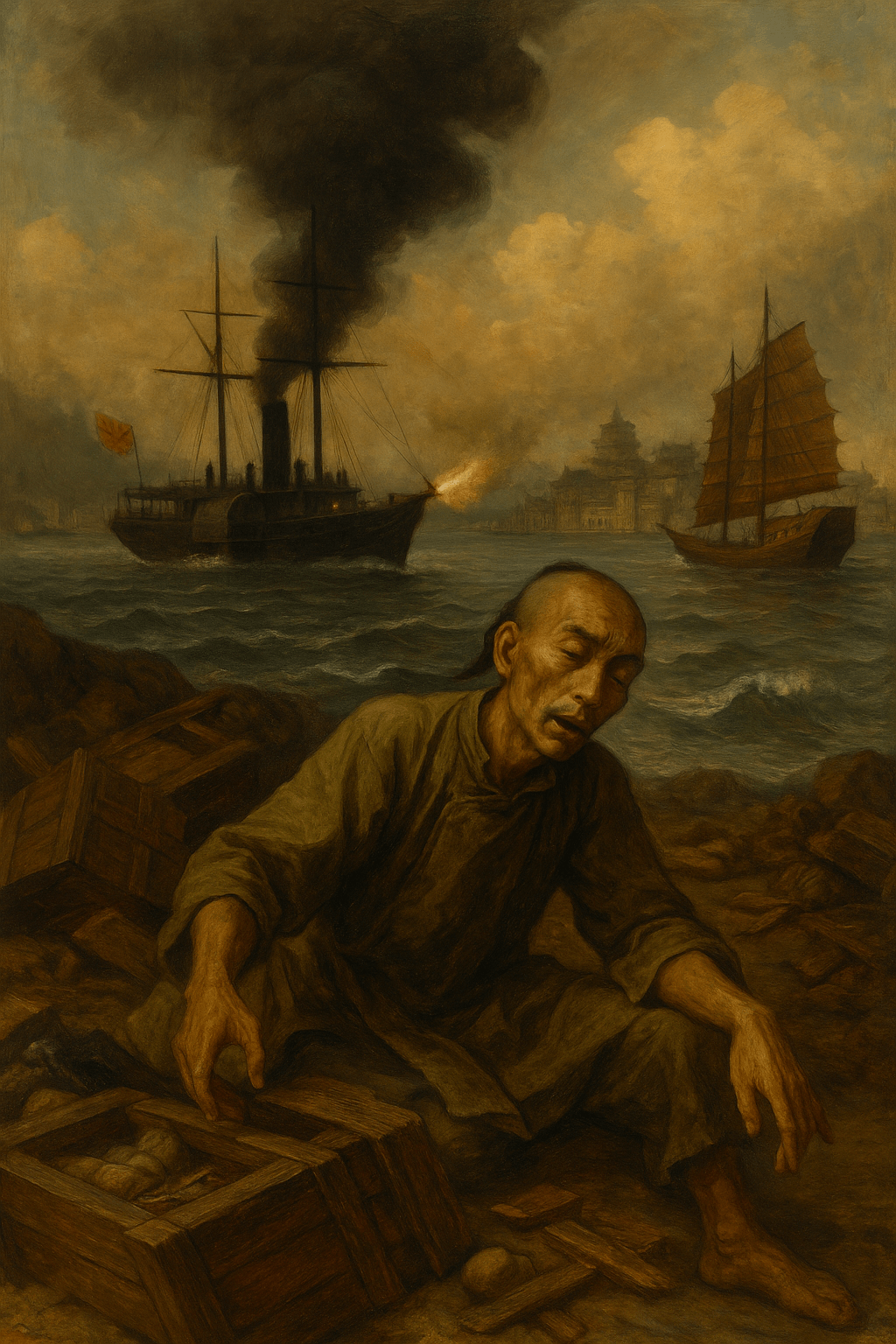
How Britain’s opium gunboats shattered China’s agrarian order, dismembered its sovereignty, and inaugurated the long colonial century that revolution would one day bury
By Pablo Katari | Weaponized Information
| July 26, 2025
Exchange as Pretext, War as Mechanism
The circulation of commodities requires peace; the expansion of capital requires war. In the case of China, this contradiction found its most grotesque expression in the figure of the opium trader—at once merchant, missionary, and mercenary—armed with ledgers and cannons, whose task was not only to sell but to shatter. The British bourgeoisie, fettered by its own surplus, confronted a world not yet fully subordinated to the logic of exchange. In China, they encountered a society rich in labor, steeped in agrarian rhythms, but disinterested in English cotton, machine tools, or factory-made baubles. Tea, porcelain, and silk flowed into Europe; silver flowed out. Capital abhors imbalance. It demanded a correction—not by the invisible hand, but by the iron fist.
The pretext was trade. The method was violence. The aim was the forcible insertion of China into the capitalist world market. Lacking adequate commodities to compel exchange, Britain turned to that most parasitic of pseudo-commodities: narcotics. Opium—grown in the subjugated soil of Bengal under Company rule, processed by colonial labor, shipped by freebooters protected by flag and fleet—became the wedge by which English capital cracked open Chinese sovereignty. The drug, banned by imperial decree and despised by the people, was thus imposed not through exchange but through extortion. This was not commerce but conquest in mercantile form.
What followed was not an anomaly but the blueprint of primitive accumulation in the epoch of mature capital. Just as the enclosures expropriated the English peasantry under the guise of legal reform, so too did the Opium Wars expropriate Chinese sovereignty under the guise of “free trade.” The Treaty of Nanjing, inked with blood and silver, was the juridical form of this expropriation. It marked the transition from autonomous tributary order to subjugated appendage. Where once a tribute system governed exchange based on hierarchy and ritual, there now stood a treaty regime backed by gunboats—capital’s law written in the language of imperialism.
Here, the hypocrisy of bourgeois liberalism reached its most obscene heights. The same Parliament that denounced the Chartists at home extolled the “rights of commerce” abroad. The same press that decried proletarian drunkenness in London applauded the flooding of Canton with opium. The law of value, unable to establish itself through equivalence, enforced itself through violence. England’s addiction to profit found its fix in the addiction of a nation. Thus began not merely a trade relationship, but a century of humiliation—a global process of accumulation that made the misery of China into a moment in the self-expansion of capital.
Commodification Through Cannons – The Genesis of Unequal Exchange
What bourgeois economists call “free trade” reveals itself, in history, as a contradiction in terms. There is no freedom in trade where arms patrol the harbor. There is no exchange where the conditions of equivalence are imposed by conquest. The Opium Wars were not commercial misunderstandings—they were wars of world-historic transformation, whereby capital, having outgrown its domestic confines, declared war on non-capitalist life itself. What it could not buy, it would bombard. What it could not persuade, it would pulverize. Thus began the age of unequal exchange, inaugurated not by market competition, but by the imperial gunship.
The Treaty of Nanjing (1842) and, later, the Treaty of Tientsin (1858), are monuments not to diplomacy, but to domination. These documents legalized the criminal. They enshrined drug trafficking as legitimate commerce, indemnified aggression with silver, and transformed coastal cities into occupied enclaves. The British Empire did not merely extract payment—it extracted principle. Under the guise of negotiation, it outlawed Chinese self-defense. It dictated tariff rates, abolished monopolies, and declared foreign merchants exempt from the empire’s laws. A new juridical regime was born: extraterritoriality—the right of the foreign bourgeoisie to exist above and beyond the sovereign order they were dismembering.
Hong Kong, that granite node of empire, was not a city but a cipher: a free port for unfree people, a factory for finance, a laboratory for colonial capital. It stood as a physical extension of the commodity form, a landing strip for imperial logistics and opium cargo. Beneath its veneer of British order lay the dislocation of a continent. Each dock piled high with crates of poison; each customs post a checkpoint in capital’s long march through Asia. The old exchange of tribute and ritual, once mediated by mandarins and moral code, was swept aside by market diktat and war reparations.
The Chinese peasantry, once buffered from world-market fluctuations by the internal granaries and local circuits of subsistence, was now bound to an alien metabolism. Rice prices collapsed under the weight of imported goods. Silver flowed outward to compensate imperial indemnities. The people, made addicts by force, were simultaneously rendered dependent and disposable. This is the logic of commodification under the rule of capital: that which does not sell must submit, and that which resists commodification must be destroyed or transformed into a commodity itself. Even the refusal of trade was thus commodified—as justification for war.
What the bourgeois historian calls “opening” was in truth an enclosure—the enclosure of national sovereignty, of peasant autonomy, of civilizational dignity. China was not invited into the world-market; it was dragged into it, shackled by treaties and narcotics. Unequal exchange is not a failure of liberalism, but its fulfillment: the full extension of capitalist command to where it had previously been denied. This was not the advent of modernization, but the dawn of dependency—a new stage in the global accumulation of misery.
The Metabolic Rift Extended – Social and Ecological Disintegration in the Pearl River Basin
When capital enters a society not through the market but through the muzzle, its impact is not the awakening of dormant productive forces but the rupture of ancient equilibriums. In China, the opium trade did not simply distort economic life—it derailed the entire metabolism of the society. The village, once the locus of subsistence and moral economy, became a site of disintegration. The extended household, the ancestral hall, the communal irrigation network—all found themselves eroded not by some abstract “modernity,” but by a concrete and poisonous accumulation process. The narcotic entered not merely the lungs and veins of the people, but the arteries of their society.
The Pearl River Basin, one of the richest ecological regions in the empire, became a laboratory of imperial devastation. Opium cultivation was banned within China but its distribution—imposed from without—sucked silver from the interior and labor from the land. Peasants, driven by despair and addiction, sold off tools, livestock, even their daughters. Family reproduction gave way to narcotic reproduction. Fields went untended. Canals fell into disrepair. The social reproduction of labor—education, rest, community, ritual—collapsed into a daily rhythm of withdrawal and dependency.
Here the metabolic rift, that alienation of human labor from nature under capital, took on a civilizational dimension. The British merchant, with ledger in hand, treated opium as a commodity like any other. But it was no such thing. It was a solvent. It dissolved the social glue that held Chinese rural life together. It fractured peasant self-reliance and saturated the land not with manure but with misery. The ecological cycles of sowing and harvest were replaced with the imperial cycles of debt and death.
Capital did not “develop” China—it underdeveloped it. It short-circuited the relations between peasant and land, labor and life. And it did so deliberately. The narcotization of the Chinese people was not an unfortunate side effect; it was the very method of marketization. By weakening the body, fragmenting the family, and eroding the village, capital created its conditions of rule. Where it could not fabricate a proletariat, it fostered a lumpen class of addicts, debtors, and dispossessed—rendered incapable of resistance and ripe for expropriation.
This was not merely an economic conquest—it was a metabolic invasion. The ecological rationality of subsistence agriculture, with its rhythms of renewal and communal stewardship, was shattered by a commodity with no use-value but addiction. The British fleet did not just traffic in opium; it trafficked in death. It replaced the Chinese granary with the British gunboat, the irrigation ditch with the silver drain, the ancestral tablet with the customs invoice. Such is the ecological cost of capital’s expansion—not merely deforestation or pollution, but the uprooting of entire lifeways.
From Tributary Sovereignty to Semi-Colonial Dependency
The essence of sovereignty under the capitalist world-market is not determined by flags or formal declarations, but by control over surplus, labor, and law. China, though never fully colonized in the manner of India, was no less subordinated. The mechanism was juridical, economic, and political—not annexation but integration. Not occupation but humiliation. Through the architecture of the unequal treaties, the Qing dynasty was transformed into a sovereign only in name, a shell from which the marrow of decision-making had been sucked dry. The emperor reigned, but foreign capital ruled.
Treaty ports multiplied like tumors: Shanghai, Canton, Ningbo, Fuzhou, and more—each carved out from the body of China like enclaves of a foreign world. Within these ports, British, French, and American merchants operated under their own laws, governed by consular courts, protected by foreign gunboats, and exempt from imperial jurisdiction. This was extraterritoriality: the legal expression of a world in which capital stands above the state, and the native law bends before the foreign ledger.
Tariff autonomy was abolished. Customs revenue, once the lifeblood of state finance, flowed into the coffers of foreign-dominated boards. Missionaries poured inland under the protection of empire, not to save souls but to pacify bodies. Railroads, telegraphs, and banks were built—not to develop the Chinese economy but to extract from it, to drain value toward coastal nodes controlled by imperial powers. And through it all, the ruling dynasty, unable to repel the foreigners nor to reform the empire, clung to power with a mixture of repression and retreat.
Emerging within this fractured sovereignty was a new class: the comprador bourgeoisie. Comprised of Chinese merchants, interpreters, middlemen, and coastal elites, the compradors were the indigenous face of foreign capital. Their role was not to build a national capitalism but to intermediate its suppression. They served as brokers of dependence, absorbing commissions, securing labor, and enforcing imperial commercial demands. In return, they were rewarded with power, prestige, and exemption from the hardships that befell their countrymen.
This comprador class had no organic relation to China’s peasantry, no loyalty to its historical mode of production, no project of national development. Their wealth was parasitic, their politics derivative. They lived in foreign concessions, educated their children in Western academies, and measured freedom not in sovereignty but in proximity to imperial capital. In them, capital found its ideal native accomplice—alienated from land, insulated from labor, and integrated into the circuits of foreign domination.
Thus was the tributary empire transfigured. Not overthrown in a singular revolution, but hollowed out by treaty, trade, and narcotics. China remained “independent” on the world stage—but it was a new kind of independence, one that masked dependence, one that preserved the shell of empire while destroying its spine. The real sovereignty had passed to foreign banks, shipping companies, and customs houses. The celestial empire, once center of a sinocentric world, now orbited the capital of London.
The Narcotic as Ideology – Orientalism and the Moral Justification of Plunder
The brutality of the Opium Wars did not merely rest on gunpowder and silver—it was cloaked in the moral garments of civilization. Every cannonball launched at Canton was prefigured by a sermon, every treaty inked in foreign favor rationalized by a textbook of racial hierarchy. To sustain the violence of primitive accumulation, capital requires more than weapons; it demands justification. And thus was born an ideological edifice as potent as opium itself: the myth of the East as backward, stagnant, despotic—incapable of rational trade, and therefore in need of imperial tutelage.
It was not enough for the British bourgeoisie to extract Chinese silver and sovereignty. It needed to imagine this theft as a gift. The Chinese people were not understood as a nation resisting foreign invasion, but as a slumbering mass awaiting civilizational awakening—an “Orient” defined not by its own history, but by its deviation from European norms. This ideological inversion, this Orientalism, functioned as the cultural superstructure to the economic base of plunder. In it, the merchant became missionary, the soldier a savior, and the narcotic a medicine.
To traffic opium to China required more than logistical routes—it required an epistemological war. British newspapers portrayed Lin Zexu, the commissioner who seized and destroyed opium, not as a patriot defending national dignity, but as a tyrant interrupting the natural flow of commerce. British schoolbooks instructed their children that the Chinese were lazy, corrupt, and unfit for self-rule. The very resistance to narcotic imperialism was reinterpreted as evidence of civilizational inferiority. This is the function of ideology: to render illegitimate all opposition to capital’s expansion.
The missionary was central to this process. Cloaked in Christian charity, the missionary preceded and accompanied the merchant, converting souls while softening the blow of foreign domination. But what gospel did they bring to the peasant reeling from addiction, the mother whose child had been sold for silver? Their promise of salvation masked a program of submission. While preaching virtue, they paved the roads for vice. The church and the custom house stood side by side, each sanctifying the work of the other.
In the opium economy, capital perfected the art of simultaneous annihilation and absolution. It destroyed communities while declaring it had come to uplift them. It debased labor while insisting it was liberating trade. It collapsed civilizational autonomy while proclaiming universal progress. This was not hypocrisy—it was ideology functioning as designed. The bourgeoisie required not truth but coherence, not reality but justification. Orientalism was not an accident of the imagination, but an instrument of empire, a cultural narcotic as powerful as the substance it defended.
Dialectics of Ruin and Resistance – The Prelude to Proletarian Revolution
Capital thinks it conquers without consequence. It plunders the world and imagines it permanent. But in razing the old, it awakens the new—not by design, but by contradiction. The century that opened with opium and ended with occupation was not only a century of humiliation; it was the prelude to another kind of reckoning. The fires lit in Canton and the blood spilled on the Yangtze were not forgotten. They smoldered beneath the ashes, reappearing in forms disjointed yet familiar: a new kind of peasant rage, a new articulation of sovereignty, a new vision buried beneath the ruins.
The destruction of the Chinese world was total: its economy destabilized, its society narcotized, its sovereignty sundered. And yet, through this devastation, the veil of heavenly order was torn open. The imperial mandarinate was revealed as unable to resist; the merchant compradors, unwilling. The people, dispossessed and dishonored, found themselves not only impoverished but politicized. That which was passive began to stir. That which bent began to break. And the ancient masses, long accustomed to bowing before emperor and heaven, began to face outward—toward one another.
This was no spontaneous awakening. Capital had shattered not only the economy but the very grammar of the old society. And yet, from this shattered syntax, a new language of revolt began to emerge. Not yet fully conscious, not yet unified, but unmistakable. From village covenants to outlaw sects, from underground rumors to open defiance, the people began to write their own reply. It would take time, defeats, and disasters. But it had begun. History, once monopolized by emperors and emissaries, began to pass into the hands of its true authors.
No force razes a society without leaving behind the embers of its own undoing. The British Empire mistook its narcotic conquest for finality. But in dragging China into the world-market through violence, it also introduced new weapons to those it had hoped to pacify: the consciousness of shared ruin, the memory of communal life, and the search for another horizon beyond the silver standard and the treaty port. Even in despair, the dialectic persists.
What followed would not be linear. It would come in waves, regressions, and contradictions. But the seed had been planted: that capital was not inevitable, that the empire was not eternal, and that another future—neither tributary nor capitalist—might yet emerge from the very heart of the wreckage. History had been forced open. What the merchant could not sell, and the missionary could not save, the people would eventually reclaim.
 Weaponized Information
Leave a comment