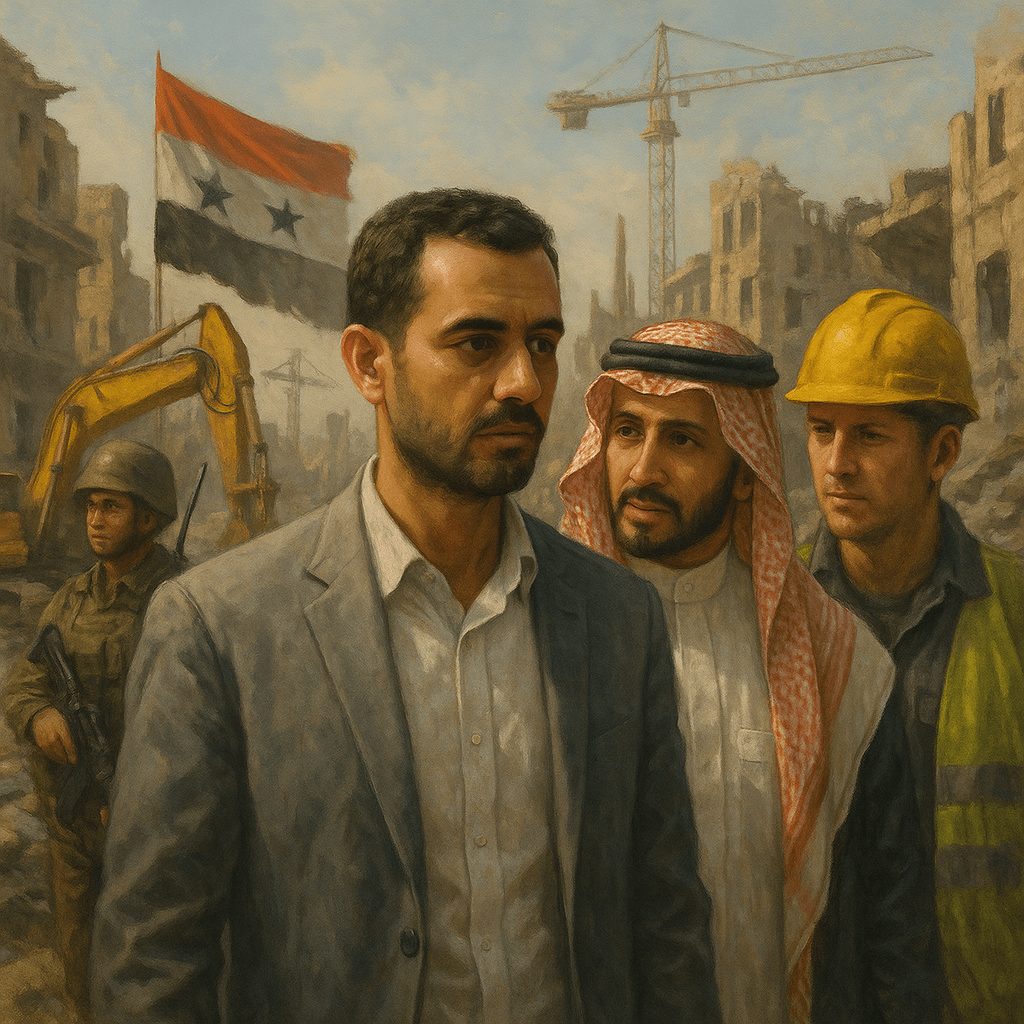
A July 7 report by The National launders Gulf capital’s recolonization of Syria as diplomacy and investment, masking empire’s return in keffiyeh and contract form.
By Prince Kapone | Weaponized Information
July 24, 2025
Empire’s Cement Contracts and Sectarian Coverups
On July 24, 2025, the Associated Press published a glowing report headlined, “Syria and Saudi Arabia sign more than $6 billion in investment deals.” It was the kind of article that slides down easy—polished, depersonalized, and laced with the usual keywords: “reconstruction,” “investment,” “jobs,” “development.” According to the report, the newly formed Syrian interim government hosted the Saudi-backed Investment Forum in Damascus, where 47 deals were inked across real estate, telecom, cement, finance, and tourism. Job creation was promised. Sectarian violence was mentioned, but as a footnote. Israel’s airstrikes made a cameo appearance—but not as aggression, just a backdrop. The thrust of the story was simple: Syria is open for business, and the Saudis are bringing the money.
Of course, no human being claimed authorship. The article is published under the institutional byline of the Associated Press, which is exactly how imperial ideology prefers to speak—without fingerprints. The AP is a wire service funded by corporate news conglomerates like CNN and ABC, and its boardrooms are populated by the kinds of men who wear press badges at Pentagon briefings. For over a century, it has provided stenographic services to empire, smoothing out the blood, scrubbing away the contradictions, and replacing analysis with adjectives. Its role in this case is textbook: obscure the violent mechanics of regime change, legitimize the comprador class, and sell economic recolonization as recovery.
The Syrian Minister of Information, Hamza al-Mustafa, makes his appearance not to deliver truth but to baptize the deal-making in technocratic optimism. Ahmad al-Sharaa, the former insurgent now interim president, stands as the smiling figurehead of a foreign-backed transition. Meanwhile, Israel launches “defensive” missile strikes in the name of Druze protection. Together, this trio of actors—state media official, rebel-turned-premier, and regional colonial power—form a tight circuit of narrative laundering. Each plays a role in rebranding recolonization as reform. This messaging is then amplified by transnational platforms like the The National, Gulf Cooperation Council investment summits, and U.S. think tanks like the Brookings Institution, which promote Gulf capital as the region’s post-conflict savior.
Strip away the press-release varnish, and what emerges is not journalism but choreography. This isn’t reporting—it’s reputation laundering. Three new cement factories, skyscrapers, telecom infrastructure, luxury tourism zones—none of it critically examined, none of it contextualized. But the AP wants us to believe that profit equals progress, that foreign direct investment is the natural sequel to crisis, and that skyscrapers mean Syria is standing tall again.
Nowhere in the article do we learn who destroyed Syria’s infrastructure to begin with. There is no mention of the forces responsible for turning the country into a “reconstruction site.” The story begins where empire always wants it to begin—after the crime, at the crime scene, with the cops handing out contracts. The “interim government” is presented as a matter-of-fact entity, not a product of anything in particular. The reader is given no tools to question its origin—only to accept its authority.
The report’s handling of the recent sectarian clashes in Sweida is even more instructive. What should be a glaring alarm—the killing of civilians by security forces, retaliatory raids, cross-border strikes—is reduced to an unfortunate episode of “tensions.” That word, repeated throughout Western coverage, performs a psychological sleight of hand. It converts orchestrated violence into natural disaster, stripping it of agency and erasing the fingerprints. We are told hundreds have died and 130,000 have been displaced, but this carnage is treated like bad weather—a storm that passed just in time for the cement trucks to roll in. What it really reveals is how empire’s storytellers neutralize horror when it interferes with a favorable investment climate.
Even the economic promises are laced with fantasy. “50,000 direct and 150,000 indirect jobs” are projected—an impossible statistic delivered without methodology, verification, or accountability. These are not projections; they are tranquilizers. They exist to pacify the public imagination, to conjure a future of prosperity that justifies surrendering sovereignty to Gulf developers, Western construction firms, and postwar speculators. The logic is simple: Syria was broken by force, and now it will be sold off by spreadsheet.
This is not journalism. It is the ideological wing of occupation—war by other means, fought with language instead of drones. The AP’s job is not to inform. It is to obscure the scorched earth, dignify the looters, and convince the world that sovereignty looks like skyscrapers funded by the same hands that lit the match. The function is propaganda. The effect is pacification. And the target, as always, is our ability to see clearly who is being robbed, who is doing the robbing, and what future is being stolen in the name of rebuilding.
The Looters Return With Laptops: How Empire Rebrands Its Pillage
It is no coincidence that the World Bank’s first “investment” in Syria in over a decade arrives just months after the U.S.-backed coup of January 2025. Nor is it surprising that its first project targets the electricity grid—a critical chokepoint in any sovereign economy. The announcement came wrapped in humanitarian garb: $146 million in funding for the “Syria Electricity Emergency Project.” But the goal isn’t development. It’s discipline. This isn’t a gift—it’s a collar.
Behind the euphemisms of “resilience” and “lifeline infrastructure” lies the same imperial logic that flattened Aleppo, starved Damascus, and splintered the state. The war that shattered Syria’s power grid was no accident of history—it was a NATO-coordinated campaign of economic, military, and psychological destruction. From CIA-backed proxy militias to Israeli bombing raids, from fuel embargoes to electrical blackouts, Syria was systematically reduced to rubble not to be defeated—but to be made available.
Now, the same imperial institutions that orchestrated the collapse are returning with fiber-optic cables and development consultants, pretending the past never happened. This is what recolonization looks like in the 21st century: not conquest through flags, but control through forms; not marines, but memoranda; not tanks, but tenders. The target is no longer the Assad government—it’s what remains of Syrian sovereignty. And the method is clear: debt, privatization, and externally governed “reconstruction.”
The cables being re-laid will not restore independence. They will monitor it. Each transmission line connects not just cities, but command centers—regional hubs of finance capital, military logistics, and extraction corridors. Syria’s re-electrification is being routed through Türkiye and Jordan, integrating its grid into a geopolitical circuitry of subordination. This is not connectivity—it is containment. The regional rerouting of energy infrastructure fragments the Resistance Axis by disconnecting Syria’s economic lifelines from Lebanon, Iraq, and Iran, and rewiring them into U.S.-aligned logistics corridors. What was once a chain of solidarity is being replaced by a mesh of managed dependencies.
The real contractors are not Syrian laborers or public utilities, but the beneficiaries of imperial triangulation: Turkish firms, Gulf investment consortia, and U.S.-aligned NGOs. Turkish corporations have already flooded in to claim the first spoils. Saudi and Qatari capital are underwriting the “public-private partnerships” that will own the reconstructed grids. The Turkish lira now dominates the economy of northern Syria, transferring not just currency but monetary policy itself. This has been corroborated by YNet News, which notes the expanding use of Turkish banks, financial apps, and dual-currency pricing even in local markets. And the World Bank sits atop it all, managing the illusion of a national recovery while tightening the leash.
Conspicuously absent from this picture are the so-called counter-hegemonic powers. Russia, though nominally allied with Syria, has offered little in terms of postwar reconstruction beyond weapons shipments and public gestures. With its resources drained in Ukraine and domestic instability mounting, Moscow has neither the capacity nor the political will to offer meaningful alternatives. China’s Belt and Road Initiative, once envisioned as a multipolar bulwark, has been effectively sidelined in Syria—hemmed in by U.S. sanctions, regional volatility, and Gulf financial dominance. No serious BRI infrastructure projects have materialized, and Beijing has avoided direct economic confrontation in Syria, preferring trade pacts elsewhere. As a result, Syria remains isolated—economically surrounded, technologically absorbed, and politically quarantined.
The stakes are not just economic—they are political. Infrastructure underwrites authority. Whoever controls the grid sets the terms of life. In this context, “electricity” is not a technical matter. It is a form of governance. And the governance model being installed is not Syrian—it is imperial. Its blueprints come from Washington and Brussels. Its funds are laundered through Bretton Woods. Its enforcement is embedded in contractual clauses, conditionalities, and opaque procurement systems designed to override democratic will.
This same blueprint is being rolled out across the region. Iraq has been handed $930 million to rebuild its railways—not to serve the Iraqi people, but to secure imperial logistics routes from Basra to Mosul. Lebanon, battered by Israeli airstrikes and IMF extortion, has been granted $250 million to repair “lifeline infrastructure.” In every case, the narrative is the same: repair, resilience, reform. And in every case, the result is identical: foreign ownership, hollowed-out sovereignty, and a permanent state of dependency masquerading as modernization.
This is not humanitarianism. It is hostile acquisition. It is the World Bank stepping over the corpses of the war it greenlit, handing out contracts like consolation prizes. The violence of occupation has simply changed costume. And if Syria’s future is to be decided by those same institutions that destroyed its past, then the war has not ended—it has only changed form.
Recolonization by Other Means: Technofascism and the Business of Collapse
Let us not be seduced by the spreadsheets. The World Bank’s $146 million “emergency” project is not a deviation from war—it is war by other means. The bulldozers and tenders arrive not as saviors, but as successors to the bombs. This is not post-war Syria. This is a continuation of conquest, now administered through contracts, currencies, and cables. Where the F-16 failed, the financier follows.
To understand what’s happening in Syria, we must place it in the broader geopolitical choreography of the U.S.-led imperial order in crisis. This is not a restoration of peace. It is an imperial recalibration. What we’re witnessing is the transformation of empire from direct military occupation to hybrid economic subjugation. Syria is not being rebuilt—it is being reformatted.
This reformatting is governed by two strategic imperatives. First, to destroy any political formation that dares to pursue sovereign development, multipolar alliances, or autonomous resource control. Second, to reabsorb the ruins into a digitally managed, capital-secured, elite-administered circuit of imperial value extraction. It is not enough for empire to kill. It must profit from the corpses.
This is the logic of accumulation through destruction, as theorized by Ali Kadri and expanded by Weaponized Information. War is no longer a means to an end—it is a mode of economic production. The rubble of Aleppo, the darkness of Damascus, the shattered substations of Homs—these are not imperial failures. They are imperial assets. The material devastation of the periphery has become the business model of the core.
What makes this moment distinct is the technological infrastructure now embedded in that model. We are not just dealing with recolonization—we are dealing with technofascist recolonization. The World Bank’s contracts are not simply about wires and watts. They are about data sovereignty, predictive control, and algorithmic governance. Infrastructure is no longer passive—it is smart. And in the hands of empire, smart infrastructure is just soft occupation.
Every power meter will come with a monitoring device. Every grid restoration will be tied to foreign oversight. Every contract will bake in austerity—mandating utility privatization, price deregulation, wage suppression, and procurement rules that privilege foreign contractors. These are not development plans; they are compliance protocols. This is reconstruction as surveillance, as discipline, as long-term extraction. The Syrian people are not being served—they are being indexed.
This is precisely why Trump’s Gulf tour, as documented in “American Caliphate”, involved not just arms deals and oil leases, but partnerships with Palantir, Starlink, and BlackRock. These are not side hustles. These are the digital tentacles of recolonization. Through them, the U.S. is outsourcing surveillance, reasserting dominance, and insulating empire from the burdens of occupation. In Syria, the coup was the gateway. The data centers are the chains.
What emerges from this analysis is a three-headed imperial apparatus:
- Finance capital (via the World Bank and Gulf investors) to fund and steer the agenda
- Technological enforcement (via Big Tech and military surveillance firms) to monitor and control populations
- Contractor governance (via Türkiye, NGOs, and private firms) to implement austerity and enforce foreign rule
This is imperialism-as-a-platform. Not just boots-on-the-ground, but code-in-the-cloud. Not just coups, but smart cities. Not just tanks, but tax incentives and tethered currencies. Syria is not a special case. It is a prototype. A live-fire beta test for recolonization in the age of crisis.
Even China’s Belt and Road Initiative—once marketed as a counterweight to U.S. domination—has been locked out of Syria. U.S. sanctions, regional instability, and Gulf capital saturation have rendered BRI infrastructure proposals nonviable. Beijing’s passivity is not neutrality—it is containment.
Meanwhile, Syria remains ensnared in what Weaponized Information identifies as the Sanctions Architecture—a global financial scaffolding that weaponizes trade embargoes, SWIFT exclusion, and asset freezes to discipline disobedient states. With billions in Syrian reserves frozen in European banks and critical development channels shut off, empire creates the very desperation that its recolonization plans pretend to alleviate.
The geopolitical stakes are high. Syria, along with Iran, Hezbollah, and the broader resistance arc, remains one of the last strongholds of anti-imperialist defiance in West Asia. That is why it had to be broken. That is why it is now being digitized. The recolonization of Syria is not just about Syria—it is about isolating Iran, fragmenting multipolar unity, and demonstrating to the Global South that no deviation will be tolerated.
Yet the contradictions cannot be hidden. Even under the al-Jolani puppet regime, the presence of continued resistance, renewed attacks in Tartus and Damascus, and rising discontent in Turkish-occupied zones exposes the lie of imperial “stability.” You cannot bomb a country for a decade, starve it, sanction it, dismember it—and then expect gratitude when you offer to rebuild it for profit.
What empire calls reconstruction, we call recolonization. What it calls reform, we call regime continuity. And what it calls investment, we call looting. This is the dialectic of our time: imperialism in crisis has no new tricks, only new interfaces. But its logic remains ancient—plunder, privatize, pacify.
From Syria to Haiti, Gaza to Venezuela, the pattern holds: destroy the state, install the puppet, outsource the infrastructure, harvest the collapse. The World Bank is not a neutral institution. It is the purse of empire. And its engineers, economists, and consultants are today’s conquistadors—armed not with swords, but spreadsheets.
Until we recognize the technofascist logic driving this transformation—and unite the struggles of the colonized, the working poor, the digital precariat, and the disillusioned petty bourgeoisie—we will remain trapped in empire’s simulations. But Syria is not just a tragedy. It is a teacher. It shows us what we’re up against. And if we’re serious, it shows us what we must destroy.
From Observation to Intervention: The Duty of the Global North
There comes a point when witnessing becomes complicity. The recolonization of Syria is not a faraway atrocity—it is a mirror. A blueprint. What’s being tested in the ruins of Aleppo will be rolled out in Athens, in Atlanta, in Accra. What they normalize there, they will enforce here. And what they perfect in Syria’s silence, they will apply in our neighborhoods, schools, farms, and factories—with applause.
This is not just about Syria. This is about the future of empire—and whether or not it will be allowed to digitize its dominion without resistance. If we fail to act, then Gaza becomes the product pitch, Haiti becomes the demo version, and Syria becomes the terms of service. And we will all be users. Not citizens. Not comrades. Users—on someone else’s platform, in someone else’s empire.
To those of us inside the imperial core, this is our contradiction to confront. We are not innocent. Our cities are wired with the capital extracted from bombs dropped abroad. Our data flows through servers cooled by sanctions. Our clean energy transition is built on cobalt, cadavers, and coups. We don’t just benefit from empire. We are deputized by it—through our taxes, our silence, our obedience.
And so we must break ranks.
We must say no to the fake humanitarianism of the World Bank and expose its recolonization projects for what they are: capitalist conquest disguised as reconstruction. We must reject the technofascist pipelines that run from Gaza to Chicago, from Damascus to Detroit, from refugee camps to predictive policing. We must organize, agitate, and sabotage the imperial machine at every link in its supply chain—digital, logistical, ideological.
Start local. Map the imperial nodes in your city. Which universities run “post-conflict reconstruction” programs funded by USAID or the State Department? Which NGOs partner with Palantir or Google to “digitally enable” refugee camps? Which zoning boards approve “smart city” infrastructure tested in occupied territories? Which tech incubators are exporting surveillance platforms to Saudi Arabia, Israel, or Turkey? Trace the pipelines, name the names, and cut the wires.
Recognize technofascism where you live. It’s not abstract—it’s visible. It’s the smart meters surveilling your apartment. It’s the predictive policing tools targeting Black and brown neighborhoods. It’s the AI hiring filters screening out working-class resumes. It’s the sidewalk cameras tracking public dissent. What they test in Syria, they normalize in the South Bronx. The frontier is global, but the fight is local.
Organize globally. Join or build anti-imperialist formations. Align with Syrian diaspora resistance networks, Palestinian solidarity campaigns, Haitian sovereignty movements. Refuse NATO narratives. Intervene in the media cycle. Use every disruption—labor strikes, hacktivist actions, blockades, student uprisings—not just to win concessions, but to rupture imperial legitimacy.
We also need to recognize and support concrete countercurrents already forming. In June 2025, Iran finalized a de-dollarized oil-for-goods agreement with Russia and China under BRICS+, bypassing SWIFT and establishing a trilateral payment system using the rial, ruble, and yuan. These are not symbolic gestures—they are strategic ruptures in the financial infrastructure of empire. And they show us that alternatives are not only possible—they are already underway.
And theorize deeper. We must arm ourselves with a revolutionary understanding of the world—not through moral outrage, but through historical materialism. Technofascism is not a glitch. It is the capitalist solution to the collapse of the old world order. If we are to defeat it, we must build a new one—rooted in multipolar cooperation, popular sovereignty, ecological survival, and the absolute right of the Global South to refuse servitude.
Syria is not a footnote. It is a frontline. Its fate is bound to ours. If we allow recolonization to proceed unchallenged, then empire will gain a second wind. But if we resist it—publicly, tactically, materially—we turn Syria from a cautionary tale into a rallying cry.
History does not offer second chances. But it does offer examples. The Paris Commune. The Black Panthers. The Vietnamese victory. The Haitian Revolution. And now—perhaps—a new internationalist front, born not out of charity, but out of shared necessity.
So to every organizer, every student, every coder, every tenant, every worker, every soul who feels the cold steel of empire brushing their back: this is your signal. The war isn’t over. It’s just changed shape. And if we don’t change with it, we will be absorbed by it.
But if we rise—strategically, collectively, unapologetically—then we do not merely reject recolonization. We begin to demolish the system that made it possible. Not just for Syria. But for all of us.
 Weaponized Information
Leave a comment