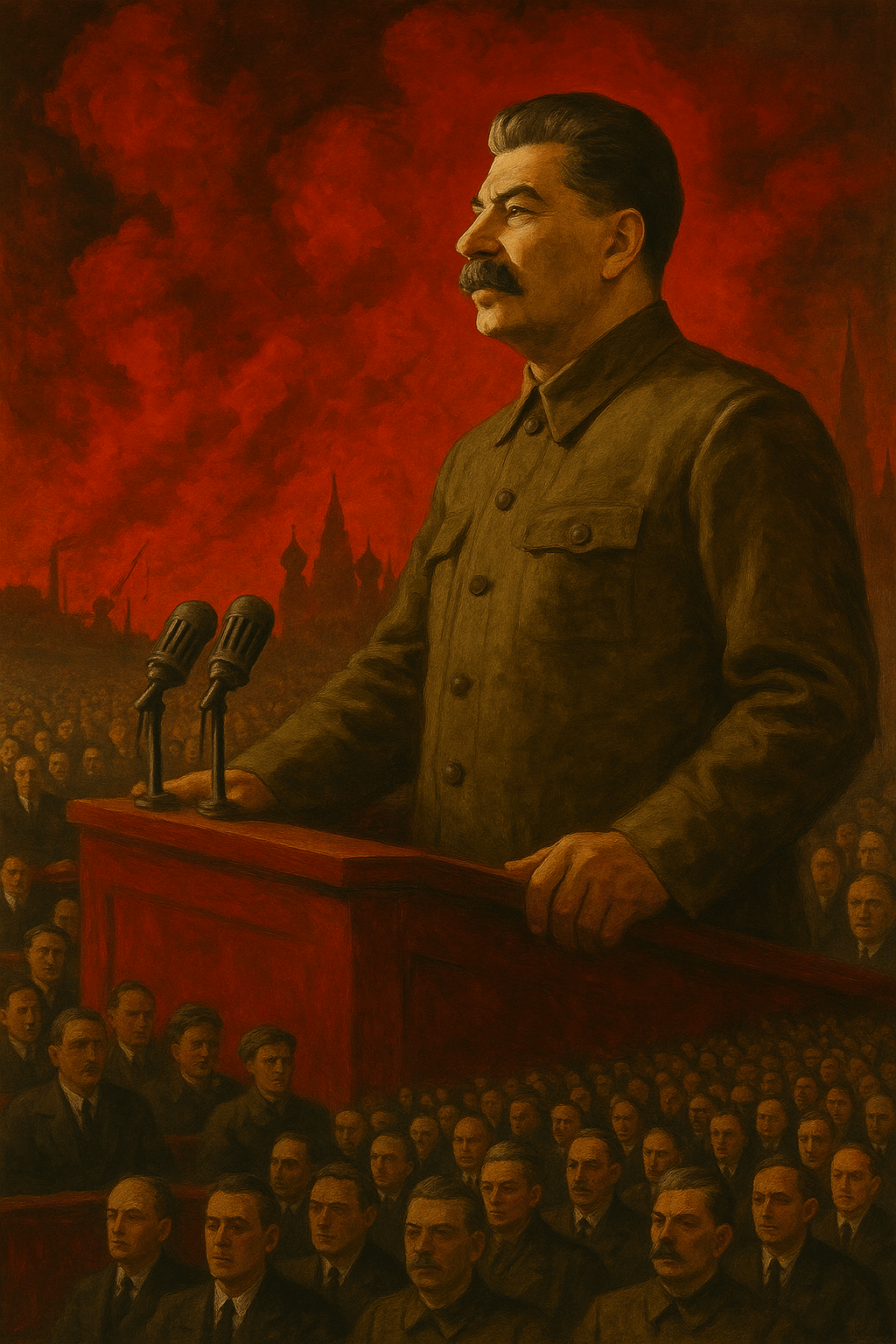
As capitalist empires collapsed into crisis and carnage, Stalin stood before the 18th Congress of the Communist Party of the Soviet Union not to gloat, but to clarify. His report, delivered in March 1939, was a cold-eyed inventory of global contradictions and a sober defense of the socialist path. It was not a speech of victory, but of vigilance. The world was on fire, and the Soviet Union, encircled, isolated, and still scarred from the wounds of civil war and sabotage, had managed not only to survive—but to build, to grow, to learn. In a time when liberalism appeased fascism and democracy armed its own destruction, Stalin offered the revolutionary alternative: fortify the base, purge the rot, arm the people, and train the future. This was not rhetoric—it was strategy. And for those serious about revolution, it remains a case study in how to govern in the teeth of history.
Weaponized Statesman Series | J. V. Stalin at the 18th Congress of the C.P.S.U.(B.)
By Prince Kapone | Weaponized Information
July 17, 2025
“In the economic sphere these were years of depression… In the political sphere they were years of serious political conflicts and perturbations.” With these blunt words, Stalin sets the world stage: a capitalist system convulsing in a cycle of depression, crisis, and war—while the Soviet Union marches in the opposite direction. Delivered in 1939, months before fascist boots would trample Poland and set the world ablaze again, this speech was not just a report. It was a sharpened sword, cutting through imperialist lies, technocratic neutrality, and liberal daydreams about peace. It was a weapon of revolutionary statecraft, wielded before the gathered cadre of a Party that had outlasted civil war, invasion, and sabotage, and had built socialism with bare hands and blistered shoulders.
This was no feel-good celebration. Stalin’s method, true to dialectical materialism, begins with contradiction: “The entire post-war system, the so-called regime of peace, has been shaken to its foundations.” He doesn’t hide the fact that imperialism is not only alive—it’s hungry, and devouring continents. From Shanghai to Gibraltar, over 500 million people are swept into conflict. Japan tightens its claws around China. Germany annexes Austria and Sudetenland. Italy bombs Abyssinia into dust. The League of Nations, that liberal fantasy of “collective security,” is exposed as a wax palace melting in the heat of militarism. Stalin names it precisely: “The new imperialist war became a fact.”
But while the world descends into slaughter, the Soviet Union has no interest in becoming the janitor of capitalist failure. “The capitalist countries thus found themselves faced with a new economic crisis before they had even recovered from the ravages of the recent one.” Meanwhile, Soviet industry climbs ever higher. This isn’t rhetorical flourish—it’s empirically grounded. Where the U.S. falls from a 1937 industrial index of 92.2 to 72.0 in 1938, the U.S.S.R. surges to 477.0. The contrast could not be clearer: capitalism offers crisis and war; socialism offers growth and life. No wonder the imperialists call that a threat.
It is here that Stalin’s speech becomes a political scalpel, dissecting the true character of the so-called “non-aggressive” capitalist states. “It is now a question of a new redivision of the world, of spheres of influence and colonies, by military action.” The Soviet leader shreds the polite euphemisms of international diplomacy, revealing British and French “non-intervention” for what it really was: complicity. While fascists carved up the globe, London and Paris played dead. Not because they were weak, but because they were calculating. “To allow all the belligerents to sink deeply into the mire of war… and then, when they have become weak enough, to appear on the scene with fresh strength.” That was the plan. To let fascism do their dirty work, and step in as saviors later. Imperialism has no friends—only timing.
And while others played double games, the Soviet Union did not equivocate. “We are not afraid of the threats of aggressors,” Stalin declares. “We are ready to deal two blows for every blow delivered by instigators of war who attempt to violate the Soviet borders.” This was not adventurism. It was revolutionary realism—the kind that sees clearly that peace must be defended by power, not paper. This is why the Soviet Union entered into mutual assistance pacts with France, Czechoslovakia, and China, and why it poured resources into building its Red Army and Navy, even as Western newspapers mocked it with lies about “riots” and “demoralization.” The Soviet Union knew: imperialism doesn’t need facts—it manufactures them.
Yet perhaps the sharpest blade in Stalin’s speech is reserved for the myth that the Soviet state should “wither away” while still encircled by wolves. “We are surrounded by a capitalist world,” he reminds the delegates. “To remember that the foreign espionage services will smuggle spies, assassins and wreckers into our country.” This is not paranoia. This is historical experience. It’s a reminder that Lenin’s theory of the state must evolve—not be memorized like scripture but developed through struggle. The Soviet state, in Stalin’s words, “no longer contains antagonistic, hostile classes,” but that does not mean the class struggle has ended. It means its terrain has shifted—into questions of sabotage, betrayal, technological sabotage, ideological warfare. Sound familiar?
To understand this speech today is not to idolize Stalin, but to weaponize his clarity. He shows us that revolution is not a moment—it is a regime of contradiction. He teaches that a socialist state must never confuse good intentions for strength. That building the people’s industry, culture, and confidence is inseparable from defending it with guns, with spies, and with steel. And that peace, in the mouth of an imperialist, is just another dialect of war.
🟥 Holding the Line in a World on Fire: Revolution, Rearmament, and the Role of the State
“Everybody is arming, small states and big states… including primarily those which practise the policy of non-intervention.” In this sentence, Stalin cuts straight through the performance of pacifism performed by the Western democracies. Britain and France weren’t protecting peace—they were preparing for war, while hoping someone else would die for it. Their neutrality was not cowardice; it was cunning. Their refusal to resist fascist aggression in Spain, Ethiopia, China, or Czechoslovakia was not a sign of isolationism, but a strategic bet that Hitler’s guns would turn eastward toward the Soviet Union. Stalin understood this perfectly: “The policy of non-intervention means conniving at aggression… transforming the war into a world war.”
This clarity was not philosophical—it was existential. The Soviet Union had no oceans to hide behind. No colonies to bleed for wartime production. No Marshall Plan waiting in the wings. It had only itself, and the will of its people. And so Stalin turns his attention inward—not to retreat, but to fortify. “From the standpoint of its internal situation, the Soviet Union… presented a picture of further progress of its entire economic life, a rise in culture, and the strengthening of the political might of the country.” This was not mere optimism. It was a report on the material base being built beneath Soviet socialism—a base strong enough to withstand the coming storm.
The industrial achievements cited are staggering. In a world where unemployment and famine stalked the working class across Europe and the U.S., the Soviet Union had not only recovered from civil war and invasion, it had doubled industrial output, eliminated private capital, and equipped its factories with world-leading modern machinery. “From the standpoint of the technique of production… our country is more advanced than any other country,” Stalin asserts—not with arrogance, but with purpose. Because he knew that the survival of the proletarian state depended not just on political line, but on tractors, turbines, and tons of steel.
But Stalin does not hide the gap that remained. “We are still lagging economically… as regards the volume of our industrial output per head of population.” He lays it out with precise numbers: 107 kilograms of steel per capita in the USSR versus 226 in Britain. 233 kilowatt-hours of electricity versus 620. And he makes clear that this was not a reason for despair—but for struggle. “We must outstrip them economically as well… We can do it, and we must do it.” Here is revolutionary planning as it should be: sober, unflinching, and collective.
What follows is a strategic directive, not a utopian promise. Pig iron output must hit 60 million tons. Grain harvests must rise to 8 billion poods. Livestock herds must double. These are not dreams. They are requisites. Because Stalin understood—as any serious revolutionary must—that socialism must feed its people, clothe them, arm them, and inspire them. Otherwise it dies.
And so he turns to agriculture—not as romantic ruralism, but as political economy. The destruction of private farms, the rise of collective agriculture, and the total mechanization of the countryside was not just economic—it was class war. “The Socialist system of farming is now our only form of agriculture.” The figures bear it out: 93.5% of households in collectives, 6,350 tractor stations, and a massive shift of surplus grain production away from Ukraine and toward the RSFSR. The peasants, once the wild card of the revolution, had now been drawn into the socialist core. “That is how things stand with regard to grain farming.”
Here we see the dialectic of discipline and development. Stalin speaks not in moralism, but in metrics. He measures victory not by slogans, but by freight tonnage, crop yields, and kilowatt-hours. And yet, behind the numbers, there is a deep ideological confidence: that socialism works. That workers and peasants, organized and empowered, can do what the bourgeoisie claimed was impossible. That progress is not a gift from capital, but the product of collective power, planned economy, and proletarian leadership.
This section of the speech is a declaration of war—not on enemies outside the gates, but on doubt, on defeatism, on the illusion that revolution ends once the palace is seized. For Stalin, the real revolution begins with power—and power, to endure, must be built, not proclaimed. “We must build new factories. We must train new cadres. But this requires time, and no little time at that.” This is not the patience of reformism. It is the urgency of those who know that their enemy does not sleep. And so the Soviet Union did not rest. It labored. It dug deep into the earth, into the grain, into the forge and the furnace—because it knew what was coming.
🟥 Building the Future in the Furnace of the Present: Cultural Revolution and the Socialist Intelligentsia
“The steady progress of industry and agriculture could not but lead, and has actually led, to a new rise in the material and cultural standard of the people.” In Stalin’s calculus, these aren’t parallel developments—they are dialectically linked. Economic development without cultural transformation is brittle. Cultural uplift without economic foundation is hollow. What’s being advanced here is a comprehensive political theory of revolution that includes not just the abolition of class exploitation, but the conscious construction of a new proletarian culture, a new human being, and a new ruling class—the working class in power.
For Stalin, the metric of progress is not just the doubling of steel output or expansion of retail stores—it is the emergence of a “Soviet intelligentsia… of the flesh and blood of our people.” This is perhaps the most underestimated feature of Soviet socialism: it did not inherit an educated working class—it produced one. It took peasants and workers, broke them from the muck of tsarist illiteracy and capitalist servitude, and trained them into scientists, engineers, doctors, teachers, and cultural workers. It did not just democratize knowledge. It turned knowledge into a weapon of class struggle.
And it did so without apologizing. Stalin doesn’t pretend this was easy. He doesn’t idealize the intelligentsia. In fact, he rebukes those within the Party who still treat education as suspicious, who “attempt to apply the old theory… to our new, Soviet intelligentsia, which is basically a Socialist intelligentsia.” Here, we get a glimpse of the revolutionary rectification process at work. Stalin is not simply affirming the new intelligentsia—he’s reeducating the Party’s attitude toward them. “Education is a pernicious and dangerous thing?” he asks mockingly. “We want all our workers and peasants to be cultured and educated, and we shall achieve this in time.”
This is the long view of revolution. Not just seizing power, but transforming social consciousness. Not just destroying the old ruling class, but constructing a new one—with new ideas, new morals, and new historical tasks. The Soviet intelligentsia, unlike their bourgeois counterparts, were not a detached caste but “emerged from the ranks of the working class, peasantry and Soviet employees.” Stalin’s challenge to the Party here is simple: stop clinging to the past. Stop mistrusting those who’ve walked the hard road from peasant field to physics lab. Stop treating learning like a liability. It is the road to socialism’s second phase.
The figures are stunning. Between 1933 and 1938, national income more than doubled. State spending on cultural and social services increased sixfold. The number of workers rose from 22 million to 28 million. Wages climbed. Grain deliveries surged. But the most important metric, Stalin suggests, is none of these—it’s that Soviet power is not just producing goods, but people. People capable of leading, learning, and defending a new society.
Here Stalin is not just delivering statistics. He’s issuing a call to ideological discipline. Revolutionaries must think historically. They must reconfigure their own categories. “What is the reason for this?” he asks of industrial gaps, of grain shortfalls, of educational lags—and then he answers concretely, with material factors. Not with slogans. Not with excuses. But with the sober analysis of a Party that intends not just to build socialism, but to defend it through war, through crisis, and through time.
And that, ultimately, is the essence of Stalin’s pedagogy: the Party is not a sect or a slogan factory—it is the leading edge of the working class. And to lead, it must learn. Not abstractly. Not individually. But collectively, systematically, and with revolutionary purpose. This is why the speech ends not just with applause but with a roadmap: new cadre schools, centralized training systems, ideological elevation through Marxism-Leninism. “The training and moulding of our young cadres… proceeds along the line of specialization. This is necessary. But there is one branch of science which all Bolsheviks are in duty bound to know… the Marxist-Leninist science of society.”
In the crucible of encirclement, sabotage, and betrayal, Stalin is not calling for retreat. He is demanding transformation. He is forging steel not just in the furnaces of Magnitogorsk, but in the minds of the people. He is building the subjective conditions for Communism, not as a dream deferred, but as a horizon in motion. A horizon carried by millions of workers who are not waiting to be saved—they are preparing to lead.
🟥 Revolution Is Not a Metaphor: The Party, the State, and the Science of Survival
“What could have given rise to this underestimation?” Stalin asks, interrogating the naïve belief that the Soviet state could afford to relax, to demobilize, or to dissolve its mechanisms of defense. His answer is not rhetorical—it is surgical: “It arose owing to the fact that certain of the general propositions in the Marxist doctrine of the state were incompletely worked out and inadequate.” Here, Stalin is not rejecting Marxism. He is developing it. Through practice. Through the contradictions of governing. Through the hard-earned knowledge that comes from twenty years of revolutionary state power under siege.
At this point, Stalin is not talking to the masses. He is talking to the Party. To the cadre who imagine that the absence of landlords means the end of the class struggle. To the theorists who can quote Engels but forget the encirclement. To the dreamers who want to “relegate the state to the museum of antiquities” while fascist armies mass on the border. And so he returns to first principles—not to affirm them as dogma, but to weaponize them in motion.
He reminds us that Engels’ formulation about the withering away of the state presupposed a global revolution, a world in which socialism had triumphed in the majority of countries. “But what if Socialism has been victorious only in one country… and must have at its disposal a well-trained army… a strong intelligence service?” What then? The answer is clear: “We have no right to expect of the classical Marxist writers… readymade solutions.” It is our task to adapt, to apply, and to advance the science of revolution under new historical conditions.
In this, Stalin models a dialectical posture: neither dogmatism nor revisionism, but militant development rooted in historical materialism. “The forms of our state are changing and will continue to change,” he says—not to justify bureaucracy, but to argue that the socialist state must evolve in struggle. When enemies infiltrate, the Party must purge. When sabotage threatens the harvest, the Party must discipline. When new generations rise, the Party must educate. This is not repression. It is survival.
He names the very organs that Western liberals and reactionaries most fear—“army, punitive organs, intelligence service”—and reclaims them as necessary organs of proletarian power. “Their edge is no longer turned to the inside of the country, but to the outside.” This is crucial. Stalin is not advocating permanent internal terror. He is arguing that the class struggle now lies in foreign encirclement, in espionage, in propaganda, in the undeclared wars waged by imperialist powers against the socialist experiment. And he insists that only a disciplined, centralized, ideologically clear Party can meet this challenge.
But even here, Stalin is not idealizing the Party. He is critiquing it. He exposes its weaknesses: the influx of careerists, the theoretical confusion, the lagging political education. He names the need for cadre selection, for ideological rigor, for “a single body” to handle Party propaganda and cadre training. And above all, he returns to the Marxist principle that without theory, practice degenerates. “It must be accepted as an axiom that the higher the political level… the more effective the results of the work.” Stalin knew what many radicals today forget: revolution is not just about burning down the old—it is about building, defending, and governing the new.
That’s why he demands an “independent elaboration” of Marxist theory for Soviet conditions. That’s why he mocks those who memorized Engels but forgot Lenin’s call to “develop the Marxist theory.” That’s why he insists that socialism is not an event, but a process—a contradiction unfolding across generations, across frontlines, across institutions. In this speech, Stalin is doing what a revolutionary leader must do: not just defending socialism, but preparing it to endure. Not just celebrating victories, but fortifying against defeat. Not just naming enemies, but training comrades.
He closes not with poetry, but with discipline. With statistics, strategy, and ideological calibration. “Our task now is to concentrate the work of selecting cadres from top to bottom… and to raise it to a proper, scientific, Bolshevik level.” Here lies the essence of Stalin’s intervention: not charisma, but construction. Not platitudes, but planning. Not moralism, but method. The Soviet Union, he knew, would not survive on hope. It would survive on iron discipline, ideological clarity, and the willingness to adapt the science of Marxism to the new contradictions of power.
 Weaponized Information
Leave a comment