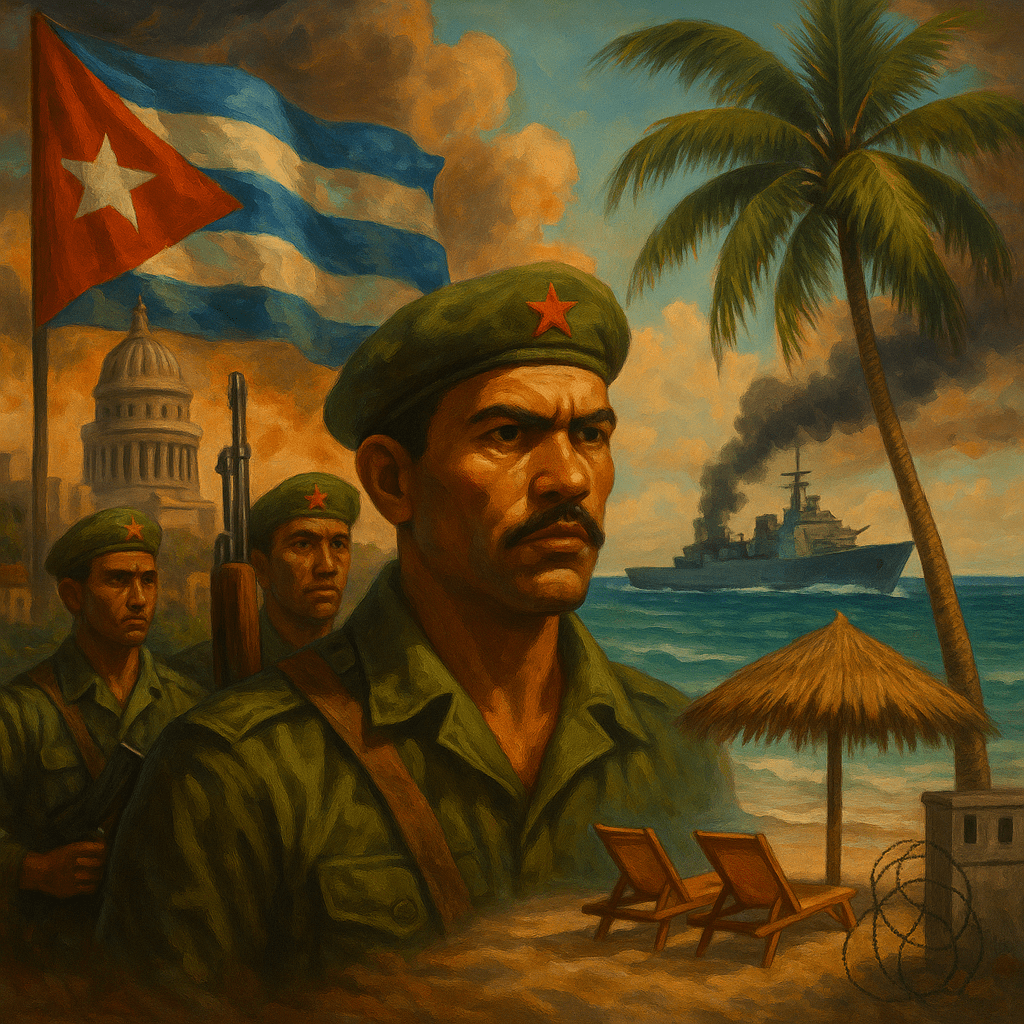
What Mexico and Cuba’s new tourism pact reveals about imperial siege, South–South defiance, and revolutionary endurance
By Prince Kapone | Weaponized Information | July 3, 2025
When Diplomacy Whispers, Revolution Must Speak Louder
On July 3rd, teleSUR published a short news brief covering the new 2025–2028 tourism cooperation agreement between Cuba and Mexico. On the surface, it’s an innocuous, almost bland account: two tourism ministers shake hands, a program is signed, a few goals are outlined, and that’s that. It’s written in the familiar dialect of diplomatic boilerplate—calm, neutral, and stripped of all tension. The article gives the impression that this was just another day in the orderly world of bilateral agreements. But that’s the trap: when a revolutionary act is dressed in polite technocratic language, its power is hidden from view. And when the stakes are concealed, the people are disarmed.
teleSUR has long been viewed as a trench in the war of ideas, a platform built to challenge the corporate press and tell the story of the South in the voice of the South. But even revolutionary projects age, institutionalize, and shift tone. In this case, the story feels curiously hollow. There is no anger, no defiance, no urgency. The tone is purely administrative, as if the agreement were about increasing travel volume or modernizing hospitality—not about breathing space, not about survival. And certainly not about resistance. One would never guess from the article that there are enemies involved, or that one party to this deal has spent decades under siege. It reads like a meeting between equals, unaffected by history or power.
Language is the battlefield. The article calls this a tourism action program. It speaks of collaboration and “mutual benefit.” It lists workshops, training sessions, and trade shows. But what it never does is explain why this matters—why a deal like this, at this time, with these countries, is anything more than a scheduling update. It gestures toward development, but avoids politics. It uses words like “cooperation” and “promotion” and “tourism attributes,” but never once invokes the people whose labor makes tourism possible, or the forces that have tried to deny those people the right to build anything at all. There is a violence in that silence.
The structure of the article reproduces the habits of diplomacy: clean, polite, and empty of mass struggle. We are told about courses in hotel management, about evaluating tourism trends, about strategies for customer service. But no one speaks plainly. No one says what this really means. No one even says who benefits, who suffers, who risks. The ministers are named. The people are not. There is a world of difference between a report and a narrative. This is the former—a sterile report, with the life drained out.
This is not a call to abandon diplomacy or journalism. It is a call to remember that revolutionary communication must name the moment. There are times when saying little is a tactic. And there are times when saying little is surrender. This story doesn’t lie. But it doesn’t tell the truth either—not the full, living, breathing truth that beats in the hearts of workers, peasants, youth, and elders who have endured far more than missed flights and low occupancy rates. The truth is bigger than a press release. And it is our task, always, to speak it where others will not.
Blockaded Horizons: What the Article Leaves Out, and Why That Matters
Once we scrape away the polish of diplomatic euphemism, the material basis of the Cuba–Mexico tourism pact begins to surface—not through what the teleSUR article tells us, but through what it omits. What we are given is a narrow snapshot of policy cooperation: joint training programs, marketing initiatives, tourism trend analysis, and future trade expos. These details are factually accurate but politically neutered. They say nothing about the structural pressures driving the agreement or the asymmetric conditions under which it was signed. They strip the story of historical memory and dialectical motion—flattening a struggle into a spreadsheet. To understand what’s actually at stake here, we must extract the skeletal facts and restore them to their living, contested context.
The article confirms that Cuba and Mexico signed a bilateral agreement covering tourism cooperation from 2025 through 2028. It notes that both countries hope to boost their foreign currency reserves through increased tourism flows and that Cuba aims to make Mexico a leading “emitter” of visitors to the island. The program outlines technical areas of collaboration: training in hotel management, customer service, and tourism marketing; the hosting of symposia and conferences; and joint participation in trade fairs—including a newly established “Americas edition” of Germany’s ITB fair in Guadalajara. It also references studies on regional tourism trends that will guide joint commercial strategies. But all of these details float in an ideological vacuum—severed from the siege conditions that make such agreements urgent, even existential.
What the article never mentions—what no sentence dares to touch—is that Cuba is the most comprehensively sanctioned country in the hemisphere. The United States’ blockade regime is not just a foreign policy dispute; it is a full-spectrum economic war. As documented in “Lawfare, Loot, and the Siege of Cuba”, Title III of the Helms-Burton Act weaponizes property claims to penalize foreign companies—like those in Mexico—for doing business with Cuba. In other words, this tourism deal is not a neutral partnership. It is a strategic circumvention of U.S. imperial legal warfare. Yet the article lets this pass in silence, as if Cuba simply woke up one day and decided to rebrand its tourism sector.
Nor does the article situate the agreement in the context of Cuba’s material survival strategy. As outlined in “Starving the Revolution”, the blockade has drastically curtailed Cuba’s ability to import food, medicine, and fuel. With its energy grid strained, supply chains throttled, and access to global capital markets choked off, Cuba has been forced to prioritize tourism not as a luxury but as one of the last viable sources of hard currency. Every hotel room booked, every peso exchanged by a foreign visitor, is a breath of oxygen in a suffocating chamber built by imperial siege. This is not about developing new service-sector efficiencies—it is about resisting strangulation.
Meanwhile, Mexico’s role in this agreement is layered with contradiction. As argued in “The Gringo is the Enemy”, the Mexican state—particularly under Claudia Sheinbaum’s emerging leadership—finds itself straddling two worlds: the rhetoric of continental nationalism and the reality of embedded dependency. While Mexican officials speak of sovereignty and regionalism, the country remains locked in asymmetric trade agreements and food import dependency under NAFTA-turned-USMCA. The tourism pact may be a gesture of solidarity with Cuba, but it also serves Mexican economic interests in diversifying its tourist destinations, expanding regional influence, and burnishing its diplomatic credentials—especially within CELAC.
That CELAC context is glaringly absent from the article. As examined in “CELAC at the Crossroads”, the Community of Latin American and Caribbean States has increasingly become a counterweight to U.S. hemispheric hegemony. Cuba, a founding member, remains a symbolic and strategic core of the project. This tourism deal is more than an economic arrangement—it’s a maneuver within the broader project of regional realignment away from Washington. By refusing to name CELAC or even hint at hemispheric struggle, the article divorces the agreement from the movement it expresses.
Finally, the article never addresses the internal contradictions that come with a tourism-dependent survival strategy. As laid bare in “Corn, Capital and Colonization”, when Global South nations orient their economies around export sectors—whether in agriculture, energy, or tourism—they risk reproducing colonial structures under new branding. While Cuba has historically resisted this pattern through state ownership and social redistribution, the danger remains: dual economies, labor stratification, and over-reliance on foreign visitors all raise strategic dilemmas that demand serious political debate. But again, none of this is acknowledged by the article. It is easier, it seems, to narrate trade fairs than to interrogate contradictions.
In the end, what the article offers is a skeleton—a basic outline of bureaucratic cooperation. What it withholds is the flesh: the blockade that frames every Cuban economic decision; the hybrid war that punishes international engagement; the uneven footing of Mexico’s political economy; the regional vision struggling to be born; the class tensions embedded in tourism itself. These are not side notes. They are the story. And without them, we are left not with journalism, but with choreography—an empty waltz of ministers in suits, spinning on a stage whose scaffolding is never shown.
Tourism as Trench Warfare: Reframing the Struggle for Sovereignty
Once the surface is stripped away—once the polite diplomacy and technocratic language are exposed for what they are—the Cuba–Mexico tourism pact emerges not as a modest commercial deal, but as a small trench carved out in a much larger war. This is not development policy. This is counter-siege strategy. In the face of sanctions architecture designed to bleed Cuba dry, this agreement offers a brief breach in the blockade. It is a functional act of internationalism—not in slogans, but in logistics, training, and economic oxygen. And yet, the dominant narrative treats it like a business seminar. That disconnect is not ideological sloppiness—it is the quiet reproduction of imperial narratives by omission.
To understand this pact dialectically, we must begin from its material base. Cuba’s tourism sector has long functioned as a double-edged sword. It offers the fastest route to hard currency, but it also invites inequality, cultural commodification, and external dependency. The revolutionary state has attempted to discipline this contradiction through centralized planning, redistributive social programs, and public ownership of major tourist infrastructure. But the pressures of blockade have forced Cuba to increasingly rely on this sector as a lifeline. That reliance is not voluntary—it is induced by economic warfare. In this sense, the tourism pact with Mexico is not about expanding luxury services or diversifying investment. It is about surviving imperial siege through partial integration with a fellow semi-peripheral state. This is tourism as trench warfare.
The U.S. blockade must be understood not simply as an embargo, but as globalized economic warfare—a system of coordinated economic, legal, and political tools designed to isolate Cuba and dissuade third parties from engaging with it. Under this architecture, even symbolic trade can trigger retaliatory measures. This is why Title III of the Helms-Burton Act matters: it enables lawfare—a form of imperial discipline that punishes not only Cuba, but anyone who dares cooperate with it. As we explored in Lawfare, Loot, and the Siege of Cuba, the threat of lawsuits, sanctions, and frozen assets are used to paralyze would-be partners through fear of reprisal. Mexico’s move here—however cautious—is therefore significant. It is not revolutionary, but it is rebellious. It signals a willingness to defy imperial deterrence mechanisms, at least within limits.
Yet this defiance carries internal contradictions. Mexico, as analyzed in The Gringo is the Enemy and Corn, Capital, and Colonization, is not a sovereign economy in the full sense. It remains deeply entangled in imperial food chains, trade regimes, and financial circuits. Its participation in this agreement may reflect a shift in diplomatic posture, but it does not signal a break from the structures that keep it subordinate. What we are witnessing is a moment of friction within a dependent relationship. The Mexican state is asserting regional leadership while still tethered to the empire’s machinery. This is not hypocrisy—it is the contradictory terrain of a country suspended between comprador obligations and popular pressures for continental dignity.
In this light, CELAC is more than a diplomatic forum—it is a strategic space for reasserting regional coordination without U.S. oversight. The fact that Cuba continues to play a leading role in CELAC—even under conditions of blockade and disinformation—speaks to the enduring gravitational pull of its revolutionary example. The tourism deal is one expression of that. It is not just about travel—it is about legitimacy, about contact, about refusing isolation. And in this multipolar moment, where BRICS expansion and South–South cooperation are slowly redrawing geopolitical lines, such agreements are building blocks in a broader scaffolding of post-imperial possibility.
But this possibility is not automatic. The contradiction at the heart of Cuba’s tourism dependency must be named. Exporting leisure to import survival reproduces a colonial dynamic, even if under state ownership. Dual economies emerge: one for workers, one for visitors. In this gap, class stratification festers. Revolutionary states must constantly fight to suppress these tendencies. The solution is not withdrawal from tourism, but militant planning from below—through union control, wage equalization, community-based oversight, and structural redistribution. The people must not be made servants in their own revolution. They must be made stewards.
Framed this way, the Cuba–Mexico pact is neither a triumph nor a sellout. It is a contested maneuver within an ongoing war. It represents the persistence of anti-imperialist sovereignty—not as an abstract slogan, but as a daily battle to remain alive and connected. Mexico’s role, while uneven, shows that even countries entangled in empire can carve moments of regional loyalty. And teleSUR’s coverage, while incomplete, reminds us that even within compromised institutions, cracks of truth can still shine through. The task now is not just to report such agreements—but to politicize them, to defend them, and to push them further down the path of collective liberation.
From Partnership to Praxis: What Solidarity Must Look Like in the Global North
If this tourism pact between Cuba and Mexico is a trench in the war for sovereignty, then our task in the Global North is not to admire it from a distance, but to fortify its flank. Cuba does not need applause. It needs air. And Mexico, for all its contradictions, has just pried open a small window. What matters now is whether we in the imperial core can push that window open wider. Because solidarity is not a sentiment. It is a practice. And in a world where Cuba’s every breath is taxed by imperial siege, practicing solidarity means interrupting the systems that make that siege possible—here, where those systems live.
First, we must be clear: tourism is not neutral. Every plane ticket, every investment, every transfer of resources to Cuba is a calculated risk under U.S. law. That’s why one of the most effective interventions we can make is to support campaigns that directly challenge the legal infrastructure of the blockade. A key target is the Helms-Burton Act—especially Title III, which enables lawfare against third-party trade with Cuba. Pressure campaigns against law firms, financial institutions, and real estate companies that exploit these provisions must be escalated. Resources like the Cuba Solidarity Campaign (UK) and NNOC (U.S.) already track complicit actors. The job of Global North militants is to translate those lists into direct action strategies: digital disruptions, public exposures, financial divestments, and legal counterclaims.
Second, we must fund and amplify grassroots media and counter-narrative platforms that resist the soft censorship imposed on Cuba. teleSUR, for all its limits, still offers more truth than CNN ever will. But we need more. Weaponized Information, multipolar think tanks, and cultural projects rooted in the South must be materially supported. This is not charity—it is counterinsurgency in reverse. Every dollar sent to a revolutionary media project chips away at the monopoly of narrative that makes economic warfare invisible. Create shareable content. Build meme squads. Host teach-ins. But above all, break the silence.
Third, build links between **labor and popular organizations** in the North and Cuban workers in the tourism sector. U.S. and European travel unions, hospitality workers, and service industry collectives can coordinate with Cuban counterparts to exchange training resources, amplify organizing models, and expose wage gaps and labor violations inflicted by Western-based tourism multinationals. This is a form of proletarian internationalism that bypasses the NGO-industrial complex entirely and builds direct class-to-class bridges. If tourism is to be a trench, let workers dig it together.
Fourth, and most urgently, we must intervene in the ideological terrain. That means pulling Cuba out of the fog of misinformation that paints it as a failed state, a relic, or a dictatorship. We must normalize the language of revolution, of sovereignty, of siege—not as slogans but as empirical realities. Political education must start at the roots: local reading groups, high school classrooms, radical podcasts, workers’ assemblies. Push back against the NGOs who talk about “democracy” while ignoring starvation sanctions. Push back against the academics who analyze Cuba’s economy without naming the blockade. Push back against the media that speaks of “reform” but never of resistance.
None of this work is glamorous. Much of it is slow. But the value of this tourism pact is not just that it keeps Cuba afloat—it’s that it reveals the small cracks in empire where oxygen can enter. Every act of Global South cooperation is a threat to imperial control. And every act of Global North solidarity is a decision: to reinforce that threat, or to leave it exposed. Cuba and Mexico have made their move. Now it’s our turn.
 Weaponized Information
Leave a comment