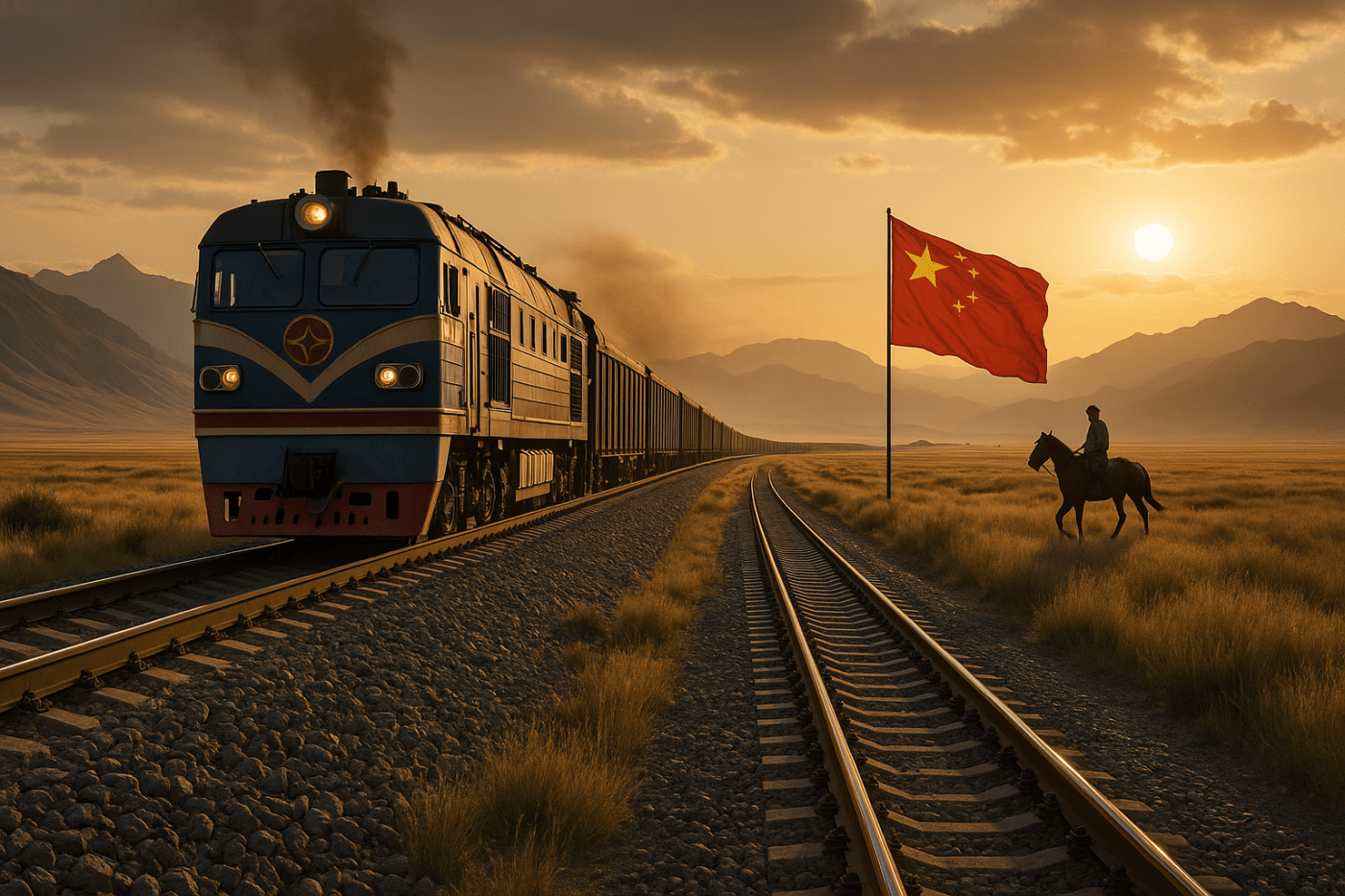
From the Astana summit to the Eurasian steppe, a new logistics corridor threatens the dollar order and NATO’s grip. But beneath the tracks, class contradictions—and revolutionary possibilities—are emerging.
By Prince Kapone | Weaponized Information | June 18, 2025
Wiring the Steppe While the Empire Sleeps
Yesterday Reuters flashed a 400-word wire announcing that China and the five post-Soviet republics of Central Asia will slash visa red tape, modernize border ports, and lay fresh rail and air corridors that “bypass NATO chokepoints.” In the space of a single paragraph the agency distilled an entire summit in Astana—treaties signed, tracks surveyed, flights plotted—into a footnote for investors.
The by-line belongs to business correspondent Liz Lee, a professional translator of emerging-market tremors into Bloomberg-terminal whisper. Her career rises inside the lattice of Thomson Reuters Corp., a data giant that earns 83 percent of its revenue from recurring subscriptions sold to Western finance, law, and government clients—precisely the class that profits when Eurasian steel stays on colonial rails.
Predictably, the wire is already being echoed by US News & World Report, signal-boosted inside NATO briefs, and queued for think-tank spin at the CSIS “On China” desk—the chorus that polices Belt-and-Road stories for “security risks.”
But listen to the silences. In classic imperial press style, the piece markets infrastructure as innocuous “connectivity,” sidestepping the sanctions chokehold that makes alternative corridors a matter of life and sovereignty. The Cold-War trigger—“bypass NATO”—frames Eurasian rail as a threat, not a lifeline, while the local working class is erased entirely. No labor contracts, no debt terms, no word on how the Kyrgyz countryside will finally ship fruit to market without paying rent to colonial bottlenecks. And outside the Reuters syndicate the Western press stays mum: nothing in NY Times, Financial Times, or cable news—proof that multipolar momentum is either blackout or belittled when it refuses to beg dollars for permission.
Compare that hush to our own archive: “The Long Road to Multipolarity” mapped BRICS credit lines cracking dollar walls; “The Silk Road Returns” exposed the last media blackout on BRI freight; “Steel Tracks & Sovereignty” traced how Kazakhstan rides Chinese rail to break its petro-dependency; “China’s 3-D Chess” chronicled Beijing’s sanction-dodging logistics game; “Supply-Chain Recalibration” showed how the dragon builds dual power while the eagle tantrums. In other words: the trains are already moving; Reuters just hands Wall Street a timetable—and hopes you never notice who laid the track.
Steel, Silk & Sovereignty: Digging Beneath the Headlines
Strip away the wire-service varnish and you find a very different story than the one painted by polite markets copy. The new China-Kyrgyzstan-Uzbekistan (CKU) Railway will stretch 523 kilometers through the mountains, backed by roughly US $2.35 billion in low-interest Chinese loans. Kyrgyzstan and Uzbekistan will still pony up more than a billion dollars of their own—but the lion’s share of engineering, steel, and locomotives comes from Beijing. This isn’t penny-ante aid; it is an axle in a new continental drivetrain.
The payoff is time itself. By slicing directly across the Tien Shan range, the corridor cuts seven to ten days off freight bound for Europe compared with the detour through Russia. “Time is money” rings truer when you’re moving wheat, copper, and car parts through a region that has spent thirty years begging distant ports for mercy. Less transit means fewer bribes at borders, cheaper food at bazaars, and lower costs for garment workers stitching jackets in Bishkek factories.
The numbers are galloping. In the first five months of 2025, China’s trade with the five Central Asian republics blasted past
286 billion yuan (≈ US $40 billion)—a 10 percent leap year-on-year, according to Reuters’ own summit dispatch. Rail’s share of that traffic has tipped the majority mark for the first time, confirming the thesis we advanced in “The Long Road to Multipolarity.” Dollars may still price the freight, but steel tracks are now denominated in sovereignty.
Reuters, however, tiptoed past the nuts and bolts. It never mentions that the winning bid on key mountain sections went to China Railway No. 5 Engineering Group, a subsidiary of the state-owned giant whose profit streams will flow back to Beijing. Nor does the wire whisper a syllable about the Digital Silk Road—the fiber, sensors, and customs algorithms riding shotgun with every train. Cue the Sinophobic panic: the Harvard Davis Center clutches its pearls in a 2021 brief, insisting that every fiber-optic strand along the Digital Silk Road is a portal for Beijing’s omnipotent “data sovereignty”—as if multipolar bandwidth alone could topple the empire’s firewalls.
Then comes the security choir. Washington think-tankers trumpet the idea that railways, ports, and cloud hubs serve Beijing’s long game of civil-military fusion. The Asia Society’s “Weaponizing the BRI” study frets that every loading dock might double as a PLA logistics node. It’s a Cold War echo chamber we’ve heard before, yet it yields a grain of truth: infrastructure is never neutral. Railroads can move textbooks or tanks; fiber can carry science journals or spyware. The class struggle doesn’t pause at the border post—it hitches a ride on the next freight wagon.
Let’s talk debt. The World Bank’s own Kyrgyz Republic BRI case study warns that without customs reform and transparency, mega-loans may widen inequality and tighten state-owned chokeholds on the economy. Yet Bishkek and Tashkent are choosing that risk over the IMF’s austerity leash—and that defiance is itself a dialectical leap. As we laid out in “Supply-Chain Recalibration,” the Belt-and-Road bankroll is a bargaining chip: take the cash, but fight for the terms.
Meanwhile, Brussels dangles its own carrots. The EU’s Global Gateway / EFSD+ touts up to €13 billion for roads, rails, and renewables in the same corridor—yet nine out of ten euro-projects stall in feasibility limbo while Chinese crews are already pouring ballast. Imperial decline isn’t measured only in military misadventure; it’s visible in bureaucratic paralysis while someone else lays the track.
Class dynamics ripple beyond steel and ballast. Chinese automakers like BYD and SAIC are building assembly plants in Uzbekistan, betting on cheaper logistics once the CKU line is up and running; Reuters tracks that pivot as Beijing’s hedge against Western tariff walls. For Uzbek youth, that could mean swapping Moscow construction gigs for local factory shifts—an embryonic shift in proletarian gravity from Russia’s rouble zone to China’s rail-fed workshops. That’s material diversification, not the rhetoric of “connectivity.”
None of this is rosy myth. Land seizures for rail yards spark protests; labor contracts remain murky; algorithmic customs systems threaten to entrench techno-policing. The World Bank again reminds us that without governance reform, benefits will flow uphill. Yet the dialectic is in motion: peasants and porters gain leverage when a single hegemon no longer holds the only key to the gate.
In short: these tracks are contested territory. They can bolster anti-imperialist sovereignty—or slide toward a new flavor of dependency. Reuters offers a hedge-fund weather report; Weaponized Information offers the class analysis. Decide which train you’re boarding, but know who’s driving the engine and who’s paid for the fuel.
Reframing the Iron Tracks: Class, Contradiction & Multipolar Promise
Let’s follow a story the Reuters wire buried beneath bland investor jargon. Average wages in Kyrgyzstan’s transport sector have risen steadily in early 2025. As noted by the Kyrgyz National Statistics Committee via CEIC, monthly salaries climbed from 39,342 soms in January to 41,854 soms by March—a 6.4 percent increase in just two months. The transport and storage sector already pays above the national average, and continued investment along the CKU freight corridor stands to accelerate that trend. That’s not finance-speak—it’s real-world redistribution: working-class families gaining material ground as multipolar logistics eclipse colonial bottlenecks.
That’s class-struggle territory. Transport and logistics improvements in the region are already delivering real benefits: according to Kun.uz, Bishkek beef prices—already higher than in Kazakhstan—stayed around $7.7/kg in early 2025, while Kazakhstan sat at $5.7/kg, suggesting room for price convergence. At the same time, a Eurasian Research Institute study reports that rail shipments via CKU massively cut transport costs—leading commodity prices in Central Asia to drop significantly as logistics shifted from seasonal, expensive roads to year‑round rail. That means working people in steppe villages and city suburbs pay less at the market, and Kazakh producers get better access when costs are lower. It’s redistribution in motion—wages rise, consumer prices fall, autonomy grows.
And make no mistake: this is Dual and Contending Power. Rather than crawling to IMF austerity, these states are choosing concessional Chinese loans—activity that mirrors the logic laid out in our “Long Road to Multipolarity.” Djaparov’s government in Kyrgyzstan opted for a resource-swap loan backed by agricultural output—not budget cuts. That’s autonomy—bite-sized but material—with dignity intact.
Contrast that with Western capital’s rats-in-the-walls reading of the same project: a recent Atlantic Council memo declares the CKU rail a “security threat,” urging NATO allies to build parallel corridors. That’s not analysis—it’s fear of imperial erosion. It confirms what we call Imperialist Decay: the empire flinches when sovereignty shows muscle.
Now, about the money. The CKU deal—$2.35 billion from China, half covered by Kyrgyz and Uzbek budgets—rings alarm bells for some. But here’s the counter-punch: the World Bank’s own case study warns that IMF-based loans lock nations into debt spirals. China’s arrangement allows repayment in wheat, minerals, and industrial goods—not state payroll cuts. That’s Financial Piracy avoided, replaced by fiscal self-defense.
Even within the multipolar camp, contradictions persist. Kyrgyzstan’s public debt stood at $6.6 billion—about 37.6 percent of GDP in 2024, according to the National Bank of the Kyrgyz Republic, with World Bank data showing that China’s Exim Bank holds roughly 39 percent of that external debt. This reflects not imperial ambition, but Beijing’s outsized role in financing Eurasian development. These loans are qualitatively different from Western debt traps—no shock therapy, no privatization mandates, no military bases in exchange. But they still concentrate leverage in the hands of Chinese state lenders—and unless governed by transparent, pro-worker terms, they can reproduce new forms of dependency. Multipolarity is not a myth—but its promises must be organized into reality from below.
Keep these contradictions in mind as we acknowledge the digital infrastructure layered beneath the rails. Fiber-optic cables, customs platforms, and logistics networks are not neutral—they reflect the class forces that design, implement, and govern them. In the hands of imperialist states, such systems enable surveillance and repression. But in the context of multipolar development, they can be harnessed to strengthen state capacity, coordinate logistics, and accelerate economic sovereignty—ifgoverned democratically and aligned with popular interests. Our task is not to fear digital power, but to organize and fight for its control: worker-run data centers, publicly accountable tech infrastructure, and cross-border union oversight of digital trade corridors. That is how we transform code and cable into tools of liberation, not domination.
In the Reuters echo chamber, this is “China vs NATO.” Our perspective snaps back with clarity: NATO hysteria isn’t strategic necessity—it’s evidence of a unipolar order unraveling under pressure. Each protest in Osh, each cheaper loaf of bread in Almaty, is a stitch in the social fabric of Anti‑Imperialist Sovereignty.
However, we can’t romanticize the project. Resource‑heavy industrial hubs in Kazakhstan rely on coal power—over 54 % of energy in the corridor comes from fossil fuels, climate‑concern groups warn. Tajik gold concessions tied to Chinese mining corporations are already fueling land conflicts. These are the contradictions that must be resolved: environmental rights, indigenous land claims, and participatory governance across the corridor.
That brings us to praxis—not advice, but solidarity. As revolutionaries in the imperial core, it is not our task to instruct comrades in Central Asia on what they should demand. It is our duty to observe, study, and stand with the working classes shaping this terrain. The CKU corridor is not state theater—it is a material battlefield. And from where we stand, the struggle ahead could revolve around:
- Transparent debt terms and crisis‑avoidance clauses in BRI contracts;
- Community‑controlled environmental oversight of rail‑linked mines, water tables, and displacement zones;
- Union‑negotiated automation safety protocols at Chinese-owned factories;
- Commons-based digital governance over customs and logistics infrastructure;
- Public investment in renewable corridor power to offset fossil lock-in.
These aren’t universal prescriptions—they are glimpses of what revolutionary infrastructure might look like when directed by the interests of workers, not technocrats or financiers. They remind us that logistics is not neutral—it either serves imperial capital, or it moves in the direction of liberation.
To transform the corridor into a vehicle for autonomy, we draw inspiration from our own archive: from “Steel Tracks & Sovereignty”, which traced how Kazakhstan is laying down multipolar ballast beneath its feet, to “Supply‑Chain Recalibration,” which maps the lines between coercion and choice under imperial siege.
So here’s the reframe: the CKU rail is not a Trojan Horse. It is a contested zone of possibility—both material force and ideological claim. Our task is not to direct it, but to politicize it. To hold up its contradictions to the light. And to organize, educate, and agitate in solidarity with those pushing its axle toward emancipation. If the tracks are laid, we ride with them—not behind them.
Mobilizing from the Belly of the Beast: Tasks for Anti-Imperialists in the Global North
We write this from inside the imperial core—rail yards, union halls, and code labs scattered across the United States and Europe. We live where NATO generals draft war games and Wall Street sets the price of wheat. That location imposes a duty: to sabotage the empire’s choke-holds and to amplify the self-determination breaking out along the China-Kyrgyzstan-Uzbekistan (CKU) line. The tracks are already humming; the question is whether we in the North will keep shoveling coal into the imperial furnace or help hammer spikes for multipolar sovereignty.
Solidarity starts where we stand. U.S. rail workers organized in Railroad Workers United (RWU) have a living tradition of fighting corporate speed-ups and single-crew mandates. Their recent statements pledging support for international rail struggles show that rank-and-file militants are ready to link arms across borders 0. Likewise, the International Transport Workers’ Federation (ITF) convenes more than 160 rail unions worldwide, including Kyrgyz and Uzbek affiliates. Tying RWU and ITF together—joint trainings, shared safety protocols, and emergency strike funds—turns “connectivity” into proletarian power.
Political education is our next rail tie. Many comrades in the North still swallow the Atlantic Council line that the Belt and Road Initiative is a “debt trap.” Break that spell by circulating our own archives—Steel Tracks & Sovereignty, Supply-Chain Recalibration—and by spotlighting primary sources from the South. The treaty of “permanent good-neighborliness” signed in Astana last week isn’t a sub-plot; it is the diplomatic spine of the rail project, pledging non-interference and mutual development between China and Central Asia (TV BRICS). Share it in study circles, union newsletters, and neighborhood meetings so people see multipolarity in the diplomats’ own words.
Our third obligation is to punch holes in the sanctions architecture that strangles infrastructure finance. The same banks that froze Venezuelan gold try to jack up borrowing costs for Kyrgyzstan. We in the North can pressure city pension funds, university endowments, and church treasuries to divest from sanction-compliant bonds and instead channel money toward grassroots-controlled development vehicles. It’s not charity; it’s repayment for centuries of Financial Piracy.
Digital fronts matter too. Empire runs on data chokepoints—SWIFT, satellite intel, cloud monopolies. Tech workers can deploy Proletarian Cyber Resistance: open-source mapping of BRI corridors, privacy audits of customs software, and mirror sites for Central-Asian union bulletins whenever state censors strike. Learn from the Git-based solidarity that sprang up when Chinese delivery-rider organizer Chen Guojiang was jailed (Labor Notes). Code is class struggle in a hoodie.
Climate contradictions cut across the rails, and activists in the North have leverage. Kazakhstan still burns coal for two-thirds of its electricity 1. Partner with Central-Asian eco-collectives to demand that Chinese state lenders earmark solar and wind offsets for every kilometer of track—no green paint, real megawatts. Northern climate blocs can add teeth by threatening shareholder resolutions against banks that finance new coal plants tied to corridor expansion.
What does all this look like in practice? A roadmap:
- Union-to-Union Brigades: RWU delegates travel to Bishkek and Tashkent workshops, sharing strike tactics and safety standards; ITF handles translation and logistics.
- Sanctions-Bust Webinars: Host teach-ins explaining how U.S. Treasury rules throttle rail finance; coordinate call-in days to pressure congressional reps to oppose new Central-Asia sanctions.
- Open-Source Cartography: Build publicly editable maps of CKU worksites, water tables, and displacement zones so local communities can flag abuses in real time.
- Clean-Energy Solidarity Fund: Crowd-finance community-owned solar micro-grids for villages along the line, reducing dependency on coal-fired supply.
- Rapid-Response Media Cells: Translate WI analyses into Russian, Kazakh, Kyrgyz, and Uzbek within 24 hours; blast them on Telegram and TikTok to out-trend NATO talking points.
- Legal & Medical Caravans: Partner with groups like the Solidarity Center to send mobile clinics and paralegals along the construction route when reports of wage theft or land grabs surface.
If these steps feel ambitious, remember we stand on precedents. Rail unions in the North have shut down entire corridors for safety. ITF affiliates in Asia have already forced port employers to raise wages. Climate divestment forced BlackRock to reconsider thermal-coal portfolios. Every victory loosens an imperial bolt; enough bolts, the war machine derails.
We in the core are not powerless passengers—we are engineers in the imperial cab. Pull the brake. Divert the line. Forge new switches toward multipolar emancipation. The CKU line may start in the steppe, but the struggle to defend and direct it begins wherever you read these words. Grab your wrench, comrade; there’s track work ahead.
 Weaponized Information
Leave a comment