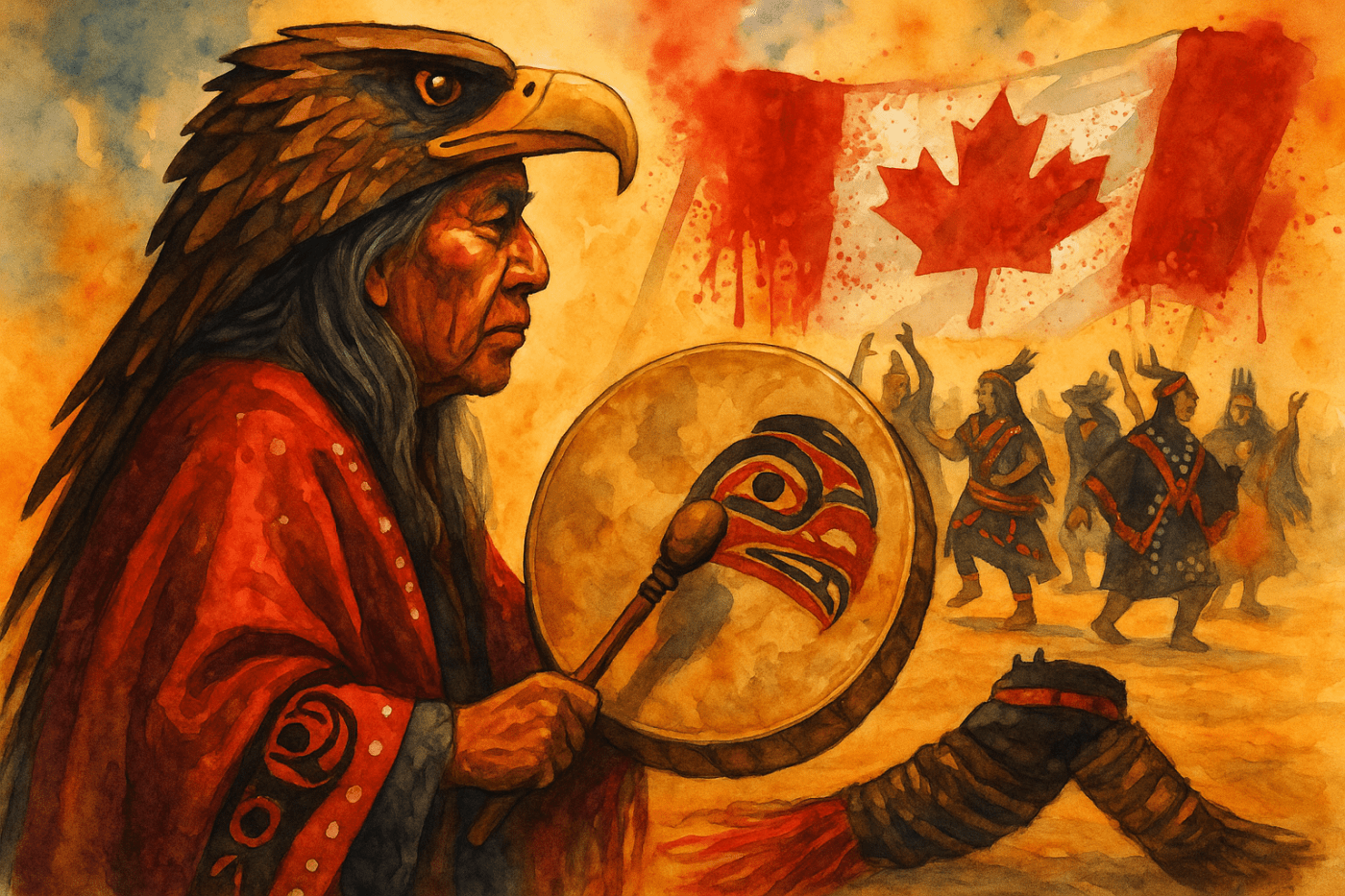
Don’t be fooled by the drums and regalia. This isn’t Canada recognizing Indigenous power—it’s Indigenous power recognizing itself. And that’s what makes the state afraid.
By Prince Kapone | Weaponized Information | June 12, 2025
Drums, Dances, and Dispossession: How the Canadian State Hides the Boot Behind the Feather
On June 12, 2025, The Guardian ran a piece applauding what it calls a historic moment for Indigenous rights: the Heiltsuk Nation has adopted its own constitution, one that supposedly gives its hereditary leadership “a constitutional voice” within Canada. The story is soaked in ceremony—kids dancing, drums echoing, elders gathered in regalia—framed as a kind of moral redemption arc for the settler state. It reads like a reconciliation fairytale, polished up to make colonialism feel like a cultural misunderstanding that can be resolved with a good potlatch and some kind words from Justin Trudeau. But behind the poetry and pageantry, the real story is still what it’s always been: the empire keeps the land, the empire keeps the power, and the empire keeps writing the rules.
This particular narrative is stitched together by Leyland Cecco, a liberal journalist whose career lives comfortably inside Canada’s media establishment. He’s not some rabid reactionary—no, his politics are softer, more digestible, more dangerous. Like many of his kind, Cecco’s job is to make empire sound reasonable. His bylines appear regularly in *The Guardian*, a paper that prides itself on “independent journalism” but is funded by a trust that exists to preserve the very institutions it claims to scrutinize. The Guardian doesn’t report from outside power; it reports for power—specifically the Anglo-liberal order that built its wealth off stolen labor and stolen land.
So it’s no surprise that the usual names are handed the microphone. Justin Trudeau, the crown prince of performative reconciliation, floats gently through the piece. The BC provincial government gets a nod for returning some land to the Haida. Even some Indigenous figures—like elected chief Marilynn Slett and lawyer Saul Brown—are framed not as radicals resisting empire, but as administrators helping manage its kinder, gentler face. This is how the state co-opts leadership: reward the voices that speak the language of “protocol” and “dialogue,” and freeze out the ones who still dare to talk about land, about liberation, about power.
Let’s be clear about what this article is doing. It doesn’t lie outright—but it’s expertly crafted to drain the politics out of the struggle. The headline says the Heiltsuk “win a constitutional voice.” What it doesn’t say is that the Canadian state hasn’t given up an ounce of legal control. There’s no power shift here—just a well-dressed ceremony. It frames this as a “redraw of power,” but the Crown still owns the map, still holds the guns, and still decides which laws count when push comes to shove.
The emotional framing is no accident either. The children dancing, the songs, the ceremonies—these are powerful cultural moments. But in the hands of liberal media, they become a smokescreen. The spectacle is used to pacify, to make settler readers feel good about the “progress” being made, even while the system that stole the land in the first place remains untouched. Culture is celebrated not as resistance, but as decoration. The state smiles, claps, and signs a few checks—then goes right back to approving pipelines through sacred territory.
The generational framing is another clever trick. The article contrasts “angry elders” who wanted to tear down colonialism with younger leaders who want to “build their own.” It’s a subtle way of saying: rebellion was emotional, irrational, outdated. This new generation? They’re pragmatic. They know how to work within the system. But working within the system only works when the system works for you—and this one never has for Indigenous nations. It’s a colonial machine with a fresh coat of paint. The kids may be holding the steering wheel now, but the engine still runs on stolen land.
Even the conflicts with neighboring nations—who rightly object to how the Heiltsuk have drawn their constitutional borders—are sanded down into polite disagreements. But these aren’t just technicalities. These are the results of 150 years of forced displacement, broken treaties, and state-imposed divisions. Now, Indigenous nations are being forced to negotiate with each other inside a legal framework designed by their colonizers. The Guardian won’t say it, but we will: this is how colonialism survives—not just through violence, but by redrawing the battlefield and calling it democracy.
What we’re seeing here is the latest performance in the Canadian state’s long-running theatre of “reconciliation.” It offers symbolism instead of substance, recognition without restitution, voice without power. This constitution may be a step forward for the Heiltsuk in asserting their own governance—but for the Canadian state and its media auxiliaries, it’s just another way to keep the land while pretending to share it. They wrap the boot of empire in cedar bark, toss some feathers on top, and call it peace. But make no mistake—it’s still a boot. And it’s still on the neck of the people.
Ink on Paper, Blood on the Land: What the Guardian Left Out
In February 2025, the Heiltsuk Nation voted to ratify its own constitution, with 67% of 725 community members casting ballots in favor. Later that spring, the community gathered in Bella Bella for a ceremonial feast to celebrate what the Guardian framed as a landmark moment of inclusion. But the ratification, as meaningful as it is internally, carries no formal legal authority under Canadian law. It’s not binding. It does not override Crown jurisdiction. It does not transfer title. It is, as far as the settler legal system is concerned, aspirational—respected only insofar as it does not interfere with the underlying assumption of Canadian sovereignty.
And that sovereignty remains brutal in both form and function. The constitution is described in the article as a “constitutional voice,” but Canada has not surrendered any power. The land remains 98% under Crown title across British Columbia, with most Indigenous communities occupying a fraction of their traditional territories. In many cases, so-called “returned” lands represent less than 1% of historic Indigenous territory. The BC Treaty Commission process itself has long been criticized for coercing First Nations into surrendering vast tracts of land in exchange for limited self-governance under frameworks like the 1996 Framework Agreement on First Nation Land Management—often privatizing previously collective land titles in the process.
This is not just symbolic; it’s systemic. The state enforces this hierarchy of law through economic dependence and coercion. Federal and provincial funding for Indigenous governance is often contingent on adherence to state-imposed legislative frameworks. Operating outside them means risking cuts to basic services—health care, education, infrastructure. In this context, the constitution becomes a high-stakes act of dual strategy: asserting sovereignty while navigating a system rigged to absorb and domesticate resistance.
This dynamic isn’t new. In 1996, the Supreme Court of Canada ruled in R v. Gladstone that the Heiltsuk Nation had a pre-existing constitutional right to commercially harvest herring spawn. It was a significant legal win. But that victory proved hollow when the Department of Fisheries and Oceans imposed restrictive quotas and refused to meaningfully implement the ruling. Heiltsuk fishers were still criminalized for asserting those rights. The lesson? Even court rulings in favor of Indigenous rights are meaningless without enforcement—and enforcement, in Canada, always favors the settler economy.
The Guardian’s article praises the recent Haida title agreement—where over 500,000 hectares of land were recognized as belonging to the Haida Nation—as a model. But what it doesn’t say is that this title was only “recognized” after decades of negotiations, countless court battles, and a near-total community referendum. And even then, the land was not returned as sovereign territory, but as a negotiated carve-out within the Canadian legal regime. The title remains subordinated to Canadian environmental law, zoning statutes, and taxation structures. It is land held in a colonial box, not liberated from it.
Meanwhile, the Guardian glosses over a sharp contradiction: three neighboring Indigenous nations—the Nuxalk, Kitasoo Xai’xais, and Wuikinuxv—have publicly disputed the territorial boundaries drawn in the Heiltsuk constitution. Their statement denounced the maps as “inaccurate and historically false,” calling for their immediate revision. This isn’t a mere inter-community disagreement. It is a legacy of colonial border-making, where Indigenous territories were forcibly broken up and rearranged by the Canadian state to facilitate land theft and undermine collective resistance. Now, as nations assert jurisdiction through their own laws, they find themselves forced to negotiate these disputes inside frameworks inherited from their dispossession.
So what looks, on the surface, like progress—a constitution, a celebration, a headline—is also a battlefield. The Heiltsuk constitution is a real achievement. It reflects deep community consultation, cultural authority, and political will. But it remains trapped in a settler colonial structure designed to limit its effect. Until the Canadian state relinquishes jurisdiction, returns land, and withdraws enforcement mechanisms like the RCMP and DFO, these legal frameworks will remain pinned between aspiration and occupation. The ink is real. The drums are real. But the land, as always, is the question that cuts through the noise.
Endnotes
-
The Guardian coverage of the Heiltsuk constitution:
https://www.theguardian.com/world/2025/jun/12/canada-indigenous-heiltsuk-constitution -
The Guardian article reporting on the Heiltsuk constitution (archived):
https://web.archive.org/web/20250612110001/https://www.theguardian.com/world/2025/jun/12/canada-indigenous-heiltsuk-constitution -
Referendum approval and ceremonial ratification coverage:
https://www.coastreporter.net/local-news/heiltsuk-nation-ratifies-self-government-constitution-in-vote-8414136 -
*R v. Gladstone* (1996), Supreme Court of Canada decision recognizing Heiltsuk commercial herring rights:
https://www.canlii.org/en/ca/scc/doc/1996/1996canlii160/1996canlii160.html -
CBC report on Haida Aboriginal title agreement (2024):
https://www.cbc.ca/news/canada/british-columbia/haida-title-agreement-1.7059577 -
Tuck & Yang, “Decolonization Is Not a Metaphor,” *Decolonization: Indigeneity, Education & Society* (2012):
https://jps.library.utoronto.ca/index.php/des/article/view/18630/15650 -
Heiltsuk and Nuxalk 2003 fish farm blockade at Ocean Falls:
https://www.thetyee.ca/News/2003/01/23/Heiltsuk_Protest_Fish_Farm/ -
2015 Heiltsuk herring fishery protest and DFO office occupation:
https://www.cbc.ca/news/canada/british-columbia/heiltsuk-herring-protest-1.2983930 -
Unist’ot’en Camp: Indigenous land defense and Wet’suwet’en sovereignty campaign:
https://unistoten.camp/ -
Historical overview of the Clayoquot Sound anti-logging blockades (1993):
https://www.thecanadianencyclopedia.ca/en/article/clayoquot-sound -
BC Treaty Commission data on land settlements and limited land return:
https://bctreaty.ca/frequently-asked-questions/ -
Shiri Pasternak, *Grounded Authority: The Algonquins of Barriere Lake Against the State* (UBC Press, 2017):
https://www.ubcpress.ca/grounded-authority -
Ruth Wilson Gilmore, “Organized Abandonment and Organized Violence,” in *Golden Gulag* (2007):
https://www.ucpress.edu/book/9780520242012/golden-gulag -
Glen Coulthard, *Red Skin, White Masks: Rejecting the Colonial Politics of Recognition* (University of Minnesota Press, 2014):
https://www.upress.umn.edu/book-division/books/red-skin-white-masks -
Leanne Betasamosake Simpson, *As We Have Always Done: Indigenous Freedom through Radical Resistance* (Duke University Press, 2017):
https://www.dukeupress.edu/as-we-have-always-done -
Tricontinental Institute for Social Research, “Dual and Contending Power” (Study 64):
https://thetricontinental.org/studies-64-dual-power/
Drums in the Courtroom, Boots on the Ground
If the Canadian state wants this moment remembered as a symbolic gesture of reconciliation, then we must remember it for what it truly is: a strategic rupture. The Heiltsuk constitution is not merely a cultural or political artifact—it is a live weapon in the hands of a nation rebuilding its power. It does not seek permission. It asserts authority. And the question is not whether Canada will recognize it, but whether the people are prepared to enforce it.
They’ve already begun. In April 2015, Heiltsuk community members occupied a Department of Fisheries and Oceans office in Bella Bella for four days, demanding enforcement of their rights to manage herring stocks in accordance with their own laws. The direct action succeeded: the government withdrew plans for a commercial harvest. This wasn’t a protest. It was jurisdiction in practice. In 2003, the Heiltsuk joined forces with the Nuxalk Nation to blockade a proposed Omega salmon farm in Ocean Falls. Chiefs in full regalia led a flotilla to defend their waters. The RCMP came, but the fish farm didn’t.
These weren’t isolated events—they were rehearsals for sovereignty. The assertion of Indigenous law is not theoretical; it happens when boats are turned away, when bylaws are enforced, when state authority is refused. This is what dual and contending power looks like on occupied land. The Heiltsuk have shown again and again that governance is not declared in Ottawa—it’s enacted on the coast.
We’ve seen similar models elsewhere. The Unist’ot’en Camp has held the line for over a decade against pipeline construction through Wet’suwet’en territory, building healing centers, community infrastructure, and defense systems. In 1993, the Clayoquot Sound blockades stopped mass clear-cut logging through mass arrests, public disruption, and Indigenous–settler solidarity. These struggles remind us that law means nothing without enforcement, and that enforcement can come from the people when the state betrays justice.
So what now? For those of us outside Bella Bella, solidarity begins with clarity. First, we must reject the lie that recognition is power. It is not. The Canadian state only recognizes what it believes it can contain. What the Heiltsuk have built is not meant to be contained. Second, we must materially support Indigenous enforcement of Indigenous law. That means funding land patrols. That means showing up when DFO boats arrive. That means standing beside communities when they say “no” and the state says “too bad.” Third, we must treat these constitutions not as internal documents, but as external battle cries. Disseminate them. Study them. Use them to educate our communities on what sovereignty looks like in practice.
If you are a settler, solidarity means more than acknowledgment. It means interruption. Interruption of extraction. Interruption of colonial mythologies. Interruption of jurisdiction. It means working to dismantle the very legal frameworks that define the Crown as supreme and Indigenous authority as contingent. The real task ahead is not inclusion in a better Canada. It is the end of Canada as a settler project.
This ink on paper is land back in embryo. The drums aren’t asking permission—they’re the heartbeat of a future being born.
This Isn’t Recognition—It’s a Breach
What The Guardian paints as a feel-good story about inclusion is, in reality, a carefully managed rupture—a fracture in the settler fantasy of legal finality and absolute dominion. The Heiltsuk Nation’s constitution is not just a cultural statement or a governance document. It is a refusal. A declaration. A crack in the foundations of settler-colonial authority. When a nation asserts its own law, on its own land, without asking for Crown permission, that’s not participation—it’s insurgency.
The Canadian state knows this. That’s why it works so aggressively to absorb such ruptures into its legal scaffolding. Through staged acknowledgments, intergovernmental partnerships, and land management protocols, the state turns active resistance into cooperative policy. It’s what Glen Coulthard called the “politics of recognition”—a system designed to pacify Indigenous resurgence while maintaining settler control. Recognition becomes the velvet glove on the iron fist. It rewards those willing to speak the language of policy while freezing out those who still speak the language of liberation.
The Guardian wants you to believe this constitution is a sign of progress. But as Tuck and Yang remind us in their foundational text, “Decolonization is not a metaphor”. It’s not about representation, or voice, or even governance. It’s about land. It’s about power. And unless the state is prepared to give up control of both, it is not decolonizing—it is rebranding. The Heiltsuk constitution, on the other hand, is not metaphor. It is infrastructure. It asserts law, jurisdiction, and responsibility. The only thing it lacks is the material capacity to enforce what it declares.
But that capacity is being built. When Heiltsuk land patrols confront illegal fishing boats, they are not lobbying—they are governing. When their leaders challenge RCMP over trespass authority, they are not appealing—they are enforcing. These are not symbolic gestures. They are expressions of what Dylan Fitzgerald Lafontaine calls “sovereignty as practice.” And they echo the broader movement across Turtle Island: the Unist’ot’en Camp resisting Coastal GasLink, the Anishinaabe water protectors halting logging trucks, the Secwepemc Tiny House Warriors reclaiming their homelands through land defense. These are acts of dual power—not just dreaming of freedom, but constructing it from below.
This is what scares the empire. It’s not the drumbeats or the regalia. It’s the fact that Indigenous nations are no longer waiting to be invited into a system built to destroy them. They are asserting power on their own terms, with their own institutions, rooted in their own histories and futures. Leanne Betasamosake Simpson calls this “grounded normativity”—resurgence as a practice, not a performance. The Heiltsuk constitution isn’t asking to be heard. It’s telling the state: we are not yours to govern.
Meanwhile, Canada continues to gaslight the world with its reconciliation theater. Trudeau’s government embraces Indigenous governance in press releases while sending RCMP to raid camps, criminalize resistance, and clear the way for pipelines. Amnesty International has documented the violence against Wet’suwet’en land defenders, noting how “reconciliation has become cover for repression”. This is not contradiction. This is strategy. “Recognize” the nations that comply; repress the ones that don’t.
The Guardian wants us to see a ceremony. But what’s really happening is a breach—an opening, a challenge, a declaration that the state is not supreme, and that Indigenous law is not going away. It is returning. It is rebuilding. And it is resisting. This constitution may be printed on paper, but it lives in the soil. It’s not a voice—it’s a weapon. And in the hands of a sovereign people, it could one day become the instrument that breaks the colonial state open.
 Weaponized Information
Leave a comment