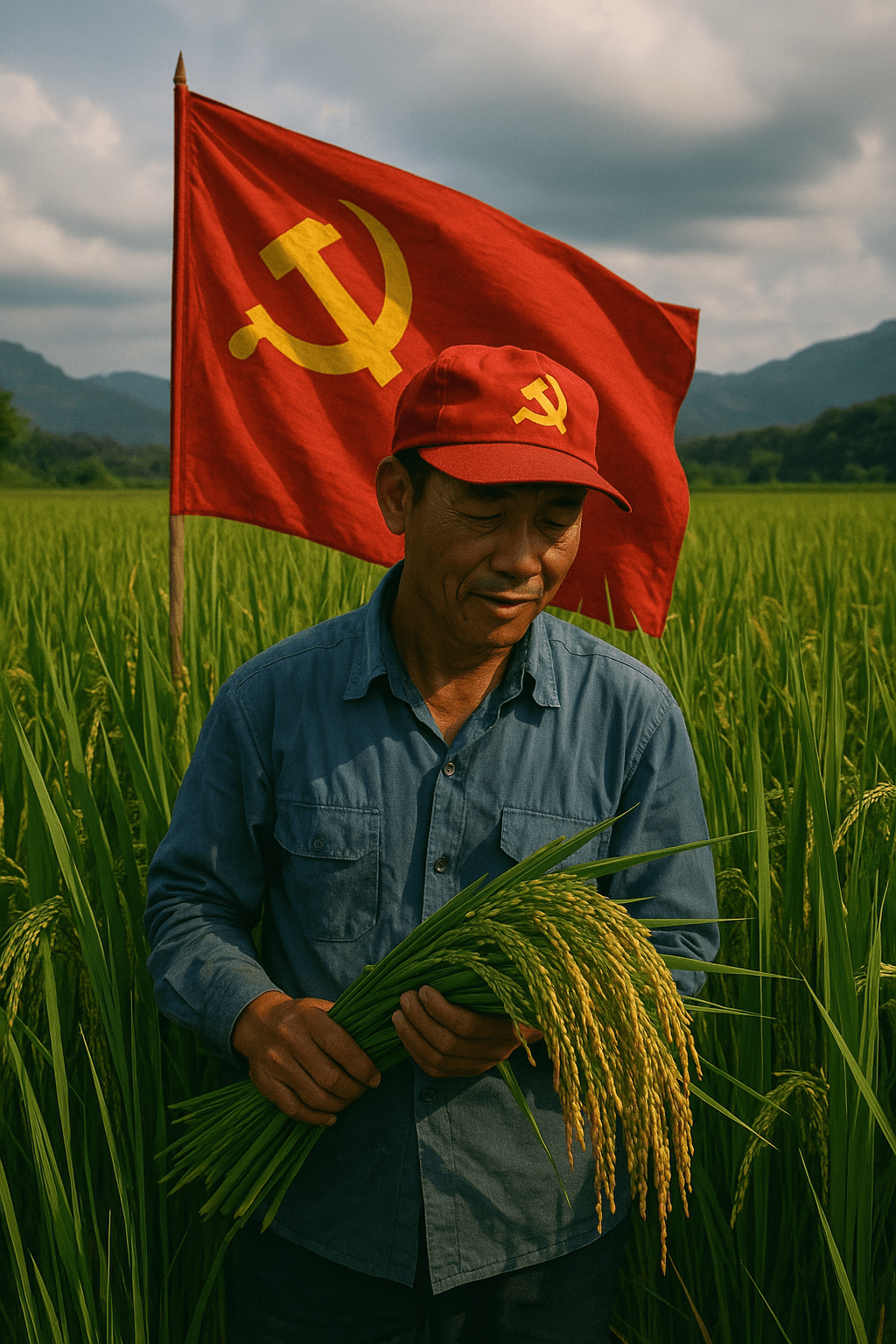
As the imperial core patents life itself and poisons the planet for profit, China is planting something else: resistance. This isn’t a miracle of the market—it’s socialist science in motion.
By Prince Kapone | Weaponized Information | June 10, 2025
I. The Article That Slipped Through the Filter
On June 9, 2025, Glass Almanac published a report titled “China Promises a New Era for Humanity with a New Cereal Capable of Growing on 14 Billion Acres of Unusable Land.” The title alone feels like a breach in the firewall of Western media narrative discipline. In just three minutes of reading time, the article highlights a revolutionary scientific breakthrough in China: a genetically optimized cereal crop capable of thriving in saline and alkaline soils, offering hope for food production amid accelerating climate catastrophe.
The tone is curious—neither hostile nor sycophantic. Written by Brian Foster, a contributor whose byline is more associated with consumer tech and science curiosities than geopolitical narratives, the article bypasses the usual mechanisms of disinformation: there is no invocation of “debt traps,” no hand-wringing about surveillance, and no snide insinuations about Chinese authoritarianism. Instead, Foster simply recounts the science, attributing it to the Chinese Academy of Sciences and Shanghai Jiao Tong University. His role is not ideological sabotage—but neither is it ideological clarity.
Glass Almanac itself is an entertainment-tech aggregator, not a hardened outlet of empire like The Economist or The Atlantic. But even seemingly neutral platforms operate within the gravitational pull of Western ideology. Their editorial filters usually ensure that Chinese scientific achievements are either ignored, framed as threats, or stripped of their political context. This article, however, names the achievement, affirms its potential for humanity, and leaves the door ajar for further inquiry. That makes it rare.
Still, the piece is constrained by what it does not say. It speaks of transforming “marginal land” into usable farmland but makes no mention of who made it marginal—no reference to colonial monocultures, structural underdevelopment, or the ecological wreckage wrought by Western agribusiness. It marvels at China’s innovation but isolates it from the historical, political, and economic model that produced it. There is no mention of China’s broader food sovereignty strategy, its rejection of patent monopolies, or the role of socialist planning in directing such research. The article presents science without struggle—a rice plant without roots.
Yet in this moment, even that matters. In an era of algorithmic manipulation and coordinated ideological warfare—what analysts have called the rise of weaponized AI propaganda—an omission can be as revealing as a fabrication. And a neutral tone on China can signal more than editorial restraint; it can reflect the cracks in narrative hegemony.
This article reached wide circulation across social media channels typically saturated with anti-China sentiment, amplified by tech influencers and science bloggers rather than political operatives. These “soft amplifiers”—disconnected from overt state power but structurally tied to its ideological circuits—extend the reach of a narrative without clarifying its revolutionary implications. In that sense, the article benefits public consciousness, but only halfway. It moves the needle, but it doesn’t change the game.
That’s where we come in. As fraternal propaganda, this piece offers a foundation—not a framework. It makes no effort to weaponize this scientific development on behalf of global food sovereignty, revolutionary ecology, or multipolar survival. But it doesn’t obstruct that weaponization either. And in this ideological battlefield, that neutrality is already an opening.
In the following sections, we will extract the article’s empirical contributions, situate them within a broader historical and political economy, and reframe them for what they truly are: not simply evidence of innovation, but proof that socialist science remains the most viable path for human survival in the 21st century.
II. What the Soil Remembers: Contextualizing the Science They Can’t Patent
The Glass Almanac article delivers one core empirical truth: Chinese scientists have developed a climate-resilient cereal crop capable of thriving in saline and alkaline soils. This is not just a technical advancement—it is a strategic intervention in the food systems of the future. But stripped of its historical coordinates, the article leaves the story rootless. To understand its full meaning, we must examine what was said, what was omitted, and what those omissions conceal.
First, the facts. The crop in question is a genetically optimized rice strain developed by the Chinese Academy of Sciences and Shanghai Jiao Tong University. Its primary innovation lies in the regulation of gibberellin—a naturally occurring plant hormone—combined with activation of two genes, ATT1 and ATT2, which enhance resistance to soil salinity, alkalinity, and heat. Under testing, these modified strains increased yields by 78% to over 100% per plot compared to conventional varieties.
According to the report, this breakthrough could reclaim as much as 1.4 billion hectares of previously unfarmable land—roughly 10% of the planet’s arable surface. The implications are staggering, especially as global food systems buckle under climate pressure, population growth, and soil exhaustion. Rice alone feeds nearly half the world’s population, with China and India producing over 50% of global supply. In this context, the potential of heat- and salt-resistant rice strains to restore agricultural productivity on vast tracts of land marks a historic leap forward.
But here’s what the article does not mention: this is not simply a scientific achievement—it is a planned response to the contradictions of imperialist food systems.
Start with the land itself. The 1.4 billion hectares affected by salinity are not naturally unproductive. Much of this land was rendered toxic through the very processes of colonial monoculture, extractive cash-cropping, and petrochemical dependency that Western agriculture imposed on the Global South. From the cotton plantations of India to the sugar fields of the Caribbean, European imperialism stripped land of biodiversity, water retention, and soil health—all in service of export profit.
The article also fails to mention that China is not hoarding this innovation. Unlike the IP-rigged models of Bayer, Syngenta, or Corteva—whose seed patents require licensing fees, annual renewal, and exclusive use of proprietary pesticides—China’s rice genetics are part of a broader commitment to open-source agricultural science. As documented in China’s “seed sovereignty” strategy, the country has resisted U.S.-style patent regimes and instead structured its state-funded agricultural breakthroughs as public domain knowledge.
Nowhere does the article reference the Africa Agricultural Modernization Plan that China has been implementing for over a decade through South-South cooperation. Nor does it mention that these collaborations often include:
- Joint R&D centers developing region-specific seed adaptations
- Infrastructure projects like irrigation and grain storage silos
- Training centers for soil science, weather monitoring, and mechanization
- Technology transfers without intellectual property restrictions
This is not charity. It is coordinated survival.
What also goes unmentioned is how the Western agribusiness sector has responded to this alternative model—with lawsuits, sabotage, and price-fixing. In 2024, U.S. courts dismissed a farmer-led lawsuit accusing Bayer, Syngenta, and Corteva of colluding to block competition in the digital seed marketplace. As reported in industry journals and legal filings, the judge deemed the alleged e-commerce boycott a “legitimate business strategy.” In other words, Western monopoly capitalism is legally protected in its efforts to inflate prices, restrict seed access, and criminalize peasant resistance. China, by contrast, has declared seed knowledge a common resource.
There’s more. The article treats the breakthrough as an isolated event, with no reference to the historical necessity that shaped it. But Chinese rice innovation has always been a response to material crisis. The work of Yuan Longping, China’s famed “father of hybrid rice,” began not in a corporate lab, but in the wake of national famine. His breakthroughs were born of hunger, not venture capital—and aimed not at markets, but at human survival. As documented in the First International Forum on Rice, Yuan’s vision was to share knowledge globally, especially with the Global South.
Compare that to the so-called “Green Revolution” pushed by Norman Borlaug and the Rockefeller Foundation. That wave of agribusiness-led expansion in the mid-20th century replaced polyculture with monoculture, swapped organic inputs for fossil fertilizers, and tied farmers to chemical dependency. Its effects—topsoil collapse, pesticide resistance, and farmer suicides—are still ravaging India, Mexico, and the Philippines today.
And what of Cuba? Absent entirely from the article is the precedent set by Cuba’s agroecological transformation in the 1990s. After the fall of the USSR, Cuba faced a near-total collapse of imported fuel, fertilizers, and equipment. Instead of privatizing or surrendering to IMF shock therapy, Cuba embraced urban farming, oxen plowing, and localized food networks. As outlined in agrarian studies of the period, Cuba’s policies included:
- Free land access for those who met food quotas
- State distribution of oxen and non-patented seed
- Urban gardening that now produces over 600,000 tons/year
That legacy continues today through Cuba-China agricultural cooperation—including seed banking, ecological soil management, and non-GMO crop innovation.
Finally, the article does not connect any of this to the structural demands of climate collapse. China’s research into perennial rice, for example, is not merely about yield—it’s about ecological preservation. Perennial crops require less tilling, reduce erosion, sequester more carbon, and decrease labor demands on peasant farmers. In contrast, Western biotech firms engineer “climate-resilient” GMOs that are chemically dependent—locking the Global South into ecological servitude through recurring pesticide contracts and soil degradation.
In short, the Glass Almanac article offers valuable factual terrain—but no ideological map. It reports the innovation, but not its genealogy. It names the science, but not the system. It identifies a future, but not the forces fighting to own it.
What we’re witnessing is the formation of a different agricultural world—one that challenges the logic of enclosures, patents, and imperial charity. A world where seeds are not currency, but commons.
III. Seeds of Survival: Reframing Science as Class War
What the West calls innovation, we must recognize as insurgency. China’s climate-resilient rice is not a technical curiosity—it’s a weapon in a global class struggle over who eats, who starves, and who controls the future of food. To reframe this development is to name the forces in motion: not simply genes and hormones, but states, systems, and survival strategies. The Chinese breakthrough is not a marvel of laboratory luck—it is the expression of a socialist system trained in the long war for food sovereignty.
1. Land Back, Seed Forward: Food Sovereignty as Decolonization
Start with the soil. The 1.4 billion hectares of saline and alkaline land referenced in the article are not simply “unusable” terrain waiting for salvation. Much of this land lies in zones once violently absorbed into the circuits of imperialist agriculture: the sugar fields of Cuba, the cotton belts of India, the rice basins of Vietnam, the maize zones of southern Africa. The land was not bad—it was brutalized.
To recover this land through seed innovation is to enact a material form of decolonization. In Africa, this intersects directly with the goals of the Comprehensive African Agricultural Development Programme (CAADP), which aims to end hunger by 2025 through locally adapted grain hubs and public sector investment. China’s rice research, transferred without patent, becomes not just technology, but tactical reinforcement in Africa’s sovereign development.
Where the West sends food aid to secure leverage, China sends seeds to support autonomy. This is not about charity—it is the foundation of multipolar survival.
2. Science as Class Struggle: Biotech vs. Biopiracy
In the capitalist world system, knowledge is property, and life is rent-seeking opportunity. Seeds are privatized. Genes are patented. Farmers are criminalized for saving what they grow. This is the model perfected by Bayer, Syngenta, and Corteva—agro-capitalists who sell genetically modified seeds that only function with their proprietary chemicals. Climate-resilient GMO crops are branded as “solutions,” but they are engineered dependency—designed to lock farmers into vertically integrated chemical contracts.
China’s approach is qualitatively different. As documented in its seed sovereignty strategy, China’s state-funded agricultural research remains public domain. The ATT1 and ATT2 genes identified in China’s new rice are not locked behind licensing schemes. The goal is not profit, but resilience.
Cuba takes this further: it bans patents on publicly funded research. Its scientists develop crops based on open-access science, often adapted through exchange with African and Latin American partners. Together, these socialist approaches pose an existential threat to agribusiness monopolies. They do not just oppose capitalist agriculture—they offer a different kind of agriculture entirely: one grounded in food as a human right, not a commodity.
3. Socialist Ecology: Climate Adaptation Without Collapse
The ecological dimension of this reframing is equally vital. Capitalist agriculture is among the planet’s primary engines of climate collapse. From deforestation to fertilizer-driven methane emissions, the industrial food system is not just vulnerable to climate change—it is producing it.
China’s development of perennial rice—which can be harvested multiple times without replanting—offers a path forward. These crops require less tilling, reduce erosion, improve carbon sequestration, and ease labor burdens on rural families. Similarly, Cuba’s return to oxen-powered farming and small-plot organopónicos in Havana signals a model of low-input, high-resilience agriculture. These are not nostalgic gestures. They are rational adaptations to an irrational global order.
The West’s so-called “green technology” solutions, by contrast, are just new packaging for old poisons. Genetically engineered “drought-resistant” crops from Monsanto require the same irrigation infrastructure that colonized landscapes cannot afford. The carbon market mechanisms pushed by imperialist institutions aim to monetize sustainability while preserving capital’s dominance. Socialist agroecology, on the other hand, dismantles the need for these markets altogether.
4. Global Multipolar Alignment: From Patent Wars to Seed Commons
We are entering a period where seed politics will define geopolitical blocs. On one side: imperialist states, transnational biotech corporations, and the World Trade Organization, which enforces seed patents as global law. On the other: a rising formation of nations and movements committed to open-source genetics, shared scientific development, and sovereign land use.
This alignment is already underway. The Sanya Rice Forum launched by China promotes “Southern Propagation as World Sources”—a vision to decentralize food production away from the Global North. Cuba and China are now collaborating on the development of anthocyanin-rich “purple rice,” an anti-inflammatory supergrain designed to fight malnutrition in poor communities. These seeds are not exported—they are shared.
Meanwhile, Western agribusinesses are investing in drones, data surveillance, and AI-based soil sensors, transforming farmers into data generators for hedge funds and seed traders. Their vision of the future is one where the seed is owned, the climate is monetized, and the poor are fed by ration, not by right.
We reject that future. Our seeds are not secrets. Our soil is not a subscription service. Our food systems will not be feudal again.
The future is being planted right now. Whether it grows into sovereignty or servitude depends on who controls the roots.
IV. Cultivating Revolt: From Recognition to Revolutionary Praxis
Every harvest comes with a question: who gets fed, and who goes hungry? And every seed contains a politics: who owns it, who controls it, who decides its future. The development of climate-resilient, patent-free rice by China is not simply a scientific feat—it’s a material challenge to the foundations of empire. But unless that challenge is seized, studied, and strategically supported, it risks becoming another fact buried under imperial propaganda, another story silenced by the loud machinery of capitalist agriculture.
That silence is not neutral. It is engineered. In the heart of the imperial core, we are taught to view science as something only the West can do, and hunger as something only the West can solve. But the truth is clearer than ever: the most meaningful innovations for human survival are emerging from outside the empire—from states and movements that have been blockaded, sanctioned, and ignored. And those of us living in the belly of this machine have a responsibility—to sabotage its lies and build with those it tries to starve.
1. Boycott the Cartels, Expose the Food Profiteers
Let’s name the enemies directly. Bayer. Corteva. Syngenta. These corporations are not just agricultural suppliers—they are imperial weapons manufacturers with a different kill rate. They hoard seed patents, fix prices, manipulate courts, and lobby to crush local food systems. As recent U.S. court rulings affirmed, their “e-commerce boycotts” to block independent seed sales were deemed “legitimate business practices.” That’s what imperial law looks like.
Expose them. Name them in your organizing. Demand your unions, co-ops, and collectives divest from their supply chains. Push local food networks to source heirloom and indigenous seed, not proprietary GMOs. Turn every grocery shelf and community garden into a front in the class war.
2. Translate the Science, Build the South-South Bridge from Below
You don’t need a lab coat to be part of the transformation. What’s needed now is translation—technical, political, and cultural. China’s breakthroughs in rice genetics and Cuba’s open-access farming manuals must reach the hands of those who need them most: peasant movements, cooperative farmers, Black and Brown growers in urban food deserts.
We must build knowledge infrastructure from below. That means:
- Translating Yuan Longping’s hybrid rice manuals into African, Indigenous, and diasporic languages
- Sharing them through La Via Campesina, Kairos, and other movement-led educational networks
- Hosting study sessions on China’s agricultural system in food justice circles and climate organizations
- Distributing open-source ATT gene-editing protocols in collaboration with radical biohacker collectives
This is how we turn solidarity into infrastructure.
3. Link Up with Urban Agroecologists and Revolutionary Land Stewards
Havana’s organopónicos—urban farming plots producing over 600,000 tons of food per year—are not a miracle. They are the result of deliberate planning, resource redistribution, and scientific adaptation under siege. They offer a living model for communities across the imperial core suffering from food apartheid and disinvestment.
It’s time to study and adapt them. Collaborate with mutual aid networks, food sovereignty projects, and land-back campaigns to repurpose vacant lots, rooftops, and school yards into zones of autonomy. Partner with Indigenous and Black land stewards reclaiming ancestral practices. The goal is not just to grow food—but to break dependency.
4. Pressure with Purpose: Force the State to Acknowledge the Alternative
Internationalist organizing must also target the institutions where the state still pretends to represent us. That means pushing for:
- U.S. withdrawal from WTO enforcement of agribusiness patent regimes
- International recognition of Cuba and China’s open-source seed banks under UNFCCC climate finance provisions
- Inclusion of multipolar biotech transfers in U.S. foreign aid accountability frameworks
- Legal recognition of open-source seed licensing models as protected knowledge commons
We do this not to reform empire, but to expose its refusal to support real solutions—and to sharpen contradictions that make revolutionary rupture more possible.
5. Organize in the Spirit of Revolutionary Debt
This is not about charity. It is about rectifying centuries of agricultural plunder. The West stole seeds, stole land, stole labor—and now it wants to sell them back to us, genetically altered, chemically dependent, and wrapped in intellectual property law. China and Cuba, by contrast, are offering pathways out. Not perfect ones, not without contradictions—but real ones. And they must be defended.
To organize in the belly of empire is to remember this: we are not saviors. We are saboteurs, educators, defectors. Our task is not to lead the world—but to break the systems that are killing it, and build alongside those who already are.
The seed has been planted. Now dig in.
 Weaponized Information
Leave a comment