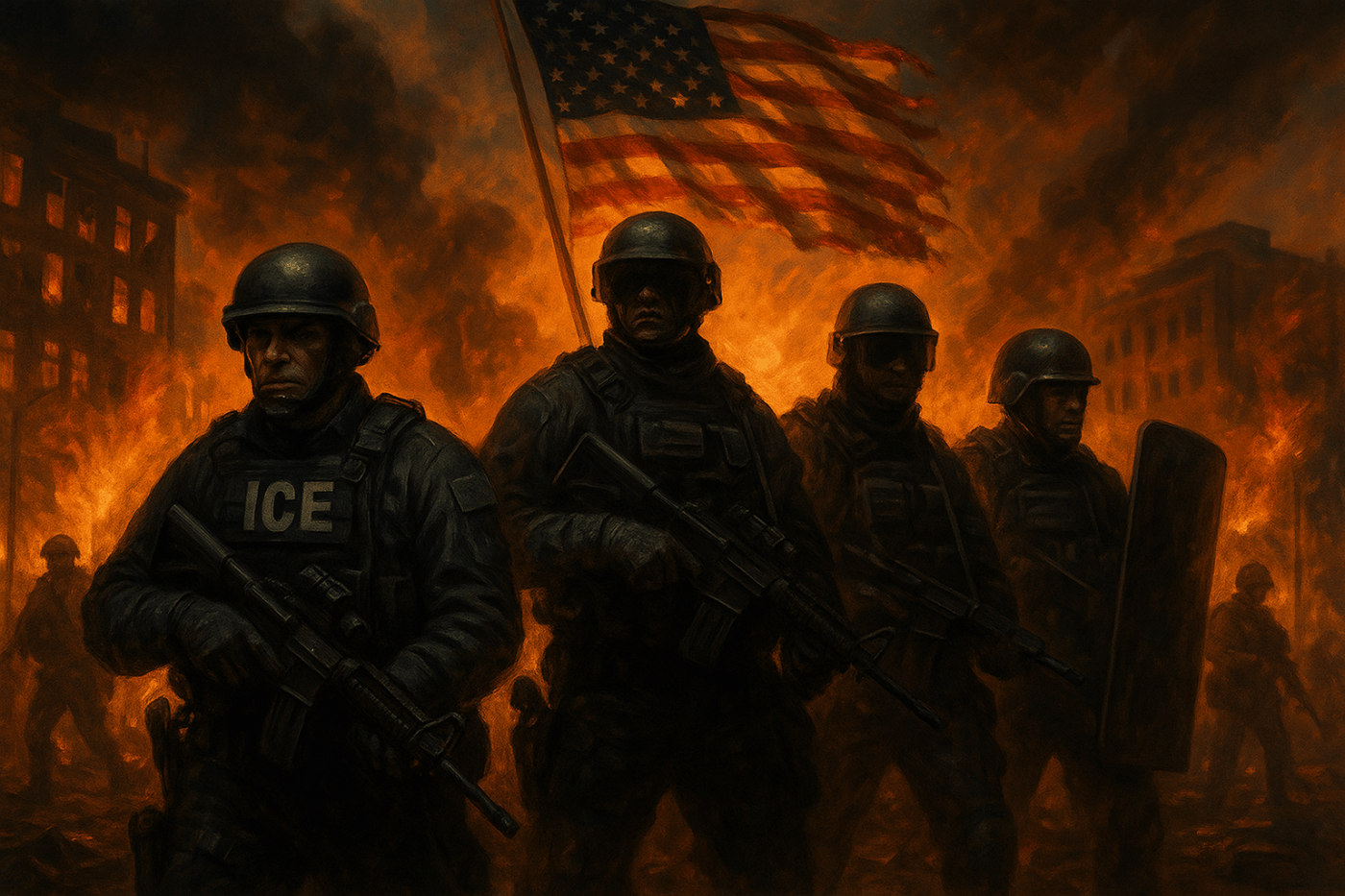
The settler regime isn’t losing control—it’s consolidating it. L.A. is the testing ground. ICE is the infantry. The Insurrection Act is the playbook. And empire is preparing to rule by repression, not consent.
The Law Wears Boots: NPR, the Insurrection Act, and the Return of Domestic Counterinsurgency
On June 9th, NPR ran a story about President Trump sending 2,000 National Guard troops into Los Angeles. The pretext? A wave of protests after ICE raids shook migrant neighborhoods across the city. California Governor Gavin Newsom filed a lawsuit to stop the deployment, while the White House floated the idea of using the Insurrection Act—a centuries-old law that lets the president deploy the military on U.S. soil. The article frames the moment as a political dispute, a constitutional tug-of-war between state and federal authority. But let’s be clear: this isn’t about Trump versus Newsom. This is about empire tightening its grip. This is about the settler state preparing to crush what it can no longer co-opt.
The author, Tom Dreisbach, is no rogue reporter. He’s a career correspondent whose job is to turn state violence into reasonable discourse. He’s built his name repackaging government press releases from the DOJ and FBI into “public radio journalism.” He doesn’t ask why the empire is collapsing. He just narrates it politely. In class terms, Dreisbach is the professional-managerial voice of the counterinsurgency—proof that some of the most dangerous weapons in the state’s arsenal are armed with credentials, not bullets.
He writes for NPR, the soft-focus arm of the imperialist media apparatus. Funded by government grants and elite foundations, it exists to reassure the liberal ear that everything happening is either procedural or unfortunate—but never systemic. It doesn’t bark orders like Fox or CNN. It lulls you into believing that the slow-motion militarization of daily life is just the messy business of democracy.
Dreisbach quotes Vice President JD Vance, who called the protestors “invaders,” and White House Press Secretary Emma Riley, who called the deployment constitutional. Vance and Riley don’t need badges or fatigues—they issue ideological cover from behind the desk, helping the regime dress fascism in the language of law.
The real work of the article, though, is in its framing. First, it presents the whole crisis as a bureaucratic misunderstanding: a legal scuffle between Trump and Newsom. But the real conflict isn’t between governments—it’s between the people being hunted and the system doing the hunting. This isn’t a dispute over law—it’s the law being used as a weapon against the colonized, the poor, and the undocumented.
Second, the Insurrection Act is treated like a dusty relic from the archives—mentioned, not explained. No history. No mention of how it was used to crush slave revolts, smother Reconstruction, or roll tanks through Black neighborhoods in the 1960s. The law didn’t go away. It just waited for the right crisis to crawl back out.
Third, the article makes 2,000 troops sound like UPS drivers rerouted to a different zip code. There’s no talk of occupation, no images of soldiers on city blocks. It’s all flattened into logistics. The state rolls out military force in a city filled with colonized people, and NPR describes it like a shipping delay.
Fourth, Dreisbach barely touches the ICE raids that triggered the protests. No mention of the videos all over social media—ICE agents looking like paramilitary units, masked up, tattooed, armed with what look like paintball guns, storming homes like it’s a warzone. This isn’t immigration enforcement. It’s a tactical preview of what the state is ready to do to all of us when the system breaks down.
Fifth, the article makes no effort to connect any of this to the bigger picture. No mention of the crumbling economy, of mass layoffs, of the empire’s slow-motion collapse abroad and its turn inward toward repression. No mention of the growing use of military powers to manage domestic unrest. What’s happening in L.A. isn’t isolated—it’s a test run for **technofascist stabilization**: the process by which the U.S. state responds to imperial decline not with reform, but with force.
And sixth, Dreisbach treats the possible use of the Insurrection Act like it’s just a scenario in a policy memo—one idea among many. But that law, once invoked, doesn’t go back in the bottle. It’s a green light for dictatorship, cloaked in paperwork. And the fact that NPR talks about it like it’s a filing error, rather than the constitutional resurrection of military rule, tells you everything you need to know about the role of journalists like Dreisbach in this moment: to make the coming repression sound inevitable, lawful, and even necessary.
The Law Was Never Neutral: Extraction and Contextualization of Domestic War
Let’s start with the facts laid bare in the NPR report. Trump has deployed 2,000 National Guard troops to Los Angeles over the objections of California’s governor. Gavin Newsom is suing the federal government. Protests erupted after ICE raids swept through working-class migrant communities. The White House is now considering the use of the Insurrection Act—a law that gives the president the authority to send military forces into domestic territory without state consent. These are the raw materials. But facts, like minerals, must be pulled from the ground, cleaned of imperialist dirt, and placed back into the hands of the people.
The first thing NPR doesn’t tell you is that the Insurrection Act was never meant to protect the people—it was crafted to protect property, slavery, and settler rule. Passed in 1807, the law was a tool to crush uprisings by enslaved Africans, to suppress early resistance by Indigenous nations, and to enforce settler hegemony during Reconstruction. It re-emerged in the 1960s to put down rebellions in Black communities—Watts in ’65, Detroit in ’67, Chicago in ’68—and again in 1992 after the Rodney King uprising. Every time the people have risen, this law has answered.
What’s different now is not the tool, but the context. In 2025, the U.S. empire is in freefall. It is losing wars abroad, shedding legitimacy at home, and watching its own population slip into joblessness, debt, and despair. The global order it once ruled with sanctions and missiles is breaking apart. What we’re witnessing in Los Angeles is what Weaponized Information calls technofascist stabilization: the use of legal violence, algorithmic surveillance, and military force to patch over the cracks of imperialist decay. This is what empires do when they are dying—they don’t reform, they rearm.
The ICE raids that triggered these protests weren’t incidental. They are part of a calculated strategy of technofascist labor recalibration—the state’s attempt to discipline, reduce, and displace surplus labor in a collapsing economy. These masked, tattooed agents didn’t just show up out of nowhere. They are the paramilitary wing of the domestic counterinsurgency, deployed to terrorize the working class, especially its most vulnerable and racialized segments. The raids are not separate from the military deployment—they are the prelude to it.
Los Angeles, with its massive Black, Chicano, Indigenous, and migrant proletarian communities, is not just a city—it’s an internal colony. The National Guard isn’t being sent there to “restore order.” It’s being sent to enforce settler order. What’s happening on the ground is not a policing event—it’s settler-colonial pacification in a new legal shell. And the law, like always, is doing exactly what it was designed to do: protect the ruling class from the people.
We also need to place this moment within the broader structure of U.S. imperial crisis. The state is not only militarizing at home—it is losing control abroad. The empire’s failures in Ukraine, West Asia, and Latin America are now echoing back in the form of domestic instability. It cannot deliver prosperity. It cannot deliver peace. So it delivers soldiers. As we’ve said before, the empire’s foreign counterinsurgency is coming home—and it’s bringing the playbook with it. What was tested in Baghdad, Kandahar, and Tegucigalpa is now being implemented in L.A., Chicago, and the Bronx.
Finally, the legal discourse around this event—Newsom’s lawsuit, the invocation of the Insurrection Act, the “debate” in the press—is not a sign of democratic health. It’s a symptom of systemic breakdown. When the state must turn to 19th-century martial powers to manage 21st-century rebellion, it is not evolving. It is unraveling. And what’s growing in its place is not freedom—it’s a domestic war machine, built on logistics, lawfare, and lethal obedience.
This Is Not Law Enforcement—It’s Domestic Warfare
If we strip away the legal jargon and PR polish, the truth is simple: this isn’t about law and order. It’s about counterinsurgency. The National Guard isn’t being deployed to “protect the public”—it’s there to pacify the poor. ICE isn’t doing “immigration enforcement”—it’s performing paramilitary raids to terrorize surplus labor. And the Insurrection Act isn’t some dusty legal option—it’s the constitutional license to bring war home.
This isn’t new. The United States has always ruled through organized violence. But what we’re seeing now is a transition—a sharpening. This is the next phase in the consolidation of what we call technofascism: a regime where the military, big tech, and finance capital fuse with the state to manage crisis through surveillance, logistics, and brute force. The open fascism of the early 20th century wore uniforms and marched through city squares. The technofascism of the 21st century wears tactical gear, runs facial recognition software, and kicks in doors with bodycams and PR talking points.
The ICE raids in L.A. aren’t just a return to brute repression. They’re theater, designed to condition the public to accept masked agents storming homes as normal. The troops aren’t just there for security—they’re a warning: we are willing to govern through guns if we must. What’s being tested in Los Angeles today is a model for national deployment tomorrow.
This is what happens when an empire begins to rot from the inside. The ruling class has no answer to rising poverty, collapsing infrastructure, or ecological disaster. It can’t raise wages. It won’t house the houseless. It has no plan for the millions living paycheck to paycheck in a crumbling economy. So instead, it militarizes. It raids. It builds walls and sends troops. This isn’t the breakdown of governance—it’s technofascist stabilization: the recalibration of the settler state to rule through fear when legitimacy is no longer an option.
The use of the Insurrection Act is not just a legal maneuver. It is a declaration: that the settler regime is preparing for mass rebellion, and it will not hesitate to crush it. But here’s what they fear most: not the protests alone, but the possibility of organized resistance—of neighborhoods building dual and contending power rooted in the people, not the state. They fear the history of Watts, of the Chicano Moratorium, of the Black Panther Party, of the George Floyd uprisings coming back—not as flash, but as fire with direction.
The state is not only sending in the Guard—it’s sending a message: that it will rule with boots and batons if it cannot rule with consent. And we must send our own message back: that we will not be disciplined into silence. That our people will not disappear. That there is no law strong enough to make injustice just.
The Fire Next Time: Stand with the Colonized, Organize Against the State
What’s happening in Los Angeles is not a local issue. It’s not just about California. This is the future the empire is preparing for all of us. From the barrios of East L.A. to the ghettos of Chicago, from Apache land to Harlem—every colonized community is being treated as an insurgent threat. And the state is preparing to meet that threat with full-spectrum repression: ICE raids, surveillance towers, National Guard deployments, and legal war doctrine dressed up as policy.
But repression is not proof of the regime’s strength. It’s proof of its fragility. A state that must raid families, silence dissent, and flood the streets with troops is a state that no longer governs—it enforces. And when enforcement becomes the norm, resistance becomes the necessity. We must now move beyond passive outrage. The time for moral statements has passed. What’s needed is material solidarity.
We stand shoulder to shoulder with the Black, Chicano, Indigenous, and migrant communities of Los Angeles. Their struggle is not just local—it is a front line in the global fight against imperialism, capitalism, and settler-colonialism. The same state that bombs Gaza sends ICE into Boyle Heights. The same regime that sanctions Cuba sends troops into South Central. There is no border between domestic and foreign policy. It is one war, fought on many fronts.
Wherever we are—whether in the heart of empire or on its periphery—we must act. This means:
- Support ICE resistance networks through donations, housing, and legal defense funds. Organize or join rapid response teams that can intervene in real time.
- Disrupt the logistics of repression: surveillance infrastructure, data brokers, and corporate collaborators in raids and deployments must be exposed and dismantled.
- Spread revolutionary political education in working-class white communities to break the consensus around “law and order.” Connect the dots between border repression and wage suppression, between militarized policing and capitalist discipline.
- Help build dual and contending power: autonomous food programs, legal collectives, neighborhood defense projects, and abolitionist infrastructure that operate outside and against the state.
- Refuse the normalization of military presence in our streets. Document, resist, and disrupt it wherever it appears. Create public memory and collective refusal.
The settler regime may have history, law, and guns on its side—but we have truth, memory, and the weight of the future. This is not just a moment of repression. It is a moment of clarification. The lines are being drawn. And we have a choice: side with the state, or side with the people it’s trying to crush. There is no neutrality here.
For those of us who benefit—however unequally—from the privileges of empire, our duty is clear: defect. Disobey. Disrupt. Organize. And most of all, fight like the future belongs to the colonized, because it does.
 Weaponized Information
Leave a comment