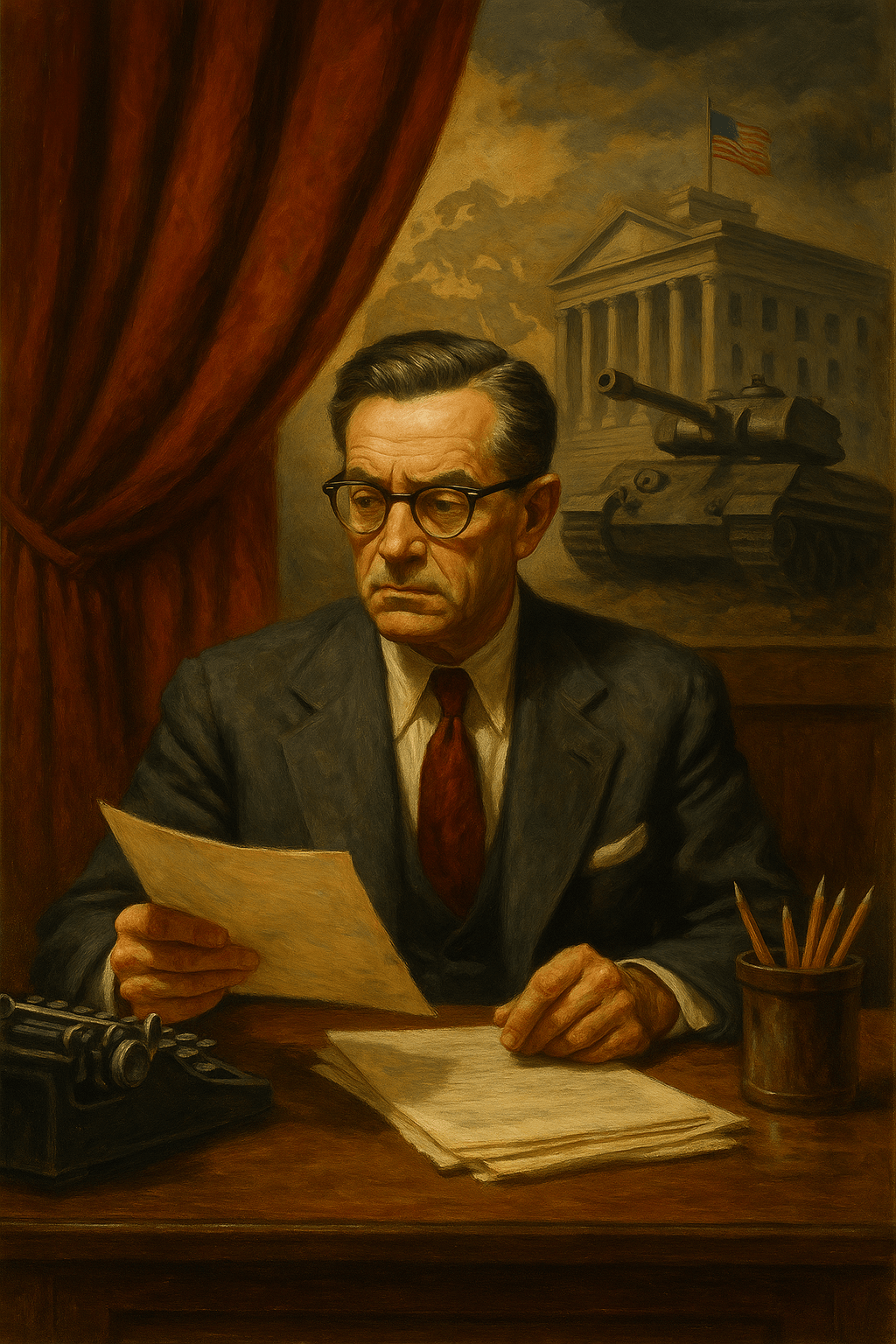
Part III – The New York Times: Liberalism’s Ministry of Truth
By Prince Kapone | Weaponized Information
May 18, 2025
📚 The Press Corps of Empire Series:
Preface to Part III: The New York Times
Long revered as a bastion of American liberalism and journalistic integrity, The New York Times occupies a paradoxical role in the modern media landscape. In this installment, we examine how the Times’ polished veneer of impartiality conceals its function as a key architect of the imperial narrative—a narrative that legitimizes U.S. intervention, enshrines elite consensus, and marginalizes dissent.
The New York Times is more than a newspaper; it is an institution whose influence extends far beyond its pages. Its editorial choices, investigative reporting, and op-ed forums have long shaped public discourse in ways that reinforce the geopolitical status quo. From silent partnerships with governmental agencies to intimate ties with corporate power, the Times often presents itself as the conscience of democracy while advancing the interests of a ruling class.
In this preface, we unpack the mechanisms by which the Times crafts its authoritative tone. We explore how its narrative style, selective sourcing, and strategic omissions contribute to a form of journalism that prioritizes institutional legitimacy over grassroots truth. By privileging voices from official corridors of power, the paper effectively silences alternative perspectives—ensuring that the dominant ideology remains unchallenged.
Our analysis does not dismiss the historical achievements of investigative journalism nor the complexity of its reporting. Instead, it focuses on the structural and ideological factors that condition how stories are told and whose interests are ultimately served. In doing so, we reveal how The New York Times, like all major media institutions, operates as a critical component of the empire’s propaganda apparatus.
Liberalism’s Ministry of Truth: How The New York Times Became the Official Narrative Engine of Empire
The Paper of Record for the Ruling Class
The New York Times is not just a newspaper—it is the ideological command center of American liberalism. Its prestige is built on a cultivated image of integrity, impartiality, and high-minded civic duty. But beneath the Pulitzer Prizes and editorial gravitas lies a deeper truth: the Times has long functioned as the official stenographer of the U.S. imperial state, laundering violence through elegant prose and turning hegemony into common sense.
Founded in 1851, the Times rose to prominence during America’s industrial expansion, aligning early on with Northern capitalists and the liberal reform wing of the white elite. While it occasionally broke with power on specific scandals or abuses, its overall trajectory has been one of consistent alignment with the interests of finance, war, and white supremacy—in both domestic and foreign policy. It has shaped not just how America sees the world, but how it sees itself: exceptional, innocent, and perpetually misunderstood.
The Editorial Board of Empire
The New York Times editorial board does not take marching orders from the Pentagon. It doesn’t need to. Its worldview is already shaped by the same social forces: Ivy League networks, corporate boardrooms, foreign policy think tanks, and the intelligence community. These relationships are not conspiratorial—they are structural. They reflect the class composition of a paper that has always catered to the professional-managerial strata of American society.
This is why the Times can criticize a war’s tactics without opposing the war itself. It can bemoan “polarization” while ignoring the material roots of fascism. It can publish critiques of inequality while celebrating the technocrats and billionaires who reproduce it. And it can call itself a watchdog even as it has helped sell every major imperialist war of the last hundred years—from Vietnam to Iraq, Libya to Ukraine.
Manufacturing Consent in Columns and Headlines
The real genius of the Times lies in its ability to shape consensus not through bombast, but through credibility. The tone is measured. The sources are official. The lies are subtle. Take these headlines:
- “Allies Say Syria Used Chemical Weapons.”
- “Venezuelan Election Brings Charges of Irregularities.”
- “U.S. and China Maneuver in the South China Sea.”
These headlines don’t scream propaganda. They whisper plausibility. They embed imperial framing in the very structure of the news—where Washington is an actor, and the Global South is always on trial.
Crucially, the Times elevates experts from Brookings, RAND, the Council on Foreign Relations, and Harvard—never from the barrios of Caracas, the streets of Gaza, or the oil fields of Nigeria. Its definition of “balance” is elite triangulation. Its definition of “objectivity” is deference to power.
When the Times Sells War
Perhaps the clearest indictment of the Times’ role came during the run-up to the 2003 invasion of Iraq. Its now-infamous front-page stories by Judith Miller—relying on fabricated intelligence from U.S. and Israeli officials—helped manufacture support for a war that killed over a million Iraqis. The retractions came later. The war crimes never did.
But Iraq was not an anomaly. It was a pattern. The Times has framed coups as democratic transitions (Chile, Haiti, Honduras), covered up genocidal wars (Indonesia in East Timor, Israel in Gaza), and demonized anti-colonial leaders (Lumumba, Chávez, Gaddafi) while glorifying U.S.-backed technocrats and puppet regimes.
Domestic Control: Disciplining the Opposition
The Times is just as critical to domestic counterinsurgency as it is to foreign operations. From the Civil Rights era to Occupy Wall Street to the George Floyd Rebellion, the Times has worked to contain radicalism within the bounds of respectable reform. It celebrates “nonviolence” while ignoring state violence. It amplifies liberal NGOs while erasing revolutionary formations. And it frames the demands of the colonized as “divisive,” “controversial,” or “counterproductive”—language designed to delegitimize resistance while preserving elite control.
Even when reporting on police murder, mass incarceration, or inequality, the Times centers “debate,” not liberation. Its analysis always stops at the system’s edge. It invites conversation, never rupture.
The Cultural Authority of the Empire’s Voice
What makes the Times uniquely dangerous is its role in shaping cultural legitimacy. It is not Fox News. It does not scream. It whispers in boardrooms, universities, and dinner parties. Its reach is not mass—it is strategic. Its function is to discipline the thinking class, to turn educated people into well-mannered imperialists, to make liberal readers feel informed while keeping them ideologically pacified.
This is the Times’ true genius: it manufactures moral authority for a decaying empire, selling the fiction that the United States can bomb, sanction, and destabilize the world with “regret,” “complexity,” and “serious debate.” It doesn’t hide the crimes—it euphemizes them. It doesn’t silence the victims—it mistranslates them.
Conclusion: Liberalism’s Ministry of Truth
The New York Times is not a neutral platform. It is the editorial wing of the liberal wing of empire. It is the conscience of the U.S. ruling class—wracked with guilt, but still pulling the trigger. Its journalists may challenge specific policies, but never the system that makes those policies inevitable.
To see the Times clearly is not to denounce journalism—it is to reclaim it from the elite institutions that have colonized it. The real crisis is not misinformation—it’s the information that masquerades as truth while upholding the very structures that keep the world in chains.
 Weaponized Information
Leave a comment