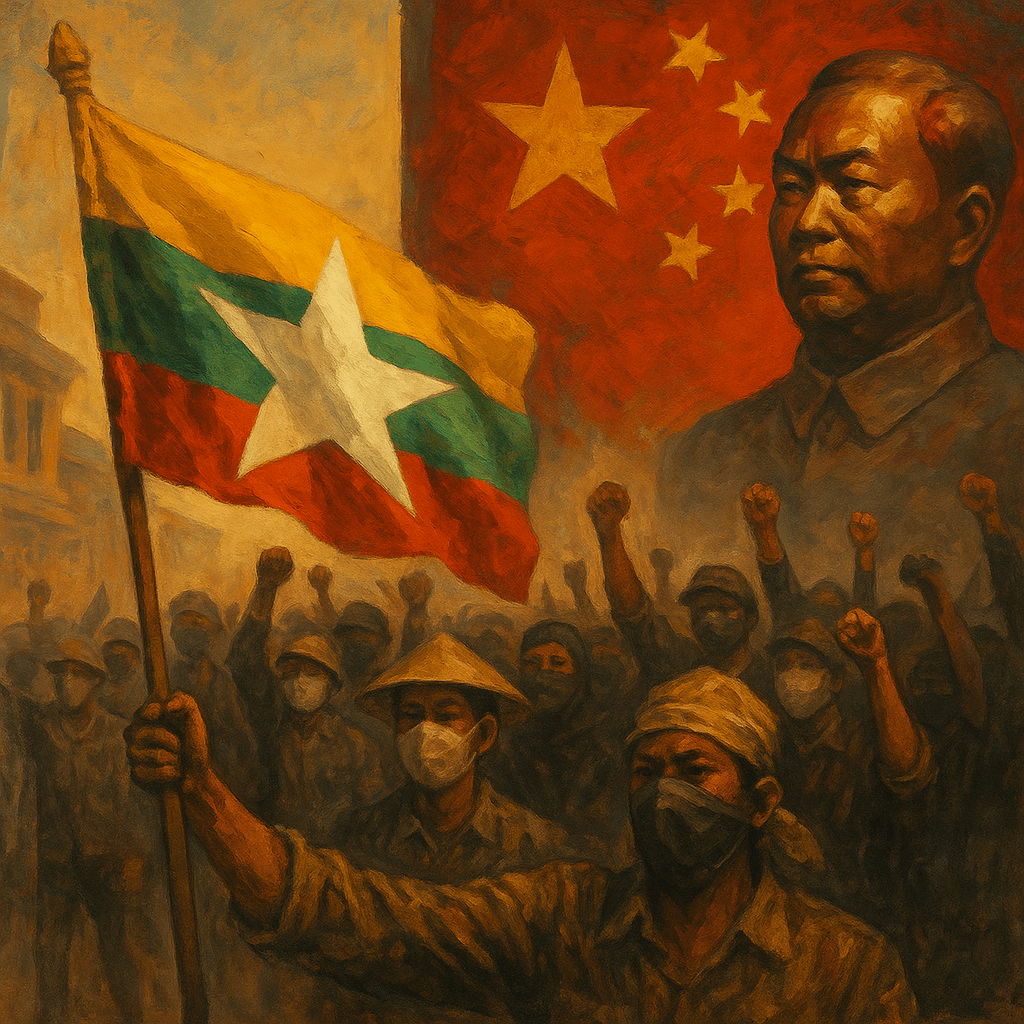
As Myanmar charts an uncertain course through crisis and contradiction, the imperial press calls China’s presence “hegemony”—but what it fears isn’t domination. It fears delinking. Beneath the narrative lies a deeper truth: the anti-colonial revolution remains unfinished, and multipolarity offers space to breathe, maneuver, and fight back.
By Prince Kapone | Weaponized Information | June 5, 2025
I. A Panic in Print: The Economist as Empire’s Anonymous Hitman
There is no name on the byline because The Economist doesn’t do names—it does imperial consensus. That consensus speaks in the clipped, officious tone of colonial governors who never needed to introduce themselves to the people they ruled. Behind the anonymous editorial voice is a class of technocratic aristocrats trained in Ivy League economics, groomed in the salons of the Financial Times, and salaried by private equity and NATO-aligned think tanks. These are not journalists in any real sense—they are the ideological architects of cognitive warfare, shaping how empire sees the world and how it wants the rest of us to mis-see it. Careerist operatives of capital who write with all the arrogance of those who know their pensions are invested in the very monopolies that profit from the chaos they describe.
As for The Economist itself, it is less a newspaper than an imperial organ. Owned by the Rothschild banking dynasty and several transatlantic financial blocs, the magazine has long operated as a hub of the imperialist media apparatus. It launders war plans into op-eds, sanctions into “policy tools,” and regime change into the language of liberal order. It presents itself as independent journalism, but its editorial board moves in lockstep with the IMF, the World Bank, the G7, and every financial speculator circling the wreckage of the Global South. It is not a news outlet—it is an instrument of imperialist recalibration, helping imperialism rebrand itself each time its previous disguise slips.
And in this case, the narrative is deployed on behalf of familiar operators: Marco Rubio, whose State Department feeds the media its lines like a press room ventriloquist; BlackRock and Shell, who view Myanmar’s pipelines and ports as disputed assets; and the Atlantic Council, whose think pieces become policy once laundered through publications like this one.
Now to the article itself—“Myanmar is a demonstration of Chinese hegemony in action”—a title that already tells on itself. In classic imperial fashion, the word hegemony is stripped of any real definition and repurposed as a slur to mean “China exists.” The West’s own history of violent domination, colonial cartography, and regime change vanishes into the fog. What remains is a cartoon: China as puppet-master, Myanmar as victim, and the West as the worried observer of someone else’s “interference.”
The propaganda technique is painfully transparent. First, projection: the article accuses China of “playing all sides,” a maneuver the U.S. has perfected for decades—from supplying both sides of civil wars to funding paramilitaries and opposition NGOs in the same breath. Second, fear-mongering through chaos framing: Myanmar is painted as an apocalyptic wasteland of “scam centers” and “drug traffickers”—not because the West cares about the suffering of its people, but because the loss of geopolitical control is being experienced as a spiritual crisis in Washington and London. The civil war becomes an aesthetic device, a way to make China’s engagement appear cynical and opportunistic, even as U.S.-led regime change and sanctions created the very instability it now laments.
Finally, there’s the sleight of hand: silence. Nowhere does the article mention Western sanctions, CIA destabilization, or the vast infrastructure China is building through its Belt and Road corridors. These are facts too dangerous to speak aloud because they reveal what’s really at stake—not human rights, not democracy, but logistical supremacy. This is not a warning about Chinese empire. It’s a lament for Western decline.
The pen may be anonymous, but the fingerprints are clear: this is not journalism. This is counterinsurgency—wrapped in copy-edited hysteria and sold as sober analysis. And the real “demonstration” on display here is not Chinese hegemony. It is the West’s ideological desperation in the face of a world slipping from its grip.
II. From Colonies to Cartels: Myanmar’s Long War Against Empire
Before Myanmar became a headline in the West’s propaganda circuit, it was a colony—bled dry by British imperialism, fragmented through divide-and-rule, and left to piece together a shattered sovereignty after formal independence in 1948. This foundational fact is absent from The Economist’s panic-piece. But it’s essential to understanding the so-called “anarchy” the West now laments. What we are witnessing is not the emergence of chaos but the long, unfinished struggle of a people trapped between empire’s past and empire’s desperate recalibration.
Myanmar’s anti-colonial struggle was real, militant, and mass-based. The British violently suppressed strikes and peasant rebellions throughout the 20th century, while cultivating ethnic divisions to divide the revolutionary potential of a multi-national working class. The legendary General Aung San—father of modern Burma—built alliances with communists and nationalists to expel both the British and the Japanese. But his assassination in 1947—conveniently ahead of independence—cut short the possibility of revolutionary unity. What followed was not freedom, but fragmentation.
In the Cold War era, Myanmar became a frontline of U.S. counterinsurgency. The CIA armed remnants of the Kuomintang (KMT) in the Shan hills, turning parts of the country into a paramilitary narco-zone. These covert operations laid the groundwork for the infamous “Golden Triangle,” where imperial intelligence and drug profits moved in tandem. Under the guise of fighting communism, the U.S. and its allies financed ethnic militias, exacerbated internal conflict, and derailed every attempt at democratic socialism or genuine national reconstruction. Western-backed NGOs, drug war fronts, and “humanitarian” infiltration masked the deeper aim: deny Myanmar strategic autonomy, especially from China.
Meanwhile, the internal class war raged on. Workers and students repeatedly rose up—most famously in 1962 and 1988—only to be gunned down or imprisoned en masse. The junta’s “Burmese Way to Socialism” was socialism in name only: a militarized bureaucratic project that crushed dissent while consolidating state and elite control. In truth, it was a reactionary fortress—built not to protect socialism, but to insulate the state from the masses. Western media called these massacres “internal affairs” until the junta began dealing with China.
Fast forward to the present: the West’s recent outrage over Myanmar’s military rule comes not from moral concern but from geopolitical disruption. Chinese-funded infrastructure projects—like the Kyaukphyu port, oil and gas pipelines, and overland rail corridors—threaten U.S. control of key maritime choke points. Myanmar is not in crisis because of Chinese “hegemony.” It is in crisis because its path to sovereignty remains blocked by 75 years of imperialist sabotage, counterinsurgency, and proxy warfare—and because it is now seeking new partners to break the blockade.
The article’s omission of this history is not accidental. It is ideological. The West wants you to believe Myanmar is collapsing on its own, or because of China. But the truth is far older, far bloodier, and far more damning. What’s collapsing is the illusion of Western stewardship—and the Myanmar people are still fighting, in the rubble of empire, for an exit from colonial time.
III. The Unfinished Revolution: Multipolarity, China, and the Terrain of Delinking
Myanmar is not a failed state—it is a nation whose anti-colonial revolution was violently interrupted. What The Economist fears is not “Chinese hegemony.” It is the unraveling of Western control and the opening of a new geopolitical terrain where nations like Myanmar can begin to delink from the colonial world system. The West mourns the collapse of unipolarity not out of concern for Myanmar’s sovereignty, but because China’s presence in the region undermines its monopoly on violence, finance, and ideological authority.
We must be clear: China is not an imperialist power. It is a socialist state navigating a capitalist-imperialist world system—using market mechanisms not to consolidate global dominance, but to develop its productive forces, defend its sovereignty, and support a multipolar world. Through initiatives like the Belt and Road and frameworks like BRICS+, China is building material infrastructure for South–South cooperation. Its engagement with Myanmar is not colonial extraction—it is logistical integration designed to bypass imperial choke points and strengthen regional autonomy.
This shift terrifies the imperial core. China’s port investments, oil and gas corridors, and cross-border rail projects in Myanmar directly threaten U.S. naval supremacy in the Indo-Pacific. The Kyaukphyu deep-sea port offers a land-based trade route that reduces dependence on the Malacca Strait—a vital artery of Western control. But more than this, it signals a future where Global South nations begin to orient toward each other, rather than upward to Washington, London, or Brussels.
The Economist cannot name this transformation because it is ideologically committed to the permanence of Western rule. It reduces China’s role to opportunism, Myanmar’s government to barbarism, and the entire Global South to a helpless periphery. But Myanmar is not helpless—it is a sovereign state making strategic choices under intense historical pressure. And China’s presence, however complex, offers breathing room for those choices to break from the colonial blueprint.
That said, multipolarity is not inherently liberatory. It is a battlefield. The existence of Chinese and Russian alliances does not replace the need for revolutionary struggle. The people of Myanmar—workers, peasants, Indigenous nations—remain the central force in their own liberation. Their task is not simply to choose partners, but to complete the project of national reconstruction that began in the fires of anti-colonial revolt.
The revolutionary horizon is not guaranteed by BRICS+, but it is materially enabled by the weakening of U.S.-led hyper-imperialism. That is the true significance of multipolarity: it reconfigures the terrain on which the global class struggle is fought. And within that shifting terrain, Myanmar has a chance—however difficult, however fragile—to reclaim its sovereignty and reignite its stalled revolution.
China’s role in this process is neither savior nor saboteur—it is a structural ally of anti-imperialist sovereignty. The West calls this hegemony. We call it history breaking its chains.
IV. Mobilization: From Narrative Rebuttal to Revolutionary Action
The truth, once revealed, is not enough. It must be weaponized. In Myanmar, the contradictions are not confined to newspaper columns—they are material. They are lived in refugee camps, in battle zones, in underground organizing networks, and in every rice field still worked under the shadow of empire. What Myanmar needs is not sympathy. It needs solidarity. And that solidarity must be built on revolutionary clarity, not humanitarian sentiment.
We declare ideological unity with the working class, the peasants, the Indigenous nations, and the armed revolutionary movements inside Myanmar who have refused to submit—either to the military dictatorship or to the neoliberal opposition groomed by Western NGOs. We reject the West’s attempts to manufacture selective outrage and proxy resistance for geopolitical ends. And we reject the portrayal of Myanmar’s current crisis as a self-inflicted wound or a byproduct of Chinese overreach. It is a wound carved by centuries of colonial violence and decades of counterinsurgency.
We must amplify the demands of the Myanmar people—not filtered through U.S.-funded media, but voiced by those on the frontlines of resistance. This means uplifting revolutionary media inside Myanmar and its diaspora. It means exposing the role of NGOs, think tanks, and sanctions regimes in suffocating sovereign development. It means calling out the hypocrisy of Western powers who supported the same generals they now condemn—so long as those generals kept China at bay.
And it means action. Revolutionaries around the world must take concrete steps to support the anti-imperialist forces in Myanmar:
- Support anti-sanctions campaigns that challenge Western economic warfare in the Global South.
- Build direct relationships with organizations on the ground resisting both the junta and foreign domination.
- Expose and disrupt Western information warfare campaigns that launder regime-change propaganda as human rights advocacy.
- Defend the right of oppressed nations to engage with China, Russia, and BRICS+ as part of a multipolar realignment that weakens hyper-imperialist command.
This is not a defense of China’s every action. It is a defense of sovereignty. A defense of the right of colonized nations to engage with the world on their own terms—even if those terms upset Washington, Brussels, or London. And it is a reminder that no nation will find liberation within the coordinates set by empire. Myanmar’s struggle is our struggle. Its revolution is unfinished—but it is not defeated. The question is whether we will stand with it—not just in word, but in action, in strategy, and in history.
 Weaponized Information
Leave a comment