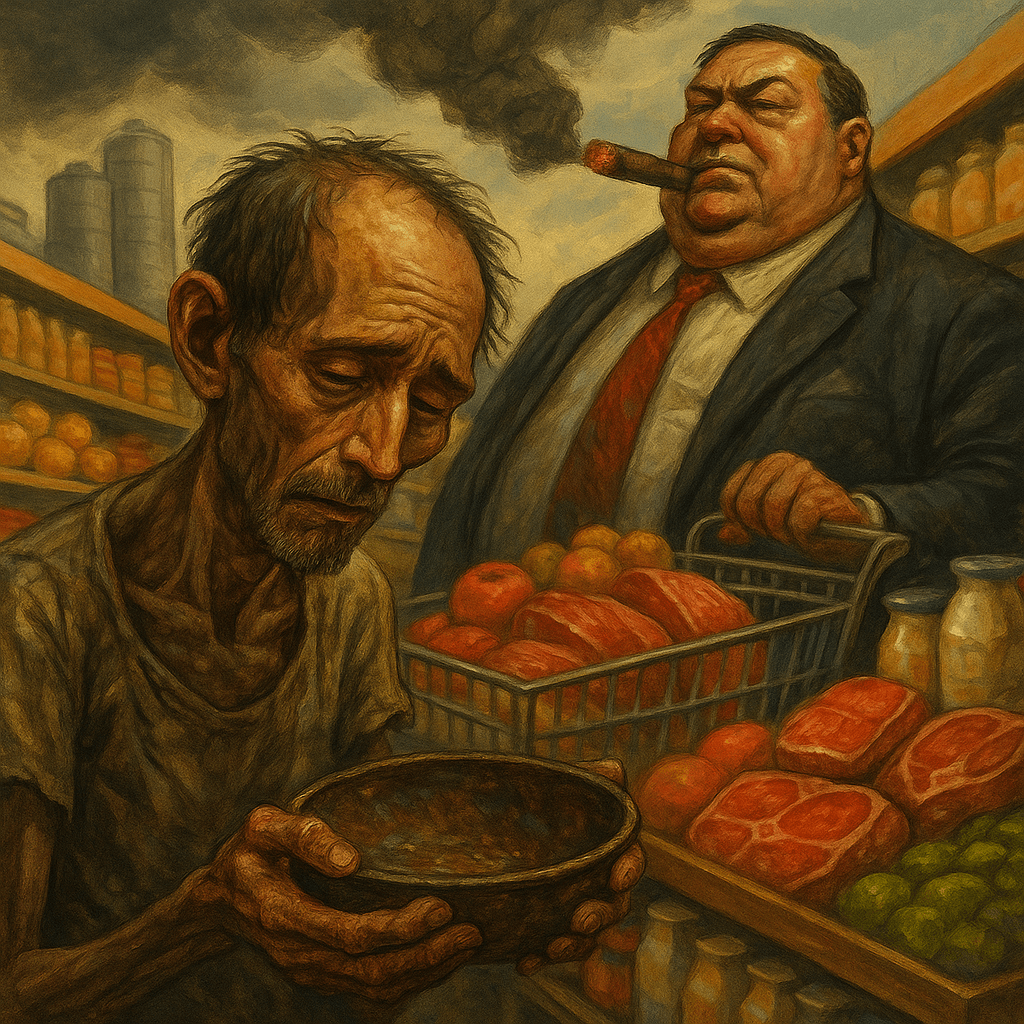
Food inflation in the imperial core isn’t a glitch. It’s how capital disciplines labor and stabilizes empire—one overpriced meal at a time.
By Prince Kapone | Weaponized Information | June 3, 2025
Part I: Hunger as Business, Affordability as Propaganda
By Weaponized Information | June 2025
G. Brian Davis is a freelance personal finance writer whose entire career has been spent repackaging systemic exploitation as middle-class strategy. His work, published across platforms like GOBankingRates and Yahoo Finance, functions as a kind of ideological customer service for capitalism—helping readers “understand” the rising costs of living without ever pointing a finger at the system causing them. He is not a reporter of injustice, but an interpreter for capital, translating structural violence into budgeting tips. Yahoo Finance, owned by Apollo Global Management, is not a journalistic institution but a privatized mouthpiece for Wall Street, designed to reframe capitalist crisis as manageable inconvenience. It doesn’t investigate inflation—it deflects blame from the system that profits off it.
The article enlists figures like Aaron Razon, a consumer finance expert at CouponSnake, and accountant Shalini Dharna to give it the veneer of expert analysis. But their function is clear: rationalize the price hikes, endorse the trade policies, and reassure the readership that the system is working as intended—even when it starves.
On the surface, the article poses a simple question: how do grocery costs compare between the U.S., Canada, Mexico, and China? But it answers that question with a sleight of hand that only makes sense if you accept the logic of capitalism as natural law. It begins by citing the sharp rise in food prices since 2020—up over 23%—but pivots immediately to a framing that downplays the crisis: Americans, it says, spend a smaller percentage of their income on food than people in other countries. And that, we’re told, is a sign of greater “affordability.” The implication is clear: the U.S. food system is functioning better, even if the prices are higher.
But this framing is pure ideological alchemy. It transforms the suffering of other nations into a justification for American excess. It turns the statistical footprint of wealth inequality into evidence of market superiority. The article presents “6.8% of income spent on groceries” as a triumph of consumer choice, when in reality it’s the result of a violently stratified society where the rich drag down national averages while the poor survive on food banks, EBT cards, and ultra-processed poison. No attention is paid to how that 6.8% is distributed across racial lines, income brackets, or geographic zones—because this article is not about explaining reality. It’s about preserving an illusion.
It buries the very mechanisms of capitalist extraction beneath friendly consumerist language. Tariffs are described as passive price inputs, not tools of imperial domination. Labor costs are cited as unfortunate byproducts of domestic production, not the wages of exploited workers trying to survive. The role of corporate profiteering, monopoly consolidation, and logistics control never appears. Even the phrase “imports groceries from other countries like Mexico and Canada for year-round availability” is doing ideological work—masking the globalized food regime in a language of convenience rather than conquest.
The function of the article is to strip hunger of its political content. It doesn’t deny that food is expensive—but it presents that fact as neutral, even rational. Inflation becomes an effect of climate, trade, and wages—not speculation, monopolization, and state-enabled profiteering. It invites the reader to accept their place in the food hierarchy, so long as they aren’t at the bottom. And it congratulates them for having less of their income stolen by the grocery industry than people in “poorer” countries—while never once asking why the richest empire in history makes people fight for affordable eggs.
This is not a neutral article. It is not an economic snapshot. It is propaganda. And like all effective propaganda, it doesn’t need to lie—it just needs to frame the truth in a way that protects power.
Part II: PPP, Class, and the Real Cost of Eating
The article offers several data points: that food prices in the United States rose by 23.6% between 2020 and 2024, slightly outpacing housing costs; that food inflation slowed in 2024; and that Americans now spend an average of 6.8% of their income on groceries. It then compares these figures to data from Canada (9.7%), Mexico (25.7%), and China (21.2%), suggesting that despite higher absolute prices, food in the U.S. is more “affordable.” On its face, these numbers appear self-explanatory. But stripped of class stratification, purchasing power parity, and material context, they function ideologically—positioning U.S. capitalism as the standard and obscuring the violence required to sustain it.
The most misleading frame is the invocation of “share of income spent on groceries” as a proxy for affordability. This figure is not disaggregated by class. Averages are statistical weapons in capitalist societies—blunting the edges of inequality. The 6.8% figure may reflect the habits of the upper-middle class and suburban professionals, but for working-class families—especially Black, Indigenous, migrant, and rural households—the share of income spent on food is often two to five times higher. The metric conceals more than it reveals. It doesn’t account for what people are eating, what’s available in their neighborhoods, or what they’re forced to forgo to stay fed. It doesn’t reflect how many are skipping meals, living on processed junk, or relying on school cafeterias to survive.
When adjusted for purchasing power parity (PPP), the article’s framing collapses entirely. In PPP terms, groceries are over 7 times cheaper in China and more than 4 times cheaper in Mexico than in the United States. The illusion of affordability evaporates when the real cost of food is measured not in dollar amounts but in what those dollars can actually buy. A PPP-adjusted food burden analysis reveals that the U.S. and Canada impose the heaviest food burdens on their populations when measured in real consumption power. The article’s framing is thus revealed for what it is: a repackaged apology for a system that extracts more while delivering less.
The article also fails to mention the role of state intervention in shaping these numbers. In the United States, the food system is massively subsidized—over $15 billion annually in farm subsidies, primarily benefiting corporate agriculture. Programs like SNAP exist not as rights, but as mechanisms of settler-colonial pacification and social control. They don’t guarantee adequate nutrition—they guarantee compliance. Canada’s dairy and poultry supply management system props up prices and production quotas, benefiting producers while offering no direct legal right to food for consumers. Mexico, on the other hand, subsidizes smallholder farmers and enshrines the right to food in its constitution—a legal acknowledgment that the U.S. refuses to even consider. China, though it lacks constitutional recognition, has invested billions in food security infrastructure, price stabilization, and rural production capacity, seeing food not as a commodity but as a pillar of sovereignty and state legitimacy.
These structural and legal differences are entirely omitted from the article—not by accident, but by design. The absence of these facts preserves the illusion of capitalist normalcy, where food is a market issue, not a matter of justice or human dignity. By comparing consumer behavior across nations without discussing class, subsidies, legal rights, or economic coercion, the article converts imperialism into lifestyle economics. It gives readers statistics without power, context, or contradiction.
What is left unsaid is as important as what is included. There is no mention of the food apartheid within the United States—how Black and Indigenous communities are systematically denied access to nutritious, affordable groceries. No mention of how the USDA collaborates with agribusiness to subsidize calorie-dense, nutrient-poor food. No analysis of how U.S. grocery monopolies like Walmart and Kroger consolidate supply chains to fix prices and eliminate competition. And no recognition of the fact that hunger in the U.S.—the so-called richest country in history—is not an accident. It’s policy.
Part III: Food as a Weapon of Class Rule and Technofascist Control
The food system in the United States is not malfunctioning—it is functioning exactly as designed. The high cost of groceries, the volatility of food prices, the concentration of logistics and supply chains, the mass criminalization of subsistence, the normalization of hunger—these are not accidental side effects. They are the deliberate outputs of a capitalist food regime whose survival depends on scarcity, inflation, and the permanent disciplining of the working class. Food under capitalism is not nourishment—it is leverage. It is a tool to extract labor, enforce compliance, and contain rebellion. The higher the price of bread, the harder it is to organize.
This is why food in the U.S. is expensive. Not because labor costs too much, but because capital demands too much. Monopolies like Kroger and Walmart, propped up by venture capital and hedge fund financing, don’t just set prices—they set the terms of life. The grocery store has become a speculative marketplace where Wall Street profit margins decide whether working families eat fresh vegetables or ultra-processed starches. Every link in the food chain—from farmland to refrigerated truck to checkout aisle—is financialized, monopolized, and enclosed. Food isn’t grown for human need. It’s grown for yield.
And for the millions who grow, pack, sort, and deliver that food—migrant workers, low-wage retail clerks, undocumented laborers—the system offers no security, no dignity, and no sustenance. These are the people who feed the empire, yet starve in its margins. They are not casualties of inflation. They are victims of technofascist labor recalibration: a system that disciplines labor through deportation, criminalization, and hunger wages, while positioning food as a weapon of pacification.
This regime of enforced scarcity is not limited to the imperial core. Globally, the U.S. food system depends on a structure of hyper-imperialist extraction: forcing farmers in Mexico, Honduras, and the Philippines to grow food they cannot afford to eat; displacing peasant agriculture through trade agreements and GMOs; then importing their surplus under the guise of “efficiency” and selling it at inflated prices to Americans. What the article calls “year-round availability” is actually year-round dispossession.
The United States imports hunger to fuel its own economy, then re-exports it as “development policy.” This is not a trade system—it is a global plantation. It relies on a planetary working class kept hungry enough to work and poor enough to accept it. This is the logic of food apartheid, both domestic and global: a system in which who eats—and who starves—is decided by class, race, and geopolitical subjugation.
There is no reforming this. No amount of budgeting apps, coupons, or policy tweaks can solve a system built on calculated deprivation. The only real solution is a revolutionary rupture—a complete seizure of the food system from the hands of capital. That means food sovereignty, not food charity. It means expropriating farmland from corporations and returning it to Indigenous, Black, and peasant communities. It means tearing down agribusiness monopolies and building horizontal, collective systems of production and distribution rooted in human need, not profit.
Until we dismantle the food regime of empire, every grocery store will be a site of extraction. Every shopping cart will be an instrument of discipline. And every empty stomach will be a ledger entry in a system that runs on hunger.
Part IV: From Empty Stomachs to Revolutionary Strategy
The empire turns food into a weapon. Our task is to turn that weapon around. We reject every framing that reduces hunger to a personal failure, a budgeting issue, or a natural economic fluctuation. Hunger is policy. Grocery inflation is class warfare. And the solution is not to beg for cheaper prices but to fight for control over production, distribution, and access.
We declare our unity with the workers and peasants who make this system run but are excluded from its spoils: the migrant field hands harvesting produce under ICE surveillance; the single mother choosing between eggs and insulin; the warehouse worker boxed in by QR codes and exhaustion; the colonized peoples of the Global South whose lands and labor fuel empire’s grocery carts. We unite with every hungry person who knows—consciously or not—that they are hungry because someone else is hoarding.
We draw lessons from revolutionary history. The Black Panther Party’s Free Breakfast Program was not a charity—it was a declaration of dual power. It proved that the people could feed themselves without capital, cops, or permission. That’s why the U.S. government targeted it with raids and surveillance. In Cuba, food sovereignty has been institutionalized through agroecological reforms that prioritize survival over speculation. In Venezuela, the CLAP system distributes food in defiance of U.S. sanctions and embargoes. These are not “alternatives”—they are prefigurations of a liberated future.
Let us organize accordingly. Build and expand Food Not Bombs chapters. Seize abandoned lots and turn them into community farms. Distribute food as a political act, not an act of charity. Develop revolutionary food networks that operate outside of capitalist circulation and directly undermine private control. Support Black- and Indigenous-led agricultural cooperatives demanding land back, reparations, and control over seed, soil, and sustenance.
Name the enemies of nourishment clearly: BlackRock, Vanguard, Tyson, Kroger, the USDA, and the IMF. These are not food companies. They are instruments of class war, gorging themselves while communities starve. Call them what they are. Expose their role in inflating prices, suppressing wages, patenting seeds, and enforcing the logistical logic of hunger.
If you are a revolutionary in the imperial core, especially if you benefit from settler food security, your duty is not to sympathize—it is to defect. That means rejecting the privileges of surplus, fighting alongside the hungry, and using every ounce of that stolen stability to sabotage the system that made it possible. Grow food, give it away, organize tenants and workers around food insecurity, and sabotage the waste stream wherever possible. Let hunger become the ground on which we build dual and contending power.
We will not watch our neighbors starve while Walmart counts its quarterly earnings. We will not “clip coupons” while financial firms speculate on grain. We will not ask for permission to eat. We will organize, expropriate, and feed each other.
Eat the system before it eats us.
 Weaponized Information
Leave a comment