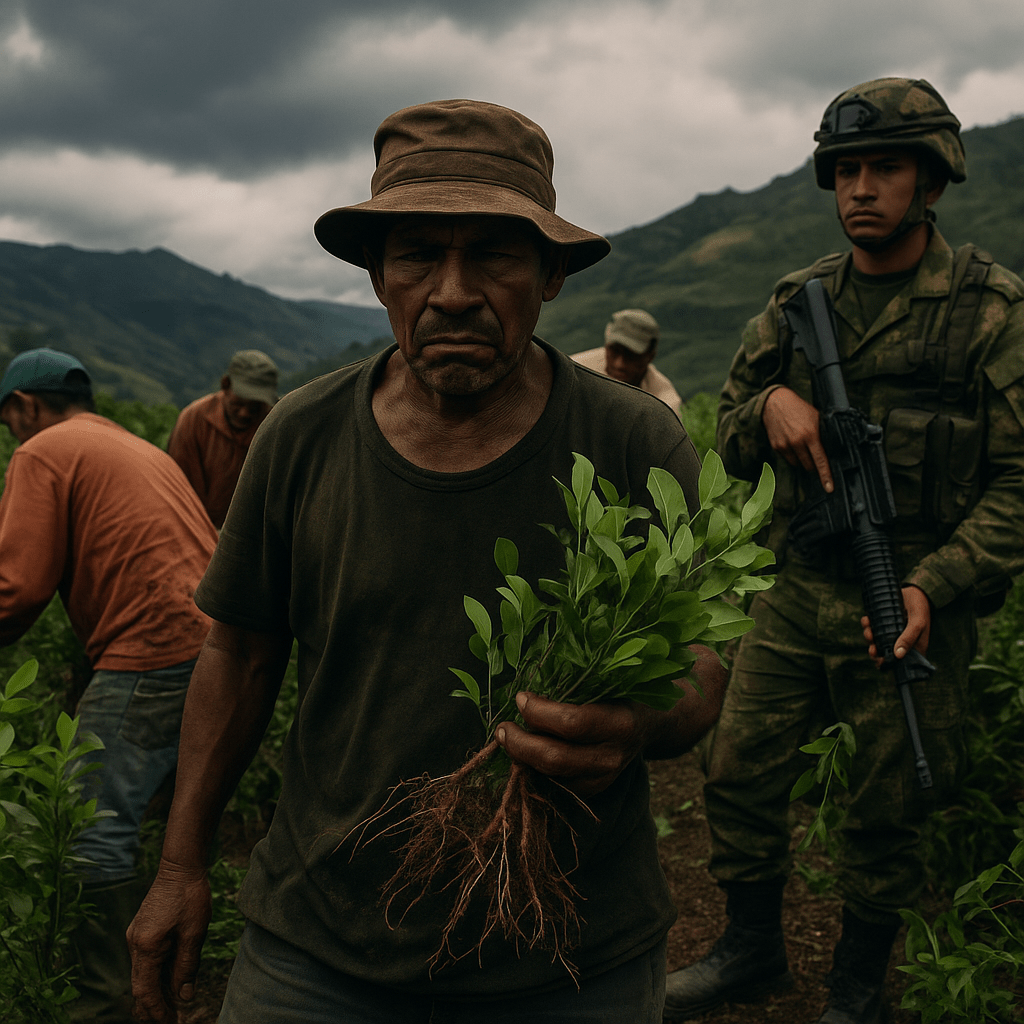
They say it’s development. We call it war by other means. Colombia’s crop substitution program won’t uproot exploitation—only revolution will. The real harvest here is imperial pacification. And the campesinos know it.
By Prince Kapone | Weaponized Information | June 3, 2025
Cash for Crops, Silence for Struggle: How Empire Gentrifies the Countryside
Al Jazeera wants you to believe Colombia is turning a corner. That with a few dollars and some coffee beans, the government is finally curing the disease of cocaine by treating the farmers who grow its leaf. In their latest “In Pictures” photo-op, they show us smiling campesinos holding up coffee berries beside uprooted coca plants. It’s soft-focus, high-resolution humanitarianism—the kind that helps the empire sleep at night. But behind the optics is something much darker: a counterinsurgency campaign disguised as crop substitution.
The article tells us that 4,000 Colombian families are receiving payments—roughly $300—to replace coca with legal crops like cocoa and coffee. It notes that coca once brought farmers $800/month, while the new crops offer no guarantees. We’re told this is part of a $14.4 million government initiative to wipe out coca across 45,000 hectares. But we’re not told who owns the land. We’re not told who controls the processing and export markets. We’re not told why people planted coca in the first place. And we’re certainly not told how often “alternative development” has been used as a pacification tactic, rather than a pathway to justice.
There’s a quiet, almost holy tone in the article—like the state is finally listening, finally helping. But it forgets to mention that this isn’t Colombia’s first crop substitution campaign. Or its second. Or its third. The last ones failed because armed groups didn’t go away, because state support dried up, and because coffee doesn’t pay when you don’t own the land you plant it on. So instead of examining why substitution fails, the article rehearses the same tired idea: that with a little more money and a lot more oversight, the peasantry will be saved.
It’s a seductive lie. That a handful of pesos can undo a century of dispossession. That planting coffee where coca once stood is development. That satellite surveillance is a substitute for state trust. But what this story really masks is a truth so obvious even the soil knows it: the problem was never the leaf—it was the land.
The voices included are telling. Farmers like Alirio Caicedo speak cautiously, torn between hope and fear. Program directors like Gloria Miranda speak bureaucratically, promising monitoring and enforcement. Former officials warn of “fraud.” And then, behind it all, the shadow of Washington: Trump 2.0, eyeing Colombia’s loyalty with military aid in hand and conditions in tow. The article doesn’t connect the dots—but the campesinos have lived those dots their whole lives. And they know that behind every cash offer is a threat.
This is not postwar development. It’s Cold War theater, staged for a new act. It’s the U.S.-funded state handing out just enough money to discourage rebellion, while paramilitaries and elites keep hold of the land. It’s peacebuilding without justice, reform without redistribution. It’s gentrification—rural edition. And in the hills of Cauca, they’ve seen this play before.
The Real Plantation: Coca, Counterinsurgency, and Colombia’s Neocolonial Ordeal
To understand why coca grows in the Colombian countryside, you have to look past the leaves. Coca is not a drug problem. It’s the visible scar of a deeper wound—one inflicted by centuries of land theft, colonial violence, and class war waged by foreign capital and domestic oligarchs. It is not planted by cartels alone. It is cultivated by history: by the hacienda, by the gun, and by the false promises of U.S.-funded “peace.”
Colombia has long functioned as the forward operating base of U.S. imperialism in Latin America. Since the Cold War, it has played the role of enforcer—sending troops, training paramilitaries, and crushing leftist movements on behalf of Western capital. From the 1960s onward, the CIA and Pentagon helped build a counterinsurgency machine that defined every peasant movement, every strike, and every call for land reform as “subversive.” Plan Colombia—hailed as anti-drug policy—was nothing of the sort. It was a war on the rural proletariat, dressed up as narcotics control.
Let’s be clear: the War on Drugs was always a war on poor people. While the U.S. flooded its own cities with cocaine in the 1980s and 90s, it militarized the Andes under the guise of “combating narcotrafficking.” In Colombia, that meant aerial fumigation of indigenous land, assassinations of union leaders, and surveillance of campesino cooperatives. Meanwhile, cocaine profits flowed freely through Miami banks, U.S. weapons flooded the paramilitary death squads, and Western mining and agribusiness corporations looted the very territories marked as “red zones.”
This isn’t history—it’s ongoing. Colombia still receives hundreds of millions in U.S. military and economic aid. It remains NATO’s only partner in Latin America. Its armed forces operate with U.S. equipment, U.S. training, and U.S. oversight. When President Petro called for an end to aerial fumigation and a move toward peace negotiations, Washington bristled. Now, with the return of Trump and the neofascist chorus of “America First” roaring louder, Bogotá is once again under pressure to prove its loyalty with eradication, not emancipation.
But even if the military backs off, the war doesn’t end. It continues through finance: IMF loans, World Bank development packages, and NGO-administered “civil society” reforms. These don’t uplift—they discipline. They carve rural Colombia into zones of extraction, where foreign capital controls what gets planted, who gets paid, and which crops are deemed “productive.” And while the state pays small farmers to grow cocoa or coffee, the land itself still belongs to the elite. The campesinos may uproot coca—but their own dispossession remains untouched.
And let’s not forget the saboteurs at home. Colombia’s Congress—dominated by conservative and neoliberal forces—has worked overtime to undermine President Petro’s revolutionary agenda. They’ve stalled land reform, blocked labor rights legislation, and refused to implement core provisions of the peace accords. Petro’s attempt to shift the country from imperial dependency to regional sovereignty has been throttled from within, leaving programs like coca substitution stranded between good intention and structural sabotage.
This is the real context behind the Al Jazeera photo essay. What they present as development is in fact the same old counterinsurgency strategy—updated with cash incentives and satellite surveillance. But for the farmers who live under the shadow of both the narco and the state, nothing has fundamentally changed. They’re still landless. Still exposed. Still caught between bullets and bureaucracy. And until the land question is resolved—until Colombia breaks free from the grip of empire and the class that serves it—no crop will ever be safe.
Coca and the Nation That Never Was: Revolution Deferred, Not Defeated
The ruling class wants you to think coca is the problem. But coca is only the symptom. The real problem is that Colombia was never allowed to become a nation on its own terms. Since the death of Simón Bolívar, the country has been governed by oligarchs and generals, always answering to foreign powers—first Spain, then the United States. The coca fields that stretch across Cauca and Catatumbo are not fields of crime—they are the footprints of a revolution interrupted.
Bolívar envisioned a united, sovereign América—a continent free of empire, built on justice, not plantations. But after his death, the local comprador class allied with foreign capital and sold off the land, the mines, and the labor force. Every time the working class and peasantry rose up—whether through strikes, guerrilla movements, or electoral insurgencies—they were met with bullets, bayonets, and bombers. Coca is what grows in the space left by broken promises and scorched treaties.
When Petro was elected—the first left-wing president in Colombia’s modern history—it sparked hope not just for peace, but for a rupture. He spoke of land reform, labor justice, and breaking with the U.S. drug war. But as we’ve seen, the state Petro inherited is not the one he commands. Its institutions were designed to neutralize popular power, not facilitate it. His crop substitution program, however well-intentioned, has been defanged—stripped of its revolutionary core, weaponized as a symbol of compliance for Washington and Wall Street.
And so the old patterns continue. Instead of agrarian reform, we get cash incentives. Instead of collective ownership, we get monitored compliance. Instead of paramilitary disarmament, we get PR campaigns. This is not liberation—it’s the choreography of empire. Colombia is being told to “develop,” but only within the coordinates drawn by imperial cartographers. And as long as those coordinates remain intact, there will be no justice in the countryside.
But still, the embers of Bolívar’s dream haven’t gone out. From the mountains of Cauca to the union halls of Bogotá, the demand for a different future persists. The people don’t want to be paid to abandon coca—they want to be paid back for five hundred years of dispossession. They don’t want to swap one plantation crop for another—they want to own the land, the labor, and the means of survival. They want to finish what Bolívar started: a decolonized, multipolar, and socialist Colombia.
The coca leaf, like the sugar cane before it, is not inherently good or evil. It is simply what grows when a people are denied sovereignty. The question is not whether it should be eradicated, but whether the world that made it necessary can finally be overthrown. That’s the real war the empire fears—and the only one worth fighting.
What Peace Requires: Land, Power, and the Memory of the Revolution
Real peace doesn’t come from payouts. It doesn’t come from promises of “development” or from NGO-approved crop rotations. It comes from power. It comes when land changes hands, when labor is organized, when the gunmen in suits and fatigues are disarmed not by treaties but by transformation. Colombia doesn’t need a new plan to replace coca. It needs a plan to replace the system that made coca necessary in the first place.
For Colombia’s peasants and workers, the lesson is clear: take the money if you must, but organize beyond the contract. Build assemblies, land collectives, and popular militias to defend what is yours. Don’t let substitution become submission. Demand land reform, not pilot programs. Demand justice for the massacres, not integration into the market. The state won’t liberate you—but your organization might.
For the international left, our task is to expose and dismantle the foreign architecture that props up Colombia’s neocolonial condition. That means opposing Trump’s renewed pressure campaign. It means rejecting the War on Drugs as a smokescreen for empire. It means pushing to cancel Colombia’s IMF and World Bank debts, shutting down the flow of weapons, and forcing the withdrawal of NATO’s hand from Latin American soil. It also means standing with Petro where he advances the revolution—and standing with the people when he is blocked.
Colombia cannot—and should not—be rebuilt by U.S. investment, European NGOs, or satellite surveillance. It must be rebuilt from the ground up: from the ancestral territories of the Afro and Indigenous peoples, from the fields worked by landless campesinos, from the memories of those who died with rifles in their hands and liberation in their hearts. It must be rebuilt with a politics that centers food sovereignty, ecological repair, and working-class power—not just electoral change.
For revolutionary media and education projects like Weaponized Information, our task is to make sure these stories aren’t reduced to coffee plantations and smiling farmers. We must tell the whole truth: that coca grows in the shadow of empire, and every uprooted plant today will regrow tomorrow if the root system of imperialism remains untouched. We must excavate that truth, reframe it, and weaponize it in the service of struggle.
So no—we do not celebrate cash-for-crops deals. We celebrate land seizures. We celebrate collectives. We celebrate the spirit of Bolívar, of the Black and Indigenous maroons, of the peasant guerrillas who dared to dream of something more than a managed truce. We fight for revolutionary peace—the kind that can’t be brokered, bought, or negotiated away. Because until that kind of peace takes root, the real war never ended. And we intend to win it.
 Weaponized Information
Leave a comment