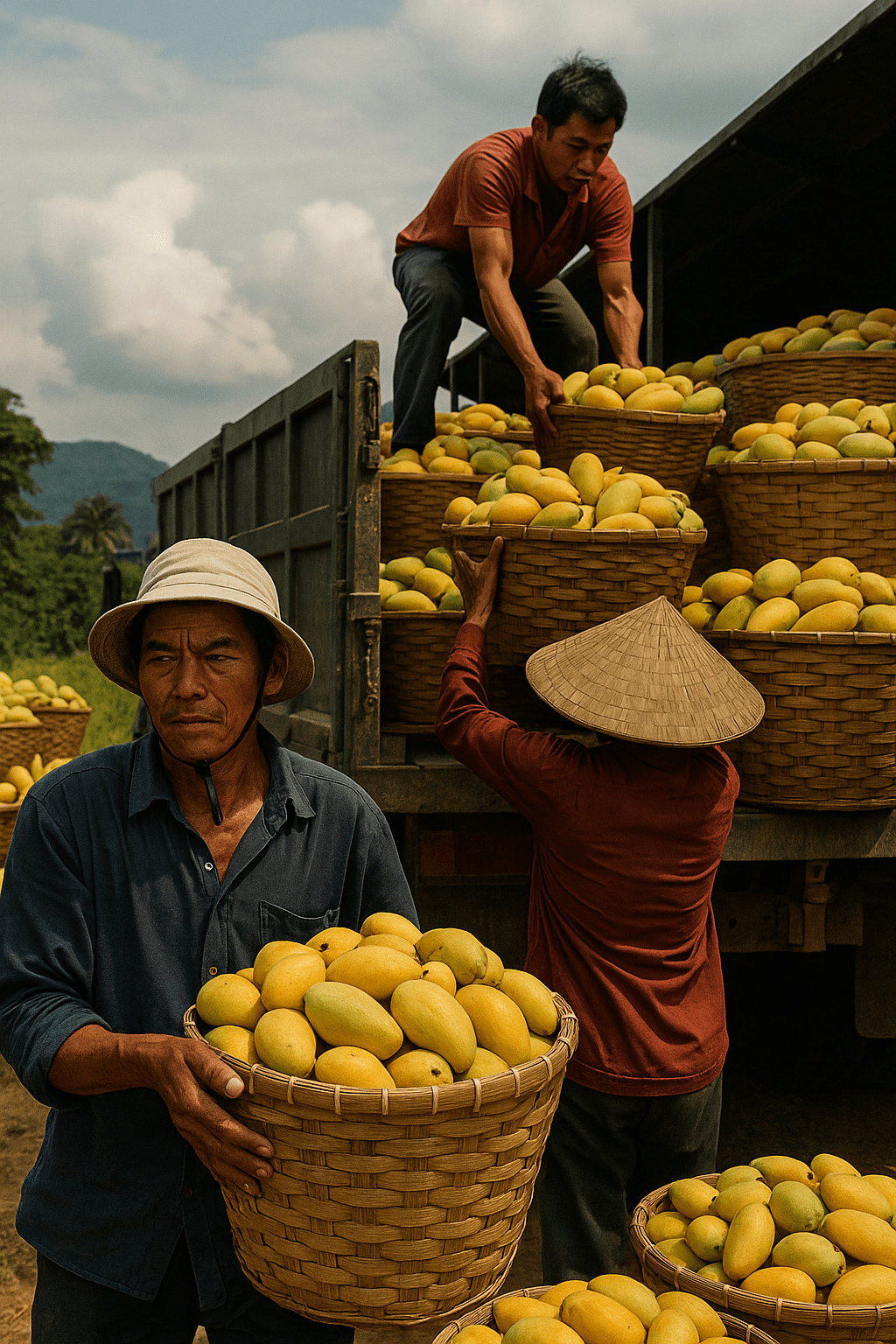
As Western empires sow war and dependency, Laos exports sovereignty by the truckload—quietly rewriting the rules of global trade with mangoes, not missiles.
By Prince Kapone | Weaponized Information | June 3, 2025
P
Peeling Back the Layers: Fruit, Power, and the Battle for Sovereignty
At first glance, it’s just a feel-good story buried deep in the “ASEANPlus” section of The Star—Laos sends mangoes to China, and everyone smiles for the cameras. But beneath the sweet surface is a bitter truth the empire would rather keep quiet: a former colony is realigning its agriculture, economy, and diplomacy away from the rotting core of Western dominance and toward a future rooted in sovereignty, multipolarity, and regional integration. And that, comrades, is why this modest mango shipment matters.
Let’s start with who’s telling the story. The Star is no rogue outlet. It’s the flagship of Star Media Group Berhad, one of Malaysia’s largest media corporations—built on the back of tight connections to comprador business factions and state-aligned elites. This isn’t grassroots journalism. It’s empire’s local news affiliate, lubricating neoliberal development with the soft language of export optimism. The article’s likely author, a desk reporter embedded in that institutional machinery, writes not as a people’s historian, but as a glorified stenographer for Southeast Asia’s rising managerial class. Trained in the depoliticized grammar of investment incentives and growth targets, their job is to make capital flow smoother, not to interrogate who owns the pipeline.
Names were dropped: Dr. Linkham Douangsavanh cutting ribbons, Zhang Ziyong representing a Chinese agri-tech firm, commercial attachés from both governments in attendance. But don’t mistake the polite formality for passivity. These aren’t just ceremonial actors—they’re mid-level agents in a deeper geopolitical transformation that threatens the very arteries of Western imperial control. Nobody calls them that in the piece, of course. That would require telling the truth.
So what does the article actually say? It chronicles the export of 90 tonnes of mangoes from Laos to China under a new trade pact. A ribbon-cutting. Some quotes about plant hygiene and “value-added processing.” A few statistics about agricultural production ticking up. All true, and all utterly void of context—until you realize that this isn’t just mango diplomacy. This is a country scarred by war, battered by colonialism, and structurally underdeveloped by IMF dictation, finally taking a step—however cautious—toward escaping the global food trap.
That trap, let’s be clear, is the one where the Global South grows what the West wants, in the way the West dictates, under terms the West enforces. Decades of monoculture. Debt-financed agribusiness. Cash crops for foreign supermarkets while domestic hunger festers. Development consultants calling it progress while peasants drown in chemicals and bills. That’s the agricultural legacy Laos inherited—from the French, from the bombs of the U.S. Air Force, from Bretton Woods bureaucrats. The article says none of this. But its silences scream.
Here’s what it does hint at, though: that Laos is now using Chinese capital and regional integration to prioritize its own exports, meet its own targets, and potentially climb out from beneath the boot of Western-dominated commodity chains. That’s not “market expansion.” That’s quiet revolution. The mango, in this context, isn’t just a fruit—it’s a wedge. A small but deliberate break from dependency. A sign that the land and labor of Laos might one day nourish its own people on its own terms, and sell what’s surplus to its allies—not its colonizers.
The article wants you to see this as a neutral economic event. But as anyone with a materialist backbone knows, there’s no such thing as neutral trade. Behind every shipment of fruit is a map. Behind every export pact, a history. Behind every sanitized headline, a suppressed rebellion. What Laos did with that mango convoy was not just ship produce—it made a quiet declaration of independence. And we would do well to hear it loud and clear.
From Bomb Craters to Banana Groves: The Historical Terrain Beneath the Mango
To understand what this mango shipment really means, you have to trace it back through the red clay of Laos’s soil—through the bootprints of colonial powers, through the blast zones of U.S. bombs, through the quiet signatures of World Bank memoranda. Only then does the mango take shape as more than fruit. It becomes historical contradiction, cultivated and ripening at the crossroads of empire and escape.
Laos, like much of Southeast Asia, was folded into the imperial world system not to flourish, but to feed European industry. Under French colonial rule, the land was carved up for resource extraction—rubber, timber, opium, and whatever else could be hauled out. Local subsistence systems were undermined and replaced with forced cultivation of cash crops for export, binding peasants to both foreign markets and colonial tax regimes. Independence didn’t reverse this structure—it just changed the management.
Then came the American war. From 1964 to 1973, U.S. planes dropped over 2 million tons of ordnance on Laos, more than was dropped on Germany and Japan combined in World War II. Rural agriculture was shattered. Entire villages were displaced. Unexploded cluster bombs still litter fields to this day, turning harvest into hazard. This wasn’t just collateral damage. It was food warfare—imperial strategy designed to destroy self-sufficiency and sever revolutionary logistics. The goal was to starve the resistance, and it nearly starved the country.
In the decades that followed, Laos was nudged into the arms of structural adjustment. The World Bank and Asian Development Bank offered “development” loans with strings attached: privatize land, open markets, reduce public spending, orient agriculture toward exports for foreign consumption. By the 1990s, Laos’s food system had been tethered to the global commodity chains—selling bananas and sugar for Chinese and Thai firms, importing packaged foods to feed its own population, and hemorrhaging value with every shipment. This is the imperial food trap: you work your own land, but someone else eats the profit.
Now comes China—not as a savior, not as a socialist bloc reborn, but as a state whose contradictions, capacities, and geopolitical priorities are opening space for other countries to maneuver. With the Belt and Road Initiative as scaffolding, Laos has built a north-south railway that cuts through mountains and slashes travel time to Chinese markets. With it comes not just trains but trucks, contracts, storage depots, processing plants—an entire ecosystem for agrarian self-assertion.
This shift must be understood through the lens developed in our prior analysis, particularly “The Belt Rolls On” and “Can the Mekong Flow Red?”. Laos is positioning itself as more than a passive corridor for capital—it is attempting to convert infrastructure into sovereignty. Food sovereignty, in this case, means building the capacity to grow, process, and export on its own terms—without routing profits and power back through New York, London, or Brussels.
The mango deal with China didn’t drop from the sky. It’s a cumulative outcome of state planning, peasant labor, and regional political alignment. It marks a transition from decades of donor dependency to strategic partnership. Yes, contradictions remain—Chinese firms are still private actors seeking profit, land deals can exploit farmers, and local elites may still sell out. But the structure is shifting. Laos is no longer a passive node in someone else’s empire. It’s slowly constructing its own pathways out.
And that’s precisely why these stories get buried in the back pages. If the average reader understood that multipolarity isn’t just a diplomatic buzzword but a material process—expressed in mango crates and rail timetables, not just speeches and flags—they might begin to question why it’s the West, and not the East, that keeps sending missiles instead of meals.
Development Is a Code Word. This Is Decolonization in Motion.
Western media calls it “development.” Donors call it “capacity building.” Economists call it “growth.” But what’s really happening in Laos can’t be stuffed into the sterile vocabulary of the IMF lexicon. What we’re seeing is the beginning of an escape—an agrarian insurgency against the colonial circuits that have siphoned wealth from the South for five centuries. This isn’t just mango farming. It’s class struggle. It’s territorial reorganization. It’s decolonization in motion.
The ruling narrative would have you believe that development comes from the top down: from loans, consultants, trade facilitation, and policy reform. But Laos is showing another path. The rails came first—not just metaphorically, but literally—with the China-Laos Railway slicing through a landlocked nation long treated as a geopolitical afterthought. That railway wasn’t built by the IMF. It wasn’t conditioned on privatization. It wasn’t funded by Washington. It was built through Chinese financing and Lao labor, and it opened the logistical arteries for agricultural sovereignty to emerge.
Now the mangoes move. And with them, the logic shifts. From a peasant’s point of view, this isn’t about “international integration”—it’s about feeding your kids and not having to sell your land to a Thai conglomerate. From a state planner’s perspective, it’s about climbing out of the periphery without bowing to Wall Street. From the standpoint of empire, it’s a threat: if Laos can trade fruit for power, others might start looking at wheat, cassava, or copper the same way.
This moment exposes the limits of the Western development model, which for decades has promised “modernization” while enforcing agricultural dependence. First they told Laos to specialize in commodities. Then they told them to privatize. Then they told them to open markets to foreign agribusiness. Then they said, “Look how poor they are.” Now that Laos is building something outside that chokehold—one mango at a time—the same institutions either ignore it or start whispering about “Chinese influence” like it’s a contagious disease.
Let’s be clear: multipolarity isn’t always clean or ideal. Chinese capital has its own contradictions. Not every rail line liberates. Not every trade deal is fair. But what matters is the terrain—the direction of motion, the widening of strategic space, the potential for states like Laos to carve out independent futures that don’t require begging for crumbs from a collapsing empire. In that context, the mango becomes more than a fruit. It becomes a symbol of what’s possible when a people begins to walk off the plantation.
This is the slow, often invisible work of decolonization. It doesn’t always come with speeches or uprisings. Sometimes it rolls out quietly, on three trucks bound for the Chinese border, carrying nothing but yellow fruit and 500 years of defiance. If we’re paying attention, we won’t just see mangoes. We’ll see a map being redrawn—not by cartographers, but by peasants, planners, and the pulse of multipolar sovereignty breaking through the soil.
Multipolar Mangoes, Imperial Missiles—Choose Your Side
There’s a reason stories like this barely make headlines in the West. Not because they’re unimportant—but because they’re dangerous. If people in the core saw what’s really happening in places like Laos, they might start asking questions that unsettle the foundations of the imperial world system. They might start wondering why the United States builds bases while China builds railways. Why NATO ships weapons, and the Global South ships mangoes. Why every path out of poverty offered by the West seems to circle right back to Western banks, foreign debt, and multinational corporations.
For the peoples of the Global South, the lesson is clear: we are no longer trapped. The infrastructure of multipolarity is material. It’s not a theory—it’s a railway, a customs protocol, a trade corridor. Laos is showing that sovereignty isn’t a slogan, it’s a supply chain you control. Other nations—landlocked, sanctioned, written off—are watching. Some are already moving. What matters now is consolidating these gains, learning from contradictions, and defending this space from recolonization through debt, destabilization, or greenwashed imperialism.
For those of us in the belly of the beast, the task is just as urgent. We must reject the manufactured consent that wraps missiles in humanitarian language and demonizes mangoes as geopolitical threats. We must expose the war machine’s logic, which sees every independent act of trade, agriculture, or cooperation as subversion. Because it is. Because empire can’t survive without monopoly. And Laos, with its crates of fruit and steel rails to the future, is breaking that monopoly open.
Our solidarity must be material. Not just retweets or moral outrage—but study, agitation, organization. We must dismantle the structures here that enable domination there: the think tanks that write trade policy, the banks that issue predatory loans, the tech platforms that shape global perception, and the military alliances that back it all up with force. We must link the fight against gentrification, land theft, hunger, and police terror in our own cities to the broader war being waged on the food systems and sovereignty of the South.
The mangoes from Laos are not just produce—they are signals. Signals that the world is changing. That imperialism is not inevitable. That even the smallest nations can take steps—sometimes quiet, sometimes radical—toward dignity. And when those steps are taken, it is our job to stand with them, to amplify them, and to fight like hell against the empire that wants to turn them into nothing but footnotes.
So let this be our line in the soil: mangoes or missiles. Sovereignty or servitude. Multipolar survival or imperial collapse. Choose your side, and get to work.
 Weaponized Information
Leave a comment