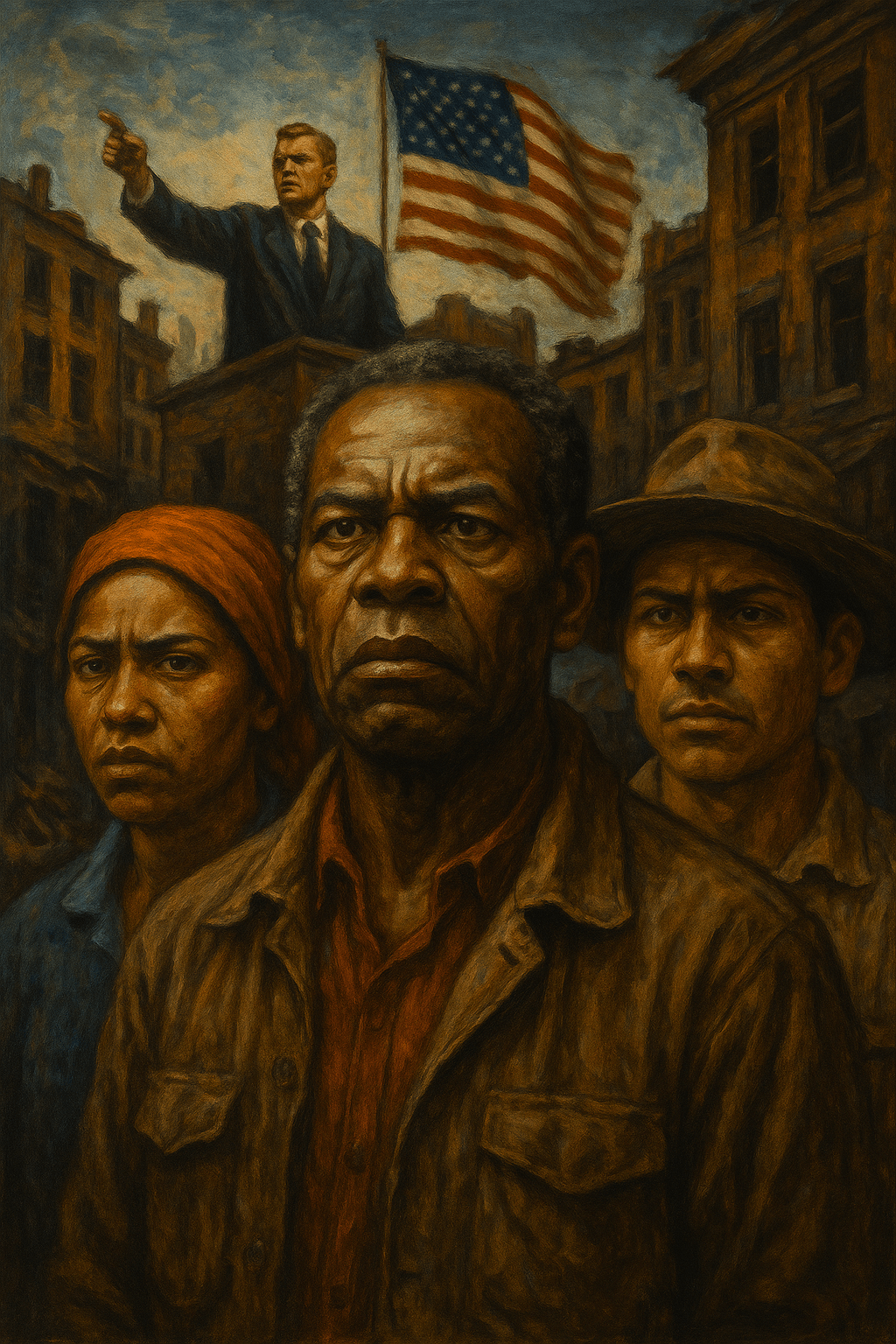
In the United States, human rights are not denied—they’re reserved. For the rest of us, survival is conditional, rationed, and policed. The fight for real human rights begins where empire ends.
By Prince Kapone | Weaponized Information
May 25, 2025
Rights for Some, Hunger for the Rest
Let’s tell the truth. When Americans scoff at free housing, healthcare, or education as “handouts,” they’re not confused. They’re not misinformed. They’re defending something. What they’re defending is a system that guarantees life, comfort, and dignity for a privileged few by systematically denying it to everyone else. They know—on some deep, half-conscious level—that if food, shelter, medicine, and stability became universal rights, the entire racial and class order of this settler-colonial empire would collapse.
What we call “human rights” in this country is really just a thin veil over organized deprivation. It’s a scam where the empire sells you “freedom of speech” while withholding the freedom to eat. It lectures the world about democracy while condemning millions of its own people to homelessness, medical bankruptcy, and life without heat, clean water, or a safe place to sleep.
The truth is, economic, social, and cultural rights—the right to live, to rest, to grow, to eat, to exist without being priced out of your own humanity—are considered a threat by this system. Because they are. Because once you guarantee those rights universally, the white suburbs lose their walls, capital loses its leverage, and the hoarded comfort of the few can no longer be built on the suffering of the many.
That’s why the U.S. government refuses to recognize these rights in law. That’s why they never signed the International Covenant on Economic, Social and Cultural Rights. That’s why “human rights” in their mouth means only the right to tweet, pray, and elect your executioner.
This isn’t a misunderstanding. It’s a strategy. A racial-capitalist logic that says: rights are for the owners. For the rest of you? Work, bleed, obey—or starve.
In this essay, we’ll expose that logic, trace its colonial roots, and lay out what real human rights would mean—for the working class, for the colonized, for the people of the earth. And why the empire would rather burn than grant them.
Paper Rights in a Plantation State
The United States has always talked a big game about freedom. But that freedom was never for everyone. The U.S. Constitution was written by enslavers and land barons. The Bill of Rights said nothing about land, food, housing, or wages. What it guaranteed was the freedom to speak, own, and trade—for those who already had power.
After World War II, as the United Nations began to draft international agreements on human rights, a split emerged. The socialist bloc and newly decolonizing nations demanded that rights include the right to survive—to eat, to work, to rest, to be educated. But the United States refused. It ratified the International Covenant on Civil and Political Rights, but not the Covenant on Economic, Social, and Cultural Rights.
Why? Because the entire structure of U.S. wealth—its suburbs, its Wall Street towers, its military bases and Ivy League schools—is built on denying those very rights to colonized people at home and abroad. To sign such a treaty would be to admit that the wealth of the empire is stolen.
Instead, the U.S. government weaponized “civil rights” as an imperial bludgeon. Political prisoners in Cuba? Violation. Nationalizations in Iran? Violation. Land reform in Zimbabwe? Violation. But mass homelessness in Detroit? Not a violation. Slumlords in the Bronx? Not a violation. Child hunger in Mississippi? Not a violation.
In the American system, rights are not for people. They’re for property. A landlord has more rights than a tenant. A corporation has more rights than a city. And a white homeowner in the suburbs has more rights than a Black tenant in a public housing project. That’s not a flaw—it’s the blueprint.
The Real Bill of Rights Is a Deed and a Bank Account
Let’s stop pretending economic rights don’t exist in America. They do. They’re just reserved for people who can pay for them. If you have money, you already have the right to choose your doctor, your school district, your lawyer, your diet, your zip code, and your access to clean water. If you don’t? You have the right to shut up and survive.
In the U.S., wealth and whiteness buy access to every right that the state refuses to guarantee universally. Homeownership is subsidized—for white families. Healthcare is accessible—if you’re insured. College is available—if you can absorb debt. Even police “protection” operates on a sliding scale: the richer and whiter your neighborhood, the more likely they’ll respond to your call, not break your door down.
This is not just class war. It’s settler logic. The rights of the colonizer were always built on the dispossession of the colonized. That’s why, from the beginning, the U.S. government guaranteed land rights—but only for settlers. Resource rights—but only for corporations. Labor rights—but only when the workers weren’t Indigenous, enslaved, or “illegal.”
Today, that system has been refined but not uprooted. Economic, social, and cultural rights are treated like luxury goods. You can have them, but only if you pay the toll—and if you can’t, the system will blame you, not itself. This is not a democracy. It’s a gentrified plantation.
So when Americans reject economic rights, it’s not just ignorance. It’s fear. Fear that if those rights were granted to all, the empire’s hierarchy would fall. And with it, the privileges that shield them from the realities they’ve forced on everyone else.
They Know What They’re Doing: Repression Is the Design
The refusal to guarantee housing, healthcare, food, or education is not a policy failure—it’s a blueprint. It’s how the empire disciplines its underclass, maintains white comfort, and guards capital’s chokehold on life. The U.S. system doesn’t break when people suffer—it works exactly as intended.
When people beg for rent relief, they’re told to budget better. When they demand healthcare, they’re told to get a job. When they organize for free education, they’re asked how they’ll pay for it. Behind every one of these responses is the same logic: if you don’t submit to the system, you don’t deserve to survive in it.
That’s not governance. That’s punishment. A colonial state can’t afford to provide for all, because that would mean dismantling the very hierarchy it was built to uphold. So instead, it starves the poor, blames them for being hungry, and then calls it democracy.
And when nations elsewhere guarantee what America won’t—Cuba’s doctors, China’s housing, Venezuela’s food programs—they’re slandered, sanctioned, and strangled. Because the real danger isn’t communism—it’s the possibility that people will start asking why their country won’t provide what others do.
The repression of economic rights is not passive neglect. It’s an active front in the war to preserve white supremacy and capitalist order. If these rights were granted, the entire racial and class scaffolding would collapse. That’s why the system would rather police you than feed you.
No Capitalist System Can Be Democratic
The ruling class loves to say capitalism and democracy go hand in hand. But that’s a lie told by the landlord in a house full of evictions. Capitalism and democracy are contradictions. One is rule by property. The other, rule by people. You can’t have both.
What passes for “democracy” in the United States is a theater of consent. Every few years you get to vote for which millionaire will auction off your life next. Meanwhile, the real decisions—about rent, food prices, school closures, and wars—are made by bankers, lobbyists, and corporate boards who were never on your ballot.
Democracy means power. Not just the right to speak—but the power to shape the conditions of your life. If you can’t decide where you live, what you eat, whether you go to school or get treated at a hospital, then your right to vote means nothing. Political rights without economic rights is like freedom of movement in a prison yard.
Socialism isn’t about control—it’s about majority rule. And the majority of people on earth are workers and peasants. The only system that can deliver real democracy is one where those who labor for the world get to govern it. That’s not utopia—it’s math.
So yes, capitalism allows speech. But only if you can afford a platform. It allows choice. But only if you can afford options. It allows freedom. But only if you define freedom as the right to watch the world burn from a gated community.
Reclaiming What Was Stolen: Revolutionary Human Rights
Let’s start here: there is no such thing as neutral rights. Every society defines rights in service of its ruling class. Under feudalism, the right to rule came from bloodlines. Under capitalism, it comes from capital. Under socialism, it must come from the people.
Revolutionary human rights are not polite requests. They are demands born from struggle. The right to food is a demand for land back. The right to housing is a demand to break the landlord. The right to healthcare is a demand to dismantle profit-driven deathcare. These are not reforms—they are battle cries.
What Cuba did with doctors, what the USSR did with housing, what Venezuela does with food programs—those aren’t anomalies. They are glimpses of what the world looks like when profit is not God. They are reminders that the imperial order is neither permanent nor necessary.
Human rights, if they are to mean anything, must be rooted in anti-colonialism, anti-capitalism, and anti-racism. They must demand reparations. Redistribution. Revolutionary rupture. Anything less is not human rights—it’s humanitarian cover for empire.
So we don’t want rights that live on paper while we die in the streets. We want rights that live in our kitchens, our clinics, our schools, and our soil. Rights backed not by slogans, but by organized power. Rights that don’t ask permission from the system—they abolish it.
There Are No Human Rights Under Empire
Let’s stop lying to ourselves. There are no human rights under empire. There are only privileges for some, deprivation for others, and the permanent threat of violence to keep that balance intact. The U.S. doesn’t fail to provide rights—it withholds them, weaponizes them, and sells them to the highest bidder.
The world doesn’t need more NGOs, white papers, or bipartisan resolutions. It needs movements that are willing to name the system for what it is and tear it out by the root. Human rights will never be secured by appealing to the moral conscience of the ruling class. They will only be won by organizing a force that can make that class obsolete.
We must reclaim the concept of rights—not as liberal entitlements, but as revolutionary principles backed by material struggle. The right to food, land, housing, culture, and dignity must become rallying cries, not talking points. And they must be enforced by power—not by charity.
If this system won’t provide them, then the system must go. Because a society that denies you life while selling you liberty is not a society. It’s a prison camp with voting booths.
And we didn’t come here to negotiate with our jailers. We came to knock the walls down.
 Weaponized Information
Leave a comment