As Petro’s modest reform is crushed by legal trickery, the Colombian working class inches closer to rupture
By Prince Kapone | Weaponized Information
May 15, 2025
From the Senate Floor to the Streets: Mapping the Terrain of Class Struggle
Let’s begin with the facts that even the ruling class couldn’t suppress. On May 14, 2025, Colombia’s Senate voted 49–47 against a referendum that would have allowed the people to decide directly on twelve core labor reform measures. These included reducing the workday to eight hours, mandating paid holidays and weekends, and extending social protections to gig workers like delivery drivers and app-based contractors. The vote was not just close—it was coordinated. Interior Minister Armando Benedetti denounced it as fraudulent, accusing Senate President Efraín Cepeda of closing the vote registry early, knowing that pro-reform senators were on their way. In any other context, this would be called what it is: political sabotage.
But this wasn’t just a dirty trick. It was the system defending itself. The referendum wasn’t some radical demand—it was an attempt to put widely supported, internationally recognized labor protections before the people for a vote. That alone proved too dangerous for Colombia’s entrenched oligarchy. Why? Because even a modest redistribution of dignity is a threat to a state built on super-exploitation. And because, in a country where power flows from Washington to Bogotá to Wall Street, the idea of working-class self-determination terrifies those whose wealth depends on its absence.
President Petro, speaking from China, responded by calling the vote “fraudulent” and urged the people to take to the streets. “If they block the voice of the people,” he said, “then the people will revoke them.” It wasn’t an offhand remark. It was a recognition that the liberal democratic framework—long upheld by imperialist NGOs and regional elites—has reached its limit. The institutions will not reform themselves. And so, Petro called for the people to organize popular assemblies: cabildos populares, street-based spaces of deliberation and resistance that echo the historical practices of Indigenous and peasant communities.
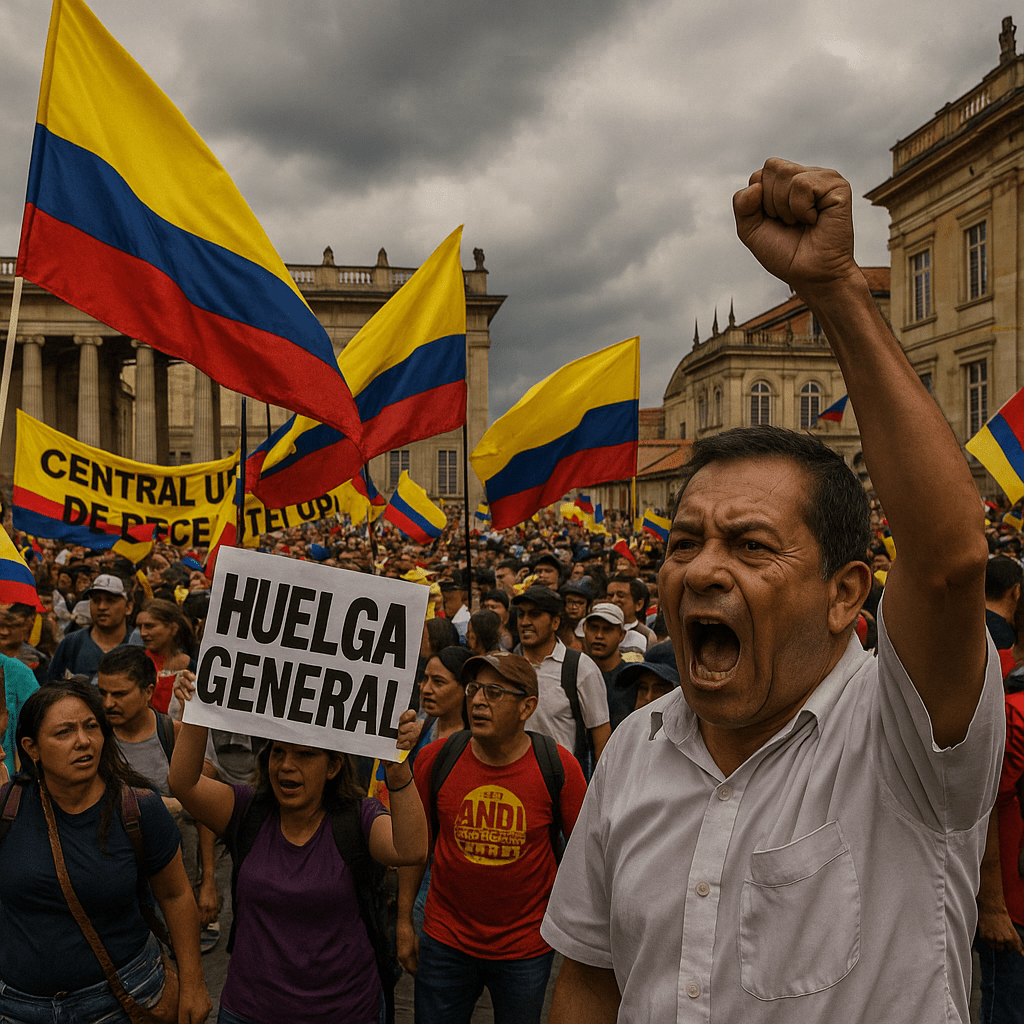
The masses responded swiftly. The Central Unitaria de Trabajadores (CUT), Colombia’s largest labor union, announced nationwide mobilizations for May 19. Union leader Fabio Arias declared the Senate’s decision “an attack on democracy and the working class,” and called for a “great social summit” to unite workers, students, Indigenous groups, and feminists in the defense of popular power.
[Source]
Indigenous and Black organizations, many of whom have been in permanent resistance since the Paro Nacional of 2021, also answered the call. They understand the stakes. Colombia’s comprador bourgeoisie has always used legalism as a form of neocolonial extraction—sanctioning repression through legislative sabotage while maintaining the illusion of democratic order. But illusions are cracking. From the sugarcane fields of Cauca to the student assemblies in Bogotá, the people aren’t just defending a referendum—they’re preparing for a rupture.
Radical voices have grown sharper. Former Medellín mayor Daniel Quintero called for the “dissolution of Congress” and the convening of a Constituent Assembly. Senator María José Pizarro declared that “a Congress that turns its back on the people cannot be reelected.” Meanwhile, the revolutionary outlet La Bagatela didn’t mince words. Its editorial headline read: “¡Huelga general!” A general strike, not more appeals to oligarchic institutions, is what they see as the necessary next step.
[Source]
This isn’t the first time Colombia’s rulers have masked repression in parliamentary clothes. In 1928, it was the Banana Massacre. In the 1980s, it was the extermination of the Patriotic Union. In 2021, it was the brutal suppression of the national strike. Today, it’s procedural fraud and legislative sabotage. But the cycle is cracking. And Petro’s own speeches show he understands this—at least partially. On May 1, he addressed thousands gathered in Bogotá:
“If Congress rejects the voice of the people, then the people will rise up and revoke them. They will build power from below.”
The labor reform is now stalled. But something deeper is moving. The contradiction between legal authority and popular legitimacy is sharpening. The referendum was never just about labor law. It was about whether a colonial state will ever concede even an inch to the people who built the country with their hands and buried their dead under its soil. And the answer, once again, is no. Not unless they’re forced.
That’s why the people are no longer just demanding reforms. They are building dual and contending power. They are turning every plaza into a parliament, every strike into a school, every act of resistance into a lesson: that power does not wait to be granted—it is taken.
Peace Was Signed, But Power Was Never Surrendered
The labor reform struggle didn’t come out of nowhere. To understand why the Senate’s sabotage of Petro’s referendum hit such a nerve, you have to trace the line back—not just to the protests of 2021, but to the 2016 peace accord between the Colombian state and the FARC-EP. That accord wasn’t just about demobilizing guerrillas. It was a demand—won through blood and struggle—for a new social contract. Rural reform, redistribution, political participation, reinvestment in the periphery, and rights for the dispossessed. The idea was simple: peace would be built not on silence, but on justice. But justice was delayed. And now the people are done waiting.
President Gustavo Petro ran on the promise to fulfill that mandate. As the first leftist head of state in Colombian history, his campaign was not just an electoral event—it was the political expression of the very demands that underpinned the peace accords. His platform was clear: dignity for labor, land for the campesino, reparations for victims, and a break with the neoliberal death spiral. The labor reform was one piece of that larger vision—a material intervention to begin undoing decades of neocolonial extraction and wage discipline imposed from above.
The Senate’s rejection of the referendum wasn’t just a policy dispute. It was a direct rejection of that mandate. The vote was 49 to 47, but the real margin was counted in centuries: centuries of exclusion, betrayal, and counterinsurgency dressed in legal robes. Interior Minister Armando Benedetti called the maneuver fraudulent. Petro denounced it from abroad, demanding the people organize and rebel. Senator María José Pizarro declared: “A Congress that turns its back on the people cannot be reelected.” But the masses weren’t waiting for slogans. They were already moving.
On May 1st, Petro addressed a sea of workers in Bogotá’s Plaza de Bolívar. He said:
“If Congress closes the door, the people will kick it open. If they reject the voice of the people, the people will revoke them.”
The masses responded with the only language the state seems to understand: mobilization. The Central Unitaria de Trabajadores (CUT) announced a nationwide day of action for May 19, declaring the Senate’s move “a betrayal of democracy and the working class.” Indigenous and Afro-Colombian organizations began holding cabildos populares—autonomous assemblies rooted in ancestral forms of governance. Radical formations like La Bagatela called openly for a general strike. The whole country, it seemed, understood that the referendum was never the final destination—it was the opening shot.
The Colombian oligarchy—well-practiced in disguising repression behind procedure—has used every tool in its legal arsenal to bury the peace process in bureaucracy. They’ve assassinated former guerrillas, underfunded restitution programs, and now blocked even the basic labor reforms that Petro’s electoral victory promised. But that contradiction is now erupting in real time: the contradiction between a signed peace on paper and a state that refuses to surrender the power it held through war.
The labor reform struggle is not separate from the peace process—it is its continuation. What was demanded with rifles is now being demanded with votes, marches, barricades, and strikes. The elite may block the referendum in Congress, but the working class is holding its own referendum in the streets. They are voting with their feet, with their fists, with their assemblies. They are voting to finish what the accords only began.
This is not a reform movement. It is a struggle to force the Colombian state to make good on its signature. It is a revolt against a system that signed peace but never disarmed its class war. And it is proof that revolutionary rupture often wears the clothes of legality—until those clothes are torn off by history in motion.
The Real Referendum Is Already Underway
The Senate thinks it voted down a referendum. But they were never voting on labor reform. They were voting on whether Colombia’s working class has the right to exist with dignity. And like always, they voted no. But here’s what they miscalculated: the masses never asked for permission. And now, they’ve stopped asking altogether.
What Petro’s modest labor reform attempted through law, the people are now advancing through struggle. It was never about just an eight-hour workday or holiday pay. It was a political faultline—a test of whether the ruling order would tolerate even the slightest deviation from the program of exploitation, precarity, and IMF-sanctioned austerity. Their answer was clear. But the people’s answer is louder.
Across cities and rural zones, across universities and peasant communities, a new kind of referendum is unfolding—not in voting booths, but in assemblies, occupations, and strikes. The question is no longer “should the labor reform pass?” The question now is: who holds power in this country? Is it the comprador elite in Bogotá and the Atlanticist bankers they serve? Or is it the taxi drivers in Barranquilla, the sugarcane workers in Cauca, the students in Cali, and the Afro-Indigenous land defenders holding the line in Chocó?
This is not a moment of democratic deficit. It is a moment of revolutionary clarity. The state is not malfunctioning—it is functioning perfectly, just not for us. The system was not corrupted by this vote—it was revealed. And now, the people are moving accordingly. They are no longer appealing to legality. They are asserting dual and contending power.
Petro’s presidency opened a crack. But it is the masses—not the state—who are prying that crack into a rupture. And it’s not just about Colombia. Across the Global South, workers are facing the same question: how long will we let parliaments postpone our liberation? In Ecuador, they criminalize protest. In Argentina, they privatize survival. In Palestine, they bomb dreams into rubble. Everywhere, empire speaks through technocrats, and everywhere, the poor are told to be patient. But in Colombia, patience is over.
The referendum was supposed to be the means by which the people could speak. Now the people are speaking without it. They are voting with their bodies, with their shutdowns, with their organizing. And the result is coming in loud and clear. They are voting no to neoliberalism. No to IMF structural adjustments. No to settler capital and platform feudalism. They are voting yes to rupture. Yes to a people’s economy. Yes to the future they were told was impossible.
This is not about saving Petro’s policy. It’s about saving the revolution his election hinted at—but could never deliver alone. If his government is serious, it will follow the people, not just lead them. And if it doesn’t, the people will keep marching—with or without it. Because the ballot box may be blocked, but history isn’t. And this moment is no longer about reform. It’s about power. Who has it. Who takes it. And who keeps it when the dust clears.
Colombia is not in a constitutional crisis. It is in the early stages of revolutionary transformation. And the only question that matters now is: will that transformation be captured, co-opted, or completed?
History Is Moving—Choose a Side
The Colombian ruling class voted against the people. Now the people are voting back—on their feet, in the streets, with their fists and their unity. They are building power where none was granted, demanding justice where none was offered. The moment has arrived where protest becomes process, and refusal becomes foundation. What’s needed now is not commentary, but comradeship. Not sympathy, but solidarity.
Weaponized Information declares full ideological unity with Colombia’s working class, Indigenous nations, peasant movements, Black communities, feminist collectives, student assemblies, and revolutionary formations who are advancing this struggle—not in parliaments, but in neighborhoods, roadblocks, and picket lines.
The May 19 mass mobilizations called by the Central Unitaria de Trabajadores (CUT) are not just a protest. They are a people’s referendum—an act of sovereign will in the face of legislative betrayal. Every revolutionary, every anti-imperialist, every worker in the belly of empire must treat this moment as ours. Because it is.
From the Paro Nacional of 2021 to today, Colombian social movements have made clear: they are not appealing to the state. They are building the new world in the shell of the old. And that deserves not applause, but support. Material support. Organizational support. Tactical support. Not tomorrow. Now.
Concrete Actions for International Solidarity
- 1. Amplify radical Colombian media like La Bagatela, Trochando Sin Fronteras, and Periferia Prensa Alternativa. Use your platforms to spread their analysis, voices, and demands.
- 2. Boycott platform capitalist firms like Rappi, whose business model depends on exploiting the very gig workers the Senate voted to exclude from protections.
- 3. Pressure trade unions in the Global North to issue public statements of support, coordinate joint actions, and materially back Colombian strikes and campaigns.
- 4. Organize local teach-ins, assemblies, and direct actions under banners of international solidarity with the Colombian people. Make their struggle visible where you are.
- 5. Build digital brigades to translate communiqués, spread revolutionary theory, and defend the movement from disinformation and media blackout. Proletarian cyber resistance is not a metaphor—it’s a necessity.
Colombia is not just fighting for labor reform. It is fighting to complete a peace that was promised but never delivered. It is fighting to make real the future buried under decades of death squads, displacement, and debt. And that fight deserves more than headlines. It deserves comrades-in-arms.
If you believe in justice, this is your front. If you believe in freedom, this is your call. The barricades are being built. The assemblies are underway. The revolution is not coming. It has already begun.
 Weaponized Information
Leave a comment